
Living plant profile
Hidden-stem rhaphidophora
Rhaphidophora celatocaulis
Comprehensive botanical dossier for Hidden-stem rhaphidophora (Rhaphidophora celatocaulis). Identification, lighting calibration, porous substrate formulation, and cultivation guide by Saigon Cay Canh.
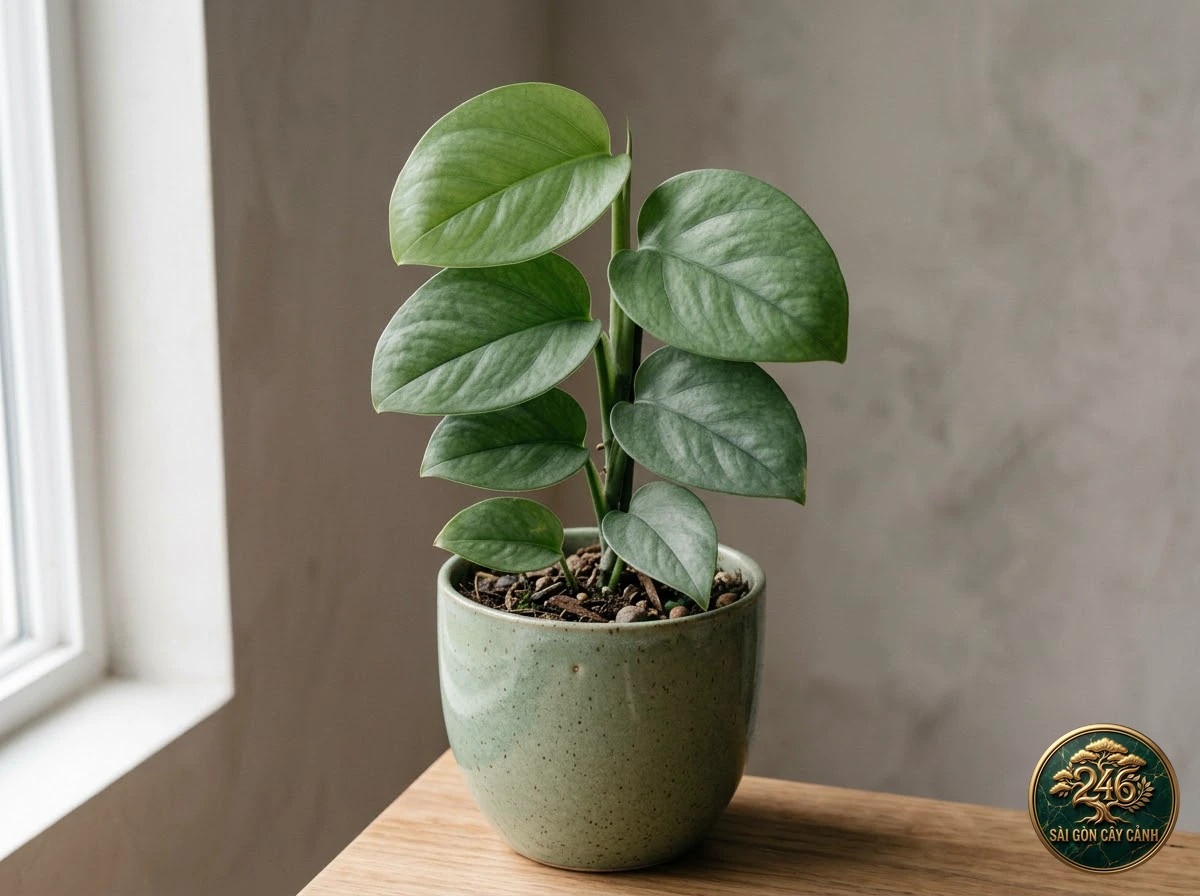
Hidden-stem rhaphidophora (Rhaphidophora celatocaulis) is an extraordinary botanical marvel native to primordial Bornean rainforests, renowned as the ‘Hidden-stem rhaphidophora’ because expansive, shield-like leaves overlap in flawless geometric alignment, completely cloaking the climbing axis beneath in living jade armor. It represents an elite living installation for wall-mounted timber displays.
1. Core Botanical Taxonomy & Cultural Specifications
| Scientific Name | Rhaphidophora celatocaulis |
|---|---|
| Botanical Family | Araceae (Aroid Family) |
| Native Distribution | Submontane wet rainforests of Borneo (Sarawak, Sabah) and Peninsular Malaysia |
| Growth Demeanor | Extreme shingling liana whose broad, overlapping leaves completely conceal the climbing stem |
| Lighting Threshold | Gentle diffused illumination (1,200 – 2,500 lux); protects delicate appressed foliage from scorch |
| Hydration Cadence | Moderate capillary moisture at base; regular misting of backing moss with purified water |
| Substrate Formulation | 40% porous pumice, 25% fine bark nuggets, 20% shredded sphagnum, and 15% horticultural perlite |
| Thermal Range | 22°C – 31°C (72°F – 88°F; thrives in warm equatorial conditions, sensitive to chills below 16°C/60°F) |
| Relative Humidity | 75% – 95% (Elevated ambient saturation is essential to keep broad shingle blades firmly adhering) |
| Cultivation Difficulty | Moderate to High (Demands strict microclimate humidity control and a dedicated planar timber mount) |
| Pet Safety Profile | Toxic (Contains insoluble calcium oxalate raphides; mount securely high out of pets’ reach) |
Formally cataloged in the Royal Botanic Gardens Kew (POWO) archives, the specific epithet ‘celatocaulis’ derives from Latin (celatus = concealed, caulis = stem), accurately describing its unique morphological trait. In Bornean rainforests, extreme shingling evolved to shield vascular pathways and anchor roots from localized moisture stress.
The subterranean-like climbing axis beneath remains flattened against the timber, completely enveloped by overlying blades. Alternating distichous leaves overlap margins by 30% to 50%, establishing an absolute planar surface optimized to intercept diffuse photons filtering through dense canopies.
Dense adventitious anchor rootlets emerge from hidden internodes, cementing firmly into timber fibers via bio-mucilage. The total foliar canopy preserves a humid micro-zone around anchor roots, suppressing evaporation and fueling continuous apical extension.
2. Morphological Identification & Foliar Architecture
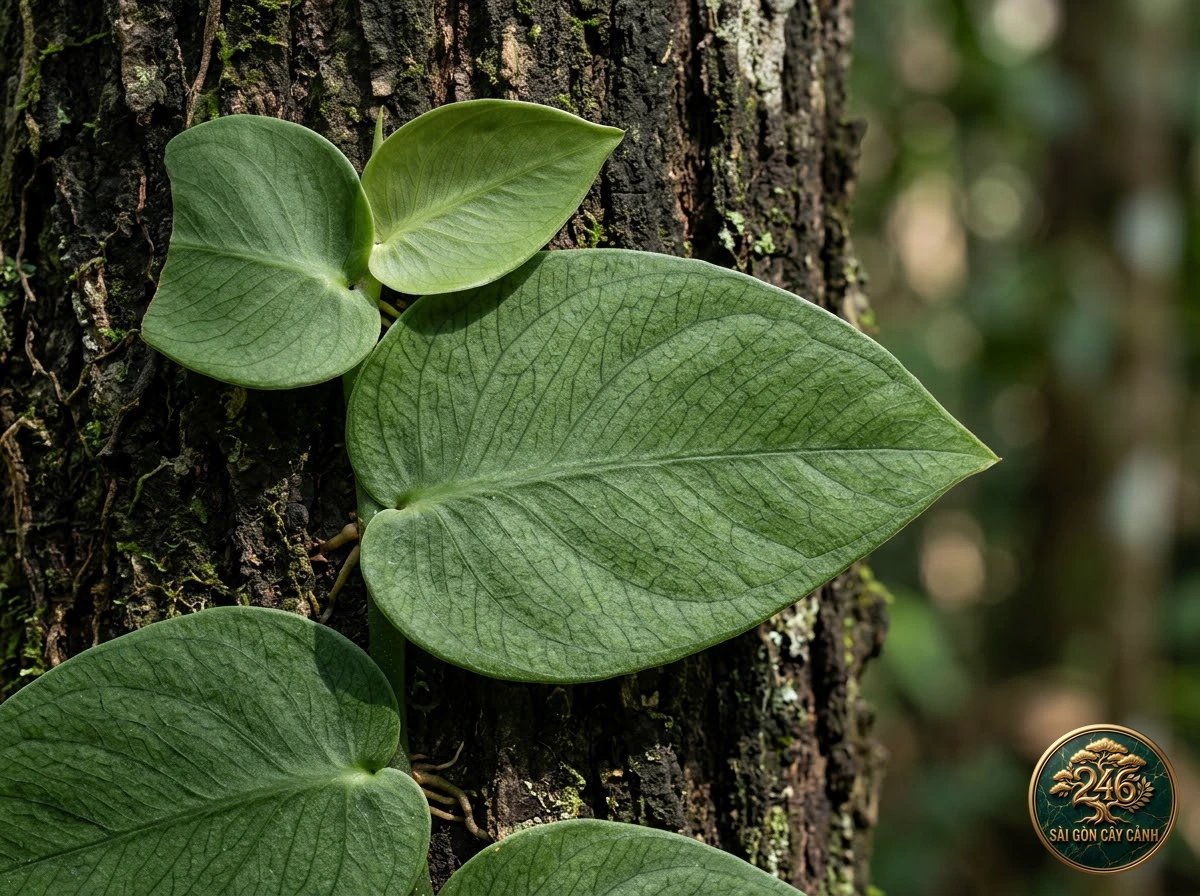
Foliar blades of Rhaphidophora celatocaulis display a broadly ovate to elongated cordate shape, measuring 8 to 16 cm across in mounting phase—considerably larger than other shinglers. The lamina is smooth with a subtle matte satin texture in deep jade green, underpinned by sunken secondary veins.
Entire leaf margins hug the timber mount flush without leaving open crevices. At peak vegetative vigor, alternating tiers align like architectural roofing tiles, presenting an alluring display of natural geometric harmony.
Morphological analysis of Rhaphidophora celatocaulis illustrates the apex of epiphytic shingling evolution in Bornean rainforests: alternating blades overlap so tightly that they completely conceal the climbing stem, as denoted by the epithet ‘celatocaulis’ (hidden stem). This forms a living biological shield, curbing stem desiccation and sheltering anchoring rootlets beneath.
3. Photometric Calibration & Window Exposure Optimization
Rhaphidophora celatocaulis favors gentle diffused lighting between 1,200 and 2,500 lux. Filtered light through sheer curtains or sheltered interior atriums sustains succulent jade turgor without thermal distortion.
Direct unfiltered sunlight incinerates the delicate appressed epidermis, causing irreversible greyish-brown scorch lesions. Conversely, severe light starvation below 700 lux arrests new blade emergence or causes stems to pull away from the mount.
Photometric evaluations show that the hidden-stem rhaphidophora assimilates photons optimally at a PPFD range of 70 to 140 umol/m2/s. Diffuse perpendicular lighting encourages symmetrically expanded overlapping blades that adhere flat against timber supports without curling.
4. Structural Vining Architecture & Support Dynamics
Irrigation requires measured discipline: lightly hydrate container root zones when the upper 30% dries. Substrates require capillary moisture films, never stagnant water saturation that suffocates roots.
The wooden climbing board requires daily morning misting with chlorine-free purified water to nourish rootlets concealed beneath foliage, ensuring blades remain firmly appressed without margin curling.
The optimal thermal envelope spans 22°C to 31°C (72°F – 88°F), reflecting its equatorial Bornean habitat. The plant is sensitive to cold drafts; temperatures below 16°C (60°F) cause blackened leaf damage.
Ambient humidity must remain elevated between 75% and 95%. In domestic quarters, deploying an ultrasonic humidifier near the mount is essential to prevent edge desiccation.
Optimal vegetative development occurs between 22°C and 31°C (72°F – 88°F) paired with ambient humidity above 70%. In dry interior conditions, leaf margins curl away from the mounting board; deploying ultrasonic humidifiers restores snug adherence.
To achieve authentic hidden-stem shingling, the ideal climbing support is a broad flat cedar plank or cork slab at least 15 to 20 cm wide. Humidifying the mount stimulates concealed adventitious roots to colonize timber grain beneath the living foliar tilework.
5. Porous Aggregate Substrate Engineering & Aeration Dynamics
Potting mix is engineered for maximum aeration: 40% pumice, 25% fine bark chips, 20% shredded sphagnum moss, and 15% perlite, buffered to pH 5.8 to 6.5.
Porous mineral aggregate architecture preserves steady gaseous diffusion around the root collar, protecting core root biomass from decay across years of indoor cultivation.
The container substrate demands high aeration utilizing 35% volcanic pumice, 30% coarse pine bark nuggets, 20% chunky coconut husk, and 15% coarse perlite. Continuous interstitial airflow protects the submerged basal stem from fungal pathogens.
6. Organic Nutrition Schedules & Periodic Micronutrient Priming
Nutrition relies upon bio-organic foliar feeds diluted to one-fifth standard strength. Misting seaweed extracts and plant amino acids across the climbing plank monthly in warm seasons nourishes anchor rootlets.
Avoid granular synthetic fertilizers; salt build-up burns delicate root hairs. Periodically flush substrates with purified water quarterly to preserve root purity.
Nutrition is delivered predominantly via ultra-dilute organic foliar mists. Cold-pressed seaweed extract combined with plant-derived amino acids applied every three weeks feeds tissues without leaving unsightly saline residues across lustrous blades.
7. Clinical Diagnostic Matrix & Rapid Correction Protocols
| Clinical Symptom | Primary Etiology | Diagnostic Evaluation | Corrective Prescription |
|---|---|---|---|
| Broad leaf margins curling and detaching from timber board | Ambient humidity below 65% or backing moss desiccation | Inspect domestic hygrometer and check moss moisture | Mist mounting moss daily and maintain ultrasonic humidifier >75% |
| Emerging blades less than half the size of older leaves | Photon deficit or mounting plank too narrow for expansion | Measure illuminance and inspect mounting plank width | Relocate to brighter filtered daylight and install a wider timber board |
| Dark brown water-soaked lesions developing on blade margins | Standing nocturnal water droplets in stagnant indoor air | Scout foliar surfaces during late evening hours | Cease evening misting, improve gentle room airflow, blot leaves dry |
| Foliage loses deep jade saturation, turning pale yellowish green | Trace mineral micronutrient deficiency or insufficient light | Review fertilization cadence and ambient lighting levels | Apply micro-diluted marine bio-fertilizer and increase diffused daylight |
8. Cryptic Pest Prophylaxis & Foliar Surface Sanitation
Because leaves clasp flush, mealybugs occasionally attempt to shelter beneath outer margins. Regularly inspect leaf perimeters under direct light, spot-treating pests with alcohol swabs.
Use soft brushes to dust the velvety emerald blades in the morning, pairing with gentle air circulation to maintain clean foliar surfaces.
Because foliage presses tightly against mounts, scale and mealybugs can seek refuge beneath overlapping blades. Inspect blade perimeter interfaces periodically; apply diluted organic soapnut sprays to repel cryptic invaders safely.
9. Asexual Propagation Methodology & Root Strike Protocols
Propagation is performed by sectioning stem segments firmly rooted onto timber mounts bearing 2 to 3 intact shingle leaves. Make clean incisions using a sterile surgical scalpel.
Fasten cuttings onto a fresh moist moss board inside an enclosure maintaining >85% humidity and 24-28°C (75-82°F). New apical shoots emerge and clasp the timber within 4 weeks.
Propagate by severing stem sections retaining 3 to 4 tightly appressed leaves. Affix the cutting to a moist moss mount inside a high-humidity incubator (85% RH); axillary nodes activate promptly to initiate new architectural shingle trails.
10. Companion Animal Safety & Veterinary Toxicology Protocols
The specimen contains insoluble calcium oxalate raphides causing oral mucosal inflammation if ingested; mount boards securely out of reach of children and pets.
11. Biophilic Curation & Contemporary Interior Design Styling
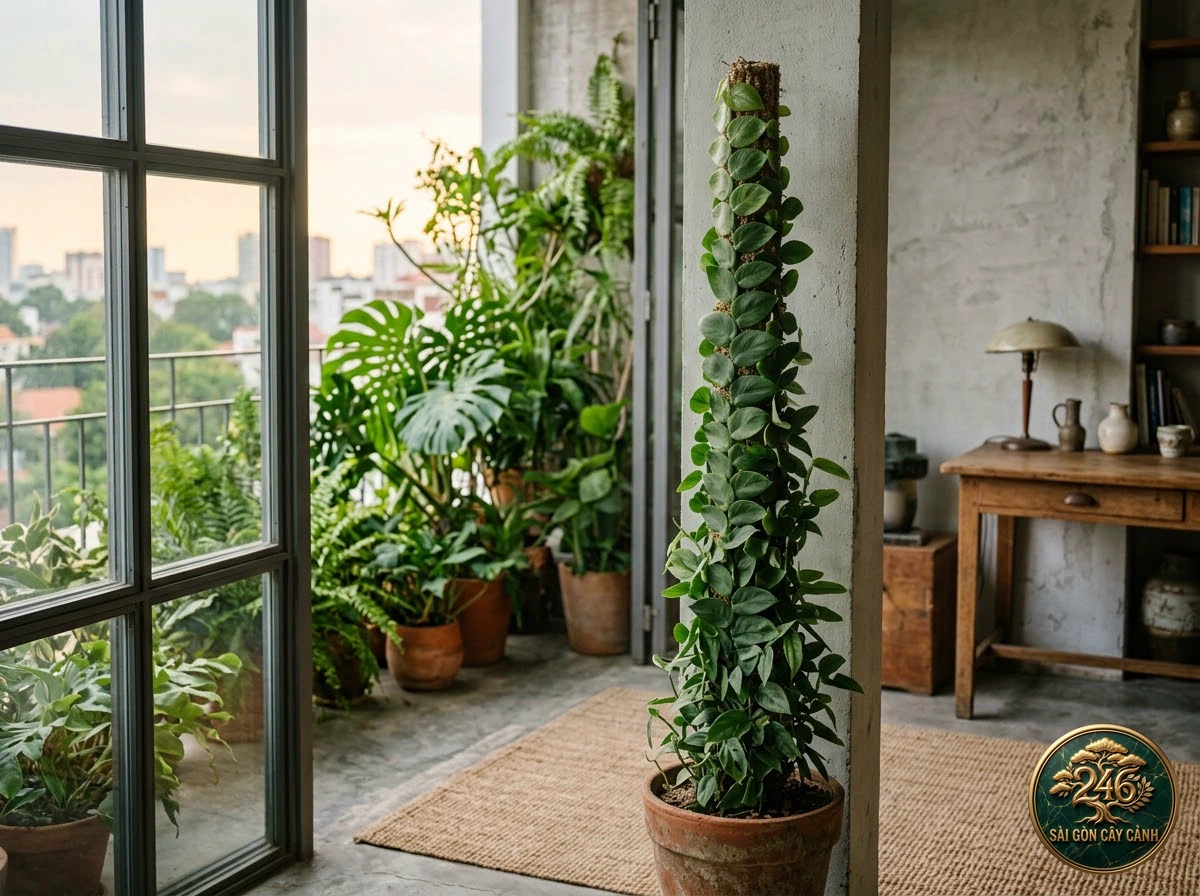
Within luxury Biophilic interiors, Hidden-stem rhaphidophora represents the apex of living botanical art. Tightly shingled jade tiers concealing the stem form a singular living relief sculpture against timber and stone accent walls.
Tranquil geometric aesthetics and immaculate natural layering impart serene visual depth, reflecting refined taste and botanical sophistication.
The seamless shingling habit of Hidden-stem rhaphidophora transforms interior vertical surfaces into captivating living art. The interplay of geometric foliar armor and rustic timber mounts provides refined organic elegance in luxury biophilic spaces.
12. Master Principles for Sustainable Indoor Acclimatization
To master the cultivation of flawless, tightly shingled Rhaphidophora celatocaulis specimens, indoor growers should observe three foundational rules:
- Hydration axiom: Provide a wide, flat timber mount and sustain surface moisture to ensure tenacious adventitious root adhesion.
- Illumination axiom: Maintain bright indirect daylight (1,500 – 3,200 lux) directed perpendicularly to keep leaves pressed flush.
- Maintenance axiom: Water foundational potting mix moderately on partial dry-down, preventing stagnant saturation around root crowns.
13. Frequently Asked Questions Regarding Hidden-stem rhaphidophora (FAQs)
Can Rhaphidophora celatocaulis climb cylindrical moss poles?
It thrives best on flat wooden boards. Cylindrical poles have sharp curvatures that prevent wide blades from clasping flush, compromising shingle aesthetics.
How long does it take for a new leaf to emerge?
Under high humidity exceeding 75% and warmth between 24-28°C (75-82°F), a new leaf emerges approximately every 3 to 5 weeks.
Why is it called ‘Hidden-stem rhaphidophora’?
Because alternating distichous leaves overlap so tightly that they completely conceal the climbing stem beneath, showing only a continuous foliar plane.
Can cuttings be taken before leaves adhere to the board?
Strictly unrecommended. Propagules establish reliably only when nodal rootlets have already penetrated the moss-lined timber mount.
What wood species is best for mounting this plant?
Cedar planks, cork bark, or treated driftwood perform best due to their natural rot resistance and micro-grooved adhesion texture.
What is the primary morphological difference between Rhaphidophora celatocaulis and Rhaphidophora hayi?
Rhaphidophora celatocaulis develops broader, deep-gloss emerald leaves that overlap completely to obscure 100% of the climbing vine stem; Rhaphidophora hayi features smaller, flatter, glaucous pewter-toned leaves.