
Living plant profile
Pacific peace lily
Spathiphyllum commutatum
Comprehensive botanical dossier for Pacific peace lily (Spathiphyllum commutatum). Identification, lighting calibration, porous substrate formulation, and cultivation guide by Saigon Cay Canh.
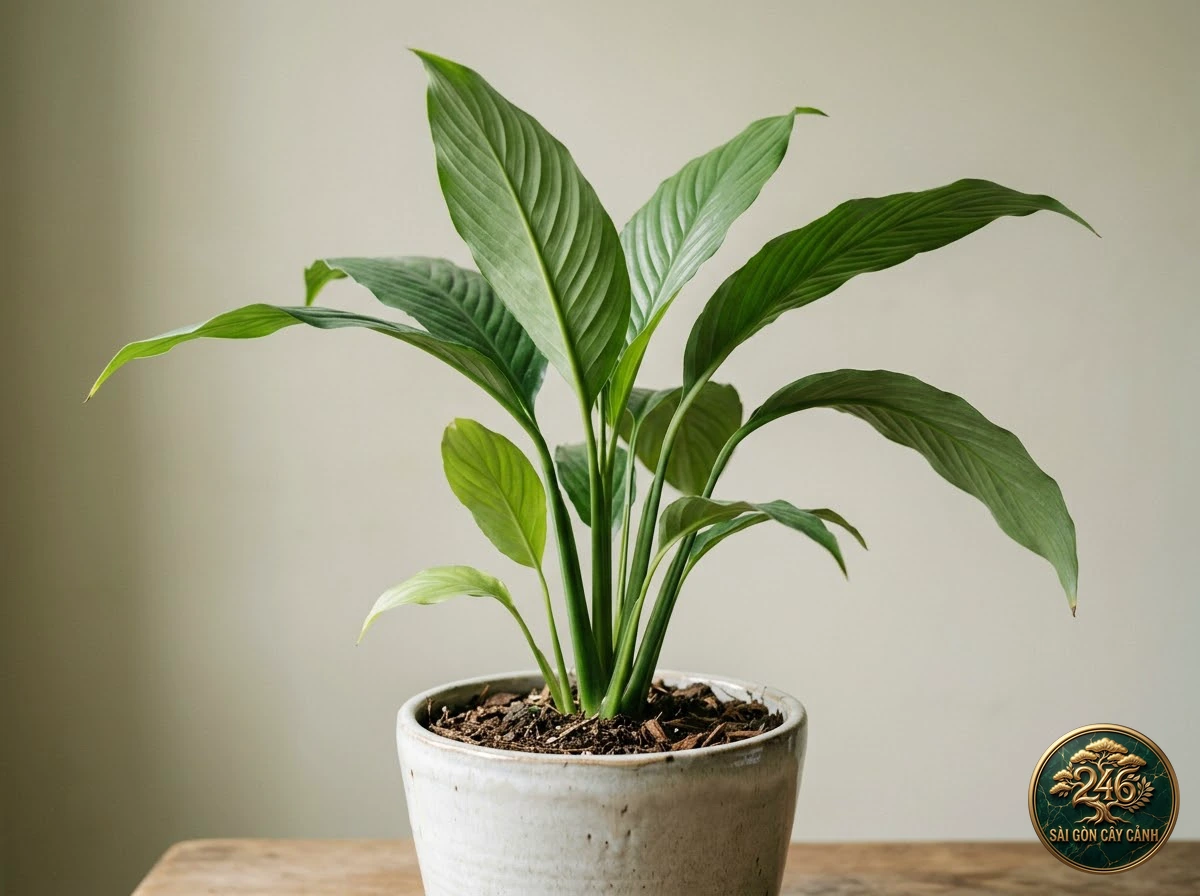
Pacific peace lily (Spathiphyllum commutatum) is an impressive terrestrial peace lily indigenous to the tropical archipelagos of the Western Pacific, renowned for its architectural stature, thick corrugated deep emerald foliage, and statuesque creamy white spathes carried aloft on stout scapes. It stands as a beacon of tranquil refinement in contemporary curated greenery.
1. Core Botanical Taxonomy & Cultural Specifications
| Scientific Name | Spathiphyllum commutatum |
|---|---|
| Botanical Family | Araceae (Aroid Family) |
| Native Distribution | Lowland maritime and valley rainforest floors spanning the Philippines, Maluku, New Guinea, and the Solomon Islands |
| Growth Demeanor | Robust erect clumping terrestrial herb forming architectural clusters 0.8 to 1.3 m in height |
| Lighting Threshold | Consistent diffused daylight (1,600 – 3,400 lux); thick leaves handle higher ambient photon flux comfortably |
| Hydration Cadence | Irrigate when top 30% substrate dries; favors uninterrupted capillary dampness without bottom ponding |
| Substrate Formulation | 35% medium pumice, 30% composted bark, 20% washed coco coir chips, and 15% coarse perlite |
| Thermal Range | 22°C – 32°C (72°F – 90°F; thrives in warm tropical climates, vegetative standstill occurs below 16°C/60°F) |
| Relative Humidity | 65% – 85% (High ambient humidity prevents marginal curling and preserves inflorescence freshness) |
| Cultivation Difficulty | Easy to Moderate (Vigorous grower, resilient root system, blossoms readily under bright filtered light) |
| Pet Safety Profile | Toxic (Contains insoluble calcium oxalate raphide needle crystals; position out of pet reach) |
Spathiphyllum commutatum was meticulously circumscribed by botanist Heinrich Wilhelm Schott and is officially documented within Kew’s Plants of the World Online (POWO). While most peace lilies are native to the Neotropics of the Americas, S. commutatum represents a distinctive Old World insular lineage thriving naturally across the Indo-Pacific realm.
The plant forms a stout, short-creeping subterranean rhizome that continually produces vigorous lateral offshoots. Petioles are thick and upright, measuring 40 to 75 cm, featuring an extended basal sheath and terminating at a prominent apical geniculum that flexibly angles the broad leaf blade toward filtered light.
A fibrous root system radiates densely from subterranean nodes, transitioning from ivory white to warm russet as cortex matures. Internal root lacunae provide essential aeration pathways, sustaining metabolic gas exchange even throughout prolonged island monsoon rain periods.
2. Morphological Identification & Foliar Architecture
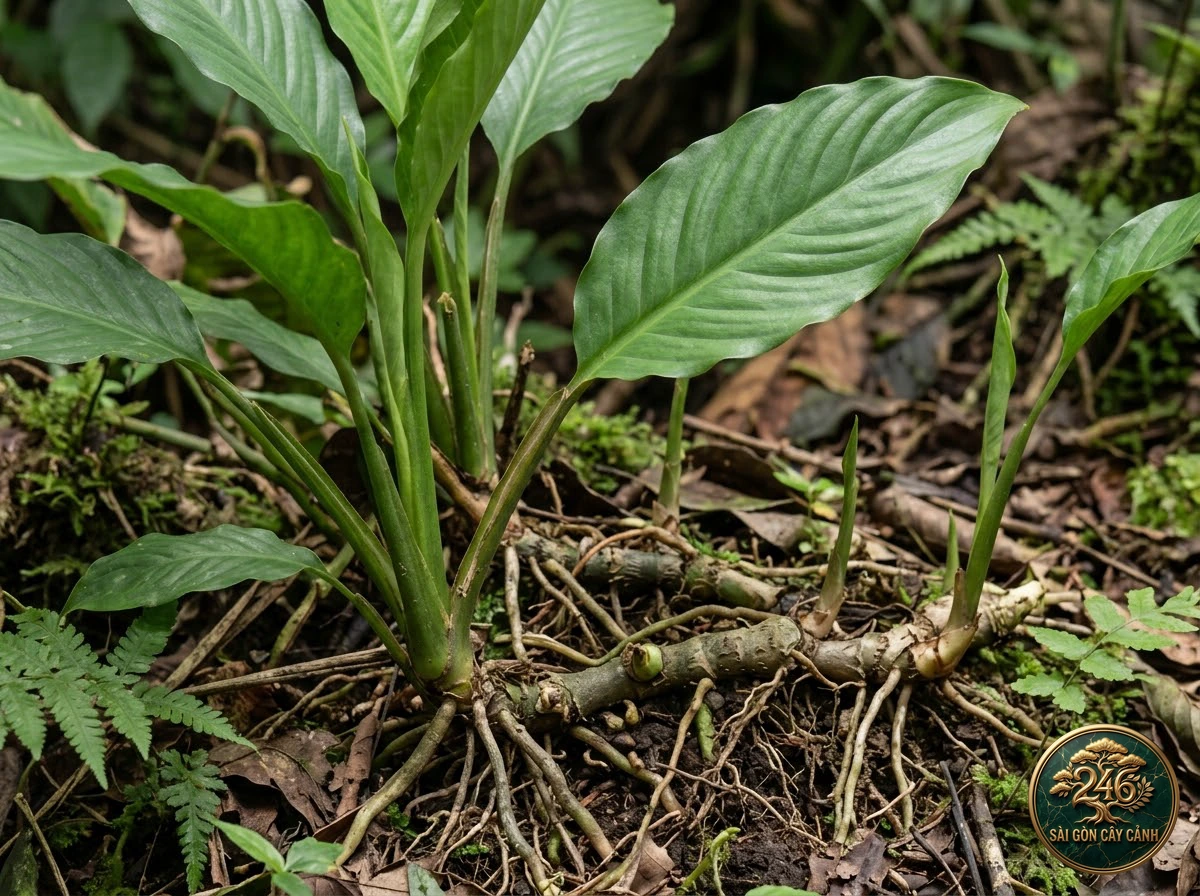
Foliar blades of Pacific peace lily present an oblong-elliptic to broadly oval silhouette measuring 35 to 60 cm in length and 15 to 25 cm in width. The apex tapers to a slender acuminate tip with gracefully undulate margins. The coriaceous leaf lamina boasts a satin-gloss deep emerald surface that resists mechanical damage.
A pronounced dorsal midrib supports evenly spaced parallel primary lateral veins that carve rhythmic sculptural grooves across the adaxial surface. The inflorescence rises above the foliage on an 80 cm scape, bearing an ivory-white ovate spathe that gracefully embraces a cylindrical spadix loaded with tiny fragrant blossoms.
Micro-anatomical examination of Spathiphyllum commutatum blades reveals heavily developed sclerenchyma bundles along primary lateral veins, enabling foliage up to 60 cm long to maintain rigid, upright architecture without sagging. Undulating adaxial epidermal cells interlock tightly, generating a satin-gloss sheen that catches light like finely woven emerald silk.
3. Photometric Calibration & Window Exposure Optimization
Accustomed to island valley fringes, Spathiphyllum commutatum thrives under bright, filtered illumination ranging between 1,600 and 3,400 lux. Positioning specimens near east-facing curtained apertures or sheltered lightwells maintains foliar luster and triggers steady floral flushes.
While tolerating modest domestic shaded corners, extended darkness under 900 lux leads to etiolated petioles and dormant blooms. Conversely, direct equatorial noon sunlight rapidly scorches the dark leaf surfaces with irreversible bleached or necrotic lesions.
Photometric testing establishes an optimal PPFD between 85 and 165 umol/m2/s for Pacific peace lily. Evolving across sun-dappled island rainforests, it exhibits wider photonic tolerance than many Neotropical cousins, adapting effortlessly to spacious sunlit living salons with bright indirect exposure.
4. Rhizomatous Clump Architecture & Growth Management
Irrigation for the Pacific peace lily focuses on maintaining refreshing, uniform moisture throughout the subterranean root zone. Apply water generously once the upper 30% layer of substrate feels dry to the touch, wetting the root ball until drainage begins at the base.
Irrigation water must remain devoid of free chlorine, chloramines, and heavy minerals. Rainwater, reverse-osmosis water, or tap water aged for 48 hours in open cisterns prevents mineral toxicity and unsightly black tip scorch.
Ideal developmental temperatures range between 22°C and 32°C (72°F – 90°F). The plant flourishes in warm ambient interiors but must be protected from localized frosty drafts blowing directly from air conditioning vents.
Relative atmospheric humidity should be sustained at 65% to 85%. Incorporating a gravel humidity saucer beneath containers or grouping lush tropical specimens generates a humid microclimate that keeps broad leaf margins pristine.
Optimal developmental temperatures range between 22°C and 32°C (72°F – 90°F). Thriving in warm tropical interiors, maintaining relative humidity at 65% to 85% preserves petiole turgor and allows ivory spathes to endure pristine and vibrant for 5 to 7 weeks.
The specimen forms robust rhizomatous crowns with stout 75 cm petioles ascending vertically. To encourage balanced architectural posture, display containers under uniform overhead or multidirectional light, or rotate pots 90 degrees weekly to stimulate even offshoot distribution around the perimeter.
5. Porous Aggregate Substrate Engineering & Aeration Dynamics
The potting medium should emulate rich, airy insular forest humus, offering generous capillary moisture alongside rapid pore aeration. An optimal mixture unites 35% pumice, 30% composted bark (6-9mm), 20% washed desalted coco coir pith, and 15% coarse perlite at pH 5.6 to 6.4.
This open aggregate architecture guarantees unhindered oxygen circulation around feeder roots, actively preventing rhizome suffocations and fungal root rots associated with compacted soils.
Substrate formulation replicates porous insular humus over coralline substrates: 35% medium pumice (5-8mm), 30% composted pine bark, 20% desalted coco coir, and 15% coarse perlite. This macroscopic aeration keeps roots oxygenated, preventing stagnation while sustaining capillary nutrient intake.
6. Organic Nutrition Schedules & Periodic Micronutrient Priming
During active growth and bud formation, provide balanced organic liquid fertilizer or kelp extract every 3 to 4 weeks. A balanced nutritional profile enriched with micronutrients preserves the glossy dark green coloration and strengthens flowering scapes.
Refrain from applying aggressive fast-release granular synthetics that chemically burn fine root hairs. Every three months, leach the entire container thoroughly with clean water to flush out accumulated fertilizer salts.
Administer liquid organic bio-fertilizer enriched with natural potassium, magnesium, and chelated iron every 3 to 4 weeks. These organic micronutrients preserve profound emerald pigmentation and empower vigorous flowering scapes to emerge proudly.
7. Clinical Diagnostic Matrix & Rapid Correction Protocols
| Clinical Symptom | Primary Etiology | Diagnostic Evaluation | Corrective Prescription |
|---|---|---|---|
| Foliar tips and margins turning blackened and brittle | Chlorine toxicity from tap water or ambient humidity below 50% | Check room hygrometer reading and analyze water purity | Switch to aged filtered water and install pebble humidity trays |
| Elongated petioles and complete absence of spathes | Light intensity insufficient to trigger floral bud initiation | Measure foot-candles or lux at the foliage canopy level | Relocate specimen into 2,000 to 3,000 lux bright indirect daylight |
| Severe sudden wilting of all leaves simultaneously | Extreme root zone dehydration or anaerobic root rot decay | Inspect root ball moisture saturation and examine root health | Bottom-water if desiccated; prune decayed roots and repot if waterlogged |
| Stippled foliage with minute yellowish punctate spots | Spider mite or thrips colonies extracting mesophyll sap | Examine abaxial leaf surfaces under magnification loupe | Rinse foliage thoroughly and treat with emulsified cold-pressed neem |
8. Cryptic Pest Prophylaxis & Foliar Surface Sanitation
Mealybugs and thrips may seek refuge within the snug folds of basal petiole sheaths. Routinely inspect these axillary crevices and apply bio-organic alcohol solutions or cold-pressed emulsified neem oil to eradicate pests.
Gently cleanse each broad lamina with a damp microfiber cloth moistened in lukewarm water monthly to remove household dust, optimizing light absorption and gas exchange.
Wipe foliar surfaces bi-weekly with damp microfiber cloths to clear domestic dust and maximize photosynthetic efficiency. Routinely examine snug petiole sheaths for early mealybugs or thrips, eliminating them promptly with mild plant-soap solutions.
9. Asexual Propagation Methodology & Root Strike Protocols
Asexual propagation of Spathiphyllum commutatum is most reliably achieved by rhizome clump division during seasonal spring repotting. Select mature, multi-crowned specimens displaying distinct daughter rosettes.
Using a sterilized sharp knife, separate connective rhizome segments ensuring each division retains viable independent roots and at least 3 sturdy leaves. Pot into aerated mix and maintain shaded humid conditions until established.
Rhizome clump division during seasonal container repotting yields near-total survival. Select divisions retaining at least 3 sturdy leaves and independent roots, separate connective rhizomes with a sterile blade, and pot into aerated mix under warm humid shelter for three weeks.
10. Companion Animal Safety & Veterinary Toxicology Protocols
Cellular tissues contain insoluble calcium oxalate raphide needle crystals capable of causing oral irritation if masticated by animals. Keep specimens elevated and secure away from curious domestic cats and dogs.
11. Biophilic Curation & Contemporary Interior Design Styling
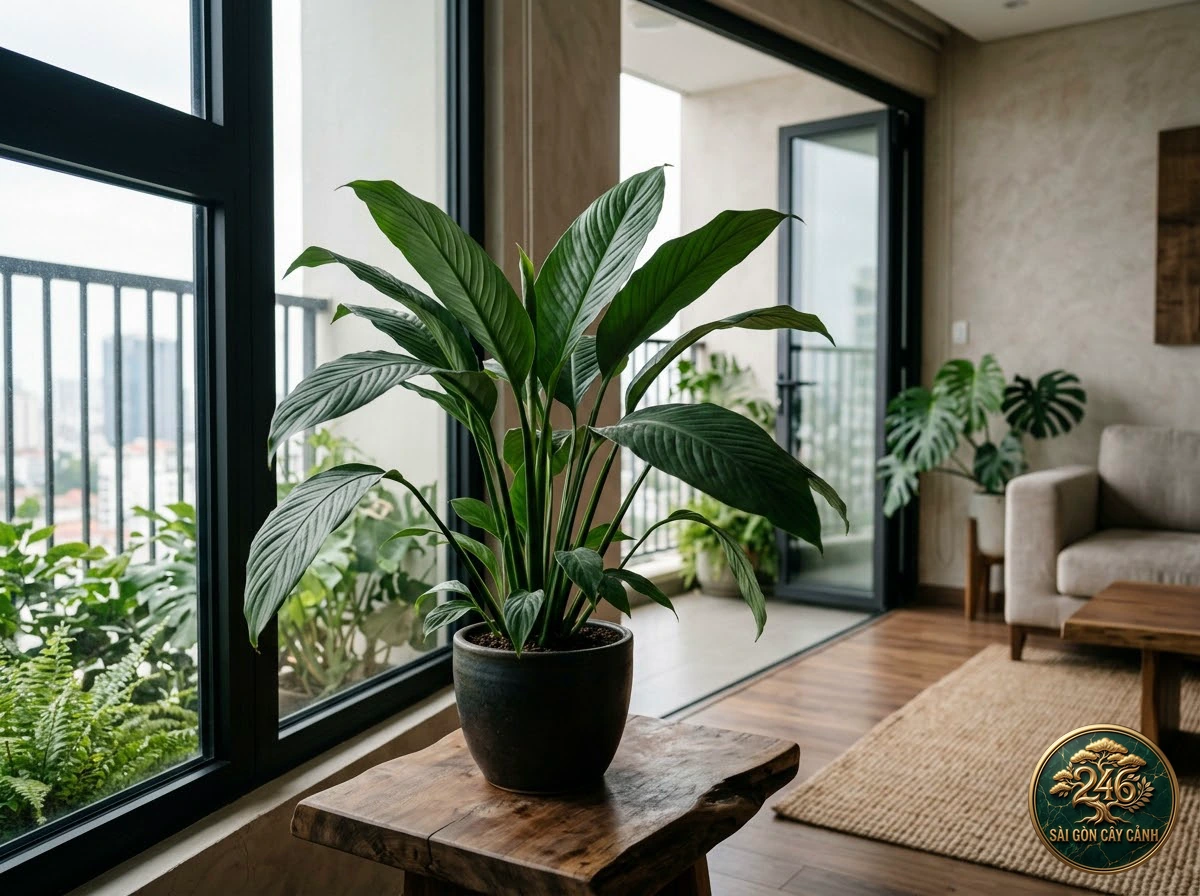
Featuring stately architectural form, broad spreading foliage, and sculptural ivory spathes, the Pacific peace lily serves as an outstanding specimen for hotel lobbies, executive boardrooms, and premium residential atriums.
The serene presence of this lush green centerpiece instills mental calm, harmonizes indoor microclimates, and introduces enduring natural sophistication to interior spaces.
With its statuesque silhouette, luxurious deep emerald foliage, and crystalline ivory spathes, the Pacific peace lily serves as a premier botanical centerpiece for luxury hotel atriums, executive boardrooms, and prestigious biophilic residences.
12. Master Principles for Sustainable Indoor Acclimatization
To maintain magnificent dark foliage and stimulate recurring pristine blooms on Spathiphyllum commutatum indoors, horticulturists should observe three core principles:
- Hydration axiom: Irrigate when top 30% substrate dries, utilizing aged filtered water to prevent unsightly black tip scorch.
- Illumination axiom: Deliver bright indirect daylight (1,600 – 3,400 lux) to sustain thick lustrous foliage and trigger steady blooming.
- Maintenance axiom: Utilize porous pumice-based potting aggregate and rotate pots weekly to ensure symmetrical upright architecture.
13. Frequently Asked Questions Regarding Pacific peace lily (FAQs)
Does Pacific peace lily perform well in air-conditioned offices?
It thrives comfortably in air-conditioned environments between 22°C and 28°C provided it is shielded from direct airflow drafts and humidity exceeds 65%.
How long does each white inflorescence persist?
Each pristine ivory spathe remains decorative for 5 to 7 weeks before gradually maturing into an architectural green hue.
Is chemical fertilizer required to induce heavy blooming?
No; chemical overdoses harm roots. Dilute organic feeds rich in natural potassium combined with sufficient filtered light naturally induce regular blossoms.
When should the specimen be repotted into a larger pot?
Repot every 2 to 3 years when roots coil thickly at drainage holes or multiple daughter crowns crowd the container brim.
Can handling the plant cause skin irritation?
The sap contains calcium oxalate which may cause mild dermatological tingling; wearing garden gloves during pruning and root maintenance is recommended.
Where does Pacific peace lily originate, and what distinguishes it from South American species?
This species is indigenous to Western Pacific islands (Philippines, Maluku, New Guinea through the Solomon Islands). It is distinguished by thicker coriaceous leaves, superior heat and light tolerance, and a distinctly more architectural stature.