
Living plant profile
Peacock plant
Goeppertia makoyana
Comprehensive botanical dossier for Peacock plant (Goeppertia makoyana). Identification, lighting calibration, porous substrate formulation, and cultivation guide by Saigon Cay Canh.
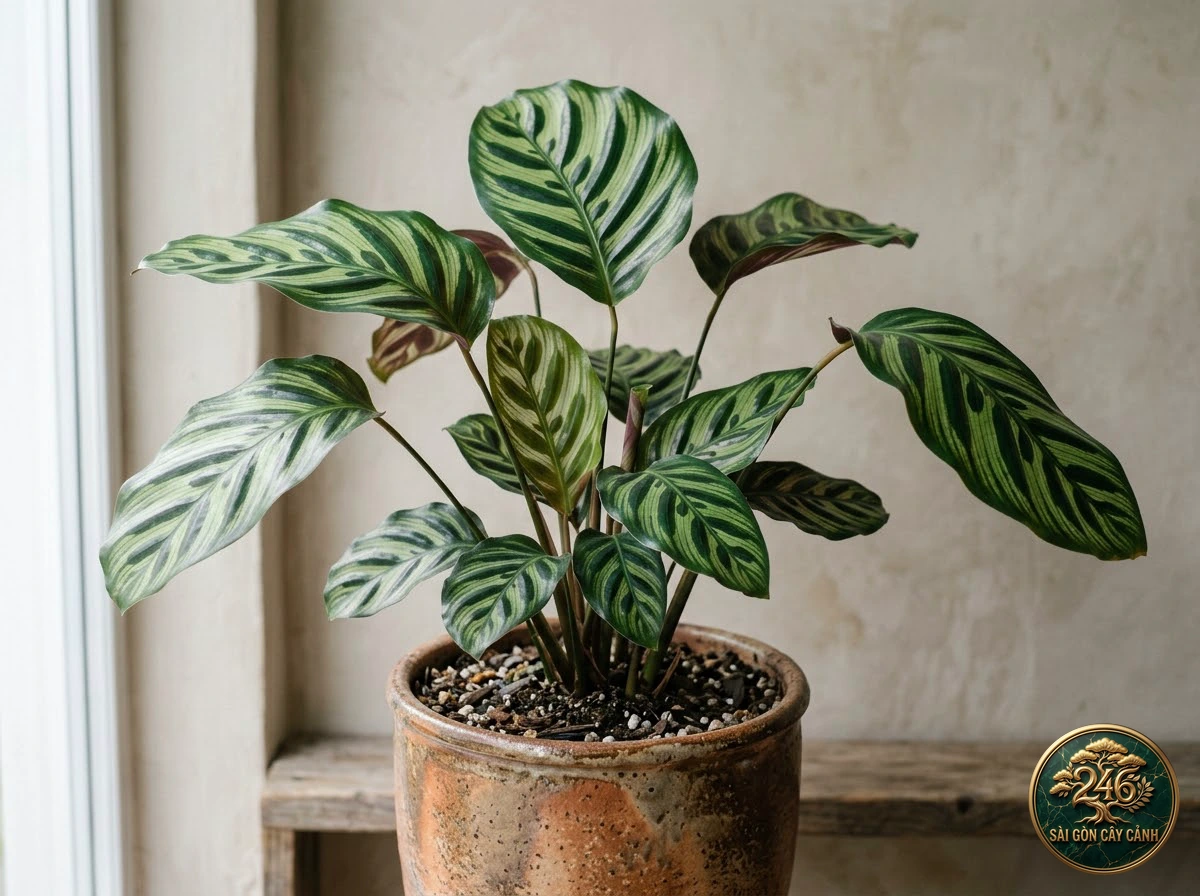
Peacock plant (Goeppertia makoyana) is an iconic tropical foliage masterpiece belonging to the prayer plant family (Marantaceae), celebrated globally for its feather-like foliar mosaics reminiscent of a peacock’s display. Delicate semi-translucent blades showcase dark emerald feathered blotches mirrored beneath by rich wine-red pigments, folding gracefully upright each night in reverent nyctinastic prayer.
1. Core Botanical Taxonomy & Cultural Specifications
| Scientific Name | Goeppertia makoyana |
|---|---|
| Botanical Family | Marantaceae (Prayer Plant Family) |
| Native Distribution | Shaded humid understory of the Atlantic coastal rainforests in Eastern Brazil (Espirito Santo, Rio de Janeiro) |
| Growth Demeanor | Dense clump-forming evergreen perennial herb 35 to 55 cm tall with slender petioles supporting patterned foliage |
| Lighting Threshold | Gentle diffused daylight (1,400 – 2,800 lux); highly susceptible to photochemical bleaching under direct sun |
| Hydration Cadence | Hydrate when top 25-30% substrate dries; prefers steady capillary coolness without moisture extremes |
| Substrate Formulation | 35% fine pumice, 30% shredded sphagnum and fine aged bark, 20% rinsed coco coir pith, and 15% perlite |
| Thermal Range | 21°C – 30°C (70°F – 86°F; flourishes in warm ambient rooms, growth stalls below 16°C/60°F) |
| Relative Humidity | 65% – 85% (High ambient relative humidity prevents crisp marginal foliage browning and leaf curling) |
| Cultivation Difficulty | Moderate (Demands stable atmospheric humidity and mineral-pure irrigation devoid of chlorine or fluoride) |
| Pet Safety Profile | Non-toxic (Completely safe for companion pets; certified non-toxic to dogs and cats by the ASPCA) |
Originally circumscribed by botanist Edouard Morren and subsequently transferred to Goeppertia by Borchsenius and Suarez based on modern molecular phylogenetic evidence, this taxon is cataloged in Kew’s Plants of the World Online (POWO). The specific epithet ‘makoyana’ commemorates the renowned nineteenth-century Belgian horticulturist Jacob-Makoy.
The plant forms a compact subterranean rhizomatous crown with closely spaced nodes that yield dense, rounded clusters. Slender reddish-brown petioles measure 20 to 40 cm, terminating at a flexible cylindrical pulvinus. This hydraulic junction alters cellular turgor, flexing the leaf blade horizontally by day and erecting it vertically at nightfall.
A shallow fibrous root network penetrates the upper humic horizons of the Atlantic forest floor. Delicate feeder roots excel at capillary moisture absorption but exhibit acute sensitivity to accumulated mineral salts and hypoxia, necessitating an airy, highly oxygenated potting environment.
2. Morphological Identification & Foliar Architecture
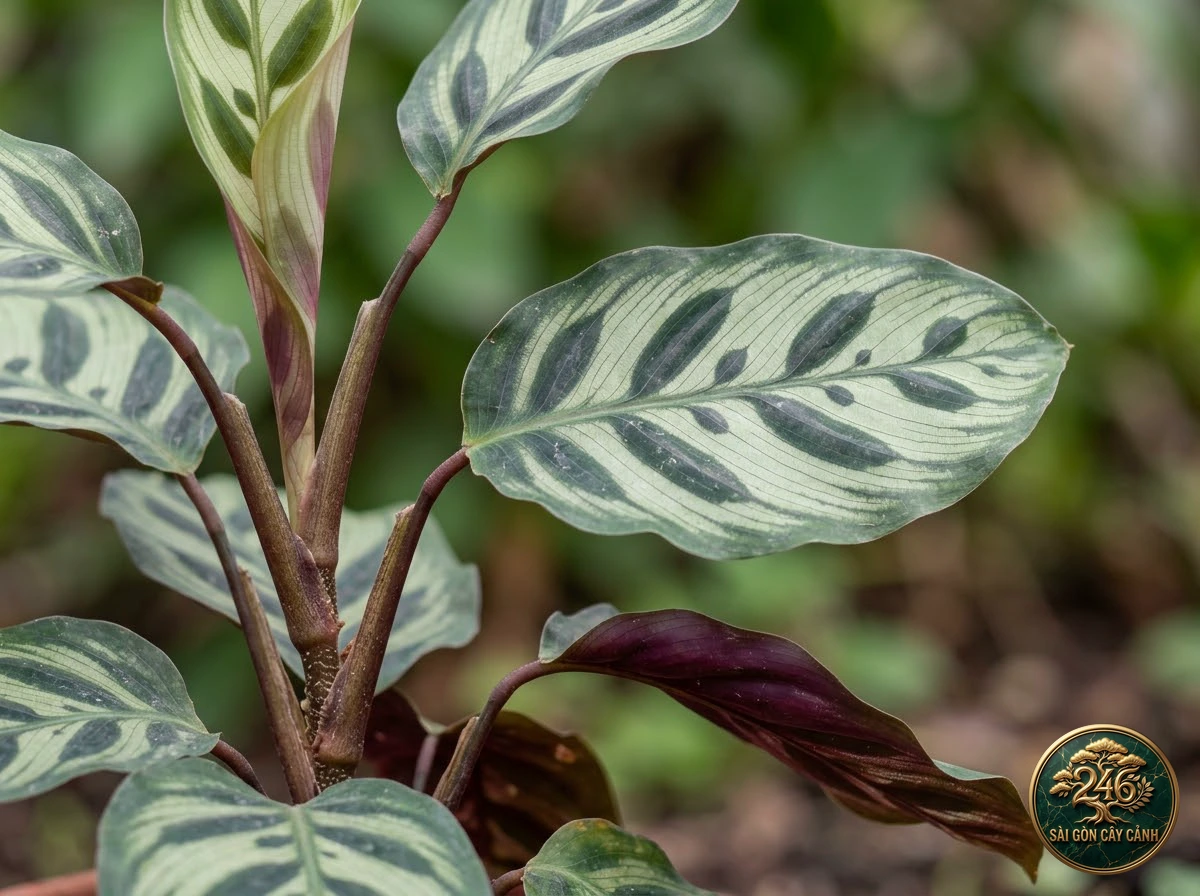
Foliar blades of the Peacock plant present an expansive oval to obovate contour measuring 20 to 30 cm in length and 10 to 15 cm in width. The papery yet pliable lamina displays a pale creamy-green adaxial surface adorned with alternating small and large deep-green elliptical blotches radiating rhythmically along lateral veins.
The botanical marvel of Goeppertia makoyana lies in its pigment symmetry: the intricate adaxial pattern is replicated precisely on the abaxial surface in radiant beetroot-maroon hues synthesized by dense anthocyanin deposits. Viewed against backlighting, the foliage transforms into living stained glass.
Microscopic examination of Goeppertia makoyana leaf cross-sections reveals adaxial epidermal cells with subtle convex lens-like contours that concentrate diffuse understory photons into palisade chloroplasts. The precise compartmentalization of abaxial anthocyanin vacuoles mirrors the peacock feather pattern exactly beneath, rendering each blade an optical two-sided stained glass canvas.
3. Photometric Calibration & Window Exposure Optimization
Thriving beneath stratified tropical canopy layers, the Peacock plant favors diffused illumination between 1,400 and 2,800 lux. The premier placement is 1 to 1.5 meters back from east- or north-facing windows, enjoying generous natural daylight completely insulated from direct solar beam radiation.
Direct midday sun bleaches intricate foliar patterns and scorches delicate margins within hours. Conversely, prolonged placement in deep shade below 800 lux halts pulvinar nyctinastic movement, causing petioles to elongate weakly and lose structural turgor.
Spectrometric assays define an optimal PPFD between 50 and 110 umol/m2/s for the Peacock plant. Supplemental horticultural LEDs tuned to a warm 4000K spectrum preserve crisp dark-green feather contrast without raising leaf boundary layer temperatures above 28°C (82°F) to avoid cellular heat shock.
4. Pulvinus Kinematics & Nyctinastic Diurnal Dynamics
Pulvinar nyctinastic movement represents one of the most fascinating biological phenomena of this species. During daylight, turgor pressure in lower pulvinus motor cells pushes the blade horizontally to optimize light interception. At dusk, potassium ion fluxes invert turgor, causing blades to elevate vertically in prayer-like unison.
This nocturnal foliar elevation protects abaxial stomata from chilling condensation while revealing the dramatic purple-maroon underside, completely transforming the visual aesthetic of the specimen between day and night.
Optimal thermal conditions span 21°C to 30°C (70°F – 86°F). The plant flourishes in warm domestic interiors, ceasing growth below 16°C (60°F) and requiring protection from direct air conditioning vent drafts.
Ambient relative humidity is critical, requiring steady maintenance between 65% and 85%. Operating ultrasonic humidifiers or gravel humidity saucers prevents crisp brown foliar margins.
A steady room temperature between 22°C and 26°C (72°F – 79°F) paired with gentle air convection prevents nocturnal chilling condensation on foliar margins. Keep pots away from hot exterior walls and AC registers, as abrupt humidity gradients cause rapid edge curling.
The hydraulic mechanism of the pulvinus is governed by plasma membrane proton pumps. When potassium ion (K+) fluxes shift from ventral to dorsal motor cells in late afternoon, osmotic water movement alters cellular turgor, generating biomechanical leverage that elevates blades 85 degrees upward throughout the night.
5. Porous Aggregate Substrate Engineering & Aeration Dynamics
Substrate architecture demands airy texture, continuous capillary dampness, and instant gravity drainage: 35% fine pumice (3-6mm), 30% shredded sphagnum moss and mini pine bark, 20% desalted coco coir pith, and 15% perlite, buffered to pH 5.8 to 6.5.
This open matrix mimics pristine rainforest humus, shielding delicate feeder roots against thermal and hydric shocks without anaerobic compaction.
A porous mineral-aggregate substrate combining volcanic pumice and mini aged pine bark establishes an uninterrupted multidirectional capillary network. Moisture disperses evenly without compressing interstitial air pores, shielding subterranean rhizomes from anaerobic fungal pathogens.
6. Organic Nutrition Schedules & Periodic Micronutrient Priming
Marantaceae root hairs react adversely to synthetic salts; fertilization must remain highly diluted (one-quarter standard rate). Apply organic liquid bio-fertilizer enriched with amino acids and kelp monthly during active spring and summer flushes.
Strictly avoid fast-release chemical synthetics that accumulate in foliar extremities. Flush the container every two months with distilled or reverse-osmosis water to leach residual mineral salts.
Because Marantaceae root hairs are extraordinarily delicate, applying cold-water kelp extract rich in humic and fulvic substances monthly stimulates root tip mitosis without raising electrical conductivity (EC) above 0.8 mS/cm, preserving radiant foliar luster.
7. Clinical Diagnostic Matrix & Rapid Correction Protocols
| Clinical Symptom | Primary Etiology | Diagnostic Evaluation | Corrective Prescription |
|---|---|---|---|
| Crisp brown leaf margins and inward blade curling | Ambient relative humidity dropped below 50% or chlorine toxicity | Monitor room hygrometer and verify irrigation water purity | Raise humidity above 65% and switch to pure dechlorinated water |
| Faded, washed-out green blotches and loss of contrast | Excessive ambient light exposure or direct sun exposure | Inspect container exposure to direct solar beam angles | Relocate specimen into gentle indirect daylight below 2,800 lux |
| Arrested nyctinastic movement and limp, sagging petioles | Severe root zone dehydration or anaerobic root rot decay | Extract root ball to evaluate moisture and examine root tip health | Bottom-water if desiccated; prune decayed roots and repot if soggy |
| Stippled yellow punctate spots and fine webbing underneath | Tetranychid spider mite infestation thriving in dry air | Inspect abaxial purple surfaces under magnification loupe | Rinse foliage thoroughly and treat with biological neem emulsion |
8. Cryptic Pest Prophylaxis & Foliar Surface Sanitation
Screen for two-spotted spider mites by inspecting the delicate abaxial burgundy leaf zones of Makoyana with a hand lens, where webbing concentrates along feathered veins. Mist cold-pressed neem oil at 0.2% concentration during late dusk to prevent epidermal burn.
Gently wipe domestic dust from leaf blades using damp microfiber towels bi-weekly to ensure unobstructed stomatal respiration and maintain luminous foliar brilliance.
The most effective prophylaxis against spider mites is sustaining humidity above 65% paired with weekly morning rinses of leaf undersides using pure water. Domestic dust settling across intricate peacock patterns is cleared safely with a soft camel-hair brush.
9. Asexual Propagation Methodology & Root Strike Protocols
The sole reliable asexual propagation technique is rhizomatous clump division during spring container repotting. Stem or leaf cuttings cannot root because petioles lack nodal meristematic tissue.
Using a sterile scalpel, section rhizome clusters retaining at least 3 to 4 sturdy leaves and independent root systems, potting into fresh airy mix under shaded humidity for three weeks.
During rhizome division, work in cool humid conditions and dust wounds with activated charcoal powder to prevent bacterial ingress. Settle divisions into 12-15 cm pots, maintaining 85% ambient humidity inside a shaded propagation enclosure for the first three weeks.
10. Companion Animal Safety Profile & ASPCA Non-Toxic Verification
According to official veterinary toxicological data from the ASPCA, Goeppertia makoyana is completely non-toxic to dogs and cats. Pet parents can display this plant safely across domestic living spaces.
11. Biophilic Curation & Contemporary Interior Design Styling
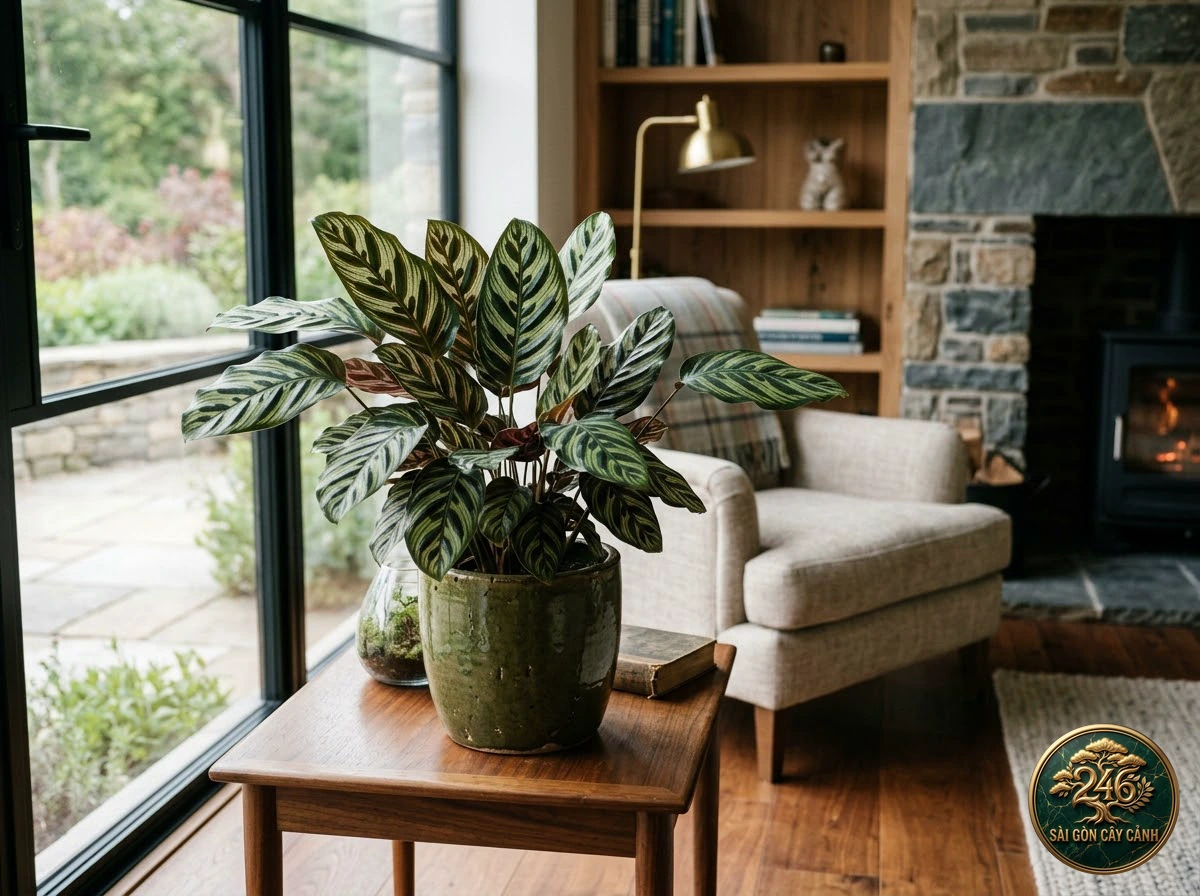
In contemporary biophilic interior styling, the Peacock plant serves as living botanical artwork, introducing sophisticated, hypnotic tropical charm to workdesks, living credenzas, and serene study shelves.
Its diurnal nyctinastic movement connects inhabitants with nature’s living rhythm, relieving urban stress and fostering a calm, contemplative residential sanctuary.
In biophilic interior design, the Peacock plant harmonizes exquisitely with matte ash-gray or pearl-white artisanal ceramics, providing vibrant chromatic focus upon executive desks and consoles while reconnecting urban dwellers with natural diurnal rhythms.
12. Master Principles for Sustainable Indoor Acclimatization
To maintain thriving emerald foliage and preserve razor-sharp peacock feather patterns on Goeppertia makoyana indoors, growers must observe three golden rules:
- Hydration axiom: Supply reverse-osmosis or distilled water whenever the upper 2 cm of soil dries; never permit root trays to harbor standing effluent.
- Illumination axiom: Position 1.5 meters from an eastern window behind sheer voile, protecting delicate feathered oval patterns from direct solar bleaching.
- Maintenance axiom: Maintain steady atmospheric humidity exceeding 65% using ultrasonic misting to prevent crisp marginal desiccation.
13. Frequently Asked Questions Regarding Peacock plant (FAQs)
Why do Peacock plant leaves fold vertically upward at night?
This is a natural physiological phenomenon known as nyctinasty, regulated by pulvinar turgor cells to minimize nighttime transpiration and protect stomata.
What water type should be utilized to avoid tip burn?
Avoid untreated tap water containing chlorine and fluoride. Use harvested rainwater, distilled/RO water, or tap water aged for 48 hours in open containers.
Is the plant safe if a pet cat or dog chews on foliage?
Completely safe. Belonging to the Marantaceae family, it is certified 100% non-toxic to felines and canines by the ASPCA.
How frequently should repotting and substrate refresh occur?
Every 1.5 to 2 years when daughter crowns crowd the container perimeter or when potting mix aggregate begins breaking down.
How can one maintain humidity in air-conditioned rooms?
Set pots atop gravel-filled humidity saucers, group tropical plants together, and operate an ultrasonic room humidifier above 65% RH.
How can one recognize acute ambient humidity stress in a Peacock plant?
The most telltale sign is crisp browning along leaf margins accompanied by inward longitudinal rolling of the blades. Immediately deploy an ultrasonic humidifier and position the container atop a pebble moisture tray.