
Living plant profile
Zebra plant calathea
Goeppertia zebrina
Comprehensive botanical dossier for Zebra plant calathea (Goeppertia zebrina). Identification, lighting calibration, porous substrate formulation, and cultivation guide by Saigon Cay Canh.
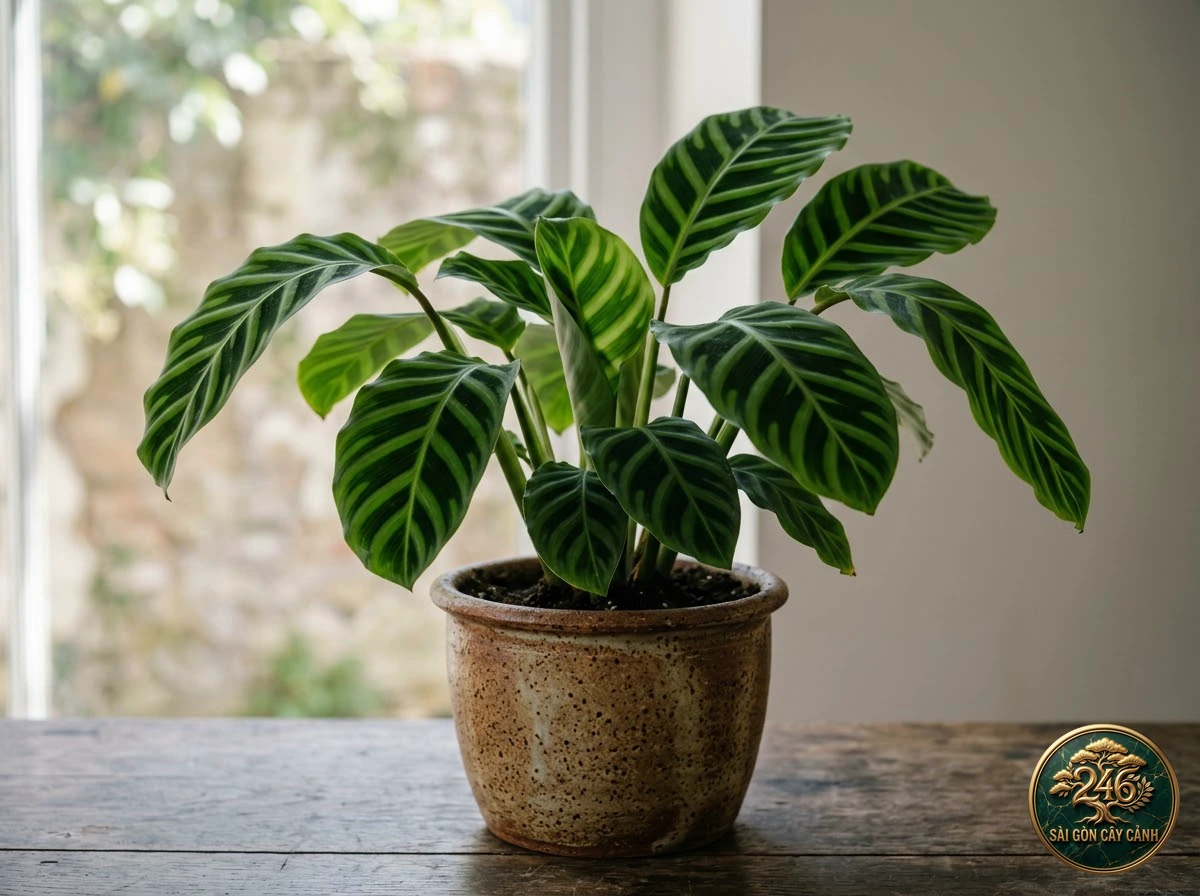
Zebra plant calathea (Goeppertia zebrina) is an aristocratic crown jewel of South American rainforests, mesmerizing plant enthusiasts with broad, velvety blades textured like royal emerald velour and boldly striped with deep black-green zebra bands radiating across lime-emerald backgrounds. It brings unparalleled tactile luxury and living opulence into high-end biophilic interiors.
1. Core Botanical Taxonomy & Cultural Specifications
| Scientific Name | Goeppertia zebrina |
|---|---|
| Botanical Family | Marantaceae (Prayer Plant Family) |
| Native Distribution | Humid lowland coastal rainforests of Southeastern Brazil (Rio de Janeiro, Sao Paulo) |
| Growth Demeanor | Expansive clumping perennial herb 60 to 90 cm tall with broad velvety matte foliage |
| Lighting Threshold | Ample filtered daylight (1,500 – 3,200 lux); prefers soft dappled understory conditions |
| Hydration Cadence | Hydrate when top 25-30% substrate dries; demands steady capillary coolness without saturation extremes |
| Substrate Formulation | 35% pumice, 30% shredded sphagnum and fine aged bark, 20% washed coir, and 15% perlite |
| Thermal Range | 21°C – 31°C (70°F – 88°F; flourishes in warm tropical rooms, vegetative arrest below 16°C/60°F) |
| Relative Humidity | 70% – 90% (Demands elevated atmospheric moisture to protect delicate micro-papillate foliar velvet) |
| Cultivation Difficulty | Moderate to High (Strict demands for elevated humidity and mineral-pure irrigation water) |
| Pet Safety Profile | Non-toxic (Completely safe for companion pets; certified non-toxic to dogs and cats by the ASPCA) |
First described scientifically by John Sims in 1817 and recombined under Goeppertia zebrina by Christian Gottfried Daniel Nees von Esenbeck, this taxon is verified in Kew’s Plants of the World Online (POWO). The specific epithet ‘zebrina’ accurately captures the bold, zebra-striped foliar banding.
The plant forms expansive clumping mounds anchored by thick subterranean rhizomes. Stout petioles 35 to 60 cm tall support massive blades reaching half a meter in length. A fleshy, responsive apical pulvinus maneuvers these heavy velvety leaves through graceful daily nyctinastic cycles.
A densely branched fibrous root system spreads through damp riparian humus in native habitats. The roots thrive in cool, aerated, oxygen-rich environments and exhibit acute intolerance toward chemically treated or saline irrigation water.
2. Morphological Identification & Foliar Architecture
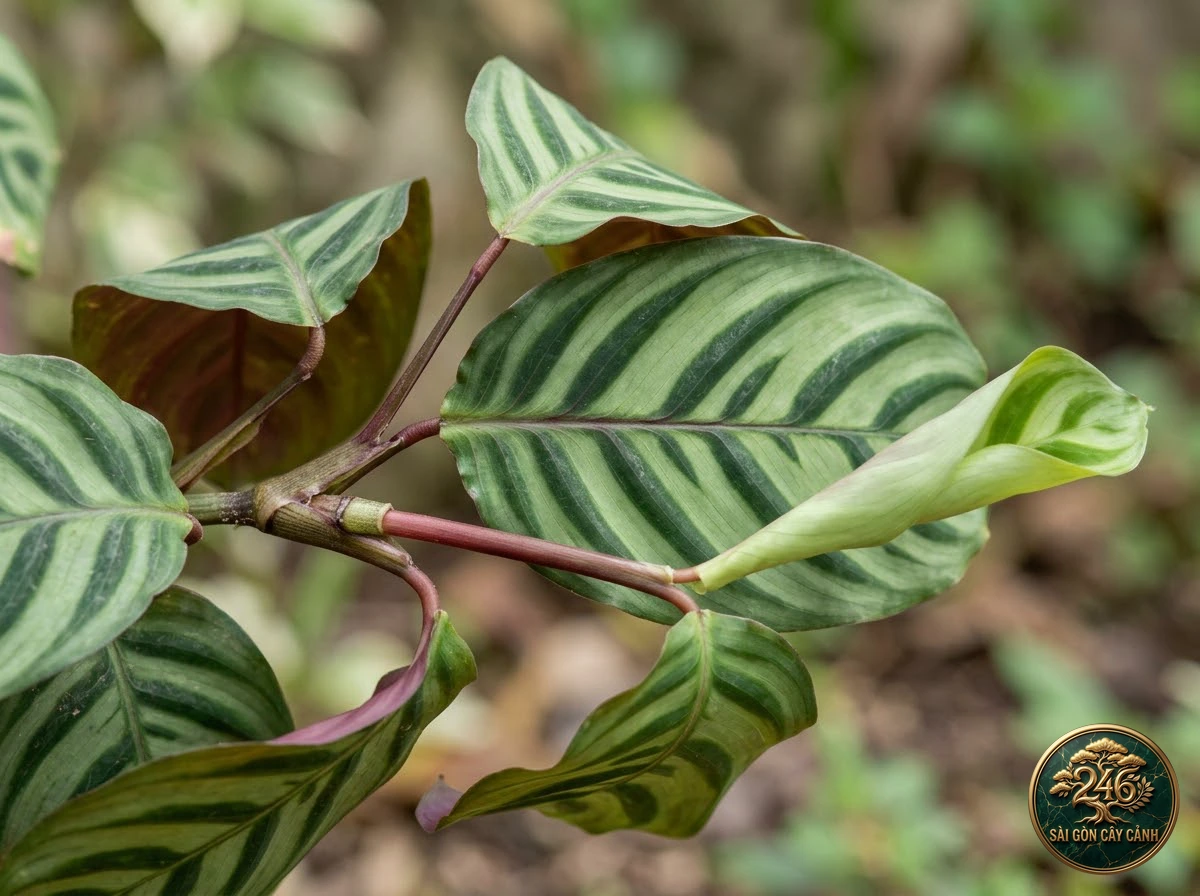
Foliar blades of the Zebra plant present an expansive elliptic to oblong-ovate outline measuring 35 to 55 cm in length and 18 to 28 cm in width. The defining physical trait is its plush, velvety texture delivering an exquisite tactile feel. Bright emerald upper surfaces are emblazoned with rich black-green bands radiating obliquely toward margins.
The abaxial surface is flushed with a delicate wine-purple cast blending into pale green. At twilight, the massive velvety canopy swings upright toward the ceiling, creating an awe-inspiring, living botanical sculpture.
Cytological analysis of Goeppertia zebrina leaf surfaces reveals millions of microscopic conical epidermal cells (micro-papillae) cloaking the adaxial lamina, scattering incident photons to produce a luxurious matte velour finish. Dark black-green zebra bands pack three times the chloroplast density of adjacent lime-green zones, creating a photosynthetic gradient that maximizes light harvesting.
3. Photometric Calibration & Window Exposure Optimization
Goeppertia zebrina flourishes under filtered daylight between 1,500 and 3,200 lux. Generous illumination softened by sheer drapes preserves intense banding contrast and keeps the velvety sheen luminous.
Direct solar exposure quickly scorches delicate velvety epidermal cells. Conversely, extended darkness below 800 lux bleaches dark zebra stripes and prompts weak, etiolated petiole elongation.
Photometric assays define an optimal PPFD between 70 and 140 umol/m2/s for the Zebra plant. Carrying massive foliar surface area cloaked in delicate micro-papillae, it demands generous indirect illumination completely devoid of direct infrared radiation to prevent foliar velvet desiccation.
4. Pulvinus Kinematics & Nyctinastic Diurnal Dynamics
The pulvinus of this species is a biomechanical wonder, effortlessly adjusting and elevating massive heavy leaves daily without structural fatigue. At dusk, blades fold inward to form a stately vertical columnar bouquet.
This motion conserves interior canopy humidity and shields the velvety surface from cold condensation during humid tropical nights.
Optimal thermal range extends from 20°C to 28°C (68°F – 82°F). Sensitive to sudden drafts; temperatures sinking beneath 18°C (64°F) trigger inward leaf curling and root uptake stalling.
Relative humidity must be maintained at a high 70% to 90%. Being one of the most moisture-demanding prayer plants, deploying an ultrasonic humidifier is essential to preserve velvety perfection.
Optimal temperatures between 22°C and 30°C (72°F – 86°F) paired with relative humidity above 70% are mandatory to prevent velvety edges from crisping. Operating an ultrasonic humidifier continuously in air-conditioned spaces replicates the humid coastal rainforest biospheres of southeastern Brazil.
The pulvinus of Goeppertia zebrina measures up to 1.2 cm in diameter, housing a muscular hydraulic vascular network. At nightfall, synchronized contraction of pulvinar motor cells elevates half-meter-long heavy velvet blades into an imposing vertical floral chalice pointing ceiling-ward.
5. Porous Aggregate Substrate Engineering & Aeration Dynamics
Potting substrates demand maximum porosity: 35% pumice, 30% shredded sphagnum moss and mini composted bark, 20% desalted coco coir, and 15% coarse perlite, balanced to pH 5.8 to 6.5.
This aerated aggregate prevents compaction, shielding fleshy subterranean rhizomes from anaerobic fungal decay.
Potting substrates for this robust species demand 30 to 45 cm containers filled with coarse pumice (5-10mm) and composted pine bark nuggets. Interstitial mineral air pockets guarantee continuous oxygen circulation around fleshy root networks, actively preventing anaerobic decay.
6. Organic Nutrition Schedules & Periodic Micronutrient Priming
Apply diluted liquid organic bio-fertilizer (one-quarter standard strength) every 3 to 4 weeks during spring and summer to nourish expansive foliage without mineral buildup.
Strictly avoid high-nitrogen chemical synthetics. Leach the container every two months with pure water to flush residual salts away from delicate feeder roots.
Nutritional management relies on ultra-diluted liquid organic bio-fertilizer fermented from cold-water kelp and plant amino acids (one-quarter rate) every three weeks. Avoid aggressive synthetics that burn sensitive velvety cells and deposit salts at blade tips.
7. Clinical Diagnostic Matrix & Rapid Correction Protocols
| Clinical Symptom | Primary Etiology | Diagnostic Evaluation | Corrective Prescription |
|---|---|---|---|
| Crisp curling margins and brown edges on velvet leaves | Ambient humidity dropped below 60% or tap water chlorine toxicity | Inspect room hygrometer and evaluate irrigation water purity | Run ultrasonic mist humidifier above 70% and switch to pure water |
| Faded zebra striping and diminished pattern contrast | Insufficient ambient indirect light or excessive synthetic nitrogen | Measure foot-candles at canopy level and verify fertilizer NPK | Relocate to bright filtered light (1,800+ lux) and taper nitrogen feed |
| Sudden synchronous collapse and wilting of velvet petioles | Severe root ball desiccation or anaerobic root rot decay | Probe substrate core depth and examine root cortex health | Bottom-soak immediately if desiccated; prune rotted roots and repot if soggy |
| Fine webbing and dusty stippling across velvety lamina | Tetranychid spider mites colonizing warm, arid environments | Inspect abaxial foliar surfaces under magnification loupe | Shower foliage gently and treat with biological emulsified neem |
8. Cryptic Pest Prophylaxis & Foliar Surface Sanitation
The delicate velvety pubescence of Zebra plant leaves prohibits aggressive mechanical wiping. Combat spider mites by applying fine micro-mists of lukewarm distilled water and deploying predatory mites (Phytoseiulus persimilis) for sustainable biological control.
Clean dust using a soft camel-hair brush or gentle mist; never rub aggressively with coarse cloths that could abrade the natural velvet finish.
Micro-papillate foliar velvet easily collects domestic dust and harbors spider mites. Gently clean blades using a soft camel-hair brush or morning micro-misting; never scrub with coarse towels that could dislodge the natural velvet pile.
9. Asexual Propagation Methodology & Root Strike Protocols
Propagate via rhizome clump division during spring container upgrades. Use a sterile sharp blade to separate divisions retaining at least 3 to 4 mature leaves and independent roots.
Pot divisions into fresh porous mix, sustaining ambient humidity above 80% in warm humid shade for three weeks to establish securely.
Propagate via rhizome clump division during seasonal spring repotting. Separate stout rhizome clusters retaining at least 3 mature velvet leaves and independent roots with a sterile knife, potting into fresh airy mix under 85% humidity for three weeks.
10. Companion Animal Safety Profile & ASPCA Non-Toxic Verification
Formally validated non-toxic to companion animals by ASPCA toxicological protocols. Accidental chewing of velvet foliage causes neither gastrointestinal distress nor mucosal inflammation.
11. Biophilic Curation & Contemporary Interior Design Styling
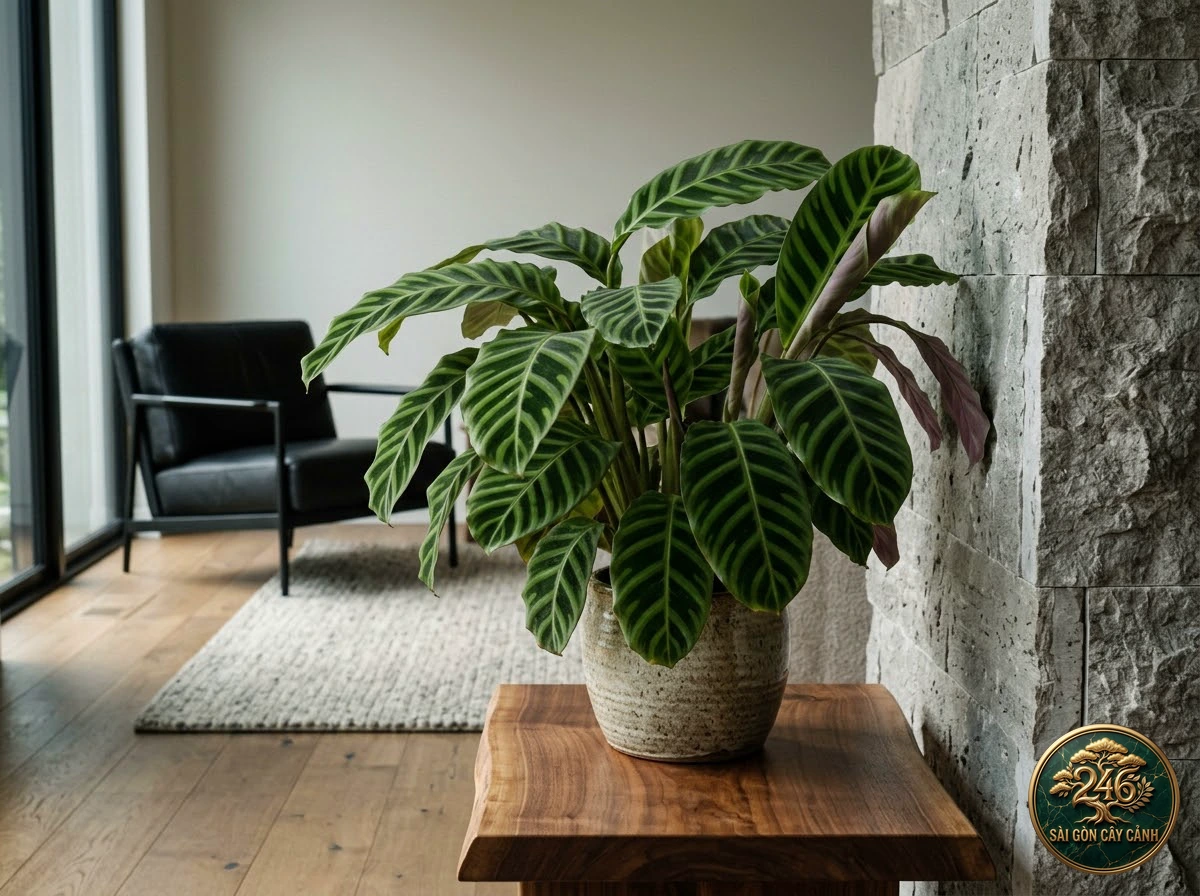
Featuring monumental presence, broad velvet blades, and bold zebra striping, the Zebra plant serves as an awe-inspiring focal installation for luxury residences, hotel lounges, and creative design studios.
The fusion of royal velvet texture and rich emerald hues introduces restorative biophilic depth, infusing contemporary interiors with tranquil natural opulence.
Featuring monumental presence, magnificent zebra-striped velvet foliage, and mesmerizing nyctinastic choreography, the Zebra plant represents the pinnacle of living botanical sculpture for luxury villas, hospitality atriums, and premier biophilic lounges.
12. Master Principles for Sustainable Indoor Acclimatization
To cultivate a magnificent, flawless velvet specimen of Goeppertia zebrina indoors, horticulturists must adhere to three foundational axioms:
- Hydration axiom: Maintain substrate moisture akin to a thoroughly wrung-out sponge; never allow complete desiccation which causes irreversible foliage collapse.
- Illumination axiom: Deliver diffused light between 1,000 and 1,500 lux; shelter attentively as tender velvety tissue burns rapidly under raw solar exposure.
- Maintenance axiom: Sustain ambient relative humidity consistently within 70% to 80% via ultrasonic humidification or broad pebble trays.
13. Frequently Asked Questions Regarding Zebra plant calathea (FAQs)
Why does the foliage of the Zebra plant feel like soft velvet?
The surface features millions of microscopic conical epidermal cells (micro-papillae) that scatter incident light and produce a plush tactile velour texture.
Does this species demand higher humidity than other Calatheas?
Yes. It is among the most humidity-sensitive prayer plants, requiring above 70% RH to prevent velvety margins from crisping and curling.
What is the ideal water source for irrigation?
Harvested rainwater or reverse-osmosis water is ideal. Tap water with chlorine and fluoride damages sensitive root hairs and scorches blade tips.
How should dust be cleaned from velvety blades without damage?
Use a soft camel-hair brush or fine micro-misting; never scrub vigorously with coarse towels that could abrade natural micro-papillae.
Is the Zebra plant safe for curious cats and dogs?
Completely 100% safe. It is officially certified non-toxic to companion animals by the ASPCA.
Why does the foliage of the Zebra plant feel like soft velvet?
The surface features millions of microscopic conical epidermal cells (micro-papillae) that scatter incident light and produce a plush tactile velour texture.