
Living plant profile
Furry feather calathea
Goeppertia rufibarba
Comprehensive botanical dossier for Furry feather calathea (Goeppertia rufibarba). Identification, lighting calibration, porous substrate formulation, and cultivation guide by Saigon Cay Canh.
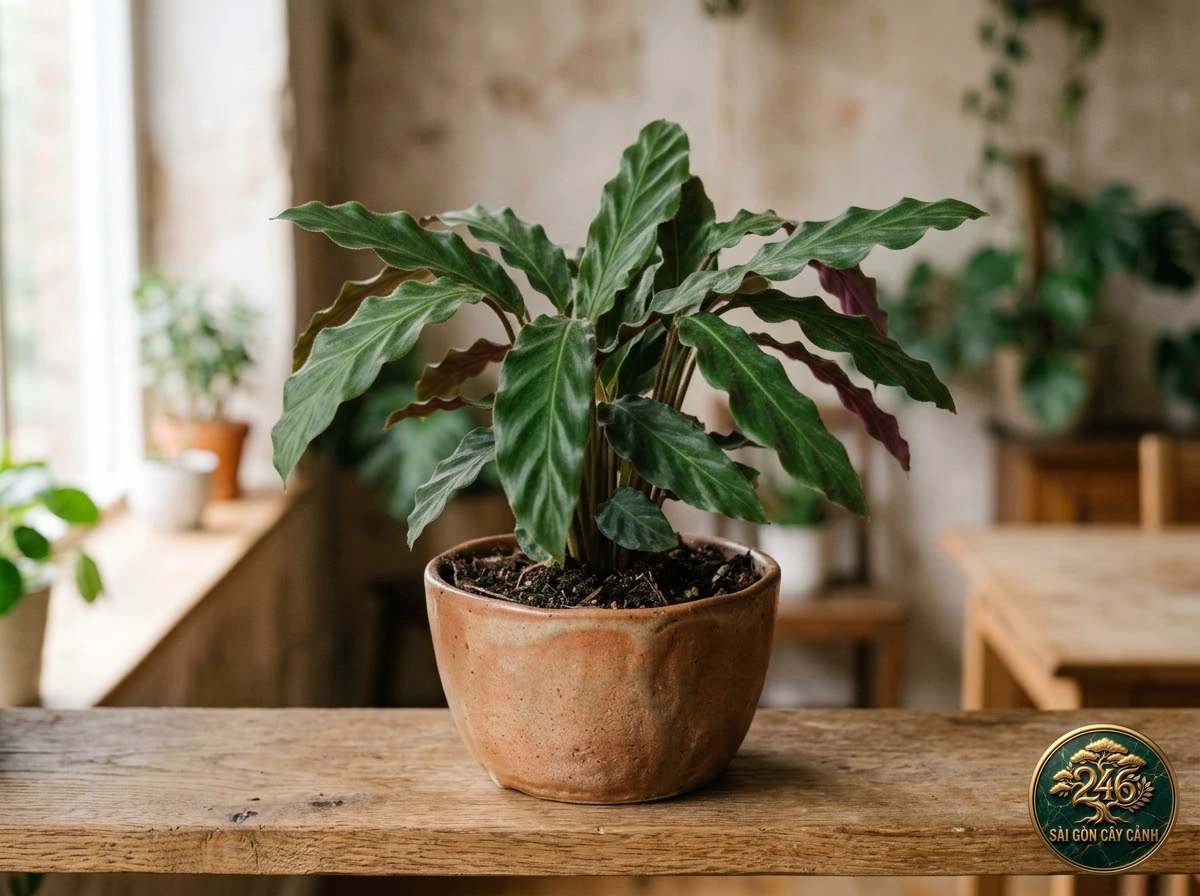
Furry feather calathea (Goeppertia rufibarba) is an extraordinary botanical jewel of the prayer plant family, captivating admirers with slender, ruffled lanceolate emerald blades whose undersides and petioles are cloaked in a soft, velvety pile of reddish-purple fuzz. The specific epithet ‘rufibarba’ translates to ‘red beard’, denoting this specialized protective foliar pubescence.
Sài Gòn Cây Cảnh Care Compass
1. Core Botanical Taxonomy & Cultural Specifications
| Scientific Name | Goeppertia rufibarba |
|---|---|
| Botanical Family | Marantaceae (Prayer Plant Family) |
| Native Distribution | Humid understories of the Atlantic coastal rainforest in southeastern Brazil (Bahia, Espirito Santo) |
| Growth Demeanor | Erect to spreading clump-forming perennial 50 to 80 cm tall with lanceolate, ruffled leaves cloaked in purple fuzz |
| Lighting Threshold | Steady diffused daylight (1,500 – 3,000 lux); supple leathery blades thrive in gentle canopy shade |
| Hydration Cadence | Hydrate when top 30% substrate dries; favors consistent capillary coolness without moisture extremes |
| Substrate Formulation | 35% pumice, 30% composted fine pine bark, 20% desalted coco coir pith, and 15% coarse perlite |
| Thermal Range | 20°C – 30°C (68°F – 86°F; flourishes in warm ambient rooms, growth stalls below 15°C/59°F) |
| Relative Humidity | 65% – 85% (Fine fuzzy pubescence helps retain surface boundary layer moisture efficiently) |
| Cultivation Difficulty | Easy to Moderate (Notably resilient and less prone to crisp marginal tip burn than thin-leaved kin) |
| Pet Safety Profile | Non-toxic (Completely safe for companion pets; certified non-toxic to dogs and cats by the ASPCA) |
Formally described by botanist Eduard Fenzl and recombined under Goeppertia by Borchsenius & Suarez, this taxon is verified in Kew’s Plants of the World Online (POWO). The rust-red foliar pubescence on leaf undersides and petioles constitutes a key diagnostic hallmark distinguishing it from all congeners.
The plant forms graceful upright clusters supported by sturdy subterranean rhizomes. Slender purplish petioles 30 to 50 cm long are lined with soft fuzz, terminating at an active pulvinus. This junction enables arching daytime displays and tight, feather-like vertical prayer clustering by night.
Fibrous adventitious roots spread shallowly through tropical coastal forest humus. Possessing greater structural resilience than fragile paper-thin cultivars, the root system recovers swiftly from transient hydric fluctuations.
2. Morphological Identification & Foliar Architecture
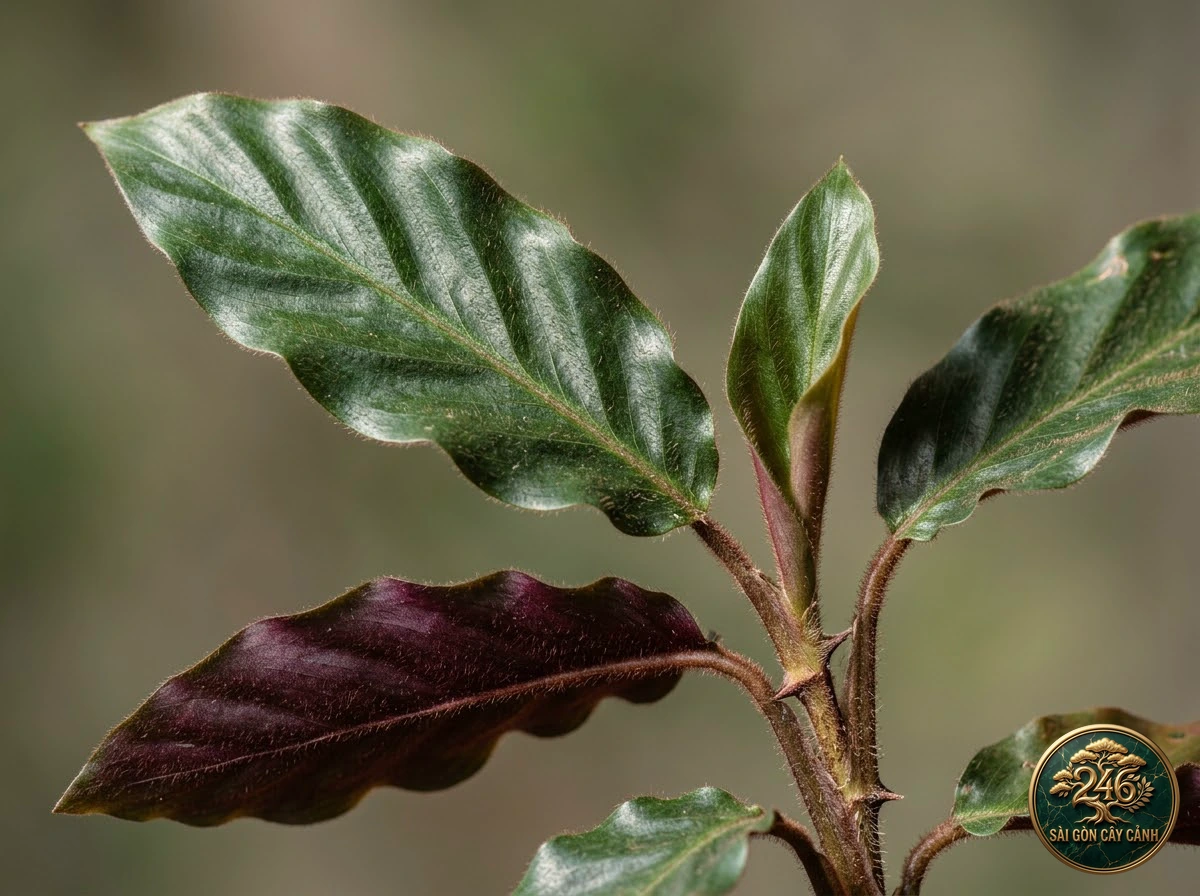
Foliar blades of Furry feather calathea exhibit an elongate-lanceolate outline measuring 25 to 40 cm in length and 5 to 8 cm in width. Deeply ruffled margins create an undulating feather-like silhouette. The adaxial surface gleams in solid, unvariegated forest green, showcasing pristine minimalist elegance.
The abaxial surface and entire petiole are saturated in deep burgundy-maroon, draped in millions of microscopic velvety hairs. Brushing the leaf underside delivers a uniquely plush, soft sensation found nowhere else in the indoor plant world.
Under optical microscopy, the abaxial pubescence of Goeppertia rufibarba comprises millions of unicellular trichomes filled with reddish-purple anthocyanin pigments. This fuzzy boundary layer shields stomatal pores against desiccating tropical winds while producing an exceptionally plush, tactile velvet sensation.
3. Photometric Calibration & Window Exposure Optimization
Goeppertia rufibarba flourishes under filtered illumination between 1,500 and 3,000 lux. Displaying containers near east-facing windows or bright indirect corners preserves deep forest-green adaxial saturation and vibrant burgundy fuzz underneath.
The plant tolerates modest shade better than most congeners, though prolonged darkness below 900 lux weakens petioles. Conversely, intense direct sunlight burns the delicate undulate margins.
Photometric assays define an ideal PPFD between 60 and 125 umol/m2/s for Furry feather calathea. Fortified by leathery laminar texture and protective pubescence, it handles a wide lighting range (1,500 – 3,000 lux) without crisping along ruffled edges.
4. Pulvinus Kinematics & Nyctinastic Diurnal Dynamics
Nyctinastic movement in this species possesses distinct elegance: at dusk, pulvinar motor cells contract to raise dozens of lanceolate blades into an upright, feather-like plume, fully exposing the captivating fuzzy burgundy reverses.
Come morning, blades arch gently outward to capture filtered daylight, creating a dynamic daily rhythm that enlivens interior living spaces.
Ideal cultivation temperatures range from 20°C to 30°C (68°F – 86°F). The specimen thrives in domestic air-conditioned comfort, stalling below 15°C (59°F) and requiring shelter from direct frosty vent drafts.
Relative humidity should be sustained at 65% to 85%. Thanks to protective foliar fuzz, it retains boundary layer moisture efficiently, exhibiting superior resistance to crisp tip burn.
Ideal temperatures from 20°C to 30°C (68°F – 86°F) paired with 65% to 85% relative humidity keep ruffled margins pristine. Protective foliar fuzz preserves boundary layer moisture far better than smooth-leaved relatives.
The pulvinus biomechanics of this species operate with persistent diurnal precision: at nightfall, it elevates lanceolate blades into an upright, feather-like plume, fully exposing the captivating fuzzy burgundy reverses under evening lighting.
5. Porous Aggregate Substrate Engineering & Aeration Dynamics
An optimal potting substrate incorporates 35% pumice, 30% composted bark (4-7mm), 20% desalted coco coir, and 15% coarse perlite, maintained at pH 5.8 to 6.5.
This aerated aggregate guarantees rapid moisture percolation and drainage, shielding fleshy root systems from anaerobic saturation rots.
An open potting aggregate blending 35% pumice, 30% composted bark, 20% desalted coco coir, and 15% coarse perlite guarantees rapid drainage, shielding subterranean rhizomes from anaerobic saturation rots.
6. Organic Nutrition Schedules & Periodic Micronutrient Priming
Administer diluted liquid organic fertilizer every 3 to 4 weeks during spring and summer to stimulate vigorous vegetative shoots and nourish lush purple pubescence.
Avoid high-salinity synthetic fertilizers. Flush containers thoroughly with pure water quarterly to leach residual fertilizer salts away from root zones.
Administer diluted liquid organic fertilizer monthly during spring and summer to stimulate vigorous vegetative shoots and nourish lush purple pubescence.
7. Clinical Diagnostic Matrix & Rapid Correction Protocols
| Clinical Symptom | Primary Etiology | Diagnostic Evaluation | Corrective Prescription |
|---|---|---|---|
| Crisp brown edges along ruffled leaf margins | Ambient relative humidity dropped below 50% or chlorine toxicity | Monitor room hygrometer and evaluate irrigation water purity | Deploy ultrasonic humidifier above 65% and switch to pure dechlorinated water |
| Fading of abaxial plum-purple pubescence to pale green | Protracted light deficit below 900 lux threshold | Measure ambient lux at foliage level with light meter | Relocate specimen into bright indirect daylight (1,500 – 2,500 lux) |
| Sudden drooping and collapse of upright petioles | Severe root zone dehydration or anaerobic root rot decay | Probe substrate core moisture and inspect container drainage | Bottom-water if desiccated; prune decayed roots and repot if waterlogged |
| Minute yellow punctate spots and fine webbing on fuzzy reverses | Tetranychid spider mites colonizing warm, arid environments | Inspect abaxial midrib surfaces with magnification loupe | Shower foliage gently with lukewarm water and treat with neem spray |
8. Cryptic Pest Prophylaxis & Foliar Surface Sanitation
The soft rufous puberulent hairs cladding petioles and abaxial surfaces readily trap environmental dust, potentially sheltering scale crawlers. Periodically cleanse foliage using low-pressure pneumatic air canisters and spray dilute organic geranium essence to repel sap-suckers.
Dust ruffled blades using a soft brush or gentle micro-misting to clear stomatal pores and maximize photosynthetic efficiency.
Dust ruffled blades using a soft camel-hair brush or gentle micro-misting bi-weekly to clear stomatal pores and maximize photosynthetic efficiency.
9. Asexual Propagation Methodology & Root Strike Protocols
Propagate by rhizome clump division during seasonal spring repotting. Select divisions retaining at least 3 sturdy leaves and independent adventitious roots.
Separate connective rhizomes with a sterile blade, potting into fresh airy substrate under shaded humidity for two weeks to establish firmly.
Propagate by rhizome clump division during seasonal spring repotting. Separate crowns retaining at least 3 sturdy leaves and independent adventitious roots with a sterile blade, potting into fresh airy substrate under shaded humidity for two weeks.
10. Companion Animal Safety Profile & ASPCA Non-Toxic Verification
ASPCA verifies Goeppertia rufibarba as non-hazardous to cats and dogs. The characteristic rufous hairs are completely benign, causing neither dermal irritation nor oral toxicity upon casual pet contact.
11. Biophilic Curation & Contemporary Interior Design Styling
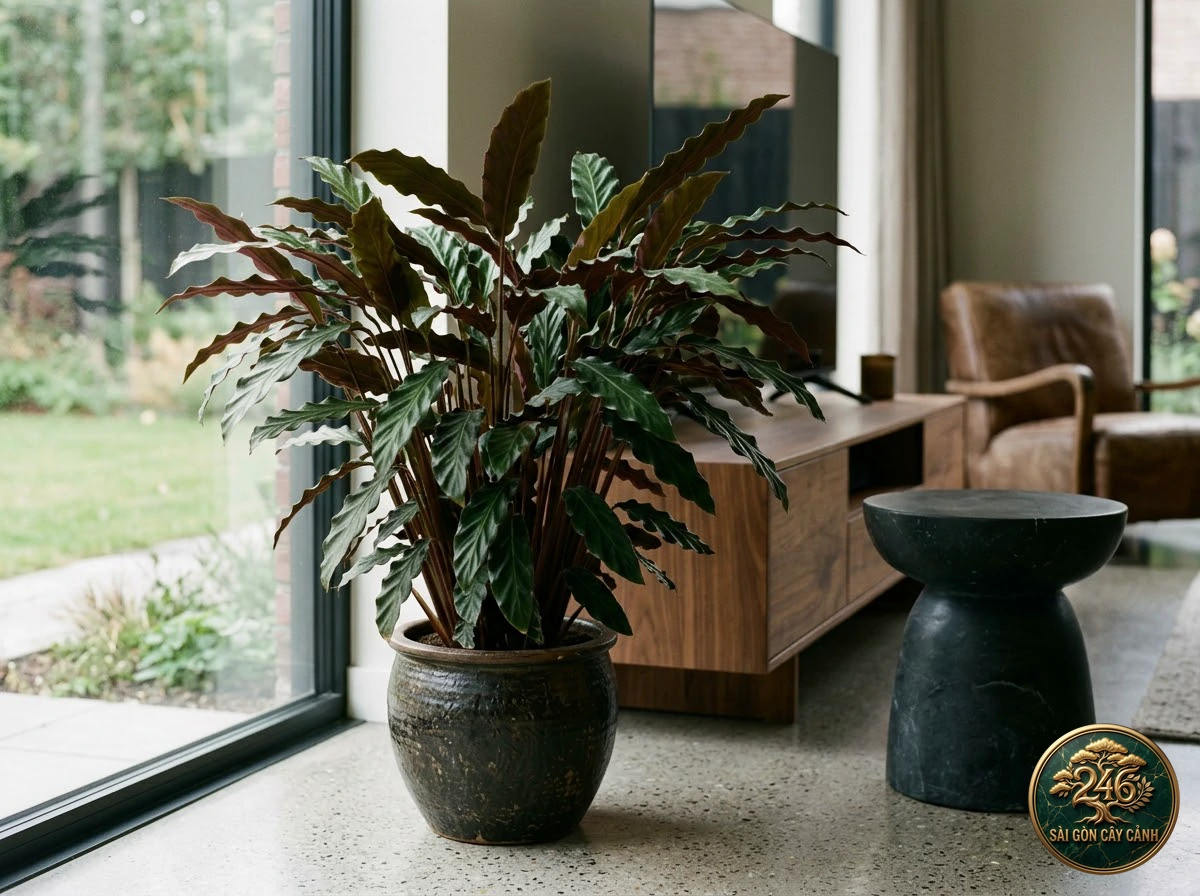
With sculpted undulate foliage, fuzzy burgundy undersides, and an upright habit, the Furry feather calathea is an ideal botanical statement for desks, consoles, and modern biophilic spaces.
Its daily nyctinastic prayer dance instills soothing tranquility, replenishing mental energy and introducing kinetic vitality into contemporary homes.
With sculpted undulate foliage, fuzzy burgundy undersides, and an upright habit, the Furry feather calathea is an ideal botanical statement for desks, consoles, and modern biophilic spaces.
12. Master Principles for Sustainable Indoor Acclimatization
To cultivate a thriving, stately specimen of Goeppertia rufibarba and preserve its luxurious purple pubescence indoors, growers should adhere to three golden rules:
- Hydration axiom: Water with dechlorinated soft water once the upper third of the root column turns dry; pour around pot margins rather than flooding the hairy central crown.
- Illumination axiom: Display in bright indirect light zones situated 1 to 2 meters away from sheer-curtained apertures.
- Maintenance axiom: Preserve relative air moisture between 60% and 75% to prevent tip browning and maintain plush silky petiole pubescence.
Nursery Care Journal & Living Greenery Moments
At Saigon Cay Canh greenhouse, each photograph captures genuine everyday care moments between plant lovers and living greenery, spreading a passion for nature and green-living inspiration.

13. Frequently Asked Questions Regarding Furry feather calathea (FAQs)
Why is this species commonly known as Furry Feather?
Because its undulating lanceolate blades resemble delicate feathers, while leaf undersides and petioles are cloaked in a soft, furry velvety fuzz.
Is Furry feather calathea easier to care for than other Calatheas?
Yes. Its protective foliar pubescence and thicker leaf texture make it considerably more forgiving of domestic humidity drops than delicate thin-leaved relatives.
What water precautions should be observed?
Avoid raw municipal tap water containing chlorine and fluoride. Always utilize pure reverse-osmosis, distilled, or rainwater.
Is the plant safe around cats and dogs?
Completely 100% safe. It is officially certified non-toxic to companion animals by the ASPCA.
When should repotting and clump division take place?
Repot every 1.5 to 2 years when emerging offshoots crowd the container brim.
Why is this species commonly known as Furry Feather?
Because its undulating lanceolate blades resemble delicate feathers, while leaf undersides and petioles are cloaked in a soft, furry velvety fuzz.