
Living plant profile
Rattlesnake calathea
Goeppertia insignis
Comprehensive botanical dossier for Rattlesnake calathea (Goeppertia insignis). Identification, lighting calibration, porous substrate formulation, and cultivation guide by Saigon Cay Canh.
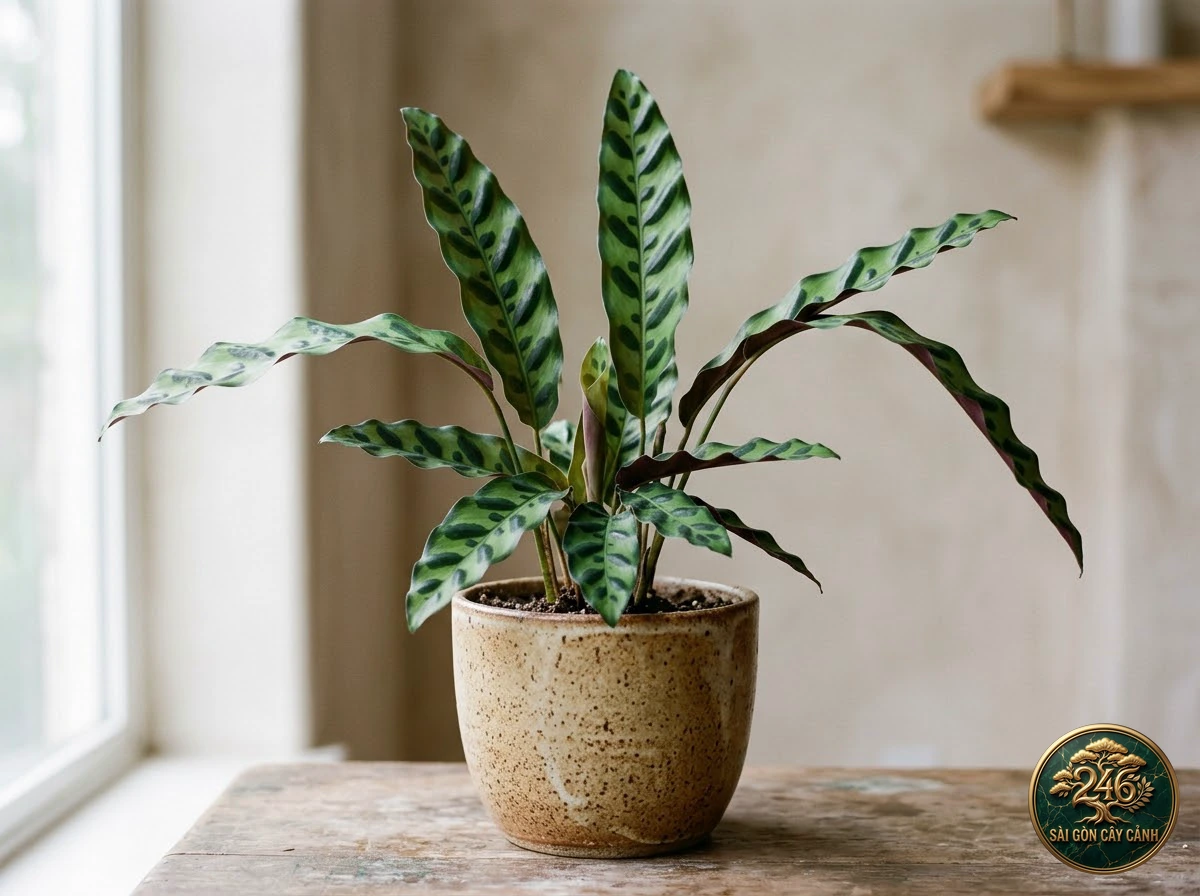
Rattlesnake calathea (Goeppertia insignis) is an exceptional morphological jewel of the prayer plant lineage, renowned for proud upright lanceolate blades with ruffled margins and chartreuse upper surfaces adorned with alternating dark olive-green elliptical spots. Backed by rich plum-purple undersides, foliage dances upward in theatrical nyctinastic prayer each evening.
Sài Gòn Cây Cảnh Care Compass
1. Core Botanical Taxonomy & Cultural Specifications
| Scientific Name | Goeppertia insignis |
|---|---|
| Botanical Family | Marantaceae (Prayer Plant Family) |
| Native Distribution | Atlantic coastal tropical rainforest understories of southeastern Brazil (Espirito Santo, Rio de Janeiro) |
| Growth Demeanor | Erect clump-forming perennial 45 to 75 cm tall with narrow, lanceolate ruffled foliage and dark elliptical blotches |
| Lighting Threshold | Consistent diffused daylight (1,500 – 3,000 lux); thicker leaf lamina handles slightly higher illumination |
| Hydration Cadence | Hydrate when top 30% substrate dries; favors consistent capillary coolness with unhindered drainage |
| Substrate Formulation | 35% pumice, 30% composted fine pine bark, 20% washed coco coir, and 15% horticultural perlite |
| Thermal Range | 20°C – 30°C (68°F – 86°F; thrives in warm indoor temperatures, vegetative arrest below 15°C/59°F) |
| Relative Humidity | 60% – 80% (Exhibits superior resilience to moderate indoor humidity compared to thin-leaved relatives) |
| Cultivation Difficulty | Easy to Moderate (Recognized as one of the hardiest and most forgiving prayer plants for interiors) |
| Pet Safety Profile | Non-toxic (Completely safe for companion pets; certified non-toxic to dogs and cats by the ASPCA) |
Discovered by botanist William Bull and later recombined under Goeppertia by Julian Mark Hugh Shaw, this taxon is verified in Kew’s Plants of the World Online (POWO). The specific epithet ‘insignis’ translates to ‘notable’ or ‘remarkable’, paying tribute to its eye-catching foliar patterning and stately stature.
The plant forms dense vertical clumps anchored by robust subterranean rhizomes. Stout petioles 25 to 45 cm tall hold blades rigidly erect. At the petiole apex, an active pulvinus articulates smoothly, fanning sword-like leaves outward during daylight and tucking them flush vertically at twilight.
A fibrous root system spreads vigorously through sandy humic soils of coastal southeastern Brazilian forests. Possessing slightly thicker root cortices than thin-leaved kin, it tolerates brief moisture deficits between waterings with remarkable grace.
2. Morphological Identification & Foliar Architecture
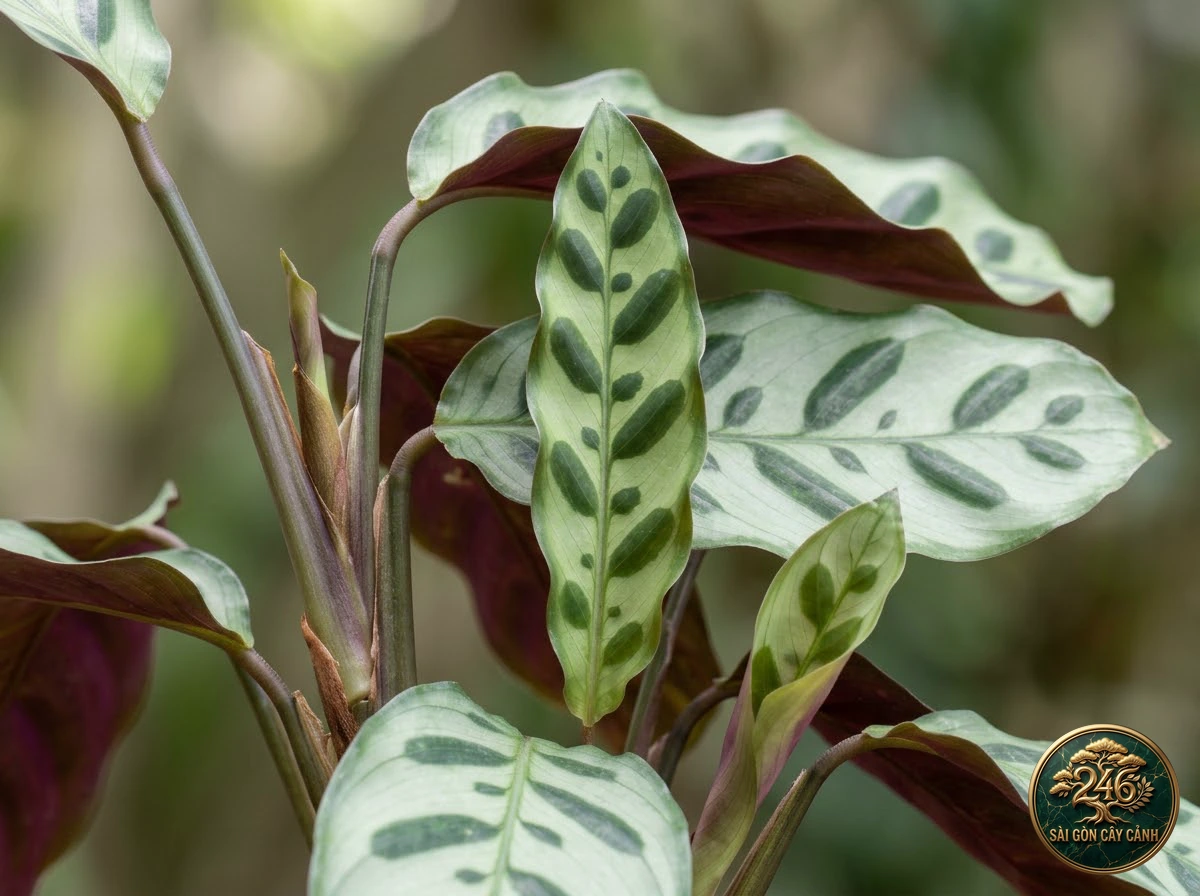
Foliar blades of Rattlesnake calathea display an elongate-lanceolate outline measuring 30 to 45 cm in length and 5 to 8 cm in width. Deeply ruffled margins create an undulating silhouette. The adaxial surface is bright chartreuse-green accented with alternating large and small dark olive-green elliptical spots.
The abaxial surface is washed in a deep plum-purple or reddish-violet tone. Observed within interior spaces, the dramatic interplay of adaxial reptilian patterns and abaxial wine-red pigments delivers mesmerizing two-tone chromatic dynamism.
Epidermal analysis of Goeppertia insignis reveals tightly organized alternating zones of high-chloroplast olive-green blotches embedded within chartreuse backgrounds. Ruffled margins are reinforced with elastic cellulose microfibrils, allowing 45 cm spear-like blades to stand rigidly erect without drooping or kinking.
3. Photometric Calibration & Window Exposure Optimization
Fortified by thicker foliar texture, Goeppertia insignis comfortably tolerates lighting between 1,500 and 3,000 lux. Positions near sheer east-facing windows preserve crisp spot contrast and deep abaxial violet pigmentation.
While hardier than other Calathea species, scorching midday sun will burn ruffled margins. Conversely, protracted low-light confinement below 900 lux fades the rich purple undersides into a dull grayish-green.
Photometric trials define an ideal PPFD between 60 and 130 umol/m2/s for Rattlesnake calathea. Adapting flexibly to bright indirect residential interiors (1,500 – 3,000 lux), it maintains high-contrast definition between dark olive spots and chartreuse grounds.
4. Pulvinus Kinematics & Nyctinastic Diurnal Dynamics
Diurnal movement unfolds with theatrical precision: as dusk descends, spear-like blades elevate completely vertical, resembling a clustered quiver of spears directed ceiling-ward and showcasing uniform plum-purple reverses.
This mechanism is driven by reversible turgor shifts within pulvinar motor tissues, minimizing nocturnal thermal dissipation and preserving internal foliar moisture throughout the night.
Ideal developmental temperatures range from 20°C to 30°C (68°F – 86°F). The specimen thrives in domestic air-conditioned comfort, stalling below 15°C (59°F) and disliking direct frosty vent currents.
Atmospheric humidity should hover between 60% and 80%. Due to leathery foliage, this species handles domestic humidity drops far better than thin-leaved relatives without curling.
Ideal temperatures spanning 20°C to 30°C (68°F – 86°F) paired with 60% to 80% humidity preserve supple margins. Its thicker leaf lamina confers superior tolerance of domestic air-conditioned dryness compared to thin-leaved relatives.
The pulvinus of Goeppertia insignis generates responsive biomechanical torque, raising spear-like blades into a clustered upright quiver at nightfall. This motion fully showcases radiant plum-purple reverses, staging a dramatic two-tone visual performance indoors.
5. Porous Aggregate Substrate Engineering & Aeration Dynamics
An optimal potting substrate blend incorporates 35% pumice, 30% composted bark nuggets (4-7mm), 20% desalted coco coir, and 15% coarse perlite, balanced to pH 5.8 to 6.5.
This open aggregate ensures rapid percolation, actively eliminating standing saturation at container bottoms that could impair tender root tips.
A potting mix combining 35% pumice, 30% composted bark, 20% desalted coco coir, and 15% coarse perlite guarantees instant drainage. Interstitial mineral pores sustain continuous capillary hydration without moisture stagnation.
6. Organic Nutrition Schedules & Periodic Micronutrient Priming
Apply diluted organic liquid fertilizer monthly during spring and summer. Balanced nutrients stimulate abundant new spear shoots while maintaining high-contrast reptilian patterning.
Refrain from applying concentrated synthetic granules near the crown. Flush the root ball thoroughly with pure water quarterly to wash away fertilizer salt residues.
Apply diluted liquid organic fertilizer monthly during spring and summer to prompt vigorous new spear shoots and maintain high-contrast reptilian patterning across every blade.
7. Clinical Diagnostic Matrix & Rapid Correction Protocols
| Clinical Symptom | Primary Etiology | Diagnostic Evaluation | Corrective Prescription |
|---|---|---|---|
| Crisp brown margins along ruffled edges | Ambient relative humidity dropped below 50% or chlorine toxicity | Examine room hygrometer and verify irrigation water quality | Deploy room humidifier and switch to pure dechlorinated water |
| Fading spot contrast and pale chlorotic chartreuse blades | Protracted photon deficiency below 900 lux threshold | Measure ambient lux at foliage level with light meter | Relocate specimen into bright filtered daylight (1,500 – 2,500 lux) |
| Sudden drooping and collapse of upright sword foliage | Severe root zone dehydration or anaerobic root rot decay | Probe substrate core moisture and inspect container drainage | Bottom-water if desiccated; prune decayed roots and repot if waterlogged |
| Minute yellow punctate spots and fine webs on purple reverses | Tetranychid spider mites colonizing warm, arid interiors | Inspect abaxial midrib surfaces with magnification loupe | Shower foliage gently and apply biological emulsified neem spray |
8. Cryptic Pest Prophylaxis & Foliar Surface Sanitation
Inspect the distinct dark elliptical markings along narrow blades of Insignis for potential cyclamen mites and aphids. Apply a gentle spray of biological potassium soap (5ml per liter of filtered water) to both surfaces monthly in early morning.
Wipe sword blades with damp microfiber cloths bi-weekly to clear household dust and optimize photosynthetic gas exchange.
Dust sword blades with damp microfiber towels bi-weekly to ensure open stomatal pores, optimize photosynthetic efficiency, and prevent cryptic pests from harboring.
9. Asexual Propagation Methodology & Root Strike Protocols
Propagate by rhizomatous clump division during spring container repotting. Select divisions retaining at least 3 mature leaves and independent roots.
Separate connective crowns with a sterile blade, potting into fresh aerated mix under shaded humidity for two weeks to establish firmly.
Propagate by rhizome clump division during spring container repotting. Select divisions retaining at least 3 mature leaves and independent roots, potting into fresh airy mix under shaded humidity for two weeks.
10. Companion Animal Safety Profile & ASPCA Non-Toxic Verification
ASPCA records classify Goeppertia insignis as entirely safe around cats and dogs. Any vomiting following pet leaf chewing stems purely from indigestible plant cellulose fibers rather than chemical toxicity.
11. Biophilic Curation & Contemporary Interior Design Styling
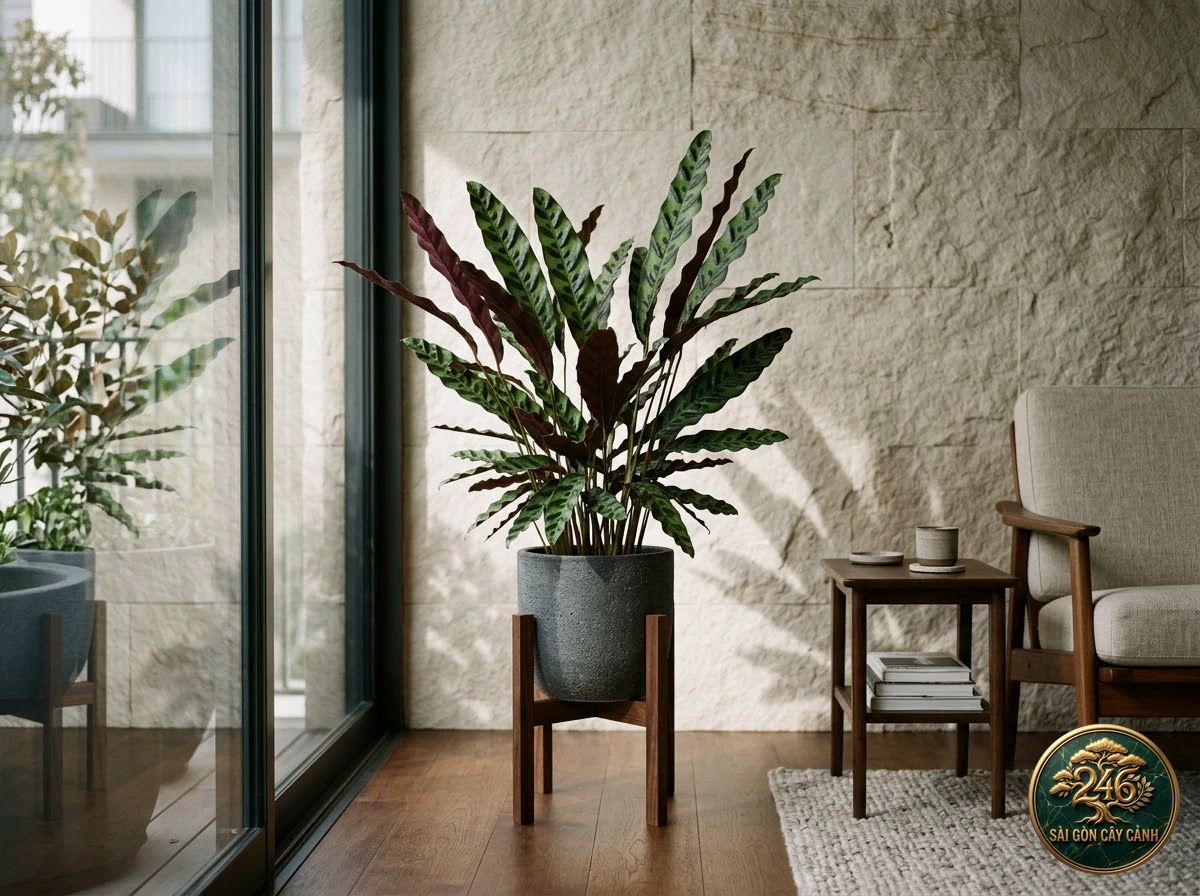
With its architectural spear-like form, sculpted wavy margins, and unique reptilian patterning, the Rattlesnake calathea serves as an ideal botanical accent for executive desks, consoles, and modern biophilic spaces.
Its serene poise and kinetic prayer movement instill soothing tranquility, replenishing vitality across contemporary living environments.
With its architectural spear-like form, sculpted wavy margins, and unique reptilian patterning, the Rattlesnake calathea serves as an ideal botanical accent for executive desks, consoles, and modern biophilic spaces.
12. Master Principles for Sustainable Indoor Acclimatization
To cultivate thriving, stately specimens of Goeppertia insignis and preserve vivid rattlesnake patterns indoors, growers should adhere to three foundational rules:
- Hydration axiom: Irrigate with softened water once topsoil dries by 2 to 3 cm; firmer foliar texture affords slightly higher drought tolerance than thinner calatheas.
- Illumination axiom: Thrives in bright ambient light measuring 1,000 to 1,800 lux; vertical blade orientation captures multi-directional ambient illumination effectively.
- Maintenance axiom: Ensure relative humidity remains at or above 60%; protect pot placement from drying direct drafts generated by ceiling fans or ventilation units.
Nursery Care Journal & Living Greenery Moments
At Saigon Cay Canh greenhouse, each photograph captures genuine everyday care moments between plant lovers and living greenery, spreading a passion for nature and green-living inspiration.

13. Frequently Asked Questions Regarding Rattlesnake calathea (FAQs)
Is Goeppertia insignis synonymous with Goeppertia lancifolia?
Historically in horticulture these names were often treated interchangeably, but botanically Goeppertia insignis is recognized by Kew POWO as an accepted distinct taxon with characteristic ruffled, spotted lanceolate blades.
What water precautions should be observed?
Never apply raw tap water containing chlorine or fluoride. Always utilize pure rainwater, filtered water, or tap water aged for 48 hours.
Is this plant safe around cats and dogs?
Completely 100% safe. It is officially certified non-toxic to felines, canines, and humans by the ASPCA.
Should the foliage be dusted routinely?
Yes. Cleansing lanceolate blades with damp microfiber cloths bi-weekly optimizes photosynthesis and maintains brilliant spot definition.
When should repotting and clump division be undertaken?
Repot every 1.5 to 2 years when emerging daughter crowns crowd container rims.
Is Goeppertia insignis synonymous with Goeppertia lancifolia?
Historically in horticulture these names were often treated interchangeably, but botanically Goeppertia insignis is recognized by Kew POWO as an accepted distinct taxon with characteristic ruffled, spotted lanceolate blades.