
Living plant profile
Thalia stromanthe
Stromanthe thalia
Comprehensive botanical dossier for Thalia stromanthe (Stromanthe thalia). Identification, lighting calibration, porous substrate formulation, and cultivation guide by Saigon Cay Canh.
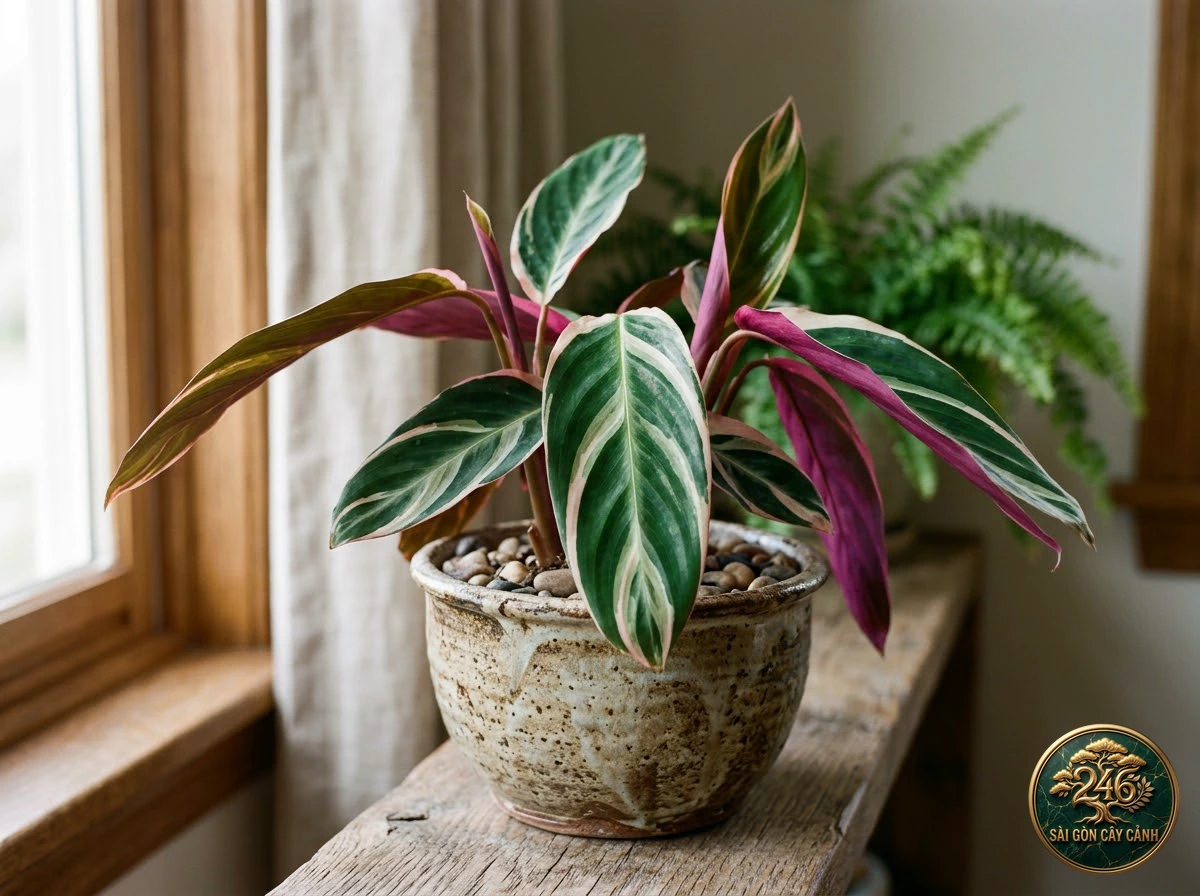
Thalia stromanthe (Stromanthe thalia) is the noble wild-type progenitor of the genus Stromanthe indigenous to the Atlantic coastal rainforests of southeastern Brazil. Diverging from variegated cultivars, the wild form displays solid lustrous dark forest-green lanceolate foliage traversed by a pale lime-green midrib, dramatically counterbalanced by carmine-red abaxial surfaces and exceptional cultural vigor.
1. Core Botanical Taxonomy & Cultural Specifications
| Scientific Name | Stromanthe thalia |
|---|---|
| Botanical Family | Marantaceae (Prayer Plant Family) |
| Native Distribution | Southeastern Brazil (Atlantic Coastal Rainforest reserves) |
| Growth Demeanor | Erect clumping herbaceous perennial producing robust leafy canopies |
| Lighting Threshold | Medium to bright diffused indirect illumination (1,200 – 1,900 lux) |
| Hydration Cadence | Hydrate with soft water once upper 2-3cm of substrate turns dry |
| Substrate Formulation | 35% pumice, 25% sterile moss, 20% mini pine bark, 20% perlite |
| Thermal Range | 19°C – 28°C (66°F – 82°F), growth arrests below 15°C (59°F) |
| Relative Humidity | Maintain atmospheric relative humidity between 60% and 80% |
| Cultivation Difficulty | Easy to Moderate (Notably hardier than variegated chimeric forms) |
| Pet Safety Profile | Completely non-toxic to companion pets (ASPCA validated) |
Stromanthe thalia was scientifically circumscribed by German botanist Karl Schumann in his comprehensive monograph of the Marantaceae family. The specific epithet ‘thalia’ honors the Greek muse of pastoral flourishing and abundance, reflecting the lush, unpretentious vitality of this wild-type Neotropical perennial.
In native habitats across the Brazilian rainforest understory, the species forms expansive colonies standing 70 cm to 1 meter tall. Because 100% of its adaxial surface area is furnished with functional chloroplasts, wild-type Stromanthe thalia exhibits twice the vegetative growth rate of variegated cultivars and superior pest tolerance.
Authoritative taxonomy maintained by Kew POWO confirms Stromanthe thalia as the accepted species entity, serving as an evolutionary model of rainforest understory adaptation to fluctuating photon flux under dense forest canopies.
2. Morphological Identification & Foliar Architecture
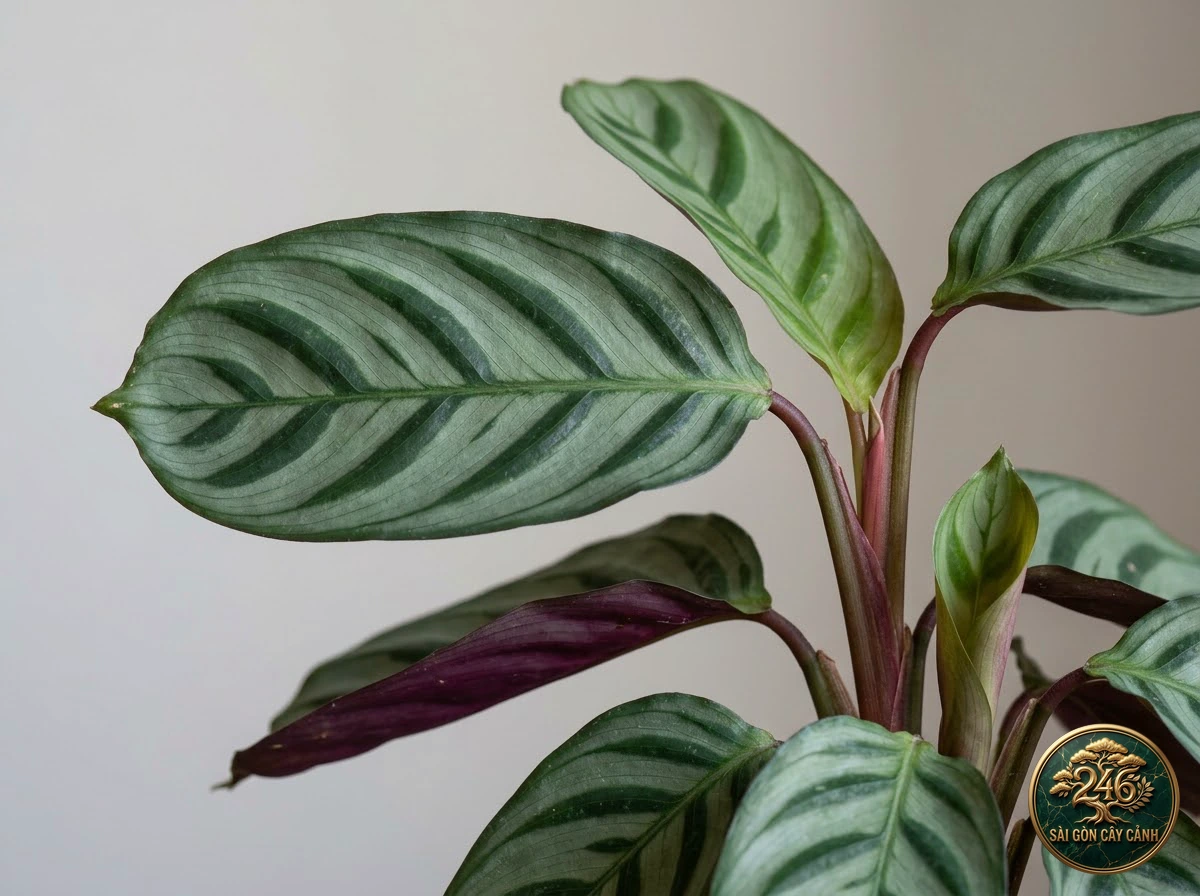
Definitive morphological features comprise erect lanceolate blades measuring 25 to 40 cm in length and 8 to 12 cm in breadth. The adaxial surface is finished in uniform lustrous dark forest-green, accented along the longitudinal midline by a striking pale lime-green midrib running from base to acute apex.
The abaxial surface is washed in rich carmine-red or deep oxblood, displaying a silky tactile sheen. The pulvinus motor organ at the petiole summit possesses robust muscular substance, smoothly articulating these expansive blades through their daily circadian elevation cycles.
Cytological analysis of wild-type Stromanthe thalia demonstrates the physiological robustness of ancestral lineages, featuring uniform chloroplast distribution throughout palisade tissue layers. Free from the metabolic constraints of foliar chimera mutations, its deep emerald blades achieve quantum yields near 0.08 mol CO2 per absorbed photon, complemented by dense abaxial anthocyanins that serve as a reflective photonic barrier under closed forest canopies.
3. Photometric Calibration & Window Exposure Optimization
Benefiting from abundant chlorophyll concentrations, Stromanthe thalia thrives across an expansive indirect light range of 1,200 to 1,900 lux. It tolerates moderate interior illumination substantially better than Triostar, making it an exceptional choice for spaces with standard window lighting.
The plant favors dechlorinated soft water. While demonstrating greater mineral tolerance than variegated forms, chronic exposure to tap water chlorine and fluoride eventually causes minor tip desiccation. Aerating municipal water for 24 hours or utilizing reverse-osmosis filtration keeps leaf tips immaculate.
Applied photometric profiling designates an optimal photosynthetic photon flux density (PPFD) between 50 and 85 µmol/m²/s. Benefiting from slightly thickened cuticular layers and high total chlorophyll content, Stromanthe thalia sustains gas exchange equilibrium even within deep interior corners receiving dim ambient levels near 35 µmol/m²/s.
4. Rainforest Canopy Foliar Habit & Ancestral Pulvinus Kinematics
Nyctinastic kinematics in Stromanthe thalia highlight the mechanical strength of the pulvinus joint. During daylight hours, dense dark green blades spread outward horizontally to create an expansive verdant canopy, maximizing diffused photon capture.
At darkness onset, ventral motor cell expansion elevates the blades vertically into an upright prayer cluster. This movement exposes the solid carmine-red abaxial undersides, transforming the green bush into a bold crimson architectural statement overnight.
Optimal vegetative development occurs between 19°C and 28°C (66°F – 82°F). The species exhibits robust heat tolerance in tropical summers, needing only insulation from cold drafts when indoor temperatures sink beneath 15°C (59°F).
Ideal ambient humidity spans 60% to 80%. Thanks to thicker foliar cuticles, Stromanthe thalia withstands dry atmospheric intervals better than thin-leaved Calatheas, though sustaining humidity above 55% prevents marginal puckering.
The optimal ambient vapor pressure deficit (VPD) ranges between 0.65 and 0.9 kPa. Stromanthe thalia demonstrates greater atmospheric tolerance than its variegated ‘Triostar’ mutation; nonetheless, maintaining indoor relative humidity above 60% remains essential to prevent localized necrotic tips and preserve crisp lanceolate margins.
The pulvinus motor organ of this ancestral taxon displays remarkable biomechanical elasticity with an angular excursion reaching 110 degrees. At dusk, synchronized potassium and chloride transmembrane fluxes induce potent turgor shifts, folding lanceolate blades into an upright conical column that shields adaxial surfaces from prolonged nocturnal dew accumulation.
5. Porous Aggregate Substrate Engineering & Aeration Dynamics
The robust rhizomatous and fibrous root system of Stromanthe thalia demands spacious containers and aerated potting aggregate. The standard formula blends 35% pumice gravel, 25% sterile sphagnum moss, 20% rinsed mini pine bark, and 20% sterile perlite.
This aggregate enables irrigation effluent to drain freely without ponding, providing uninterrupted oxygenation to root tissues and preventing subterranean decay during protracted rainy seasons.
The potting medium for wild-type Stromanthe requires air-filled porosity above 25% paired with unhindered drainage. Blending coarse perlite with washed coco chips possessing an EC below 0.3 mS/cm enables feeder rootlets to proliferate into a dense capillary network, assimilating moisture efficiently without hypoxic root decay risks.
6. Organic Nutrition Schedules & Periodic Micronutrient Priming
Fertilize Stromanthe thalia with liquid organic biological nutrients (such as worm casting tea or hydrolyzed fish emulsion) every 4 weeks throughout active growing intervals. Organic nitrogen and potassium fuel continuous shoot emergence and foliar luster.
Suspend feeding during dormant winter phases or when soil is parched. Leach the container with clean water flushes quarterly to eliminate mineral residues.
Nutritional management prioritizes fermented banana peel extract rich in bio-potassium combined with soluble humates applied monthly. This organic nourishment fuels active subterranean rhizome tillering, producing thick emerging petiole sheaths while intensifying the deep plum-red coloration along abaxial surfaces.
7. Clinical Diagnostic Matrix & Rapid Correction Protocols
| Clinical Symptom | Primary Etiology | Diagnostic Evaluation | Corrective Prescription |
|---|---|---|---|
| Crisp brown leaf tips and subtle curling | Excessive tap water minerals or ambient humidity dropping below 50% | Check room hygrometer reading and evaluate water purity | Transition to pure RO or rainwater and set planter atop moist gravel trays |
| Foliage pales and canes turn leggy and etiolated | Chronic light deficit below 800 lux threshold | Measure ambient lux levels with digital photometer | Relocate specimen to bright indirect light zone between 1,200 and 1,800 lux |
| Total canopy collapse accompanied by sour soil odor | Compacted potting mix causing waterlogging and subterranean root rot | Unpot root ball to inspect root integrity and substrate smell | Prune decayed roots, sanitize tissue, and repot in fresh aerated pumice aggregate |
| Fine yellow stippling and minute webbing on red undersides | Spider mite colonization triggered by prolonged dry indoor conditions | Inspect abaxial midrib surfaces with magnification loupe for active colonies | Shower foliage gently with lukewarm water and treat with biological neem emulsion |
8. Cryptic Pest Prophylaxis & Foliar Surface Sanitation
Thanks to vigorous biology and durable foliar cuticles, Stromanthe thalia displays notable pest resistance compared to variegated forms. Nevertheless, routinely monitor petiole axils and leaf undersides for mealybugs during arid weather.
Monthly dusting with a soft microfiber cloth dampened in warm water sustains glossy green radiance, optimizes stomatal transpiration, and enhances overall specimen vitality.
To deter two-spotted spider mites and thrips proactively, applying a 0.2% horticultural botanical mineral oil spray across abaxial leaf surfaces delivers exceptional protection. The thin micro-layer suffocates resting pests without blocking foliar stomata, simultaneously heightening the natural satin sheen of the emerald foliage.
9. Asexual Propagation Methodology & Root Strike Protocols
Propagation of Stromanthe thalia is straightforward and enjoys high success rates via root clump division during early spring container repotting. Each division requires 2 to 3 sturdy stems and healthy fibrous roots.
Sever connective rhizomes cleanly with a sterilized knife, potting divisions into moist aerated substrate under warm, shaded shelter above 70% humidity for 25 to 35 days until firmly rooted.
Propagation via rhizome clump division is best conducted during early seasonal growth flushes when root bounds occur. Severing connecting subterranean stolons with sterile shears ensures each division retains at least 3 mature leaves and healthy root masses, establishing independent root systems within 25 to 35 days in moist sphagnum-pumice media.
10. Companion Animal Safety Profile & ASPCA Non-Toxic Verification
Pet owners can confidently situate specimens anywhere indoors without fearing toxicological repercussions should pets playfully mouth or investigate the foliage.
11. Biophilic Curation & Contemporary Interior Design Styling
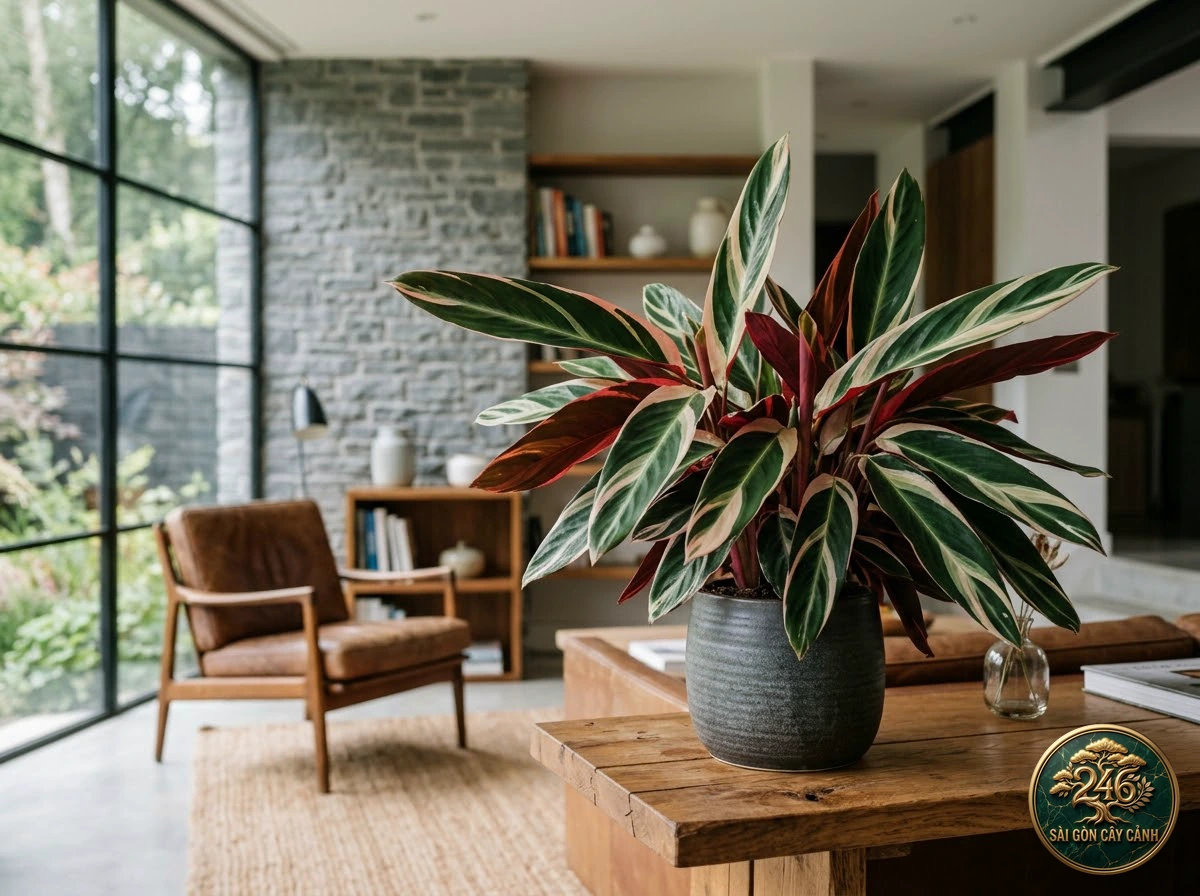
With an upright statuesque habit and bold emerald-and-carmine chromatic pairing, Stromanthe thalia serves as an exceptional architectural floor plant for living rooms, executive lobbies, tropical cafes, and sunlit lightwells.
Its unpretentious wild-type vigor and enduring resilience instill a sense of grounded strength, natural abundance, and authentic biophilic balance in modern architectural spaces.
Within minimalist interior landscaping, Stromanthe thalia introduces profound botanical authenticity and understated elegance. Its rich emerald canopy accented by flashes of wine-red abaxial tones creates visual tranquility, anchoring contemporary architectural spaces with enduring organic poise.
12. Master Principles for Sustainable Indoor Acclimatization
Three cardinal rules for sustaining peak health in Stromanthe thalia indoors:
- Hydration axiom: Diffused Light Axiom: Situate in generous 1,500 lux filtered daylight; shelter completely from raw midday solar exposure.
- Illumination axiom: Soft Hydration Standard: Irrigate with dechlorinated soft water once topsoil dries; prevent stagnant effluent in saucers.
- Maintenance axiom: Foliar Hygiene Protocol: Dust foliage monthly to maximize photosynthetic throughput and maintain glossy emerald radiance.
13. Frequently Asked Questions Regarding Thalia stromanthe (FAQs)
How does Stromanthe thalia differ from Stromanthe Triostar?
Stromanthe thalia is the wild-type green form with lime midribs, exhibiting significantly greater vigor, faster growth, and higher edge burn tolerance than Triostar.
What is the maximum height achievable indoors?
Given generous containers and optimal care, specimens reach 80 to 100 cm tall with an expansive spreading canopy.
Is Thalia stromanthe safe around dogs and cats?
Completely 100% safe. The ASPCA verifies that Stromanthe thalia is non-toxic to companion animals.
What is the recommended fertilization schedule?
Apply diluted liquid organic fertilizer every 4 weeks throughout active spring and summer growth flushes.
When should repotting occur?
Repot every 1 to 2 years in spring as expanding root systems colonize the container profile.
How does wild-type Stromanthe thalia differ fundamentally from its popular Triostar cultivar?
Ancestral Stromanthe thalia bears solid emerald green foliage devoid of chimeric white or pink variegation. Consequently, it exhibits substantially greater photosynthetic vigor and broader tolerance to ambient humidity and light fluctuations than delicate Triostar selections.