Living plant profile
Butterfly begonia
Begonia amphioxus
Comprehensive botanical dossier for Butterfly begonia (Begonia amphioxus). Identification, lighting calibration, porous substrate formulation, and cultivation guide by Saigon Cay Canh.
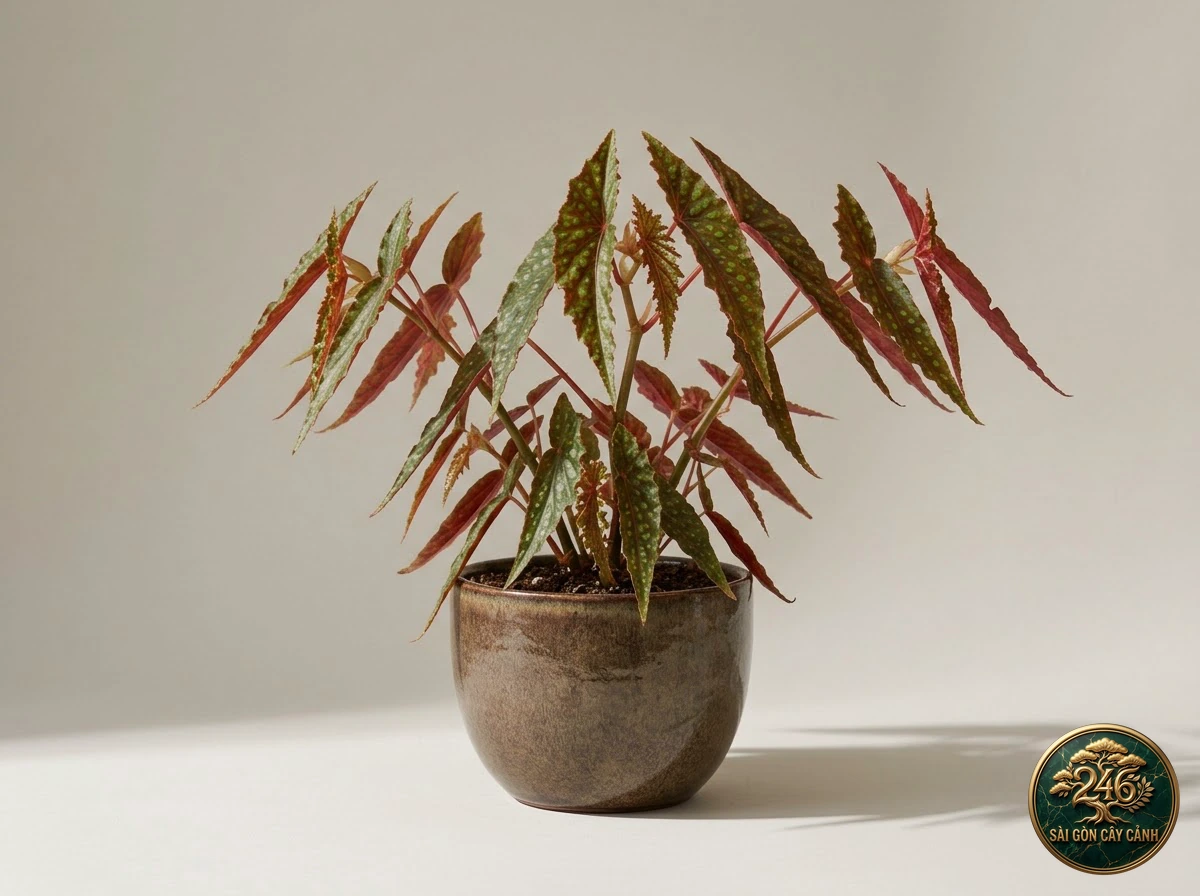
Butterfly begonia (Begonia amphioxus) is one of the most morphologically bizarre and mesmerizing botanical wonders on Earth, strictly endemic to secluded limestone karst formations in Sabah, Malaysian Borneo. The species is celebrated for extraordinary ‘bipolar’ crescent leaves tapered to sharp points at both ends like outspread butterfly wings, displaying bright lime-green tissue dotted with vivid crimson-ruby maculations and edged with rose-red margins.
1. Core Botanical Taxonomy & Cultural Specifications
| Scientific Name | Begonia amphioxus |
|---|---|
| Botanical Family | Begoniaceae (Begonia Family) |
| Native Distribution | Borneo Island (Sabah state, Malaysia) |
| Growth Demeanor | Slender branching succulent herbaceous perennial growing 20-35 cm tall |
| Lighting Threshold | Gentle filtered indirect light (1,000 – 1,600 lux) |
| Hydration Cadence | Hydrate gently when upper media dries, keeping balanced airy moisture |
| Substrate Formulation | 45% pumice, 25% mini bark, 15% Chilean sphagnum, 15% worm castings |
| Thermal Range | 21°C – 27°C (70°F – 81°F), foliage collapses beneath 16°C (61°F) |
| Relative Humidity | Optimal relative humidity 75% – 95% |
| Cultivation Difficulty | Advanced (Strictly requires enclosed terrarium or plant cabinet) |
| Pet Safety Profile | Toxic to companion animals (Contains soluble organic salts) |
Discovered in the Segama River valley of Sabah by British botanist Martin Sands and officially described in 1990, Begonia amphioxus ignited widespread botanical astonishment due to its unmatched foliar geometry. The specific epithet ‘amphioxus’ references morphological parallelism with lancelets (genus Amphioxus / Branchiostoma)—primitive chordates characterized by bodies sharply tapered at both extremities.
Within its native Sabah habitat, the species clings lithophytically to sheer limestone karst crevices inside shaded grottoes and river bluffs beneath equatorial canopies. Its delicate roots forage through calcium-rich rock fissures perpetually bathed in humid mists and gentle river canyon breezes.
According to Kew’s Plants of the World Online (POWO), Begonia amphioxus is classified within section Petermannia of family Begoniaceae. Its definitive diagnostic features comprise an asymmetrical crescent lamina tapered into opposing acute tips, medial petiole insertion, and vivid ruby maculations set against chartreuse tissue.
2. Morphological Identification & Foliar Architecture
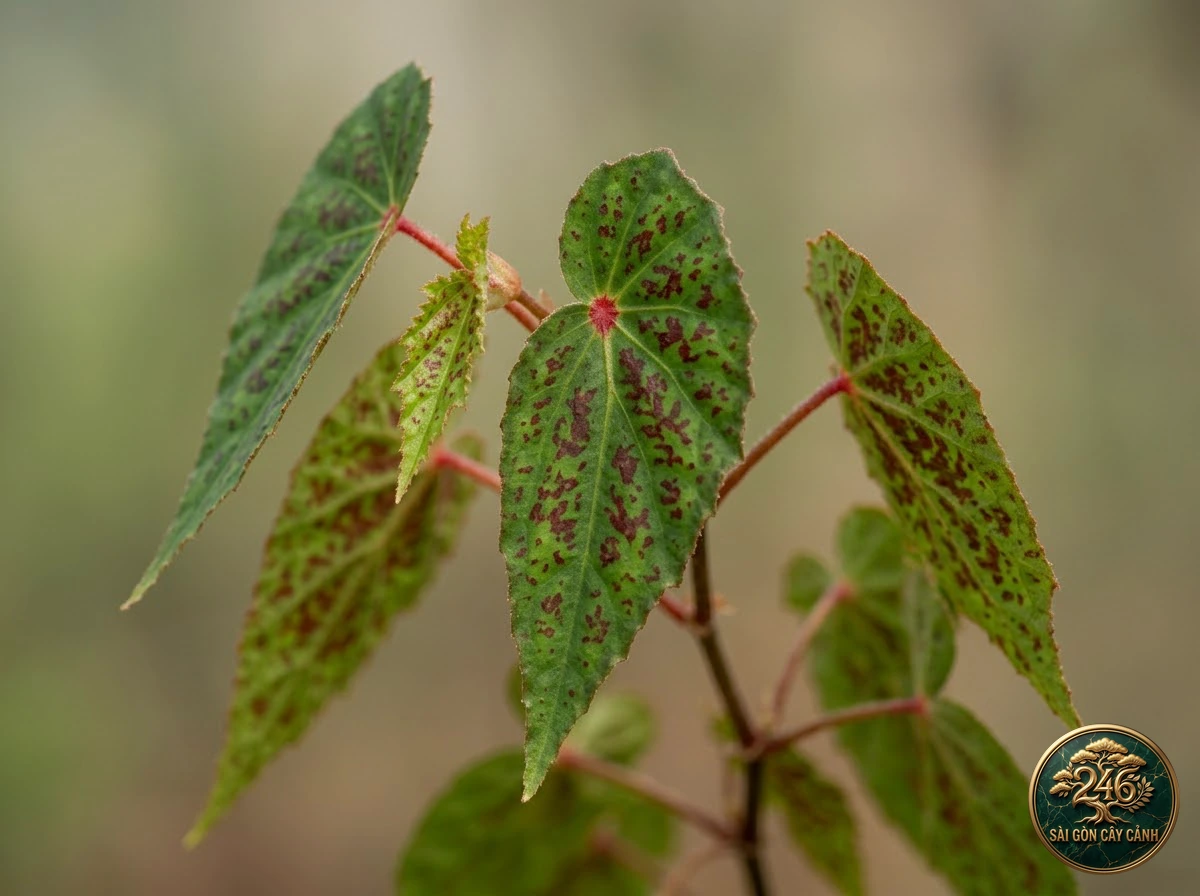
Laminas of Butterfly begonia exhibit a bipolar crescent form spanning 8 to 14 cm in length and 2 to 4 cm across the central belly. Both laminar extremities taper into pronounced, slender acute apexes curving gracefully like an archer’s bow or outspread lepidopteran wings, composed of delicate chartreuse tissue.
Decorating the lamina are dozens of vivid crimson-ruby maculations measuring 1 to 3 mm in diameter, distributed strategically along primary venation lines. Foliar margins feature delicate rose-pink serrations, contrasting exquisitely with translucent coral-red petioles that loft the airy canopy.
Foliar micromorphology of Begonia amphioxus illustrates the pinnacle of evolutionary adaptation to tropical karst cliff faces. The bipolar crescent lamina tapered to acute tips at both ends comprises delicate palisade mesophyll rich in chlorophyll a and b, while vivid ruby spots arise from concentrated vacuolar anthocyanins in upper epidermal cells, yielding stunning chromatic brilliance.
3. Photometric Calibration & Window Exposure Optimization
Begonia amphioxus requires gentle, consistent filtered irradiance correlating with a PPFD range of 40 to 70 µmol/m²/s. Under optimal diffuse photons, the translucent chartreuse ground color achieves peak clarity, and the ruby-red maculations manifest maximum chromatic intensity.
Even 15 minutes of direct solar exposure scorches the wafer-thin foliar tissues, incinerating the delicate bipolar tips. Conversely, prolonged light deficiency induces weak leggy internodes, stunted emerging laminas, and the total loss of signature ruby spots.
Photosynthetic light saturation for Butterfly begonia peaks across an optimal PPFD threshold of 40 to 70 µmol/m²/s. Gentle diffuse photons stimulate balanced growth across butterfly canopies without scorching delicate bipolar tips. Sustained irradiance exceeding 90 µmol/m²/s induces rapid marginal necrosis on thin terminal apexes.
4. Bipolar Crescent Lamina Architecture & Karst Lithophytic Ecology
The slender branching habit of Begonia amphioxus ascends erectly before arching gracefully, featuring delicate succulent nodes that present butterfly blades in balanced, alternating tiers. Placing slender bamboo stakes provides discreet structural support as mature specimens develop multi-tiered canopies.
The bipolar geometry and medial petiole junction represent an evolutionary stroke of genius for rainy limestone cliff habitats: incident rainwater instantly bifurcates, draining rapidly off the twin acute tips into the abyss and preventing foliar water retention that invites soft rot.
Ambient temperatures for Begonia amphioxus must remain steady between 21°C and 27°C (70°F – 81°F). The plant exhibits extreme sensitivity to cold drafts and thermal shocks; temperatures below 16°C (61°F) cause rapid foliar limpness and severe leaf drop.
Atmospheric humidity is indispensable: relative humidity must be sustained between 75% and 95%. In standard urban apartments, the species strictly requires enclosure within glass terrariums or dedicated climate-controlled plant cabinets.
Target vapor pressure deficit (VPD) is tightly calibrated between 0.5 and 0.7 kPa with ambient relative humidity held between 75% and 95%. Arid drafts from residential air conditioning rapidly dehydrate delicate butterfly wings, inducing severe tip curling within hours unless safely enclosed inside terrariums.
The slender branching succulent habit of Begonia amphioxus features flexible collenchyma bundles supporting butterfly blades in exquisitely balanced alternating tiers. Medial petiole insertion evenly distributes laminar mass while facilitating instantaneous rainwater drainage toward twin acute tips along native karst bluffs.
5. Porous Aggregate Substrate Engineering & Aeration Dynamics
The potting medium for Butterfly begonia demands exceptional granular porosity exceeding 45% air space enriched with calcium. An optimal formula incorporates 45% Indonesian pumice, 25% mini pine bark fines, 15% shredded Chilean sphagnum, and 15% worm castings amended with horticultural calcium grit.
Substrate pH must remain circumneutral between 6.5 and 7.2 to replicate Bornean limestone karst ecology. Never permit container bottoms to sit in stagnant effluent; gravitational drainage must proceed freely within moments of hydration.
Potting aggregate for Begonia amphioxus demands air-filled porosity exceeding 40% enriched with mineral calcium. Blending 45% pumice with 25% mini pine bark, 15% Chilean sphagnum, and crushed limestone creates a free-draining buffer that eliminates succulent root rot under hyper-humid regimes.
6. Organic Nutrition Schedules & Periodic Micronutrient Priming
Fertilization protocols must be restrained to trace levels. Apply organic liquid nutrients diluted to one-sixth strength monthly at the root line during active vegetative flushes, supplemented with chelated calcium to reinforce slender petiole cell walls.
Completely avoid concentrated synthetic NPK fertilizers, as chemical salts incinerate delicate feeder roots and blacken the bipolar tips. Flush the root zone thoroughly every 6 weeks with pure distilled water.
Biological nutritional protocols require diluted vermicompost tea at one-sixth strength fortified with bio-available calcium applied monthly at an EC strictly beneath 0.5 mS/cm. This gentle feeding reinforces slender petiole cell walls without burning delicate lithophytic rootlets.
7. Clinical Diagnostic Matrix & Rapid Correction Protocols
| Clinical Symptom | Primary Etiology | Diagnostic Evaluation | Corrective Prescription |
|---|---|---|---|
| Bipolar leaf tips drying crisp and blackening | Atmospheric humidity collapsing below 65% or direct solar beam contact | Inspect enclosure hygrometer and verify light ray orientation | Elevate ultrasonic humidification to 80% and introduce a sheer light diffuser |
| Succulent branches softening and collapsing mid-stem | Bacterial or fungal stem rot from stagnant moisture and poor air movement | Inspect stem base for water-soaked discolored tissue lesions | Excise rotten sections, repot into coarser pumice aggregate, and run 24/7 convective fans |
| Loss of ruby spots, blades fading to dull pale green | Severely deficient illumination below 400 lux over prolonged intervals | Measure photonic irradiance at canopy level with a photometer | Install full-spectrum botanical LED fixtures delivering 1,200 lux for 10-12 hours daily |
| Accelerated lower leaf abscission along lower nodes | Thermal shock triggered by temperatures dipping beneath 16°C | Examine nocturnal temperature logs for unexpected chill plunges | Equip an automated thermostatic seedling heat mat maintaining 23°C warmth |
8. Cryptic Pest Prophylaxis & Foliar Surface Sanitation
Inside high-humidity terrariums, bacterial soft rot and Botrytis gray mold represent the foremost perils for thin blades. The golden preventative rule is maintaining continuous 24/7 micro-convective airflow so that water droplets never stand overnight upon foliar surfaces.
Cleanse the canopy periodically by scouting senescent basal leaves, excising them cleanly with micro-shears at the stem line; never tear petioles manually to avoid wounding succulent epidermal tissue.
Defending against Botrytis and bacterial rot relies primarily on continuous 24/7 micro-convective ventilation inside terrarium vitrines. Never permit standing water droplets to linger overnight on wafer-thin butterfly blades, and apply quarterly preventative misting with 10 ppm biological colloidal silver.
9. Asexual Propagation Methodology & Root Strike Protocols
The most reliable propagation technique for Begonia amphioxus involves taking stem cuttings bearing 2 to 3 nodes during spring or early rainy periods. Sever stems cleanly just beneath a succulent node using a sterile razor.
Insert cuttings into moist perlite-sphagnum within a closed 90% humidity enclosure at 24°C warmth; cuttings develop a healthy adventitious root system over a 25 to 35 day developmental interval before potting.
When propagating via nodal stem cuttings, select semi-firm shoots bearing 2-3 healthy nodes, severed with a sterile scalpel and set into moist perlite-sphagnum. Enclosed within a 90% humidity chamber at 24°C warmth over 25 to 35 days, cuttings establish 100% root strike success.
10. Companion Animal Toxicology Profile & ASPCA Safety Evaluation
Because it demands 80-90% relative humidity, Begonia amphioxus is almost universally cultivated within enclosed terrariums or specialized vitrines, automatically establishing an impenetrable physical barrier ensuring total safety for household companion animals.
11. Biophilic Curation & Contemporary Interior Design Styling
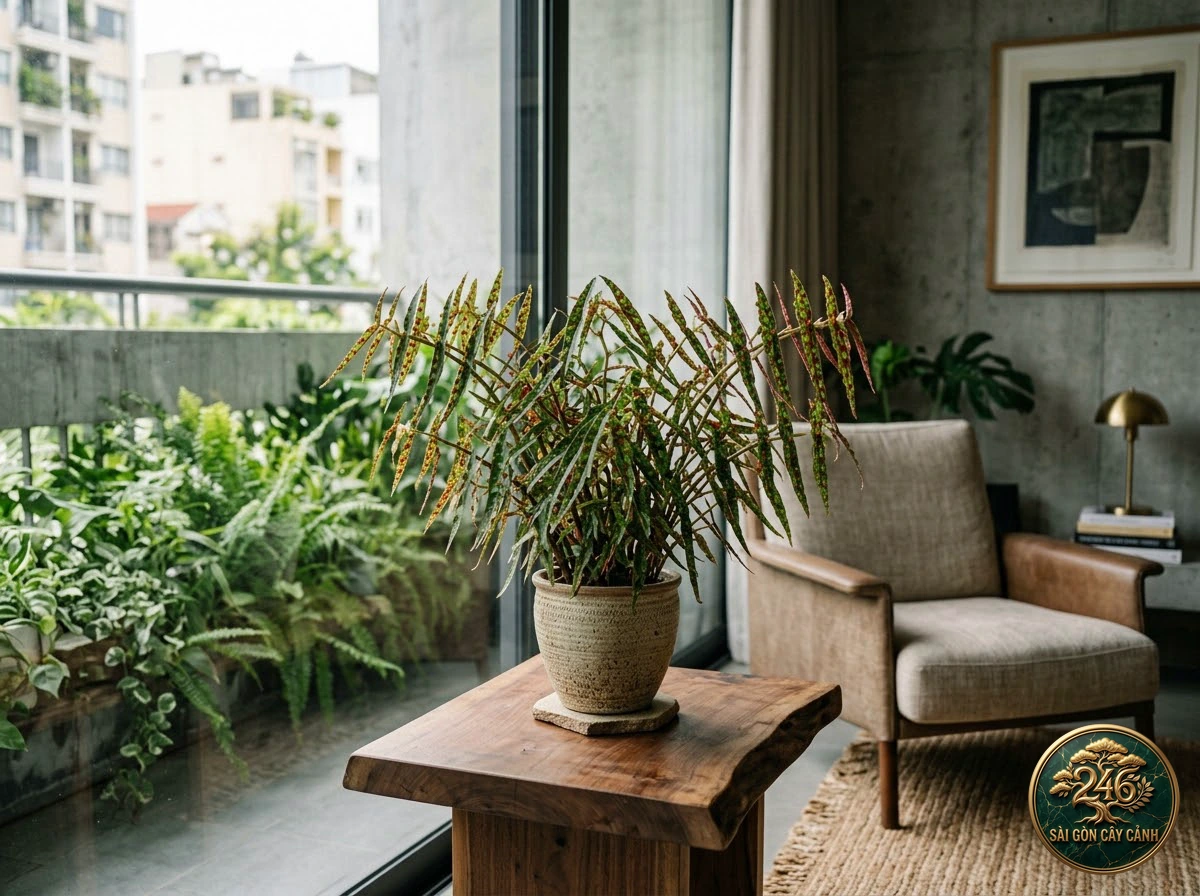
Begonia amphioxus represents an ultimate crown jewel within miniature tropical botanical collections. The surreal allure of its bipolar butterfly blades studded with ruby gems transforms enclosures into futuristic living art installations across bespoke terrariums and high-end Biophilic showcases.
The presence of this elusive Sabah begonia commands profound reverence for natural morphological evolution, conferring immense collector pride and refined botanical elegance to discerning interior spaces.
In futuristic tropical botanical art, Begonia amphioxus is celebrated as an extraordinary living architectural sculpture. The surreal poise of its bipolar butterfly blades studded with ruby gems brings captivating otherworldly mystique into bespoke glass terrarium landscapes.
12. Master Principles for Sustainable Indoor Acclimatization
Three foundational axioms for sustaining Begonia amphioxus specimens:
- Hydration axiom: Terrarium Enclosure Axiom: Strictly cultivate within closed terrariums sustaining 75% – 90% humidity alongside gentle convective airflow.
- Illumination axiom: Dry Foliage Axiom: Never mist water droplets directly onto fragile bipolar butterfly laminas.
- Maintenance axiom: Calcified Pumice Substrate Axiom: Employ porous pumice media amended with limestone grit, hydrating gently when the surface dries.
13. Frequently Asked Questions Regarding Butterfly begonia (FAQs)
Why do Begonia amphioxus leaves possess twin acute tips?
The unique bipolar crescent morphology evolved to split and drain heavy rainforest deluges rapidly off cliff faces, preventing standing water from decaying tissue.
Can Begonia amphioxus be cultivated in standard open indoor air?
Virtually impossible; its wafer-thin blades desiccate, crisp, and drop entirely within 48 to 72 hours under ambient humidity below 65%.
When does it bloom and what do blossoms look like?
Specimens flower in spring and summer, bearing delicate sprays of small white to blush-pink blossoms, though the butterfly foliage remains the true spectacle.
How can branching be encouraged for a denser specimen?
Pinching terminal meristems when canes reach 15-20 cm breaks apical dominance, prompting lower axillary buds to form a multi-branched bushy canopy.
What water quality is essential for Butterfly begonia?
Exclusively use distilled water, rainwater, or RO effluent; chlorinated tap water laden with heavy mineral salts clogs stomata and scorches delicate leaf tips.
What ecological purpose does the bipolar crescent leaf shape serve?
The bipolar crescent shape evolved specifically to bifurcate and drain heavy equatorial rainfall instantaneously off sheer Bornean limestone bluffs, preventing moisture from pooling on delicate tissues and causing fungal rot.