Living plant profile
Watermelon peperomia
Peperomia argyreia
Comprehensive botanical dossier for Watermelon peperomia (Peperomia argyreia). Identification, lighting calibration, porous substrate formulation, and cultivation guide by Saigon Cay Canh.
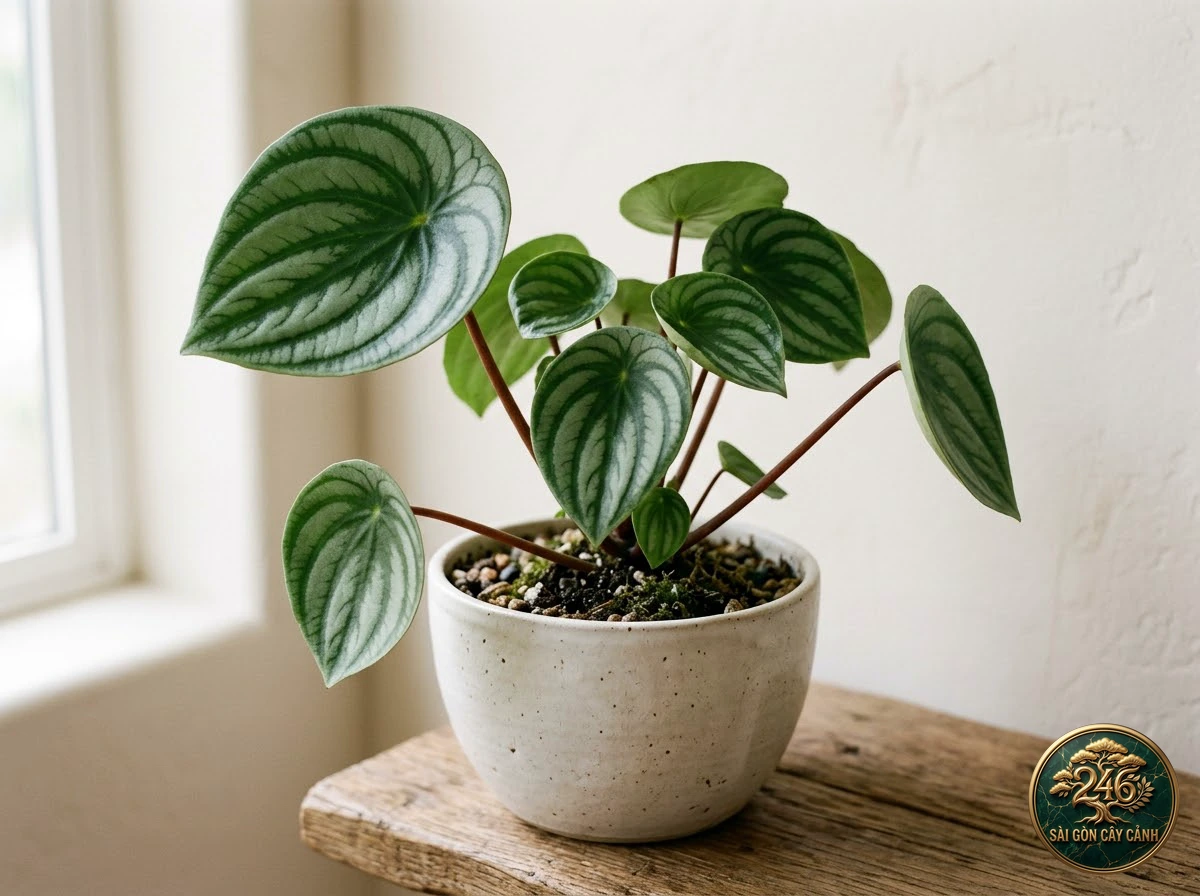
Watermelon peperomia (Peperomia argyreia) is one of the most universally admired and coveted foliage treasures on Earth, native to Neotropical rainforests across Brazil, Bolivia, and Ecuador. The species is celebrated for thick peltate shield-shaped leaves flawlessly mimicking the rind of a watermelon, showcasing shimmering metallic-silver radial stripes alternating with deep emerald bands, hoisted by vibrant coral-crimson petioles.
Sài Gòn Cây Cảnh Care Compass
1. Core Botanical Taxonomy & Cultural Specifications
| Scientific Name | Peperomia argyreia |
|---|---|
| Botanical Family | Piperaceae (Pepper Family) |
| Native Distribution | South America (Brazil, Bolivia, Ecuador) |
| Growth Demeanor | Compact clump-forming rosette perennial growing 20-30 cm tall |
| Lighting Threshold | Bright filtered indirect illumination (1,200 – 2,200 lux) |
| Hydration Cadence | Hydrate when 50% dry, drought-tolerant, intolerant of standing water |
| Substrate Formulation | 40% pumice, 25% mini bark, 20% coarse coir, 15% worm castings |
| Thermal Range | 18°C – 26°C (64°F – 79°F), damaged by cold below 12°C (54°F) |
| Relative Humidity | Optimal relative humidity 60% – 80% |
| Cultivation Difficulty | Easy to moderate (Prevent soggy media that decays peltate petioles) |
| Pet Safety Profile | Certified 100% non-toxic to domestic pets (ASPCA verified) |
Scientifically described in 1847 by Dutch botanist Friedrich Anton Wilhelm Miquel and subsequently championed by Belgian botanist Charles Jacques Edouard Morren, Peperomia argyreia has enraptured horticultural collectors since the nineteenth century. The specific epithet ‘argyreia’ stems from classical Greek ‘argyros’ (silver), paying homage to the radiant metallic-silver bands illuminating its foliage.
In its native Neotropical forest biotope, the species colonizes low understory niches beneath towering canopies where it receives dappled, gentle daylight. Its delicate fibrous root system spreads shallowly through spongy, highly organic forest litter characterized by brisk drainage.
According to Kew’s Plants of the World Online (POWO), Peperomia argyreia is an accepted species of family Piperaceae. Its crowning morphological distinction is peltate foliar attachment: the petiole inserts directly into the center of the abaxial lamina rather than attaching to the basal margin.
2. Morphological Identification & Foliar Architecture
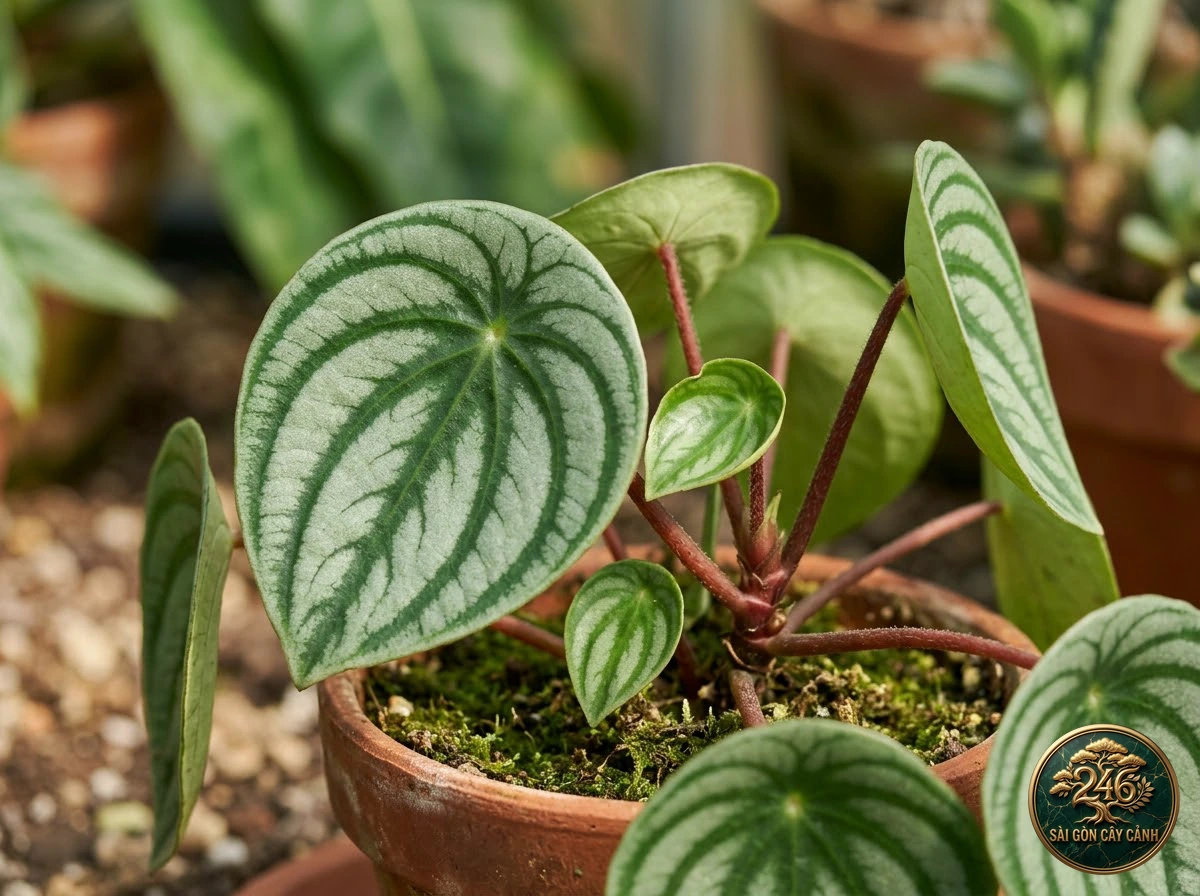
Laminas of Watermelon peperomia display a rounded peltate-ovate profile with short acute apexes, measuring 7 to 12 cm in length and 5 to 9 cm across. The surface is smooth and semi-succulent, distinguished by exquisite watermelon striping: broad 4-8 mm radiant metallic-silver bands alternate rhythmically with rich emerald green stripes radiating outward.
Stout succulent petioles spanning 8 to 15 cm exhibit striking coral-crimson to ruby coloration, inserting directly into the abaxial center to present blades in a rounded, tiered canopy resembling a cluster of miniature watermelons. Abaxial undersides display pale silvery-green tinted with blush.
Cytological analysis of Peperomia argyreia foliar tissue unlocks the secret behind its shimmering silver watermelon stripes. Beneath the upper epidermis along the silver bands lie prominent air-filled sub-epidermal intercellular cavities. Incoming photons hitting these microscopic air spaces undergo internal total reflection, producing a metallic silvery sheen that contrasts strikingly against chlorophyll-dense emerald bands tracking radial veins.
3. Photometric Calibration & Window Exposure Optimization
Peperomia argyreia prospers under bright filtered indirect irradiance, settling within a PPFD range of 55 to 110 µmol/m²/s. Generous diffuse photons stimulate the formation of sub-epidermal refractive intercellular pockets, maximizing the metallic luminescence of its silver bands.
Harsh direct midday sun scorches semi-succulent tissues, degrading silver patterns into dull brown necrotic lesions. Conversely, prolonged shade beneath 600 lux prompts weak, floppy petiole stretching, cupped blades, and the dilution of silver variegation into plain green.
Photobiological efficiency in Watermelon peperomia reaches equilibrium under photon flux densities (PPFD) between 60 and 120 µmol/m²/s. Bright diffuse light devoid of direct scorching rays is essential to sustain vivid contrast between metallic silver arcs and dark green bands. Severe light deprivation below 40 µmol/m²/s shrinks reflective sub-epidermal cavities, muting the silver sheen into uniform dull green.
4. Peltate Lamina Attachment & Reflective Silver Radial Venation
The compact rosette architecture of Peperomia argyreia features a condensed basal stem from which coral petioles radiate at varied angles, forming an umbrella-like dome 20-30 cm tall. The peltate petiole junction affords remarkable biomechanical flexibility, enabling blades to orient smoothly toward indirect light vectors.
Optical histology reveals that the silver stripes contain no white pigment granules; instead, they are engineered by microscopic sub-epidermal air gaps separating the clear upper epidermis from green mesophyll cells. Total internal light reflection across this air-cell boundary generates the brilliant metallic silver sheen.
Optimal indoor temperatures for Peperomia argyreia range between 18°C and 26°C (64°F – 79°F). It flourishes within climate-controlled interiors, exhibiting zero frost tolerance and suffering petiole rot if temperatures drop below 12°C (54°F).
Optimal relative humidity spans 60% to 80%. Although succulent laminas store water effectively, maintaining atmospheric moisture above 60% ensures flat, planar shield blades and prevents unsightly inward marginal curling.
Target vapor pressure deficit (VPD) for Peperomia argyreia ranges between 0.75 and 1.1 kPa. The plant flourishes vigorously at temperatures from 20°C to 27°C with relative humidity at 55% – 70%. Avoid cold water applications or positioning plants near drafty windows, as sudden chilling causes cellular rupture and mechanical petiole drooping.
The definitive architectural hallmark of Peperomia argyreia is its peltate lamina attachment: slender crimson petioles join the underside of the blade internally away from the margin rather than at the base. Blades are thick, broad-ovate to orbicular with pointed tips, presenting a glossy smooth texture reminiscent of fine enameled ceramic sculptures.
5. Porous Aggregate Substrate Engineering & Aeration Dynamics
The potting medium for Watermelon peperomia demands exceptional aeration porosity exceeding 35% to shield root balls from hypoxic rot. An elite blend combines 40% pumice, 25% mini pine bark, 20% coarse washed coco coir, and 15% screened vermicompost.
Core irrigation axiom: hydrate only after the upper 50% of the substrate dries out. Apply room-temperature pure water gently around the root periphery, strictly removing standing saucer runoff within 15 minutes.
The delicate root system necessitates an aggregate with structural longevity and ultra-rapid drainage. Formulating 35% pumice, 30% buffered coco coir chips, 25% mini pine bark, and 10% coarse perlite yields a well-aerated rhizosphere, holding pH between 6.2 and 6.7 while preventing petiole collapse caused by subterranean moisture accumulation.
6. Organic Nutrition Schedules & Periodic Micronutrient Priming
Nutritional management should remain moderate: apply liquid biological organic fertilizer diluted to quarter-strength every 3 to 4 weeks in spring and summer. Supplementing chelated calcium and magnesium reinforces petiole rigidity, supporting heavy peltate blades without drooping.
Suspend fertilization during winter dormancy. Avoid synthetic fertilizers with high salt indexes; chemical salt accumulation burns feeder root tips and blackens the sensitive peltate insertion node.
Feed regularly with dilute organic foliar or rhizosphere nutrition calibrated to an EC of 0.6 to 0.8 mS/cm every 4 weeks during spring and summer. Incorporating bio-available calcium and silica fortifies cell walls within crimson petioles, keeping watermelon blades upright and stiffly displayed.
7. Clinical Diagnostic Matrix & Rapid Correction Protocols
| Clinical Symptom | Primary Etiology | Diagnostic Evaluation | Corrective Prescription |
|---|---|---|---|
| Petioles liquefying, snapping at base or peltate junction | Excessive irrigation causing hypoxic rot at the petiole crown | Examination reveals mushy discolored stems and waterlogged container base | Excise afflicted foliage, halt watering, repot in airy pumice media, and bottom-water |
| Blades cupping inward into bowls, silver striping fading | Deficient illumination or excessively arid atmospheric humidity | Photometer measures light below 600 lux and hygrometer reads beneath 50% | Relocate to bright indirect 1,500 lux exposure and rest pot on a moist pebble humidity tray |
| Crisp brown foliar burn lesions, silver stripes bleached | Direct intense sunbeams blistering succulent water-storage cells | Lesions align precisely with direct sun ray angles | Draw sheer window curtains or move specimen into bright filtered indirect light |
| Emerging blades stunted with irregular wavy margins | Micro-nutritional deficiency of bio-available calcium and magnesium | Potting medium depleted of organic reserves over extended periods | Supplement diluted worm casting tea fortified with bio-chelated calcium every 3 weeks |
8. Cryptic Pest Prophylaxis & Foliar Surface Sanitation
Primary hazards encompass petiole rot from over-saturation (Pythium/Phytophthora) and mealybugs hiding at the peltate junction. The foremost defense is permitting media to dry partially between irrigations and ensuring buoyant air circulation.
Cleanse foliage periodically using a soft damp micro-cloth to remove dust from the silver surface, restoring brilliant metallic reflectivity and optimizing gas exchange through stomata.
Biological plant protection focuses on preventing Cercospora foliar leaf spot and bacterial blight sparked by overhead watering at night. Always irrigate via sub-irrigation capillary trays or directly onto the soil surface, ensuring lustrous watermelon blades stay clean, dry, and well-ventilated.
9. Asexual Propagation Methodology & Root Strike Protocols
Propagating Peperomia argyreia is an extraordinary botanical demonstration yielding prolific success via leaf-petiole cuttings or horizontally halved leaf wedges. Using a sterile scalpel, slice a mature blade in half horizontally and insert the cut edge into moist perlite-sphagnum.
Enclose within an 85% humidity propagation chamber at 24°C in diffuse light; over a 25 to 35 day developmental interval, dense clusters of miniature plantlets bearing perfect watermelon patterns emerge along cut vein endings.
The classic propagation method for Watermelon peperomia involves bisecting the leaf horizontally and inserting cut margins into moist perlite. Held under warm 24°C conditions inside a sealed humidity container, callous tissue develops along severed veins, giving rise to multiple vigorous plantlets over a 25 to 35 day developmental interval.
10. Companion Animal Safety Profile & ASPCA Non-Toxic Verification
This certified non-toxic profile allows cultivators to position specimen pots freely on low coffee tables, desks, or dining surfaces without anxiety regarding curious companion dogs or cats.
11. Biophilic Curation & Contemporary Interior Design Styling
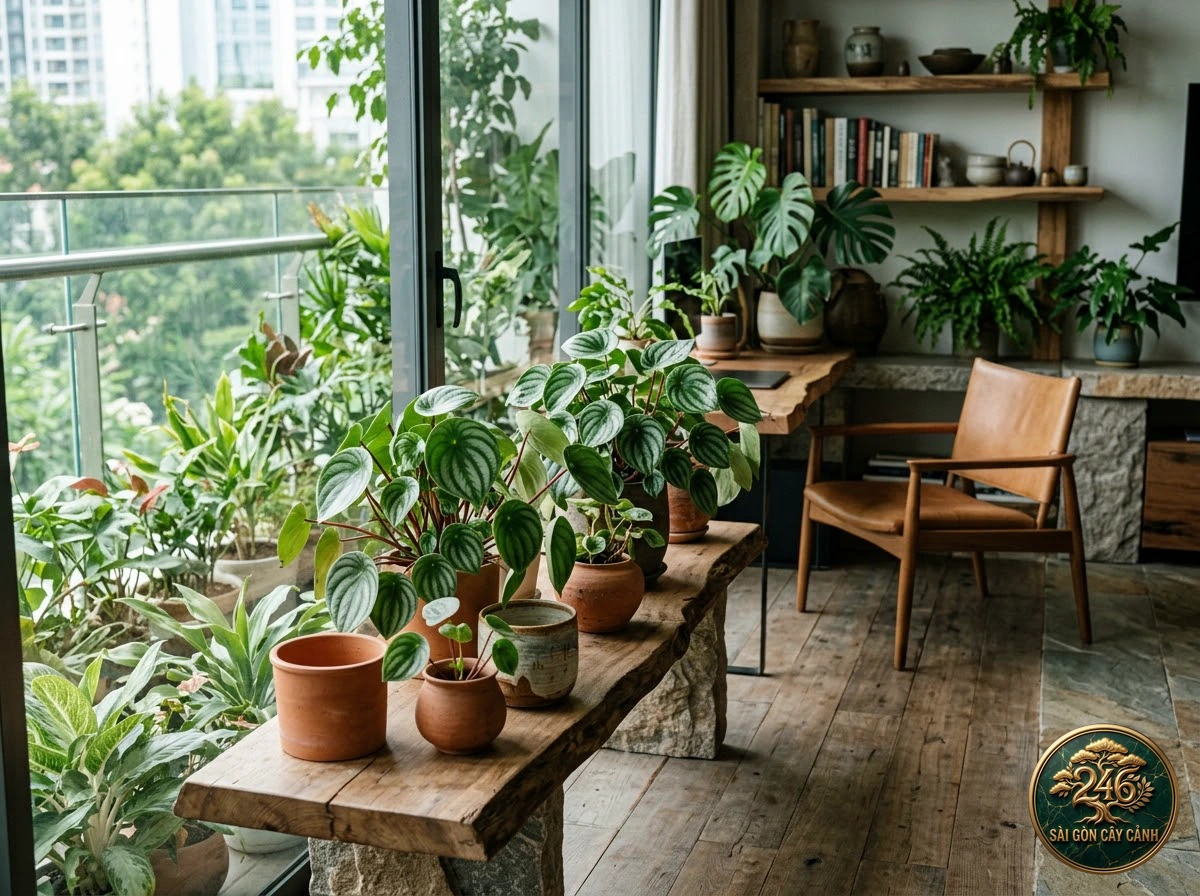
Peperomia argyreia stands as one of the most aesthetically celebrated subjects in Biophilic Modernist interior design. Its shimmering silver-and-emerald watermelon stripes paired with coral-red petioles establish an iconic chromatic harmony that enlivens any contemporary living environment.
The specimen serves as an extraordinary botanical showpiece and thoughtful living gift, imparting joyful visual delight and fostering intimate connection with the artistic wonders of tropical nature.
The exquisite geometric symmetry and playful watermelon striping of Peperomia argyreia elevate it into a living art piece within Scandinavian and Minimalist interior themes. Positioned on dining credenzas, kitchen islands, or executive desks, it delivers an invigorating burst of organic energy and timeless delight.
12. Master Principles for Sustainable Indoor Acclimatization
Three foundational axioms for cultivating immaculate Peperomia argyreia specimens:
- Hydration axiom: Substrate Dryness Axiom: Hydrate strictly after the upper 50% substrate dries; succulent peltate crowns cannot tolerate continuous sogginess.
- Illumination axiom: Generous Photonic Axiom: Situate in bright indirect daylight (1,500 – 2,000 lux) to sustain maximum metallic reflectivity across silver stripes.
- Maintenance axiom: Free Drainage Axiom: Utilize pots with unrestricted drainage apertures and pumice-rich media that drains freely without standing effluent.
Nursery Care Journal & Living Greenery Moments
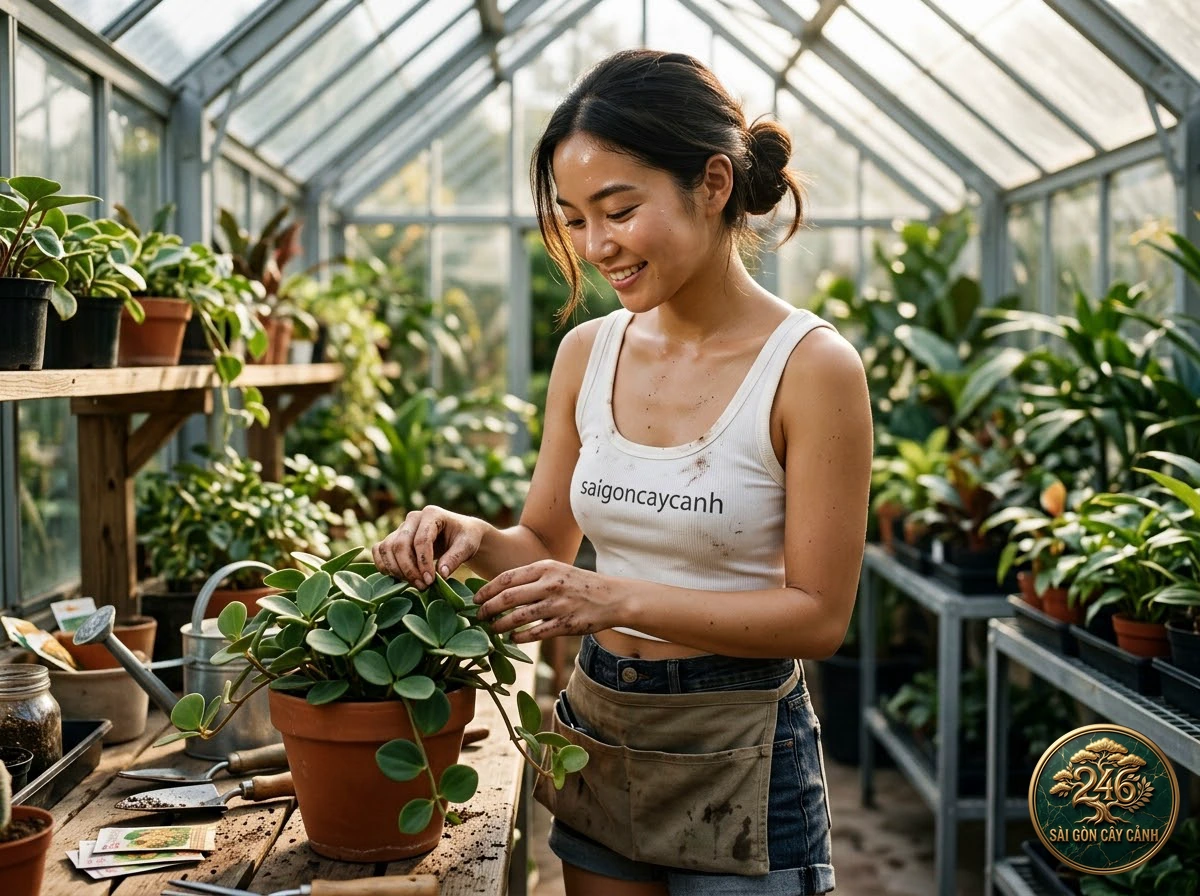
At Saigon Cay Canh greenhouse, each photograph captures genuine everyday care moments between plant lovers and living greenery, spreading a passion for nature and green-living inspiration.
13. Frequently Asked Questions Regarding Watermelon peperomia (FAQs)
Why do Peperomia argyreia leaves resemble a watermelon rind?
The watermelon motif is engineered by sub-epidermal micro-air pockets reflecting light as metallic silver bands alternating with green mesophyll to optimize light capture.
Why do petioles snap off at the slightest touch?
This is a classic symptom of overwatering causing basal petiole fungal decay; immediately cease irrigation and allow the root zone to dry out completely.
Can Watermelon peperomia be propagated from a halved leaf?
Absolutely; slicing a blade horizontally and inserting cut edges into moist sphagnum produces clusters of plantlets within 25-35 days.
When does it bloom and what do flowers look like?
Mature specimens project upright cream-colored mouse-tail spadix spikes in summer; florets are diminutive, petal-less, and unscented.
What pot material is most advantageous for this species?
Terracotta or unglazed ceramic planters with generous drainage holes are premier, as porous clay walls dissipate excess moisture and prevent root rot.
Why do my Watermelon peperomia leaves curl inward like spoons?
Cupped or curled foliage typically results from localized calcium deficiency during leaf development, or dry air causing leaf margins to transpire faster than central veins; supplying soluble calcium and boosting relative humidity above 60% restores flat, symmetrical growth in new leaves.