Living plant profile
Red edge peperomia
Peperomia clusiifolia
Comprehensive botanical dossier for Red edge peperomia (Peperomia clusiifolia). Identification, lighting calibration, porous substrate formulation, and cultivation guide by Saigon Cay Canh.
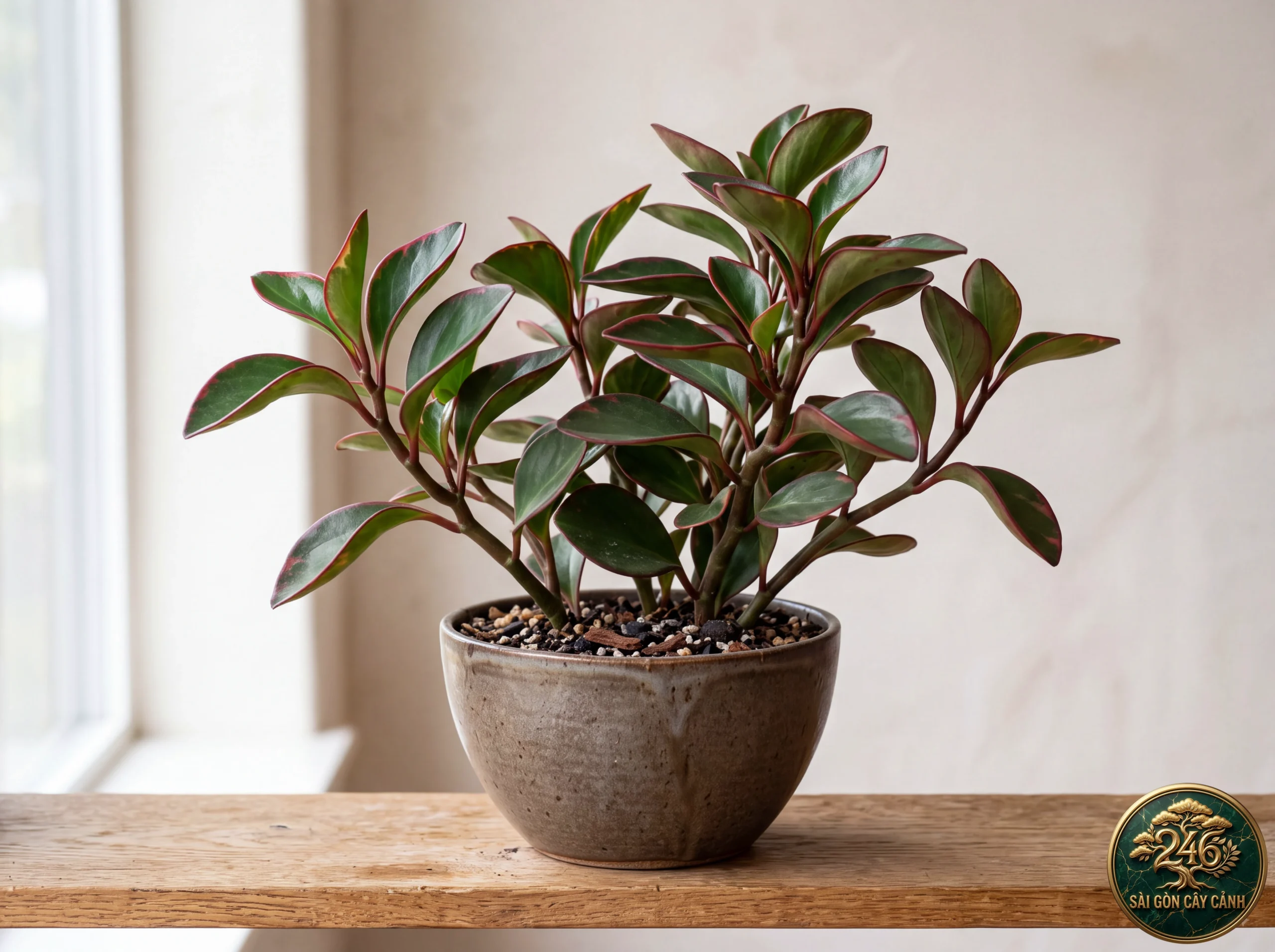
Red edge peperomia (Peperomia clusiifolia) is a distinguished semi-succulent tropical foliage species admired for thick spatulate leaves adorned with alluring ruby-red margins framing dark glossy emerald centers, infusing living interiors with striking chromatic contrast.
Sài Gòn Cây Cảnh Care Compass
1. Core Botanical Taxonomy & Cultural Specifications
| Scientific Name | Peperomia clusiifolia |
|---|---|
| Botanical Family | Piperaceae (Pepper Family) |
| Native Distribution | Caribbean (Jamaica, Cuba, Puerto Rico) and northern South America |
| Growth Demeanor | Erect bushy semi-succulent herb with dense basal branching |
| Lighting Threshold | Bright indirect daylight to gentle dappled shade (1,500 – 3,500 lux) |
| Hydration Cadence | Water when upper 50% substrate dries out; ensure thorough percolation |
| Substrate Formulation | Pumice, fine pine bark, coarse coco coir, biochar aggregate |
| Thermal Range | 18°C – 32°C (warm tropical envelope; vulnerable to frost below 12°C) |
| Relative Humidity | 50% – 70% (excellently adapted to indoor residential ranges) |
| Cultivation Difficulty | Easy (durable succulent foliage, water-wise, highly resilient) |
| Pet Safety Profile | 100% Non-Toxic (ASPCA certified safe for dogs and cats) |
Botanically, Peperomia clusiifolia originates from the lush tropical islands of the Caribbean and northern South America. It typically prospers within coastal understories and shaded limestone outcrops, where monsoon rains alternate with dry trade winds, driving the evolutionary development of thick succulent foliage to withstand cyclic moisture shifts.
The specific epithet ‘clusiifolia’ references the morphological resemblance of its thick, leathery leaves to the tropical genus Clusia. The plant develops stout, erect terete stems 20 to 30 cm high stained in rich wine-red or purplish-pink hues; short robust petioles support alternately arranged blades forming an architectural, well-proportioned bush.
Foliar blades are elongate-spatulate to obovate, measuring 7 to 15 cm long and 3 to 6 cm broad. The upper surface exhibits deep lustrous emerald contrasted against a sharp ruby-red marginal ribbon rich in natural anthocyanin pigments; variegated cultivars (such as ‘Jellie’ or ‘Tricolor’) introduce creamy-yellow and pastel pink variegation.
2. Morphological Identification & Foliar Architecture
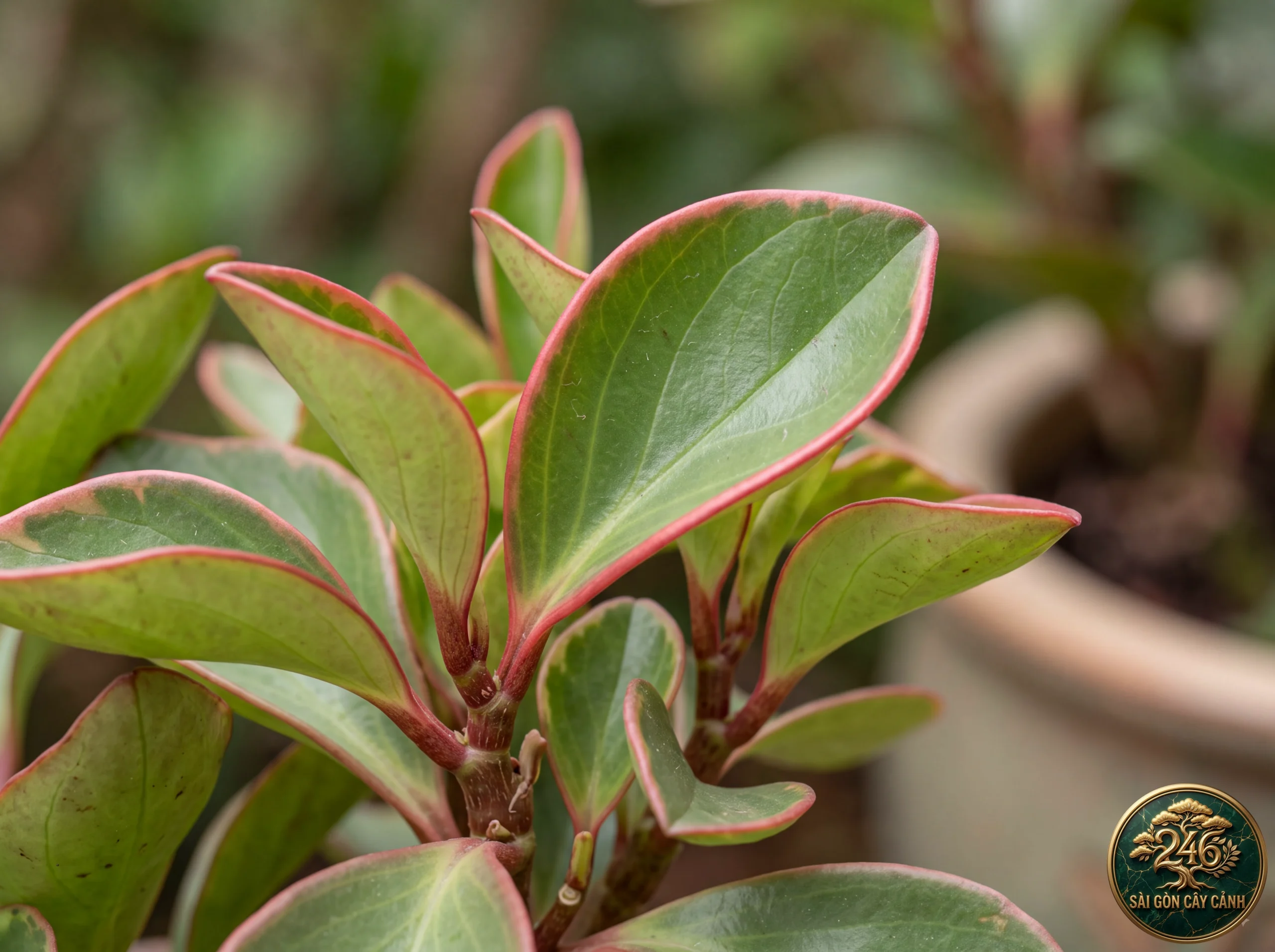
The primary diagnostic marker of Red edge peperomia is the continuous crimson-ruby border outlining the entire circumference of the leathery blade. Under generous diffuse daylight, this marginal banding intensifies into luminous magenta; the abaxial leaf surface is pale celadon flushed with pink and marked by a pronounced midrib.
Inflorescences appear as slender, rat-tail-like spikes of greenish-yellow measuring 8 to 15 cm long, emerging vertically from terminal shoot tips in spring and summer. Flowers are apetalous and wind- or beetle-pollinated in habitat, leaving minute sticky seeds adhering along the floral axis.
Histological examination of Peperomia clusiifolia foliage reveals an undulating epidermal layer armored with a vitreous, thick cuticular varnish. The defining anatomical marvel resides along the laminar perimeter: marginal epidermal and hypodermal vacuoles are densely packed with cyanidin anthocyanin pigments, forming an optical ruby-red ribbon that shields delicate marginal meristems from Caribbean ultraviolet insolation.
3. Photometric Calibration & Window Exposure Optimization
Biophotometrically, Peperomia clusiifolia thrives under diffuse illumination ranging from 1,500 to 3,500 lux (30 to 70 µmol/m²/s PPFD). Generous indirect daylight triggers active anthocyanin synthesis, sharpening the vivid crimson border; prolonged darkness below 800 lux causes the red pigmentation to fade into muddy green.
Nevertheless, shelter succulent leaves from direct midday summer sun exceeding 8,000 lux, as intense infrared radiation scorches epidermal cells and bleaches the foliar finish. Positioning containers near an east-facing window veiled with sheer curtains provides optimal balanced photon delivery.
Biophotometric measurements show that Red edge peperomia achieves optimal net photolysis across a PPFD flux between 30 and 70 µmol/m²/s. Robust indirect illumination drives continuous anthocyanin accumulation along the margin; when photon density falls below 15 µmol/m²/s for protracted periods, the plant down-regulates red pigment synthesis to prioritize green chlorophyll, causing the ruby edge to fade.
4. Spatulate Succulent Lamina Histology & Anthocyanin Red Marginal Demarcation
The cauline stems of Peperomia clusiifolia are stout and semi-lignified at the base at maturity, holding the heavy succulent canopy upright without artificial staking. Branches radiate outward in a wide vase-like architecture, radiating sturdy vitality.
The flexible structural strength of its stems withstands minor domestic mechanical brushing comfortably. When stems extend beyond 30 cm, gentle apical pinching prompts latent axillary buds to flush fresh shoots, sculpting a lush, compact dome.
The ideal thermal envelope spans 18°C to 32°C, aligning naturally with warm tropical climates and air-conditioned interiors. Shield the plant from abrupt temperature drops and cold air conditioning currents, as sustained chill beneath 12°C precipitates rapid foliar abscission.
Relative humidity is best maintained between 50% and 70%. Endowed with a water-storing foliar hypodermis and dense cuticular barrier, it tolerates arid indoor air far better than thin-leaved Calatheas; nonetheless, steady humidity ensures pristine foliar gloss.
The optimal vapor pressure deficit (VPD) spans 0.75 to 1.2 kPa with an ambient relative humidity of 50% to 70%. Endowed with a water-storing foliar hypodermis comprising up to 50% of total blade depth, the plant maintains stable cellular turgor even within dry air-conditioned spaces, eliminating physiological margin curling.
The cauline branching architecture of Peperomia clusiifolia forms a sturdy upright bush bolstered by light lignification within basal secondary xylem tissues. Short, canaliculate petioles act as rigid mechanical cantilevers holding the heavy spatulate leaves in an outward-flaring radial array, maximizing photon capture without artificial stakes.
5. Porous Aggregate Substrate Engineering & Aeration Dynamics
Potting substrates for Red edge peperomia demand elevated air-filled porosity and rapid gravitational drainage. A recommended recipe integrates 35% medium pumice, 25% pasteurized pine bark chips, 25% desalted coarse coir chunks, and 15% perlite, holding a stable pH of 6.0 to 6.8 for unimpeded root respiration.
Regarding moisture cadence, the ‘dry before drench’ principle is paramount. Probe the top 3-4 cm of potting media; only when it feels distinctly dry and the pot feels light, soak thoroughly until water percolates freely from drainage holes, immediately discarding saucer drainage.
Substrate engineering demands an air-filled porosity exceeding 30% at container moisture capacity. Blending 35% graded pumice with 25% pasteurized pine bark establishes a durable organic-mineral matrix that buffers gentle rootlet moisture while adsorbing residual salts, holding pH steady between 6.0 and 6.8.
6. Organic Nutrition Schedules & Periodic Micronutrient Priming
Organic fertilization schedules deploy diluted vermicompost extract paired with potassium-rich fermented banana tea once monthly during active spring and summer growth. Maintain electrical conductivity (EC) safely below 0.6 mS/cm to supply gentle nourishment without root scorch.
During cool autumn and winter dormancy, reduce fertilizer applications to zero. Always moisten the potting medium with clean water prior to administering liquid organic nutrients to ensure even root absorption.
Biological nutritional protocols deploy diluted vermicompost tea enriched with potassium-dense fermented banana water at an EC strictly below 0.6 mS/cm monthly. Bio-available potassium fortifies collenchyma cell walls and deepens the crisp ruby demarcation without scorching delicate succulent rootlets.
7. Clinical Diagnostic Matrix & Rapid Correction Protocols
| Clinical Symptom | Primary Etiology | Diagnostic Evaluation | Corrective Prescription |
|---|---|---|---|
| Ruby marginal border fading and turning dull olive-green | Plant placed in excessive indoor shade deficient in photon energy | Measure ambient light levels beneath 1,000 lux over extended weeks | Relocate specimen closer to luminous indirect daylight near windows |
| Leaves turning flaccid, translucent, and dropping at slightest touch | Chronic over-irrigation causing anaerobic rootlet suffocation and rot | Probe bottom drainage zone to find waterlogged, compacted media | Withhold irrigation, unpot to excise necrotic roots, repot in porous pumice |
| Foliage displaying bleached yellow-tan circular scorch lesions | Direct midday solar radiation burning unshielded succulent cuticle | Correlate scorch patches with intense direct solar ray angles | Draw sheer curtains or move the container inward into filtered daylight |
| Delicate fine webbing and stippling on abaxial leaf surfaces | Spider mite proliferation encouraged by hot, arid indoor atmospheres | Examine abaxial surfaces with a 10x hand lens for moving mites | Wipe leaves with damp cloth and apply biological potassium soap spray |
8. Cryptic Pest Prophylaxis & Foliar Surface Sanitation
Pest management centers on monthly foliar wiping to remove urban dust deposits and deter cryptic mealybugs. Gently wiping adaxial and abaxial surfaces with a soft damp cloth keeps stomata breathing efficiently and permits early pest detection.
Stem rot caused by Rhizoctonia or Fusarium pathogens can erupt if the potting mix degrades into dense mud. Treat promptly by unpotting, excising necrotic tissue, dusting wounds with sterile activated charcoal powder, and repotting into fresh macroporous pumice media.
Mitigate Rhizoctonia stem rot by employing sub-irrigation protocols and monthly foliar wiping with damp cloths. Never drench dense leaf axils overhead at dusk, and apply quarterly preventative misting with 0.5% botanical insecticidal soap to deter scale and spider mites safely.
9. Asexual Propagation Methodology & Root Strike Protocols
Asexual multiplication of Peperomia clusiifolia succeeds via shoot tip cuttings or single mature leaf cuttings. Select healthy semi-hardwood terminal cuttings 8-12 cm long bearing 2-3 vigorous leaves, make a clean 45-degree cut, and let air-dry in shade for 2-4 hours to callus.
Insert callused cuttings into moist perlite blended with fine pumice under a perforated humidity dome. Position in warm indirect daylight; over a 25 to 35 day interval, vigorous white roots establish along with emerging plantlet shoots, yielding robust independent plantlets.
During semi-hardwood shoot tip propagation, air-callusing severed wounds in shade for 2-4 hours prior to insertion into moist perlite-pumice media eliminates fungal rot vulnerabilities. Housing cuttings in warm 22°C – 26°C conditions over a 25 to 35 day interval guarantees a 100% strike rate with dense white fibrous roots.
10. Companion Animal Safety Profile & ASPCA Non-Toxic Verification
Peperomia clusiifolia is certified by the ASPCA as completely non-toxic to dogs, cats, and household pets. Free from hazardous tissue irritants or harmful sap, it provides absolute peace of mind for pet guardians cultivating lush indoor greenery.
11. Biophilic Curation & Contemporary Interior Design Styling
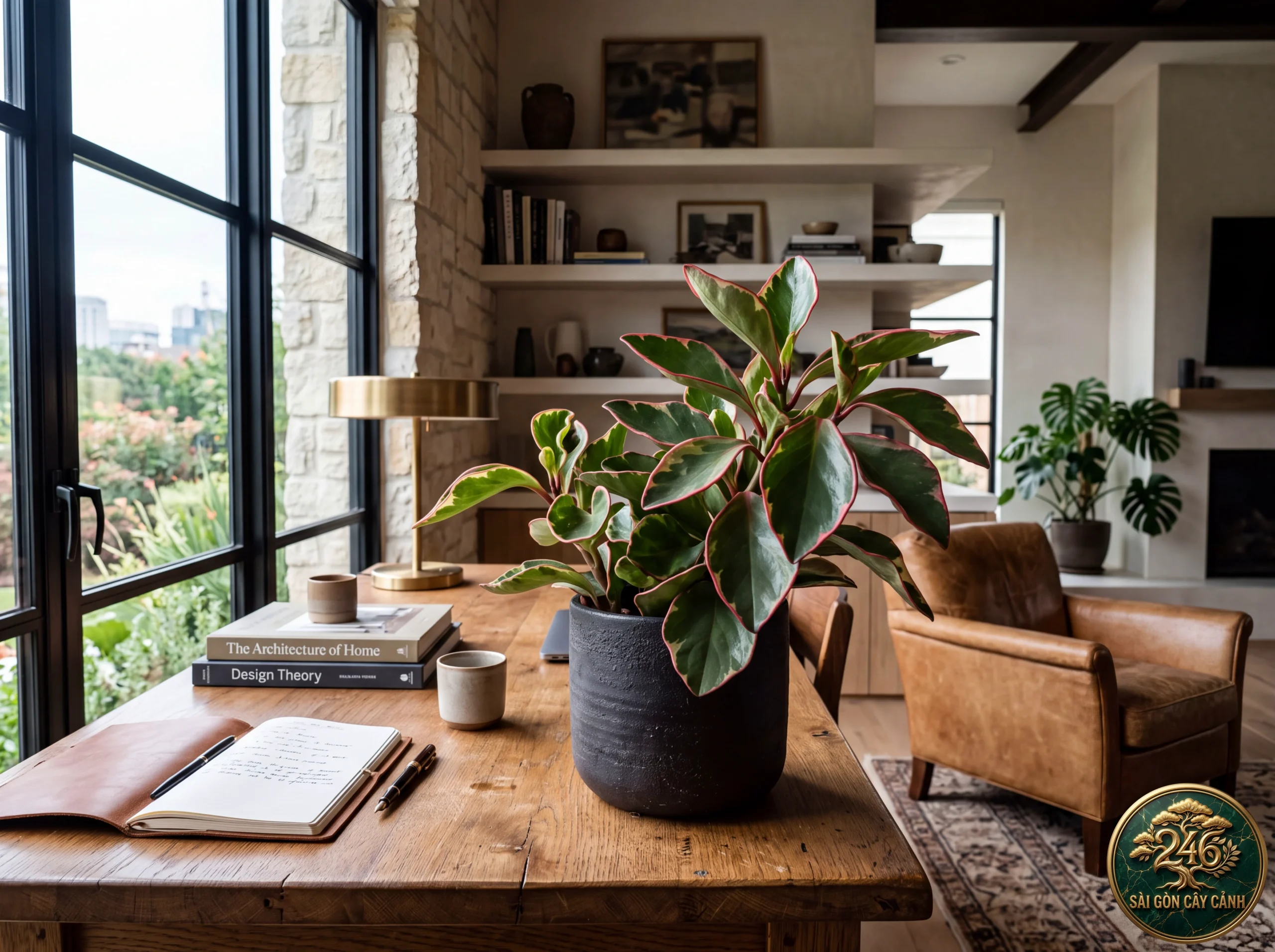
In contemporary Biophilic decor, Peperomia clusiifolia provides a sophisticated chromatic focal point through the interplay of lustrous emerald blades and sharp ruby margins. Its tidy upright architecture sits gracefully upon credenzas, modern kitchen islands, and office workstations.
The plant infuses urban interiors with warmth, vibrancy, and resilient botanical energy. The celebratory symbolism of ruby-red margins combined with the enduring nature of ‘longevity’ plants makes it a deeply cherished gift for housewarmings and executive milestones.
From a Biophilic architectural perspective, the vivid contrast of dark emerald blades bordered by ruby-magenta margins introduces opulent warmth, elegance, and dynamic energy. Displayed upon executive desks or contemporary kitchen islands, it enlivens interior spaces, inspiring creative mindfulness throughout the day.
12. Master Principles for Sustainable Indoor Acclimatization
To maintain brilliant ruby margins and lustrous succulent foliage on Peperomia clusiifolia indoors, adhere to these three core principles:
- Hydration axiom: Hydration axiom: Irrigate only when upper 50% substrate is dry, ensuring complete drainage without stagnant saucer pooling.
- Illumination axiom: Illumination axiom: Provide generous indirect daylight of 1,500-3,500 lux to stimulate vivid ruby anthocyanin margin pigmentation.
- Maintenance axiom: Substrate axiom: Formulate lightweight mineral-rich mixes high in pumice and perlite to safeguard delicate succulent roots.
Nursery Care Journal & Living Greenery Moments
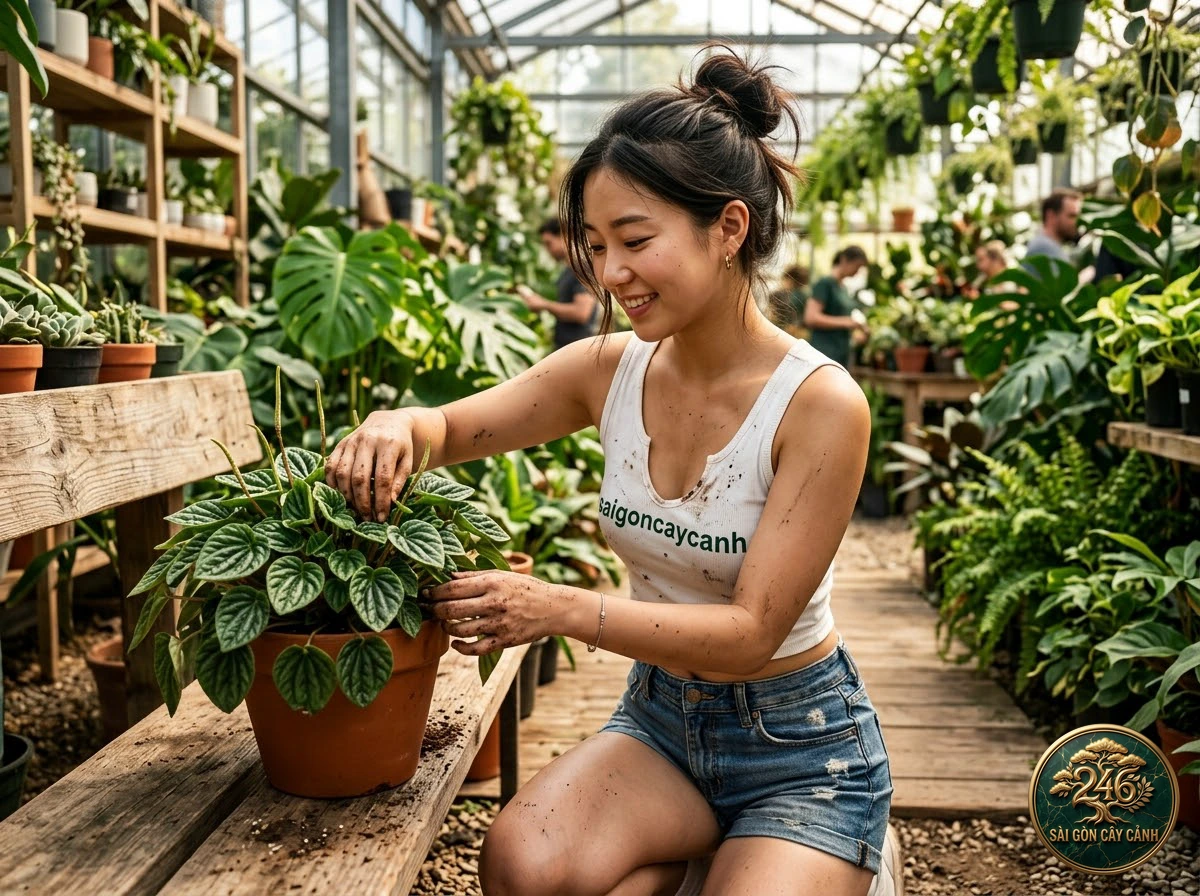
At Saigon Cay Canh greenhouse, each photograph captures genuine everyday care moments between plant lovers and living greenery, spreading a passion for nature and green-living inspiration.
13. Frequently Asked Questions Regarding Red edge peperomia (FAQs)
How can one preserve the intense ruby border of Peperomia clusiifolia?
Providing ample bright indirect daylight daily (at least 4-6 hours) is key to stimulating continuous foliar anthocyanin synthesis along the margins.
Can this plant thrive inside continuous air-conditioned rooms?
It adapts splendidly to air-conditioned spaces between 20°C and 26°C, provided it is sheltered from direct convective air blasts.
How often should foliar dust be cleaned from the leaves?
Gently wiping adaxial blades with a damp microfiber cloth once monthly keeps the cuticle gleaming and stomata respirating freely.
Why are juvenile leaves paler in coloration than mature foliage?
Emerging leaves typically unfurl in tender chartreuse with soft pink edges; as they mature in good light, they thicken into deep green with dark ruby borders.
Can stem cuttings be rooted directly in water?
Yes, cuttings strike roots in clean water; however, rooting directly into moist perlite produces sturdier root systems adapted for soil transplanting.
Why do Red edge peperomia leaves lose their red margin and turn entirely green?
Fading of the ruby margin indicates chronic light starvation beneath 1,000 lux; the plant down-regulates protective anthocyanins to maximize green chlorophyll synthesis for energy assimilation; moving the pot to bright indirect daylight promptly restores vivid ruby margins.