
Living plant profile
Black-eyed Susan vine
Thunbergia alata
Comprehensive botanical dossier for Black-eyed Susan vine (Thunbergia alata). Identification, lighting calibration, porous substrate formulation, and cultivation guide by Saigon Cay Canh.
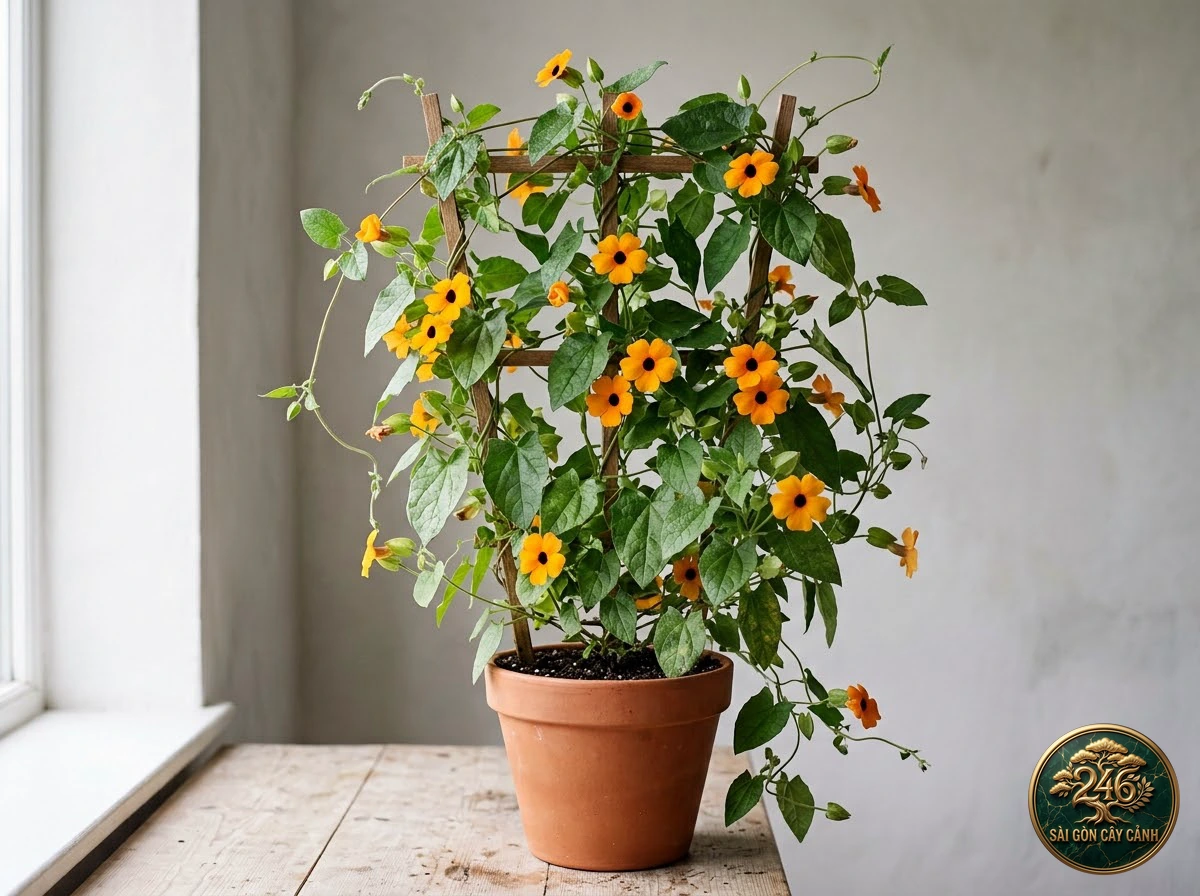
Black-eyed Susan vine (Thunbergia alata) is an exuberant, charming tropical herbaceous twining vine in the acanthus family Acanthaceae, native to warm savannas of East Africa. Universally cherished for bright salverform blossoms in fiery apricot-orange contrasted against an enigmatic deep chocolate-purple central eye, carried upon supple stems that cascade gracefully over balconies and trellises.
Sài Gòn Cây Cảnh Care Compass
1. Core Botanical Taxonomy & Cultural Specifications
| Scientific Name | Thunbergia alata |
|---|---|
| Botanical Family | Acanthaceae (Acanthus Family) |
| Native Distribution | East Africa (Kenya, Tanzania, Mozambique) |
| Growth Demeanor | Supple herbaceous twining climber, trellis vine or hanging basket |
| Lighting Threshold | Full sun to bright diffuse light; thrives with 4-6 hours direct sun |
| Hydration Cadence | Regular moderate hydration; well-drained, avoid waterlogging |
| Substrate Formulation | Sandy organic loam, rich leaf mold, perlite, coco coir |
| Thermal Range | 20°C – 35°C (tropical heat lover; cold tender beneath 10°C) |
| Relative Humidity | 55% – 75% (accommodates standard urban balcony humidity) |
| Cultivation Difficulty | Very easy; vigorous growth rate and continuous floral flushes |
| Pet Safety Profile | Certified 100% pet safe (non-toxic to companion animals) |
Botanically, Thunbergia alata represents a fast-growing herbaceous twining climber capable of extending stems 2 to 4 meters within a single warm growing season. Stems are slender, supple, faintly quadrangular, and softly pubescent; young shoots twine counter-clockwise autonomously around supports, trellises, or neighboring branches.
Leaves are positioned opposite-decussate, presenting cordate to arrow-shaped (sagittate) blades 4-8 cm long and 3-6 cm wide with shallowly dentate or undulating margins. The defining taxonomic marker resides in its winged petiole (the epithet ‘alata’ translates to ‘winged’), bearing two narrow membranous ridges along its entire length.
The definitive aesthetic hallmark is its solitary axillary flowers nodding from slender pedicels. Each blossom is clasped by two prominent boat-shaped green bracteoles; the salverform corolla displays five rounded spreading petals spanning 3-4 cm across in warm apricot-orange, contrasting starkly with a velvety chocolate-purple to near-black tube throat mimicking a captivating eye.
2. Morphological Identification & Foliar Architecture
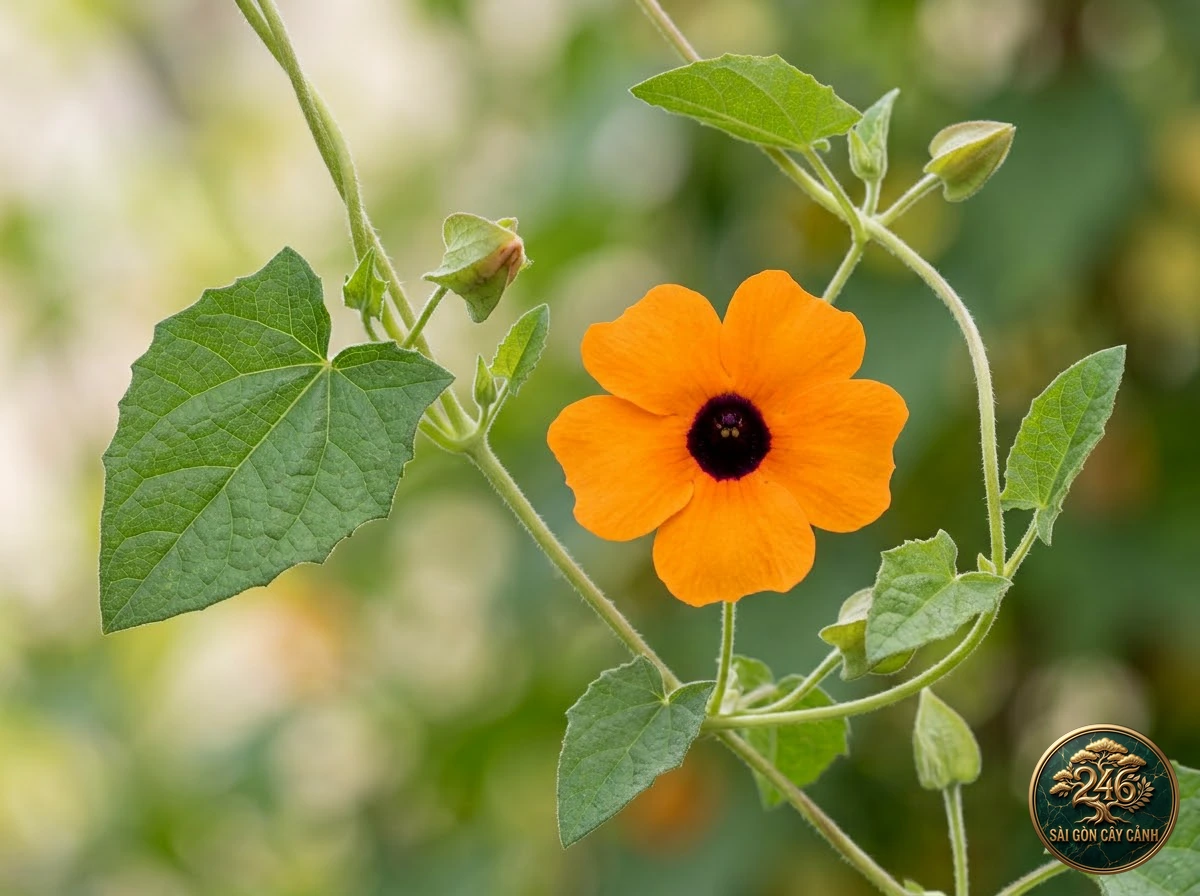
Diagnostic keys center on the pairing of winged petioles with the signature dark floral throat eye. Modern horticulture has expanded phenotypic cultivars: ranging from traditional fiery orange, sunny lemon-yellow, and soft ivory to sunset-vermilion and blush-pink, all retaining the signature black eye.
The fruit develops as a globose beaked capsule with a tapering rostrum resembling a miniature pigeon head; upon desiccation, the capsule splits open with elastic force, catapulting rough dark brown seeds away from the maternal vine to facilitate natural colonization.
Morphological analysis of Thunbergia alata reveals slender twining stems with terete or faintly angled cross-sections, cloaked in dense retrorse pubescence that enhances frictional grip across vertical trellises. Oppositely arranged leaves are triangular-sagittate with distinct winged petioles—the definitive morphological marker codified by the specific epithet ‘alata’ (winged) in international botanical taxonomy.
3. Photometric Calibration & Window Exposure Optimization
Photobiologically, Black-eyed Susan vine is a heliophilic tropical plant flourishing under full to partial sun. It attains peak photosynthetic performance and prolific flowering flushes when receiving 4 to 6 hours of direct morning sunlight daily or photon flux densities (PPFD) between 200 and 450 µmol/m²/s.
When cultivated in residential interiors, containers must be positioned along sun-drenched balconies, loggias, or eastern/southern window pergolas. Shaded environments beneath 1,200 lux stimulate rampant green cauline foliage at the complete expense of flower bud formation.
Biophotometric evaluation demonstrates that Black-eyed Susan vine is a sun-loving tropical climber requiring 400 to 850 µmol/m²/s PPFD to energize floral differentiation and carotenoid synthesis in the petals. Receiving 5 to 6 hours of unhindered morning sunlight on east- or south-facing balconies ensures prolific year-round blooming; prolonged shade below 200 µmol/m²/s prompts lush vegetative climbing but suppresses flower induction.
4. Twining Voluble Cauline Mechanics & High-Contrast Salverform Corolla
Growth dynamics in Thunbergia alata rely on gentle twining stems without wall-damaging adhesive rootlets or coarse tendrils. Cultivators should install mini lattice trellises, nylon netting, or U-shaped bamboo hoops in planters to allow vigorous apical vines to weave into living floral cascades.
When trailing strands become congested, periodic apical pinching triggers abundant lateral sub-branches from axillary nodes, tripling blossom density. Concurrently, removing spent developing seed capsules conserves vital energy, prolonging prolific bloom cycles.
Regarding water management, due to rapid vegetative flushes and heavy foliar transpiration under warm sun, the vine requires generous, systematic daily watering in early morning. Drench root zones thoroughly until runoff drains freely; during scorching summer heatwaves, a secondary late-afternoon watering may be needed.
Despite its moisture needs, root waterlogging is detrimental; compacted media chokes roots, triggering widespread foliar yellowing. Ideal vapor pressure deficit (VPD) ranges from 0.8 to 1.25 kPa; avoid wetting open petals directly to extend individual flower longevity.
The optimal thermal bracket spans 20°C to 32°C, mirroring its native provenance across East African savannah margins. It prospers under a VPD bracket of 0.85 to 1.35 kPa; during intense urban heatwaves, consistent morning watering replenishes the substantial transpirational moisture lost through the extensive foliar canopy.
The climbing mechanics of Thunbergia alata rely on continuous counter-clockwise circumnutation of active terminal shoots. Lacking specialized tendrils, the flexible cauline stems wrap tightly around vertical bamboo stakes or wire trellises, ascending 2 to 3 meters. The ultimate visual hallmark is its salverform corolla of vivid apricot-orange, strikingly offset by a deep purple-black, velvety eye in the floral throat.
5. Porous Aggregate Substrate Engineering & Aeration Dynamics
Substrate for Black-eyed Susan vine requires airy porosity, abundant organic nutrients, and rapid drainage. An ideal recipe incorporates 35% fertile sandy loam, 30% buffered coco coir peat, 20% carbonized rice husks or perlite, and 15% aged organic vermicompost.
Containers should offer a diameter of at least 20-25 cm with generous base drainage holes. Substrate pH calibrated between slightly acidic and neutral (6.2 to 6.8) promotes optimal micronutrient absorption, keeping floral pigmentation intense.
Container and hanging-basket potting media require swift drainage to forestall root rot during monsoon downpours while buffering hydration under intense sunshine. An optimal recipe consists of 40% friable loam, 25% rich aged vermicompost, 20% washed shredded coco coir, and 15% coarse perlite, anchoring a balanced pH between 6.0 and 6.8.
6. Organic Nutrition Schedules & Periodic Micronutrient Priming
Nutritional management during active bloom phases requires phosphorus- and potassium-rich organic feeds (fermented banana peel tea, seaweed extract, or bio-organic NPK 10-15-15) diluted to an EC of 0.8 to 1.2 mS/cm applied every 2 to 3 weeks.
Avoid excessive synthetic nitrogen feeds, which promote runaway vegetative foliage at the expense of blossom bud formation; supplementing potassium and chelated iron ensures saturated petal tones and velvet-black throat contrasts.
Rapid vegetative climbing paired with non-stop blossoming demands sustained nutritional replenishment. Applying organic potassium-rich fermented banana peel tea combined with diluted vermicompost bi-weekly fosters deep saturated petal coloration, thick flower substance, and prolonged floral longevity.
7. Clinical Diagnostic Matrix & Rapid Correction Protocols
| Clinical Symptom | Primary Etiology | Diagnostic Evaluation | Corrective Prescription |
|---|---|---|---|
| Vine produces luxuriant foliage but zero blossoms | Excessive synthetic nitrogen feeding combined with deficient direct sunlight | Audit fertilizer formulation and assess direct sun hours | Pinch tips back, move container into full sun, and transition to high-phosphorus feeds |
| Leaves yellowing and dropping heavily starting from base | Waterlogged aggregate from clogged drainage or overwatering during rainy spells | Inspect pot base drainage efficiency and assess soil odor | Elevate container on pot feet, withhold watering temporarily, and gently aerate topsoil |
| Fine dusty webbing and minute stippling on leaf undersides | Spider mite outbreak accelerated by sustained hot, dry, stagnant air | Examine abaxial foliar surfaces under magnification for crawling mites | Hose foliage thoroughly with water and apply organic cold-pressed neem emulsion at dusk |
| Floral buds turning yellow and dropping before opening | Sudden root desiccation shock or fertilizer salt burn on delicate feeder roots | Check root ball moisture levels and review recent fertilizer dosage | Flush pot thoroughly with clean water to leach salts and maintain steady hydration |
8. Cryptic Pest Prophylaxis & Foliar Surface Sanitation
Notable pests include two-spotted spider mites proliferating during hot arid spells and mealybugs hiding along winged petiole axils. Regularly wash foliage with gentle morning water sprays to disrupt mite webbing, applying organic cold-pressed neem emulsion preventatively.
Powdery mildew can surface during humid seasonal transitions with sluggish air movement. Thin out crowded inner foliage and apply 0.5% potassium bicarbonate or biological soap sprays to keep leaves pristine and healthy.
Integrated pest protection prioritizes vigilance against two-spotted spider mites (Tetranychidae) that proliferate under dry, stagnant microclimates. Forceful morning water sprays beneath foliage physically disrupt mite webbing, while preventative evening applications of 0.5% cold-pressed neem oil suppress thrips and aphids effectively.
9. Asexual Propagation Methodology & Root Strike Protocols
Propagating Black-eyed Susan vine is remarkably straightforward via seeds or apical stem cuttings. For seeds, soak in warm water (40°C) for 4-6 hours before sowing into moist seedling mix; germination proceeds reliably within 7 to 10 days under warm ambient conditions.
For vegetative propagation, take semi-mature apical cuttings 10-12 cm long bearing 2-3 nodes and insert into moist perlite or coarse sand. Maintained in shaded warmth at 22°C – 26°C, vigorous roots establish over a 25 to 35 day developmental interval.
Asexual propagation via semi-hardwood stem cuttings provides rapid, clonal plantlet production. Severing 10 to 12 cm shoot tips bearing 2 to 3 nodes, removing basal leaves, and inserting into moist perlite-coir nursery beds under filtered light over a 25 to 35 day interval generates robust root strikes ready for trellis transplanting.
10. Companion Animal Safety Profile & ASPCA Non-Toxic Verification
This non-toxic certification allows homeowners to drape cascading Black-eyed Susan hanging baskets freely across verandas, garden fences, and sunny corridors with complete confidence in pet safety.
11. Biophilic Curation & Contemporary Interior Design Styling
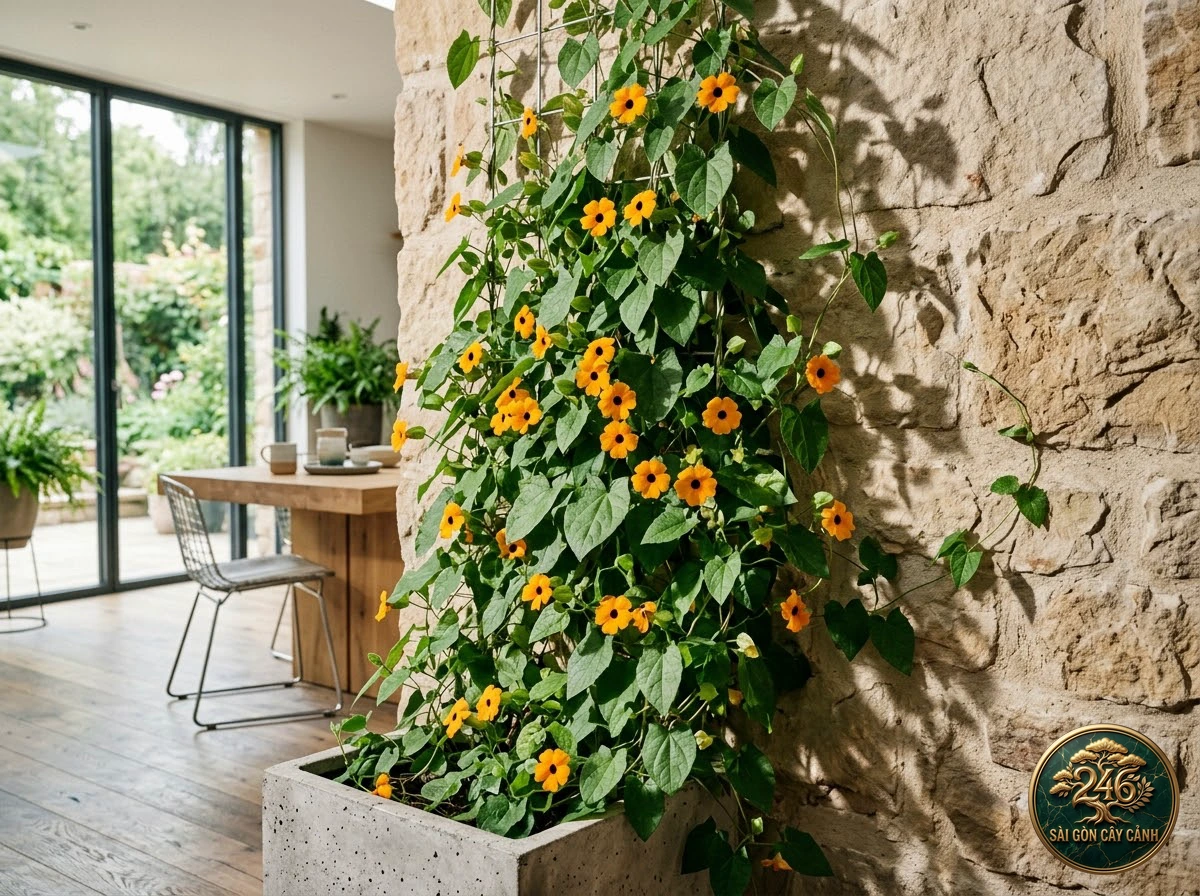
In urban biophilic exterior design, Black-eyed Susan vine symbolizes vibrant optimism, infectious joy, and boundless vitality. Its warm fiery blossoms exploding continuously against rich green foliage create an invigorating living tapestry, lifting moods across modern apartment dwellings.
A trellised display climbing along apartment railings or a cascading hanging basket on open porches forms a breathtaking organic welcome, greeting homeowners with radiant botanical warmth after demanding workdays.
In urban balcony landscaping and Biophilic vertical architecture, Thunbergia alata weaves a jubilant, living tapestry of blazing apricot blooms. The cheerful contrast between warm petals and deep dark eyes framed by emerald green foliage transforms compact city verandas into joyful sanctuaries teeming with visiting butterflies and beneficial pollinators.
12. Master Principles for Sustainable Indoor Acclimatization
Sustaining a profusion of radiant blossoms and vigorous cauline health in Black-eyed Susan vine demands three key cultural rules:
- Hydration axiom: Provide at least 4 to 6 hours of direct solar exposure daily to stimulate continuous flower bud flush.
- Illumination axiom: Irrigate thoroughly each morning to maintain consistent soil moisture; never let the root ball dry out completely.
- Maintenance axiom: Pinch terminal shoots and excise spent blossoms to prevent seed exhaustion, driving prolific new lateral bloom points.
13. Frequently Asked Questions Regarding Black-eyed Susan vine (FAQs)
What is the lifespan of Black-eyed Susan vine in containers?
In tropical climates, it behaves as a robust perennial surviving multiple years with routine rejuvenative pruning and feeding.
How can you encourage the vine to cover trellises quickly?
Pinch apical tips when vines reach 30-40 cm to trigger abundant branching, and feed with organic nutrition bi-weekly.
Can it be grown successfully in hanging baskets?
Splendidly; stems cascade naturally over basket rims, creating an eye-catching sphere of warm apricot flowers.
Why do flowers appear pale instead of vibrant orange?
Insufficient direct sunlight is the primary culprit; increasing sun exposure saturates floral pigmentation.
Does it cause allergic reactions or toxicity in pets?
Completely non-toxic; certified safe by ASPCA guidelines, presenting zero hazard to cats and dogs.
Why do flower buds on Black-eyed Susan vine drop prematurely before opening?
Premature bud abscission typically occurs when the root ball experiences transient drought shock under midday heat, or when light levels are insufficient; maintaining steady root moisture and providing bright direct morning sun halts bud drop.