Living plant profile
Sabah snake grass
Clinacanthus nutans
Comprehensive botanical dossier for Sabah snake grass (Clinacanthus nutans). Identification, lighting calibration, porous substrate formulation, and cultivation guide by Saigon Cay Canh.
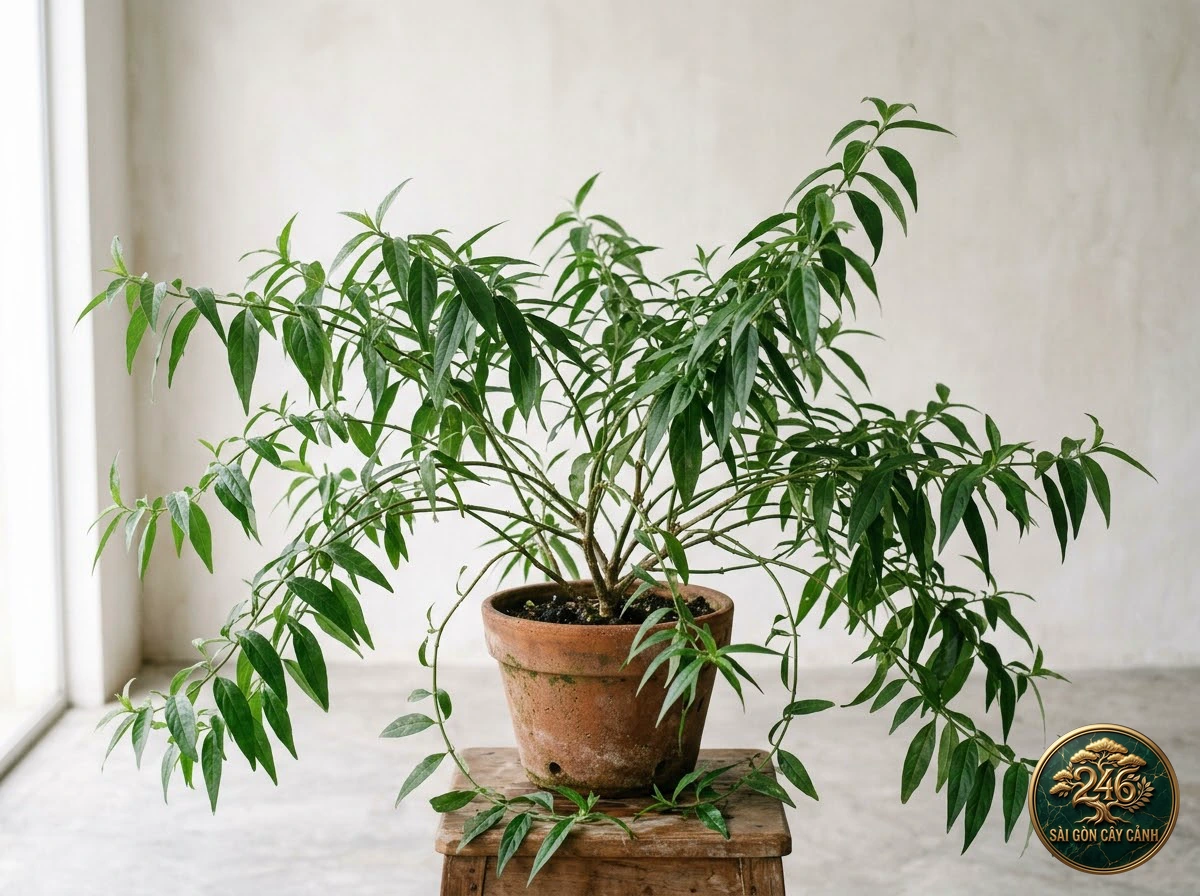
Sabah snake grass (Clinacanthus nutans) is a distinguished tropical subshrub in the acanthus family Acanthaceae, widely distributed across tropical Southeast Asia. Universally known as Sabah snake grass or Bim bip herb, the species is treasured in contemporary botanical landscaping and ethnobotanical collections for delicate emerald foliage, bright vermilion-orange flowers, and therapeutic herbal virtues.
1. Core Botanical Taxonomy & Cultural Specifications
| Scientific Name | Clinacanthus nutans |
|---|---|
| Botanical Family | Acanthaceae (Acanthus Family) |
| Native Distribution | Southeast Asia (Vietnam, Thailand, Malaysia, Indonesia) |
| Growth Demeanor | Sprawling perennial subshrub, supple branches, clumping habit |
| Lighting Threshold | Bright diffuse daylight to partial sun (1,500 – 3,500 lux) |
| Hydration Cadence | Moderate moisture; irrigate when surface soil dries, well-drained |
| Substrate Formulation | Loamy humus, composted rice hulls, coco coir, pumice |
| Thermal Range | 20°C – 34°C (flourishes in tropical warmth; tender to frost) |
| Relative Humidity | 60% – 80% (tropical lowland humidity) |
| Cultivation Difficulty | Low difficulty; exceptionally robust and vigorous grower |
| Pet Safety Profile | Certified 100% pet safe (non-toxic medicinal herb) |
Taxonomically, Clinacanthus nutans represents a perennial herbaceous subshrub standing 1 to 1.5 meters tall, occasionally clambering up to 2.5 meters when supported by surrounding vegetation. Stems are cylindrical, smooth, rich emerald-green, featuring distinctly swollen nodal joints that produce gracefully arching lateral branchlets.
Leaves are arranged opposite-decussate, bearing lanceolate to oblong-lanceolate blades measuring 7 to 12 cm in length and 2 to 4 cm in width, with acuminate tips and cuneate bases. Both adaxial and abaxial surfaces are glabrous and supple, bordered by entire to faintly undulating margins supported by 4 to 6 pairs of ascending lateral veins.
Inflorescences emerge as dense nodding cymes clustering at branchlet terminals. The bilabiate corolla displays vivid vermilion-orange or crimson tones spanning 3 to 4 cm in length, featuring a curved tube with a narrow erect 2-lobed upper lip and a broad spreading 3-lobed lower lip. Golden-anthered stamens protrude prominently, attracting sunbirds and pollinators.
2. Morphological Identification & Foliar Architecture
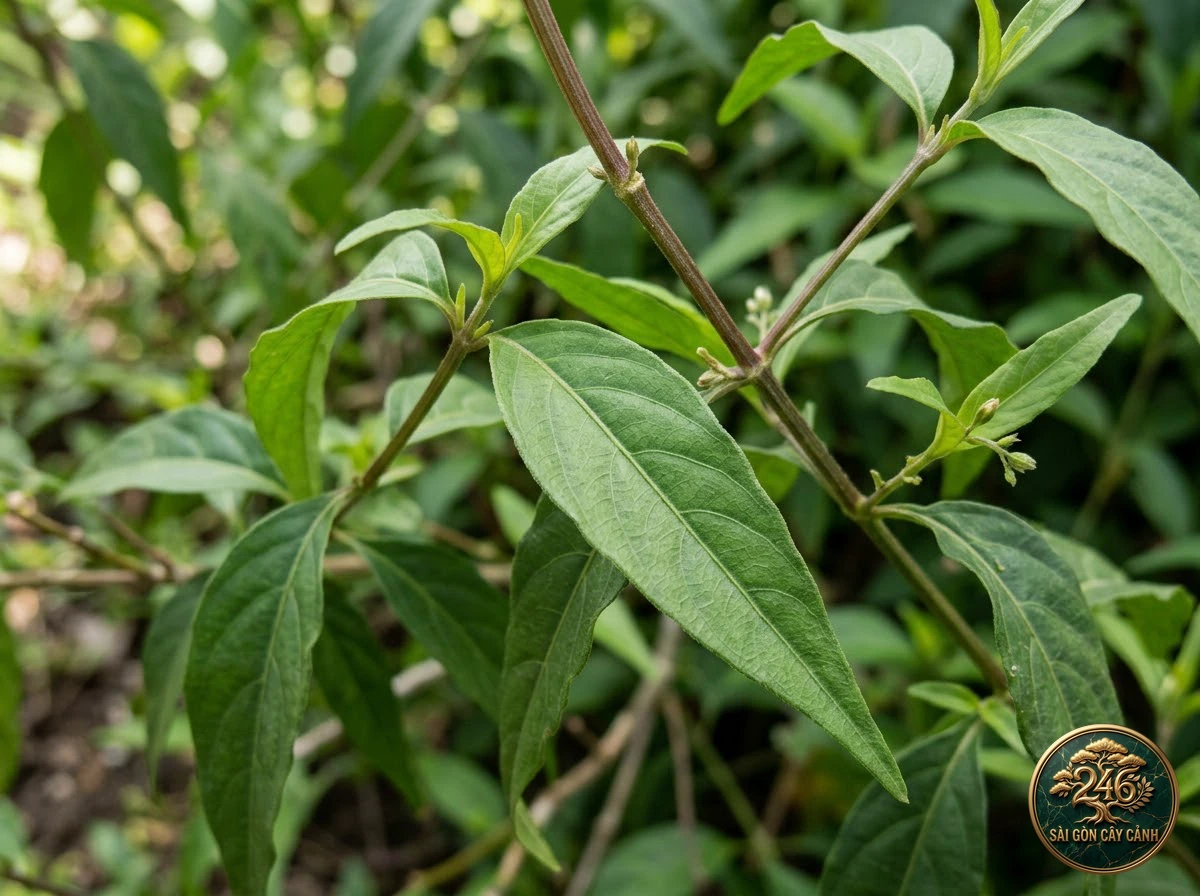
Diagnostic keys distinguishing Clinacanthus nutans include its nodding inflorescence habit (the specific epithet ‘nutans’ denotes nodding in Latin) and a mild grassy herbal fragrance upon crushing leaves. Devoid of stinging bristles or thorns, its fleshy succulent-tinged stems clearly differentiate it from related Acanthaceae genera such as Barleria or Ruellia.
Within Southeast Asian ethnobotany, the taxon is celebrated for hyper-accumulating bio-active polyphenols, flavonoids (notably schaftoside and vitexin), and sulfur-containing glycosides with proven antioxidant profiles, rendering it an invaluable living component within urban ecological medicinal gardens.
From cytological and organographic viewpoints, Clinacanthus nutans possesses terete, glabrous dark green cauline stems marked with pronounced articulative nodes spaced 4 to 10 cm apart. Narrowly lanceolate leaves are arranged in decussate opposite pairs with gently undulate margins. The subepidermal palisade parenchyma harbors concentrated polyphenols, flavonoids, and stable chlorophyll, providing outstanding antioxidant vitality and perpetual verdancy.
3. Photometric Calibration & Window Exposure Optimization
Photobiologically, Sabah snake grass attains photosynthetic equilibrium under photon flux densities (PPFD) from 80 to 180 µmol/m²/s. It thrives in bright diffuse daylight or gentle morning direct sun. In residential spaces positioned near sheer-curtained windows, foliage develops expansive emerald blades of exquisite texture.
Subjecting plants to harsh unshielded midday sun above 350 µmol/m²/s bleaches blades dull yellowish-bronze with crisp edges; conversely, prolonged deep shade beneath 500 lux induces weak leggy internodes and diminished leaf sizing.
Photosynthetic dynamics show that Sabah snake grass adapts effortlessly across moderate to high diffuse lighting regimes, registering peak net assimilation between 250 and 500 µmol/m²/s PPFD. It prospers in partial outdoor sun or luminous balcony containers; exposure to harsh midday irradiance exceeding 750 µmol/m²/s induces mild foliar chlorosis due to temporary photo-inhibition.
4. Cauline Articulate Nodal Habit & Apical Pinching Branching Mechanics
Cauline architecture in Clinacanthus nutans displays a scandent, clumping habit. When grown in solitary planters, it forms a rounded bushy mound with perimeter branches arching gracefully downward; paired with small bamboo stakes or mini trellises, supple stems climb neatly into living green screens.
Routine apical pinching represents the vital technique to sustain compact bushy density. When branches reach 30-40 cm in length, pinching the top 3-5 cm activates 2 to 4 dormant axillary buds beneath, effectively doubling canopy fullness within four weeks.
Regarding irrigation, Sabah snake grass appreciates steady, moderate moisture. Water thoroughly once the top 2 cm of soil dries to the touch; drench until water trickles from bottom holes and discard runoff from drainage saucers, preventing root suffocation.
Target vapor pressure deficit (VPD) spans 0.7 to 1.05 kPa, harmonizing effortlessly with urban microclimates in southern Vietnam. The specimen tolerates transient dry intervals thanks to succulent cauline tissues, yet wilts conspicuously when dry, signaling prompt watering.
The humid tropical provenance of Southeast Asia endows Sabah snake grass with thermal tolerance spanning 20°C to 36°C and a target VPD between 0.75 and 1.2 kPa. It thrives in relative humidity above 60%; during dry spells, thorough early-morning irrigation preserves turgor pressure within the fleshy nodes, keeping foliage crisp and succulent.
The branching subshrub habit of Clinacanthus nutans demonstrates prolific axillary bud activation whenever terminal shoots are pinched. Latent nodal buds erupt into arching scandent branches, creating a lush bushy canopy 1 to 2 meters in height. Terminal cymes bear striking tubular blossoms of radiant scarlet or orange-red that curve gracefully outward.
5. Porous Aggregate Substrate Engineering & Aeration Dynamics
Potting mix for Sabah snake grass demands porous aeration and rapid drainage to protect fibrous root systems. An optimal blend comprises 35% clean sandy loam, 30% desalted coco coir peat, 20% carbonized rice husks or perlite, and 15% aged organic vermicompost.
Substrate pH is best maintained at circumneutral 6.0 to 6.8. Pot bases must offer generous perforations cushioned by a 1 cm biochar drainage layer to facilitate root aeration while discouraging damping-off pathogens during humid rainy months.
Cultivation substrates for Clinacanthus nutans demand elevated porosity, rapid moisture throughput, and abundant humic fractions. A tested mix comprises 45% sandy loam, 25% composted manure or vermicompost, 20% carbonized rice husks, and 10% coarse coir chunks, sustaining an ideal rhizosphere pH between 6.2 and 6.8 for unimpeded root respiration.
6. Organic Nutrition Schedules & Periodic Micronutrient Priming
Nutritional management emphasizes natural organic feeds such as diluted vermicompost tea, fermented soybean extract, or balanced bio-organic NPK (8-8-8 ratio) calibrated to an EC of 0.6 to 0.9 mS/cm once monthly during active flushes.
Because foliage is prized for ethnobotanical applications, avoid synthetic chemical boosters or high-nitrate salts; regular organic inputs foster crisp, deeply pigmented leaves packed with wholesome botanical compounds.
Because foliage is routinely harvested for therapeutic herbal teas and culinary uses, nutritional management relies exclusively on certified organic inputs. Applying fermented soybean meal tea or diluted vermicompost monthly, coupled with top-dressing composted organic cake, enriches soil microbiome biodiversity and sustains wholesome foliar vigor.
7. Clinical Diagnostic Matrix & Rapid Correction Protocols
| Clinical Symptom | Primary Etiology | Diagnostic Evaluation | Corrective Prescription |
|---|---|---|---|
| Lower leaves yellowing and dropping along basal nodes | Subterranean moisture accumulation or chronic organic nutrient depletion | Inspect root ball drainage and evaluate potting soil compaction | Aerate topsoil, moderate watering, and top-dress with aged organic vermicompost |
| Stems stretching spindly with sparse internodes and pale leaves | Light deprivation from placement in deep interior shade beneath 500 lux | Measure ambient lux levels around canopy | Relocate to brighter window perimeter and pinch leggy terminals back |
| Foliar margins scorched dry and crispy brown | Sun scald from harsh unshielded midday sun or intense localized heat | Check sun exposure angle and leaf temperature | Move container into bright diffuse shade or beneath protective sheer screening |
| Tender young leaves curling with fine silvery feeding stipples | Thrips or leafhoppers rasping sap during warm arid weather | Examine abaxial surfaces of young shoots under magnification | Rinse foliage thoroughly and apply organic neem or garlic-chili emulsion twice 5 days apart |
8. Cryptic Pest Prophylaxis & Foliar Surface Sanitation
Pest management for Sabah snake grass focuses on deterring occasional mealybugs or thrips sheltering beneath young blades. The safest biological control involves weekly foliar rinsing with water or applying homemade garlic-chili-ginger sprays to repel pests without toxic residue.
Maintain plant sanitation by regularly excising senescent basal stems to stimulate continuous vegetative rejuvenation. Preserving airy canopy ventilation and clean topsoil prevents anthracnose and seasonal foliar leaf spots.
Sanitation and pest control rely strictly on manual and ecological techniques without synthetic agrochemicals. Routine manual scouting removes occasional foliage-feeding caterpillars, while preventative applications of organic fermented garlic-chili extract every two weeks repel aphids and thrips safely, preserving culinary harvest integrity.
9. Asexual Propagation Methodology & Root Strike Protocols
Propagating Clinacanthus nutans is exceptionally effortless, yielding near-100% strike rates via apical or nodal stem cuttings bearing 2-3 leaf nodes. Select healthy semi-mature stems, cut 10-15 cm segments just below a node, and trim basal leaves to curb transpirational loss.
Insert cuttings into clean water or moist perlite set in warm diffuse light. Over a 25 to 35 day developmental interval, profuse white adventitious roots emerge from submerged nodes while energetic fresh leafy shoots begin expanding.
Asexual multiplication via nodal stem cuttings achieves near-perfect 100% strike rates. Selecting vigorous semi-mature segments 10 to 15 cm in length bearing 2 to 3 nodes and inserting them at a 45-degree angle into moist shaded coco-perlite beds over a 25 to 35 day interval generates robust nodal root clusters and sprouting axillary shoots.
10. Companion Animal Safety Profile & ASPCA Non-Toxic Verification
This absolute pet safety empowers pet parents to cultivate Sabah snake grass freely across any living space, from sunny balconies and window ledges to open living rooms without restrictive enclosures.
11. Biophilic Curation & Contemporary Interior Design Styling
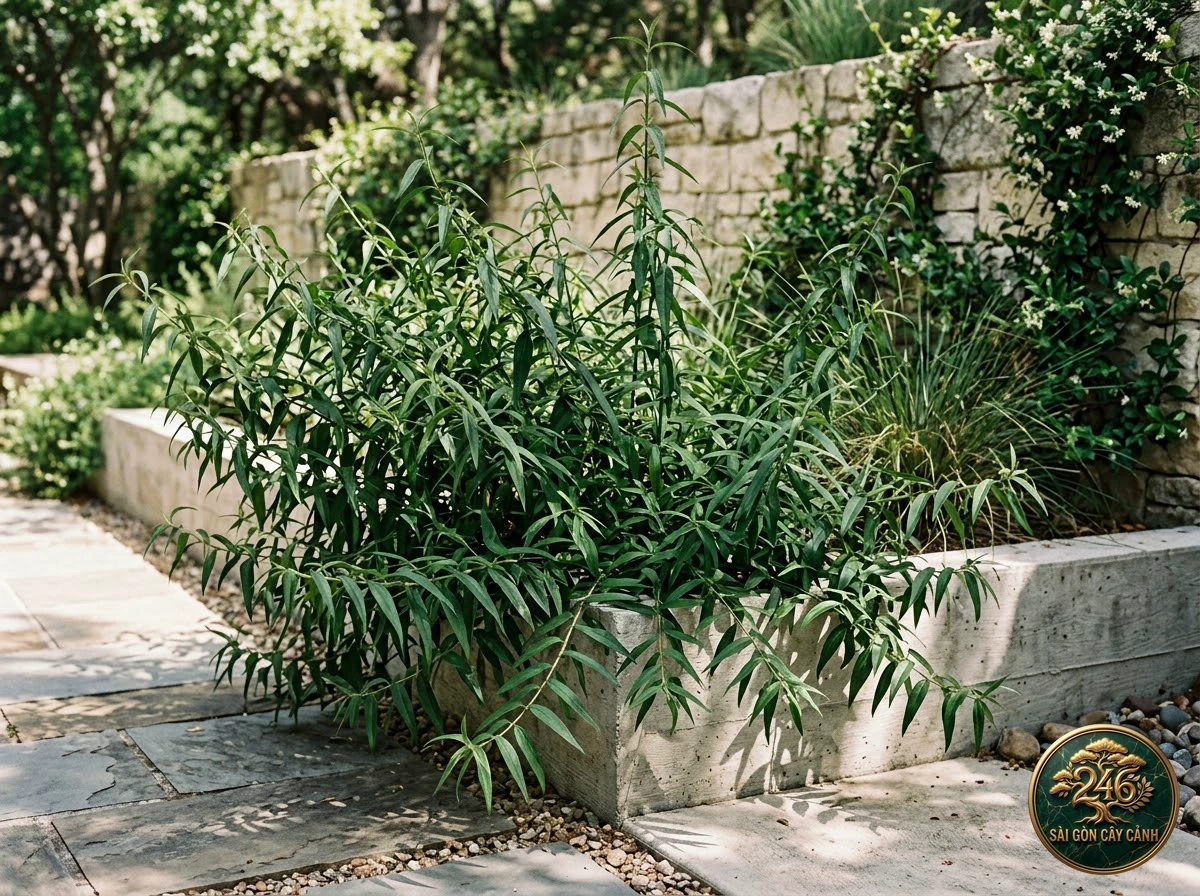
In urban biophilic landscapes and eco-conscious lifestyle curation, Sabah snake grass pairs understated rustic grace with rich practical value. Soft cascading emerald foliage punctuated by spirited vermilion flowers infuses interior spaces with botanical warmth and natural harmony.
Cultivating a thriving pot of Sabah snake grass on apartment verandas or sunny kitchen counters provides vibrant living decor while supplying fresh botanical leaves for daily soothing herbal tea infusions.
Within urban edible landscapes and Biophilic homesteads, Clinacanthus nutans bridges ornamental greenery with wellness herbology. Its exuberant emerald habit infuses compact city verandas with vibrant organic energy, providing both visual serenity and an abundant harvest of revitalizing botanical tea for wellness enthusiasts.
12. Master Principles for Sustainable Indoor Acclimatization
Sustaining vigorous, dense growth and recurrent blossoms in containerized Sabah snake grass requires three essential cultural rules:
- Hydration axiom: Irrigate moderately once topsoil dries slightly; never permit stagnant drainage puddle accumulation.
- Illumination axiom: Position plants where bright diffuse illumination or gentle morning sun is received for at least 4-6 hours daily.
- Maintenance axiom: Pinch stem tips periodically and harvest outer shoots to stimulate vigorous multi-branched compact growth.
13. Frequently Asked Questions Regarding Sabah snake grass (FAQs)
Does Sabah snake grass adapt well to apartment balcony living?
Exceptionally well; it thrives on balconies and bright windowsills, forming lush green mounds with consistent watering.
How frequently can stem shoots be pruned or harvested?
Once established for 2-3 months, trim vigorous shoots every 3-4 weeks; pruning stimulates denser bushy branching.
Does it flower reliably in residential interiors?
The plant requires 4-6 hours of gentle direct morning sunlight during winter and spring to trigger vivid vermilion flowers.
Can stem cuttings be rooted directly into potting soil?
Yes; semi-hardwood cuttings inserted into moist porous potting soil root reliably over a 25 to 35 day interval.
Is it dangerous if domestic cats or dogs chew the foliage?
Completely safe; certified 100% non-toxic by the ASPCA, presenting zero danger to companion pets.
How should one harvest Sabah snake grass foliage sustainably without stressing the plant?
Harvest intermediate mature leaves along middle nodes and pinch terminal tips 1 cm above axillary buds; this stimulates dense branching while preserving lower mature foliage to maintain continuous photosynthetic support for root systems.