Living plant profile
Amazon sword
Echinodorus amazonicus
Comprehensive botanical dossier for Amazon sword (Echinodorus amazonicus). Identification, lighting calibration, porous substrate formulation, and cultivation guide by Saigon Cay Canh.
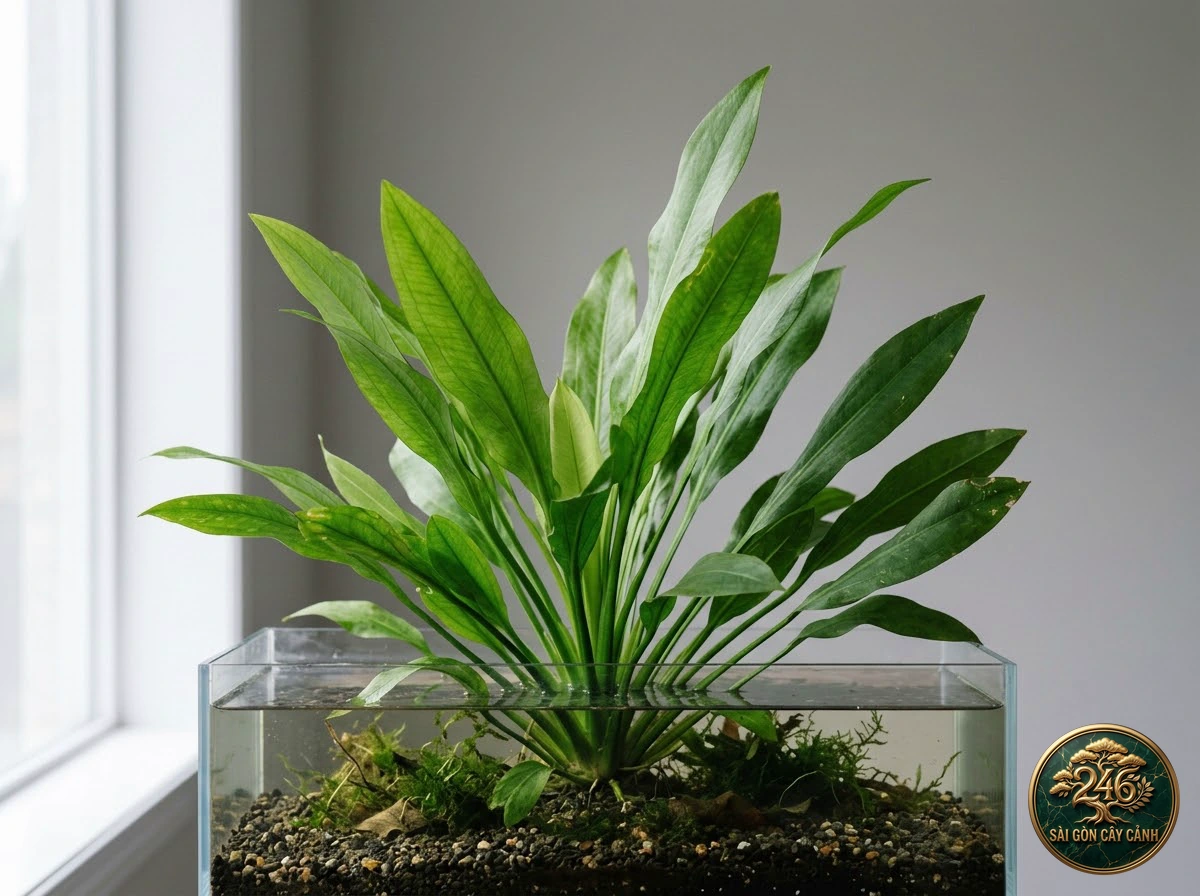
Amazon sword (Echinodorus amazonicus) is an illustrious titan of the freshwater aquarium world in the water-plantain family Alismataceae, indigenous to the majestic Amazon River basin of Brazil. Celebrated as the quintessential ‘Amazon Sword’, it commands admiration for expansive rosettes of submerged lanceolate emerald blades, vigorous benthic root networks, and unmatched bio-filtration capacity.
1. Core Botanical Taxonomy & Cultural Specifications
| Scientific Name | Echinodorus amazonicus |
|---|---|
| Botanical Family | Alismataceae (Water-Plantain Family) |
| Native Distribution | Amazon River basin (Brazil, South America) |
| Growth Demeanor | Submerged or emergent aquatic rosette perennial, benthic rhizome |
| Lighting Threshold | Moderate to bright aquatic LED lighting (1,500 – 3,500 lux) |
| Hydration Cadence | Fully submerged; water temp 22°C – 28°C, pH 6.5 – 7.5, kH 3-8 |
| Substrate Formulation | Specialized nutrient-rich aquatic substrate, clean river gravel, clay tabs |
| Thermal Range | 22°C – 28°C (optimal tropical aquatic range) |
| Relative Humidity | 100% submerged (or 80-90% in emergent riparium environments) |
| Cultivation Difficulty | Easy; vigorous growth rate and highly adaptable in freshwater tanks |
| Pet Safety Profile | Certified 100% safe for aquatic fauna and companion pets (ASPCA Safe) |
Botanically, Echinodorus amazonicus represents an amphibious freshwater perennial adapted to both submerged and emergent life cycles. In fully submerged aquarium conditions, it forms an imposing rosette of 30 to 50 narrow lanceolate sword-like blades standing 25 to 50 cm tall with an expansive spread of 20 to 40 cm.
Blades arise from a stout basal rhizome, narrow-lanceolate, measuring 20 to 40 cm long and 2 to 4 cm wide with acute tips and channeled petioles. Foliar tissue is supple, semi-translucent underwater in vivid chartreuse to bright emerald hues, supported by 3 to 5 prominent longitudinal veins running parallel from base to apex.
The plant anchors through an extensive, fibrous white benthic root network that penetrates deeply across substrate layers. This massive root system anchors the crown securely against aquatic filter currents while functioning as an efficient bio-filter, consuming dissolved ammonium, nitrates, and phosphates.
2. Morphological Identification & Foliar Architecture
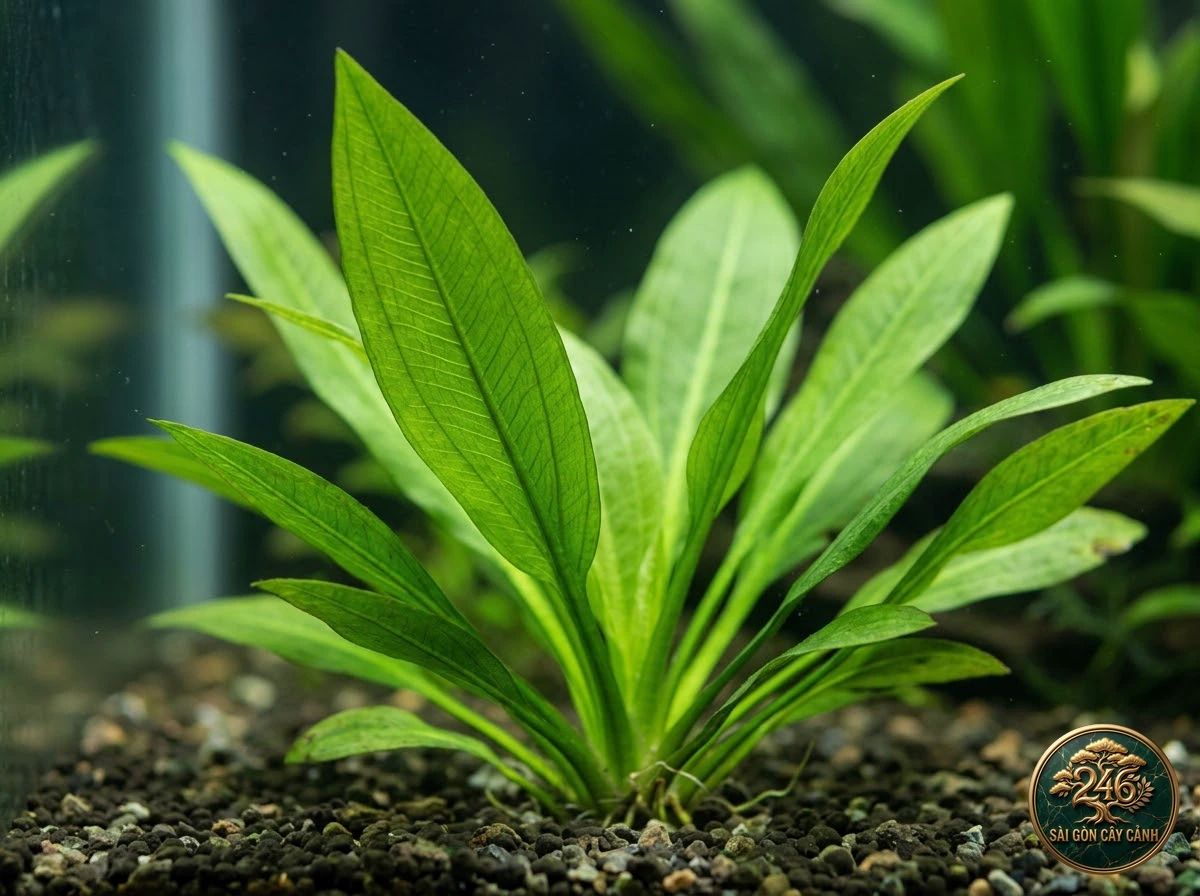
Diagnostic keys distinguishing Echinodorus amazonicus focus on its narrower lanceolate blades paired with significantly shorter petioles (petiole length spans only one-third to one-fourth of blade length), contrasting with broader-bladed, long-petioled Echinodorus bleheri.
Under emergent conditions or when runners reach the water surface, specimens project long inflorescence scapes 60 to 100 cm long bearing whorls of delicate 3-petaled white flowers; at spent floral nodes along the scape, miniature adventitious plantlets develop spontaneously.
Morphological analysis of Echinodorus amazonicus reveals submerged narrowly lanceolate foliage of brilliant translucent emerald, characterized by 5 distinct longitudinal veins traversing from the petiole base to the acute apex. Delicate cross-venules link these longitudinal cords, creating a resilient architectural mesh that flexes gracefully within aquatic currents without mechanical tearing under hydrodynamic forces.
3. Photometric Calibration & Window Exposure Optimization
Photobiologically underwater, Amazon sword prospers beneath full-spectrum aquatic LED lighting calibrated to 1,500 to 3,500 lux (roughly 0.5 to 0.8 Watts per liter). Providing 8 to 10 hours of steady illumination daily enables vigorous photosynthetic pearl-bubble oxygen release into the water column.
The species tolerates lower illumination beneath 1,000 lux with slowed growth and thinner foliage; however, excessive irradiance above 5,000 lux without balanced dissolved CO2 and micronutrients precipitates nuisance algae blooms (hair algae, brown diatoms) on blade surfaces.
Submerged photosynthetic dynamics demonstrate that Amazon sword requires moderate to intense benthic aquatic lighting, prospering under a bottom-level PPFD of 150 to 350 µmol/m²/s. Under full-spectrum 6500K aquatic illumination, it exhibits vigorous oxygen pearling along the lamina; under dim lighting below 80 µmol/m²/s, leaves become attenuated, thin, and chlorotic.
4. Submerged Lanceolate Rosette Habit & Benthic Aquascaping Architecture
In aquatic aquascaping design, Echinodorus amazonicus is positioned as a premier background or midground centerpiece within medium to large aquaria (100 liters and above). Its expansive, radiating foliar vase creates a majestic living backdrop for schooling community fish.
Systematic pruning is essential: use curved aquascaping shears to excise spent or algae-encrusted outer blades at the rhizome base. Deadheading outer foliage stimulates fresh, crisp emerald swords to erupt continuously from the rosette center, preserving tank hygiene.
Water chemistry parameters demand water temperatures between 22°C and 28°C, pH stabilized at 6.5 to 7.5, and carbonate hardness (kH) of 3 to 8 dKH. Execute weekly 20-30% water changes with clean dechlorinated water to replenish essential minerals and dilute organic waste compounds.
While the plant survives without pressurized CO2, supplementing dissolved CO2 at 15-25 ppm doubles growth rates, thickens foliar cuticles, deepens jade pigmentation, and produces mesmerizing pearling bubbles across blades under lighting.
Optimal water temperature ranges between 22°C and 28°C, matching the tropical warmth of the Amazon basin. Introducing moderate dissolved CO2 injection at 15-25 ppm coupled with gentle water filtration flow thickens leaf substance and keeps foliar surfaces completely free of opportunistic epiphytic algae.
The rosulate aquatic architecture of Echinodorus amazonicus radiates from a stout, compact rhizomatous crown seated at the sediment interface. Mature specimens form an impressive crown of 30 to 50 arching lanceolate leaves 25 to 45 cm in length, creating a commanding background green focal point that conceals aquatic equipment and highlights shimmering tropical shoaling fish.
5. Porous Aggregate Substrate Engineering & Aeration Dynamics
Unlike stem plants that absorb nutrients primarily from the water column, Amazon sword is an obligate heavy root feeder. The substrate bed must measure at least 6 to 8 cm deep, utilizing nutrient-rich aquatic soil or capping clay-based substrate with washed river gravel.
When planting, grasp roots with aquascaping tweezers and insert deeply into the substrate, then gently pull upward until the root crown sits flush with the gravel surface; never bury the crown deeply beneath silt, which causes crown suffocation and rot.
Aquatic substrate design demands a bed depth of 6 to 8 cm, featuring a nutrient-rich aquarium soil layer topped with 2-3 mm washed quartz gravel to anchor extensive roots. A vigorous white fibrous root system spreads extensively through benthic sediments, stabilizing aquarium water pH between 6.2 and 7.4 with a general hardness (dGH) of 3 to 12.
6. Organic Nutrition Schedules & Periodic Micronutrient Priming
Nutritional protocols must target the benthic root zone: insert chelated iron-rich root fertilizer tabs deep into substrate 3-5 cm from the plant base every 2 to 3 months. Bio-available iron is the single most vital element governing brilliant emerald leaf synthesis.
Supplement with modest doses of comprehensive liquid micronutrients following weekly water changes; minimize liquid nitrogen/phosphorus additives if the aquarium houses active fish populations, as natural fish waste supplies ample macronutrients.
As a classic heavy root feeder absorbing primary nutrients via its expansive subterranean root network, nutritional maintenance centers on burying slow-release root fertilizer tabs rich in chelated iron and trace minerals deep into the sediment bi-monthly. Restricting excessive liquid water-column dosing prevents nuisance filamentous algae outbreaks.
7. Clinical Diagnostic Matrix & Rapid Correction Protocols
| Clinical Symptom | Primary Etiology | Diagnostic Evaluation | Corrective Prescription |
|---|---|---|---|
| Young emerging blades translucent, bleached white, and stunted | Acute iron (Fe) deficiency within benthic substrate layers | Inspect young foliage for loss of green pigment turning transparent | Insert chelated iron root fertilizer tabs deep into substrate near roots immediately |
| Small pinholes with yellow halos developing across mature blades | Potassium (K) deficiency in the aquarium water column | Examine mature foliage for tiny perforations expanding over time | Dose aquatic-safe soluble potassium sulfate supplement following water changes |
| Blade surfaces encrusted with stubborn black beard or hair algae | Excessive photoperiod or light intensity combined with nutrient imbalance | Feel leaf texture for slimy coatings or dark filamentous tufts | Reduce photoperiod to 7-8 hours, introduce algae-eating fauna, and prune heavily encrusted leaves |
| Basal crown turning black, mushy, and leaves detaching easily | Crown buried too deeply beneath substrate causing anaerobic suffocation | Gently tug plant to inspect crown for black decay and anaerobic odor | Elevate plant so crown sits flush with gravel surface, excise rot, vacuum detritus |
8. Cryptic Pest Prophylaxis & Foliar Surface Sanitation
Common pests in aquaria involve nuisance pest snails rasping holes in soft foliage and invasive algae films covering blades. The premier biological management deploys cleanup crews (Otocinclus catfish, Siamese algae eaters, Amano shrimp) to graze algae naturally without harsh algaecides.
Execute regular tank hygiene by vacuuming excess detritus, clearing decaying detached leaves, and scraping glass algae to preserve pristine water clarity, preventing toxic anaerobic hydrogen sulfide (H2S) accumulation in the substrate.
Aquatic ecosystem balance is maintained by introducing biological cleaning crews including Amano shrimp and Nerite snails that graze harmlessly upon foliar biofilms. Periodically pruning elderly outermost leaves close to the basal crown with aquascaping shears stimulates fresh leaf emergence without disturbing sediment beds.
9. Asexual Propagation Methodology & Root Strike Protocols
Asexual propagation of Amazon sword proceeds via emergent runners. When mature and well-nourished, the crown projects a creeping runner scape along which 3 to 6 miniature plantlets form at nodal junctions, developing independent rootlets.
Once plantlets display 4-5 small sword leaves and roots 3-5 cm long (typically over a 25 to 35 day post-emergence root interval), snip them cleanly from the runner and anchor into the substrate to establish independent rosettes.
Asexual multiplication occurs naturally along elongated reproductive floral scapes arching toward the water surface. Prolific adventitious plantlets emerge at the scape nodes; submerging the runner gently in water over a 25 to 35 day interval allows plantlets to develop independent 3-5 cm root clusters before severing for planting.
10. Companion Animal Safety Profile & ASPCA Non-Toxic Verification
The supple, broad sword leaves serve as favored natural spawning substrates for breeding angelfish and discus, offering secure shelter for newly hatched fry in peaceful community tanks.
11. Biophilic Curation & Contemporary Interior Design Styling
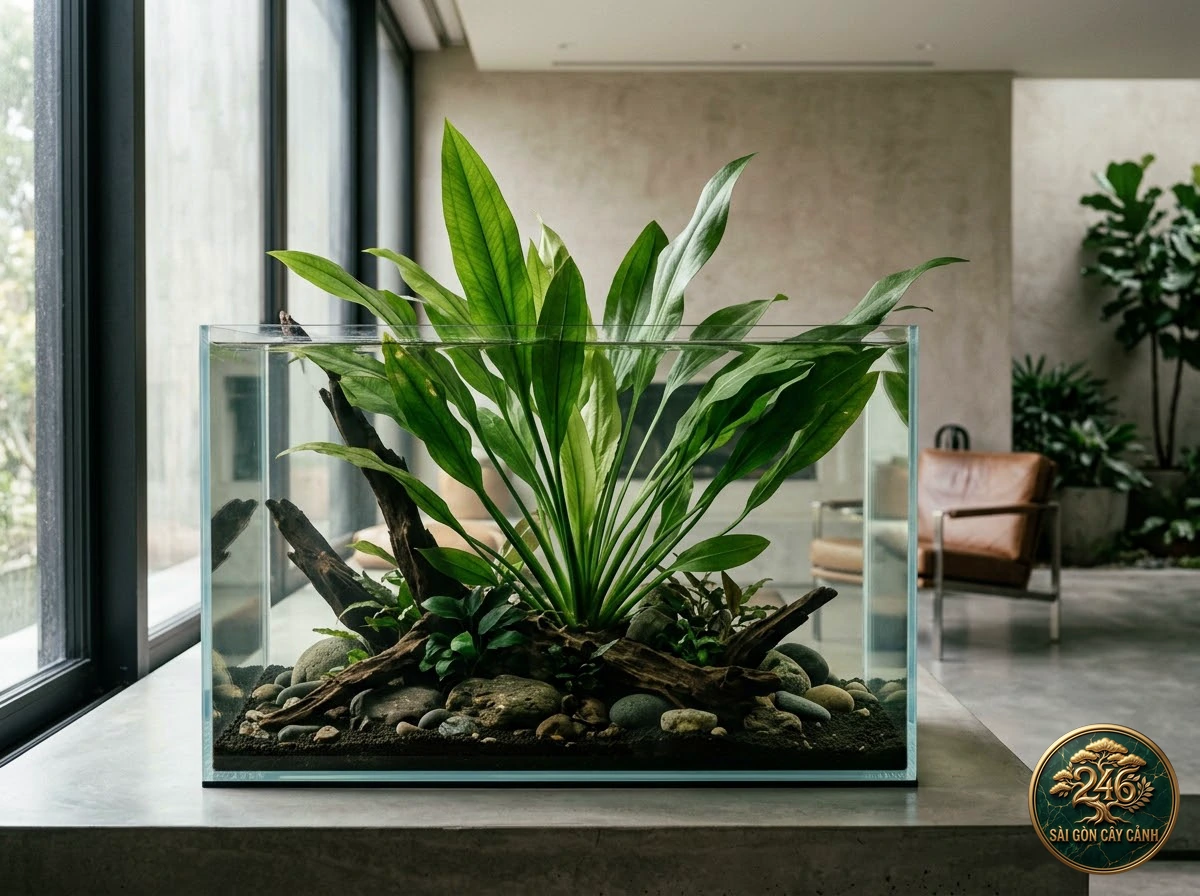
In contemporary aquatic Biophilic interior architecture, an aquarium featuring thriving Amazon swords delivers priceless psychological restoration and serene contemplation. Watching lush emerald blades sway rhythmically in crystal currents dissolves urban digital stress effortlessly.
Positioned within residential living rooms, creative offices, or corporate lobbies, an Amazon sword aquascape serves as a sophisticated living installation, providing natural humidification and an enchanting slice of wild Amazonian nature.
In contemporary Nature Aquarium design and Biophilic office aesthetics, a lush planted tank anchored by an expansive Amazon sword creates the breathtaking illusion of a tranquil submerged rainforest. Watching schools of tropical fish glide smoothly through its arching green foliage lowers heart rates, relieving cognitive fatigue and evoking profound peace.
12. Master Principles for Sustainable Indoor Acclimatization
Maintaining vigorous underwater sword foliage, extensive root colonization, and algae-free health demands three foundational axioms:
- Hydration axiom: Provide at least 6-8 cm of nutrient-rich substrate and insert iron-rich root fertilizer tabs into root zones every 2-3 months.
- Illumination axiom: Illuminate with aquatic LED fixtures for 8 to 10 hours daily; avoid photoperiods exceeding 12 hours to prevent algae blooms.
- Maintenance axiom: Execute weekly 20-30% dechlorinated water exchanges and prune outer senescent blades at the base to drive fresh leaves.
13. Frequently Asked Questions Regarding Amazon sword (FAQs)
Does Amazon sword strictly require pressurized CO2 injection?
No; it flourishes reliably in non-CO2 low-tech setups with fertile substrate; however, supplemental CO2 accelerates growth and deepens coloration.
What is the maximum size achievable in home aquaria?
In spacious, nutrient-rich tanks, rosettes comfortably reach 40-50 cm tall with a spread exceeding 30 cm, forming a massive background centerpiece.
How can cultivators prevent the plant from outgrowing smaller tanks?
Regularly prune outer mature blades at the crown base and moderate root tab fertilization to restrain expansive spread.
Do aquarium fish damage or consume the sword leaves?
Blades are leathery and durable; small community fish (tetras, guppies, angelfish) never harm them; however, large herbivorous goldfish or cichlids may nibble.
Is the plant safe for delicate dwarf shrimp species?
Completely safe; certified non-toxic, providing an ideal natural foraging ground for biofilm-grazing shrimp.
Why do Amazon sword leaves develop pinholes and turn translucent-yellow?
Foliar chlorosis accompanied by localized perforations indicates acute iron (Fe) and potassium deficiency within the benthic substrate; inserting supplemental chelated iron root tabs directly beneath the root zone rapidly rectifies this condition.