
Living plant profile
Spotted dumb cane
Dieffenbachia maculata
Comprehensive botanical dossier for Spotted dumb cane (Dieffenbachia maculata). Identification, lighting calibration, porous substrate formulation, and cultivation guide by Saigon Cay Canh.
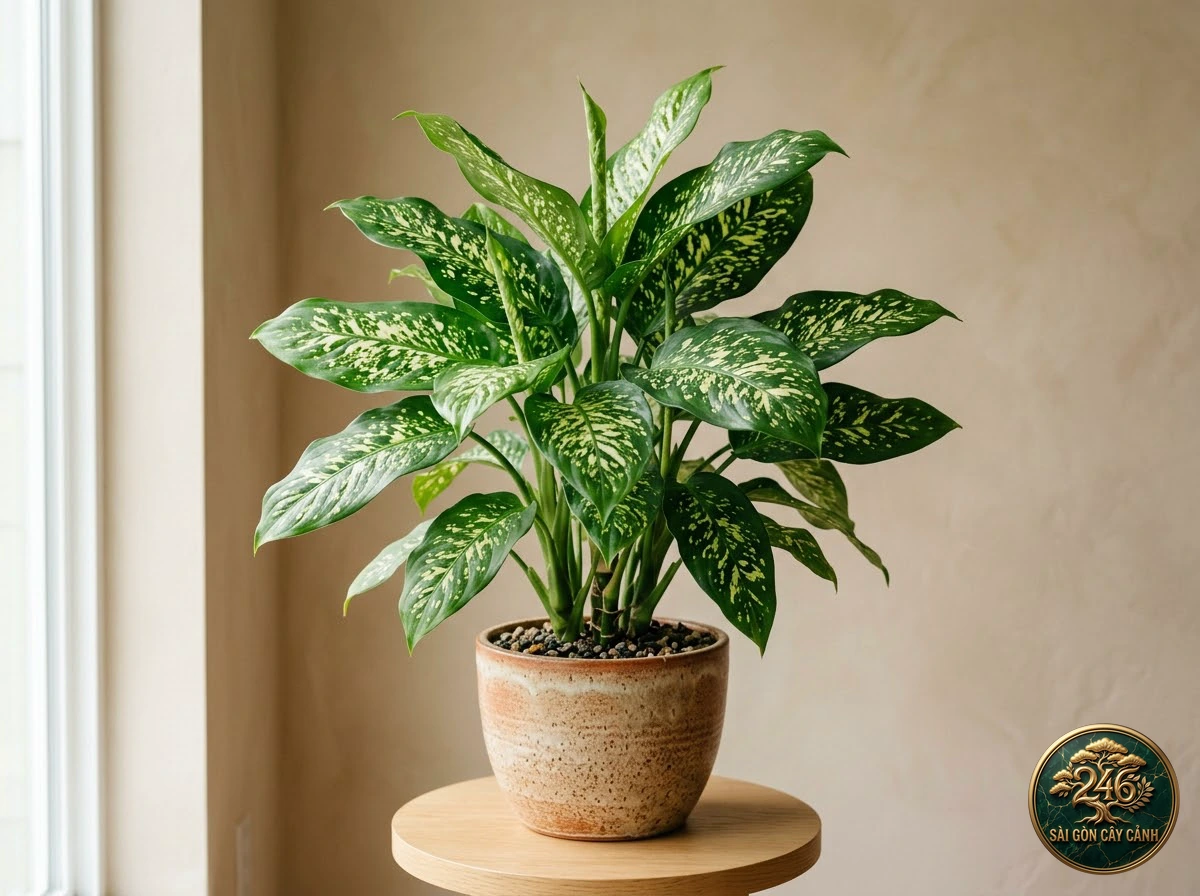
Spotted dumb cane (Dieffenbachia maculata) is a celebrated Neotropical foliage variety renowned globally for bold golden-ivory markings resembling leopard spots across deep emerald leaf blades. Native to rich Brazilian rainforests, it brings wild tropical exuberance and vibrant vitality into interior spaces.
1. Core Botanical Taxonomy & Cultural Specifications
| Scientific Name | Dieffenbachia maculata |
|---|---|
| Botanical Family | Araceae (Aroid Family) |
| Native Distribution | Monsoonal tropical rainforests of Brazil, the Amazon basin, and northern South America |
| Growth Demeanor | Vigorous upright clumping perennial developing stout canes with abundant basal tillering |
| Lighting Threshold | Bright filtered indirect daylight (1,400 – 3,200 lux); preserves vivid leopard-like golden spotting |
| Hydration Cadence | Irrigate once upper 40% substrate dries down; semi-succulent canes tolerate transient dry spells |
| Substrate Formulation | 35% aged pine bark, 25% volcanic pumice, 25% coarse perlite, and 15% vermicompost |
| Thermal Range | 19°C – 32°C (66°F – 90°F; thrives vigorously within warm monsoonal tropical temperatures) |
| Relative Humidity | 60% – 80% (Readily accommodates standard domestic household humidity levels) |
| Cultivation Difficulty | Easy (Hardy vegetative constitution, vigorous grower, forgiving nature) |
| Pet Safety Profile | Highly Toxic (Insoluble calcium oxalate crystals pair with protease enzymes; strict pet exclusion) |
Cataloged in taxonomic registries of Kew Gardens (POWO), Dieffenbachia maculata occurs naturally across the monsoonal rainforest floors of Brazil and the lower Amazon basin. Beneath the shelter of ancient tropical canopies, it forms dense colonies anchored into fertile alluvial deposits enriched by seasonal leaf fall.
Its environmental resilience is underpinned by muscular succulent canes and a dense fibrous root system. Storing substantial moisture reserves internally, it continuously fuels dense crowns of variegated foliage throughout fluctuating seasons.
Within primary Amazonian forest biomes, this variety flourishes in canopy gap openings created by fallen tree falls. Increased solar irradiance within these sunny forest clearings triggers synthesis of intense golden-ivory pigments, setting the plant conspicuously apart amidst dense South American undergrowth.
2. Morphological Identification & Foliar Architecture
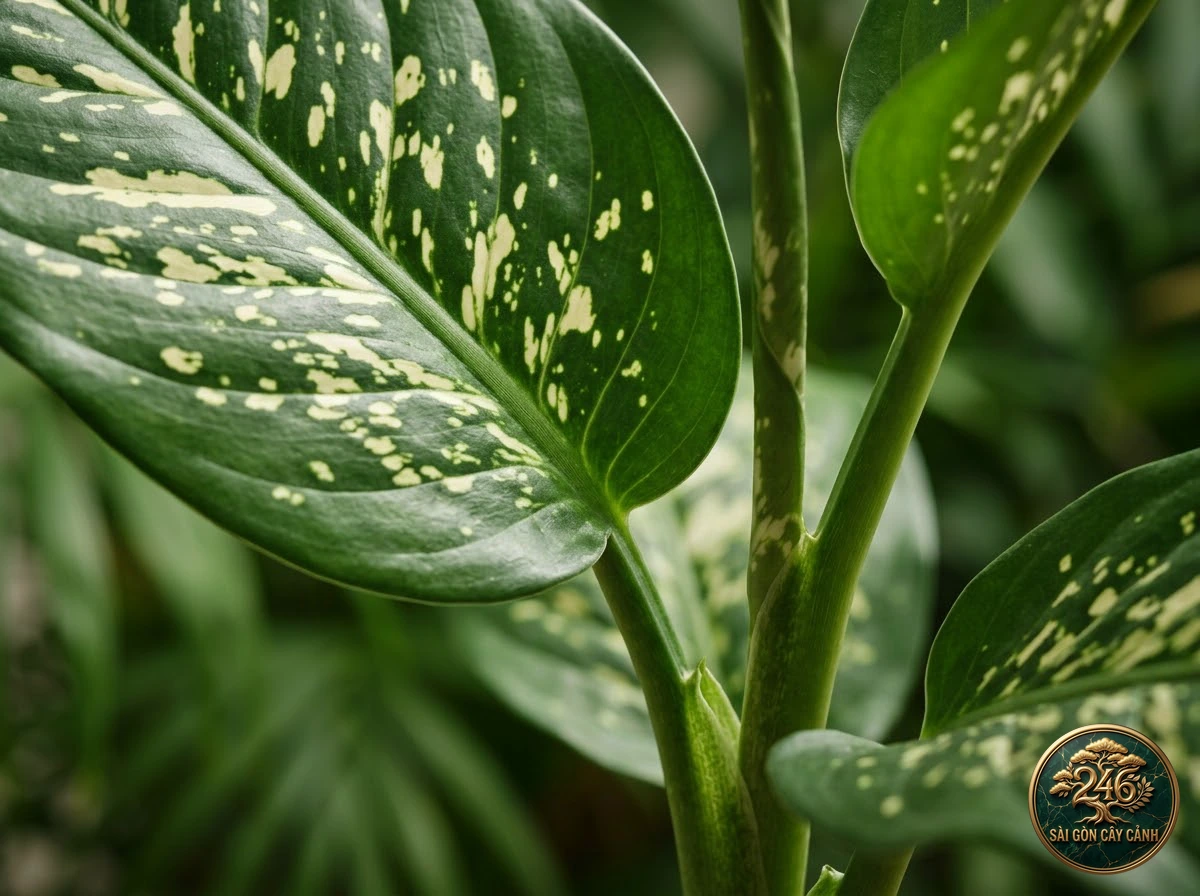
Foliar morphology represents an arresting visual display. Broad oblong-elliptic blades measuring 25 to 45 cm feature a saturated jungle green ground densely speckled with irregular blotches and spots of creamy gold, ivory, and chartreuse in an intricate leopard-skin mosaic.
Muscular petioles clasp cylindrical canes securely through channeled basal sheaths. The smooth abaxial surface displays a paler green tone with prominent raised ribs that hold large leaf blades outward in balanced architectural symmetry.
The distribution of leopard spotting across Spotted dumb cane foliage follows asymmetrical cell division patterns during early leaf primordia development. Cells containing carotenoid-rich leucoplasts cluster along secondary vascular traces, creating dynamic chromatic patterns that optimize light harvesting across varying radiation spectra. Each mature blade presents an irreproducible living mosaic, providing perpetual fascination for plant collectors.
3. Photometric Calibration & Window Exposure Optimization
Preserving the intense leopard spotting requires abundant diffused daylight between 1,400 and 3,200 lux. Staging the specimen 1 to 1.5 meters back from sheer-curtained East or South-facing domestic windows provides ideal photon density for high variegation.
Harsh midday solar radiation rapidly scorches fragile golden tissues into crisp brown lesions. Conversely, prolonged placement in deep shade causes spots to recede, leaving foliage solid dark green.
4. Structural Cane Dynamics & Form Optimization
Spotted dumb cane maintains an erect, self-supporting clumping habit with thick cylindrical canes. Continuous basal suckering produces a dense, full foliar crown without requiring moss poles.
Select substantial ceramic or terrazzo containers to counterbalance elevated foliage mass. Turning the pot a quarter turn weekly ensures uniform radial foliage expansion.
5. Engineered High-Porosity Substrate Formulation
Muscular root systems demand coarse, porous potting media to ensure continuous subterranean oxygen circulation. Dense, saturated soils suffocate roots and trigger rapid basal cane rot.
A proven bespoke mixture combines 35% aged pine bark, 25% volcanic pumice, 25% coarse perlite, and 15% mature vermicompost. This matrix permits surplus irrigation to exit freely while preserving cool moisture around root zones.
The equilibrium between 8 to 12 mm pine bark chunks and volcanic pumice creates a crush-resistant potting matrix. Vermicompost supplies natural humic colloidal complexes that bind essential nutrient cations without clogging critical air voids in the root zone.
The physical angularity of coarse perlite and volcanic pumice prevents circumferential root circling at the container base. Root tips encountering porous mineral surfaces naturally branch outward, establishing a dense, highly efficient fibrous absorption network that keeps potting soil continuously aerated.
6. Organic Bio-Fertilization & Mineral Management
With vigorous growth dynamics, the plant benefits from steady nutrition during warm seasons. Administer diluted organic liquid fertilizer or kelp drench every three weeks to fuel continuous leaf unfurling.
Every three months, thoroughly flush the potting container with copious rested water to leach away accumulated mineral salts from the potting medium.
7. Clinical Diagnostic Matrix & Horticultural Resolutions
| Clinical Symptom | Root Pathology | Diagnostic Method | Targeted Resolution |
|---|---|---|---|
| Lower cane softens, basal foliage collapses in yellow rot | Substrate waterlogging triggering bacterial rot | Gently press lower cane base to test firmness | Excise rotten sections, disinfect with 70% alcohol, root healthy top |
| Crisp brown foliar margins and tips | Ambient atmospheric humidity below 55% | Check digital hygrometer reading | Relocate away from air conditioning drafts, add pebble moisture trays |
| Golden spots turn faint, leaves revert to dark green | Protracted deficit of photosynthetic light | Measure light intensity with a lux meter | Move closer to bright filtered daylight or install horticultural lamp |
| White cottony deposits clustered inside petiole sheaths | Mealybug colonies taking root in stagnant air | Inspect petiole clefts closely | Wipe clean using cotton swabs soaked in 70% alcohol, apply neem |
| Golden spots collapse into perforated dry holes | Thermal solar magnification through window pane | Measure leaf surface temperature at midday | Draw sheer curtain, retreat container back 50 cm |
8. Pest Mitigation Protocols & Foliar Sanitation
In enclosed domestic rooms, mealybugs and spider mites may shelter inside petiole axils. Dab active colonies directly with cotton swabs dipped in 70% alcohol to halt pest spread promptly.
Large leaves naturally attract household dust layers. Wiping foliage monthly with a warm damp microfiber cloth restores striking luster and unblocks stomata for optimal photosynthesis.
To prevent pest introductions from newly acquired greenhouse specimens, quarantine new plants for two weeks in a dedicated space. Inspect petiole sheaths routinely and apply preventative botanical garlic-chili sprays to eliminate dormant insect vectors before integrating into shared rooms, safeguarding the entire domestic collection.
9. Asexual Propagation Methodology
Propagation is readily achieved via cane sectioning or basal offset division. Using a sterilized knife treated with 70% alcohol, section canes into 10 to 15 cm segments containing nodes, seal cut surfaces, and dry 24 hours.
Bed cuttings into damp perlite and coco coir for 4 to 6 weeks in warm shade. Adventitious roots and fresh green shoots will emerge steadily from nodal junctions.
10. Veterinary Toxicology & Domestic Safety Safeguards
Strictly exclude companion animals from spaces housing this specimen. Wear protective waterproof gloves during pruning and wash hands thoroughly with soap afterwards to prevent sap contact with eyes or sensitive skin.
11. Biophilic Interior Design & Architectural Styling
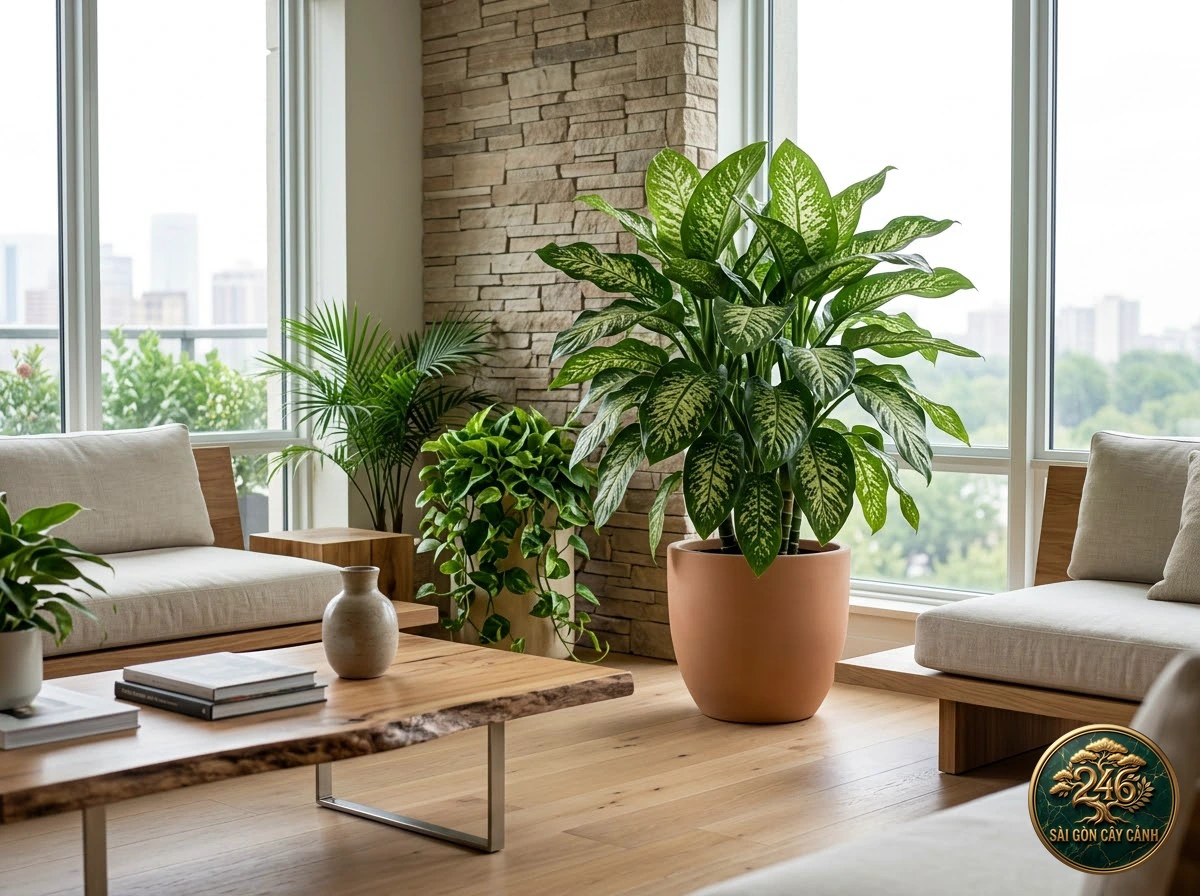
Featuring dramatic leopard-skin patterns and lush architecture, Spotted dumb cane serves as an extraordinary focal accent within tropical-inspired living spaces, hotel foyers, and contemporary creative offices.
It displays exceptional harmony staged inside terrazzo planters, rustic glazed stoneware, or minimalist composite containers, infusing modern living quarters with wild Neotropical exuberance and living tranquility.
High foliar chromatic contrast injects invigorating creative energy into design studios and modern workspaces. It dispels the monotony of bare drywall, anchoring a thriving Neotropical micro-oasis within metropolitan dwellings.
12. Master Cultivation Axioms
Distilled from practical tropical plant nursery operations at Saigon Cay Canh, observe these three cardinal care principles:
- Hydration Precision: Irrigate only after the top 40% of substrate dries down; confirm moisture depth with a wooden probe before watering.
- Solar Management: Provide ample filtered daylight between 1,400 and 3,200 lux; shelter foliage from harsh direct midday solar radiation at all times.
- Foliar Care: Wear protective gloves during pruning and wipe foliage monthly with a damp cloth to maintain hygiene and stomatal exchange.
13. Frequently Asked Botanical Questions (FAQs)
Why do the golden spots fade over time?
This occurs when ambient daylight is insufficient. The plant produces surplus green chlorophyll to maximize photosynthetic yield, overshadowing golden markings. Relocate closer to filtered bright daylight.
Does the plant branch readily into dense clumps?
Yes, it tillers vigorously from basal subterranean nodes. Under good care, it naturally forms a lush multi-stemmed specimen within a year.
When is container repotting recommended?
Every 14 to 18 months during early spring or warm monsoonal onset, once roots thoroughly colonize the container volume.
How should one handle a tall cane that leans?
Stake the cane with an unobtrusive bamboo pole, or execute an apical cut to root the top while rejuvenating compact basal shoots.
Does contact with plant sap cause skin irritation?
Sap containing calcium oxalate crystals triggers itching on sensitive skin. Wash immediately with soap and water if accidental contact occurs.
How can one promote dense, uniform golden spotting?
Furnish generous filtered daylight exceeding 2,000 lux and rotate the pot weekly so all foliar sectors receive uniform photosynthetic stimulation.