Living plant profile
Tuberculate zebra haworthia (Haworthia attenuata)
Haworthia attenuata
Comprehensive botanical monograph on Tuberculate zebra haworthia (Haworthia attenuata): structural morphology, physiological adaptations, porous mineral substrate, and specialized cultivation guidelines.
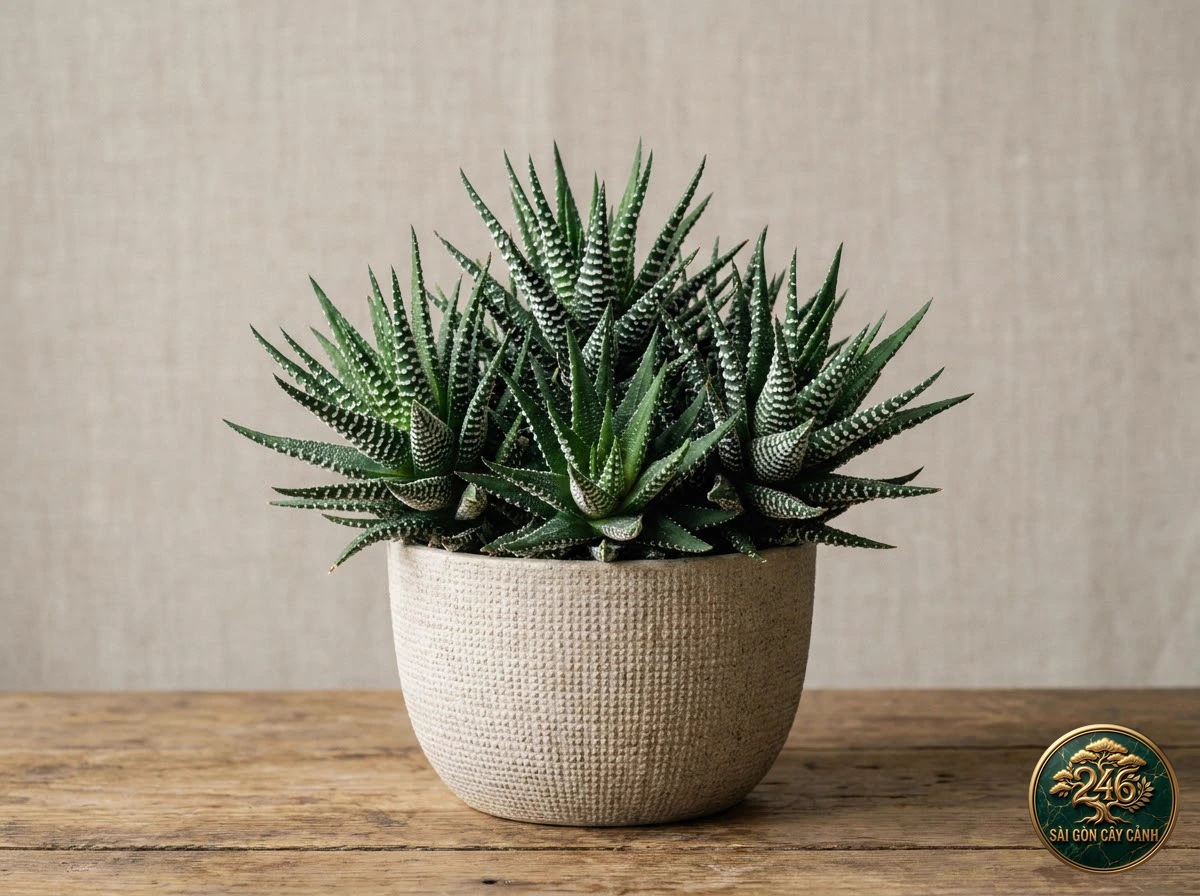
Tuberculate zebra haworthia (Haworthia attenuata)
Sài Gòn Cây Cảnh Care Compass
1. Botanical Introduction & Taxonomic Identity
Within the realm of ornamental succulents, Haworthia attenuata, widely known as the tuberculate zebra haworthia or rough zebra plant, is one of the most resilient, adaptable, and extensively cultivated plants in the world. Frequently conflated by collectors with its close congener Haworthia fasciata, Haworthia attenuata possesses a decisive morphological diagnostic hallmark: whereas H. fasciata features an entirely smooth adaxial (inner) foliar face, Haworthia attenuata displays prominent, raised pearly white tubercles on BOTH the inner and outer surfaces of its leaves. These white warty nodules are randomly scattered or loosely aligned on the upper surface while coalescing into prominent horizontal bands across the exterior, creating a rich beaded texture reminiscent of studded leather armor.
Haworthia attenuata was scientifically published in 1812 by English botanist Adrian Hardy Haworth within Synopsis Plantarum Succulentarum, based on holotypes discovered across the Eastern Cape near Port Elizabeth (now Gqeberha), South Africa. The specific epithet attenuata derives from Latin, meaning tapering or drawn out, honoring its elongated triangular foliage that tapers gradually to sharp apical points. Frequently confused with Haworthia fasciata, Haworthia attenuata is unequivocally distinguished by possessing prominent raised white tubercles across BOTH the inner and outer foliar surfaces, establishing it as one of the most textured and vigorous members of the genus.
2. Native Habitat & Geographical Distribution
In nature, Haworthia attenuata occupies a considerably broader geographical range than H. fasciata, colonizing gravelly river valleys, sandstone slopes, and succulent bushveld around Gqeberha (Port Elizabeth) and Enon in South Africa’s Eastern Cape Province. Thriving at altitudes of 100 to 800 meters, specimens inhabit well-drained quartz sands and rocky crevices. The local climate is semi-arid, characterized by warm summers and mild winters with occasional coastal rain showers. This broad ecological adaptability grants the species superior physiological toughness, allowing it to withstand prolonged drought and adapt seamlessly to tropical domestic cultivation across Vietnam.
3. Detailed Morphological Characteristics
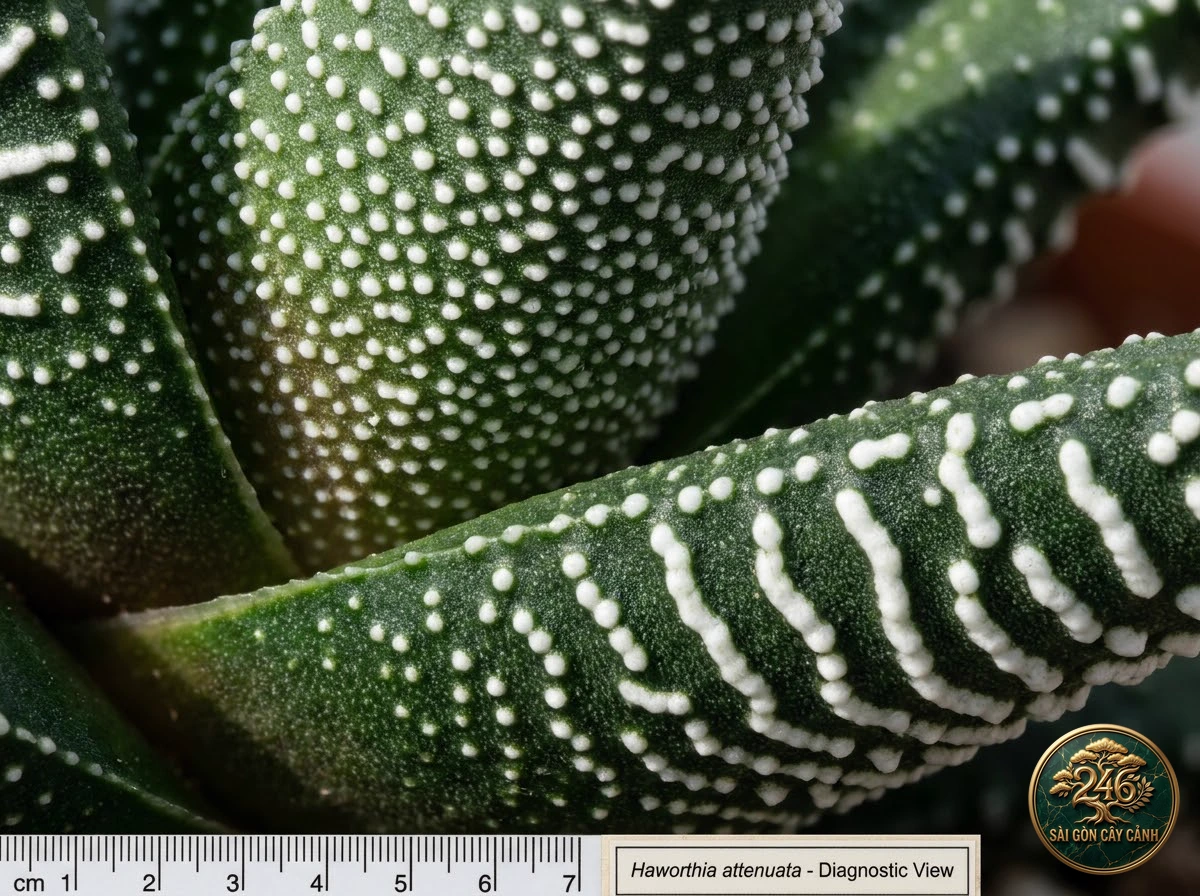
Detailed botanical morphology reveals Haworthia attenuata forming dense acaulescent rosettes standing 10 to 18 cm tall and 10 to 15 cm wide. The foliage is packed in tight spirals, displaying elongated triangular blades that taper gradually (attenuate) to sharp points, measuring 6 to 12 cm in length and 1.5 to 2 cm wide at the base. Leaf coloration varies from dark olive-green to near black-bronze under generous illumination. The raised white tubercles are hardened epidermal structures rich in mineral crystalloids, imparting a delightfully rough, bumpy texture to the touch. A defining biological attribute is its rapid basal pupping capacity, capable of transforming an isolated rosette into an expansive multi-headed clump in a few seasons. Slender floral scapes rise 30 to 45 cm, displaying small tubular whitish-green florets from spring to autumn.
Microscopic inspection of Haworthia attenuata leaf surfaces reveals a high spatial density of raised tubercles distributed across both adaxial and abaxial epidermal surfaces. These nodular structures are formed from hypertrophied, cutinized cells rich in precipitated silicate mineral complexes. This all-around studded texture creates a coarse tactile landscape across the leaves, expanding total surface area to trap nocturnal marine mist from coastal breezes, while reflecting intense solar radiation to maintain cooler leaf core temperatures during hot African river valley days.
4. Core Botanical Matrix
Core taxonomic and cultivation parameters:
| Botanical Parameter | Observed Trait | Saigon Cay Canh Horticultural Recommendation |
|---|---|---|
| Scientific Name | Haworthia attenuata (Haw.) Haw. | Maintain certified taxonomic labeling across nursery stock |
| Plant Family | Asphodel family (Asphodelaceae) | Observe specialized succulent physiological requirements |
| Native Distribution | Rocky river valleys and scrub slopes around Gqeberha (Port Elizabeth) and Enon, Eastern Cape Province, South Africa | Replicate native climatic parameters in indoor cultivation |
| Illumination Intensity | 18,000 – 38,000 lux | Bright filtered sunlight or gentle morning light; exceptionally tolerant of domestic indoor environments |
| Thermal Window | 16°C – 32°C | Protect against frost below 8°C and provide ventilation during heat |
| Relative Humidity | 40% – 65% | Sustain gentle atmospheric air movement to disperse stagnant moisture |
| Substrate pH | 6.0 – 6.8 | Utilize porous neutral mineral components for rapid drainage |
| Substrate Formulation | 40% coarse pumice, 20% basalt scoria, 15% mineral perlite, 15% desalinated coco peat, 10% seasoned worm humus | Maintain coarse granular structure; avoid dense suffocating soils |
| Irrigation Strategy | Drench thoroughly once the substrate is completely dry; displays superior drought resistance and rapid rebound upon watering | Enforce thorough substrate dry-down between watering sessions |
| Propagation Pathways | Separating rooted basal offsets, or dividing mature multi-headed clustered mounds | Perform during warm spring or early wet season for peak vigor |
| Veterinary Toxicology | NON-TOXIC TO PETS (ASPCA Non-Toxic) | 100% NON-TOXIC TO COMPANION ANIMALS (ASPCA Non-Toxic); completely pet-safe for dogs and cats. |
5. Toxicity Profile & Domestic Safety
From a toxicological and household safety perspective, Haworthia attenuata stands as one of the most pet-friendly succulents available. As confirmed by official documentation from the ASPCA Animal Poison Control Center, this species is certified as 100% NON-TOXIC to companion animals including cats, dogs, and horses. It contains no hazardous bufadienolide cardiac glycosides like those in Kalanchoe and lacks caustic chemical irritants. Even if playful cats or curious puppies chew on its rigid, bumpy foliage, no toxic physiological consequences or mucosal burns will occur, making it an ideal ornamental centerpiece for pet-loving households.
6. Lighting Dynamics & Photosynthetic Adaptations
Illumination requirements for Haworthia attenuata are exceptionally versatile. It thrives under bright indirect light or gentle morning sun with light levels between 18,000 and 38,000 lux. Adequate illumination maintains rigid foliar architecture and sharpens the contrast between the raised white tubercles and dark green blades. This species demonstrates far superior indoor shade tolerance compared to most other succulents; in office spaces, positioning it near a window or under standard LED grow lights keeps it robust. Prolonged exposure to scorching midday tropical sun should be avoided to prevent foliar tip bronzing and tissue dehydration.
7. Moisture Equilibrium & Irrigation Regimes
Watering regimes for Haworthia attenuata rely upon the classic dry-down protocol: allow the potting substrate to desiccate completely between thorough applications. With tough fibrous roots and water-retentive rigid leaves, the species endures extended dry intervals and plumps up quickly upon rehydration. In tropical lowlands, watering once every 7 to 10 days during warm dry weather is optimal. Apply water smoothly around the pot perimeter until moisture drains freely from the base. During damp monsoon seasons, widen intervals to 14 to 18 days, and never permit the container to rest in stagnant runoff saucers to avert root suffocation.
8. Substrate Architecture & Nutrition Strategy
The optimal potting medium for Haworthia attenuata emphasizes high mineral porosity and rapid drainage: combining 40% coarse volcanic pumice (3-6mm), 20% iron-rich basalt scoria, 15% expanded perlite, 15% thoroughly washed coco peat, and 10% biologically active worm humus. An inorganic mineral fraction exceeding 75% ensures instantaneous drainage while delivering fresh oxygen to the root zone. Substrate pH should remain stable between 6.0 and 6.8. A modest sprinkle of low-nitrogen slow-release fertilizer pellets applied in early spring supplies steady nutrients to fuel vigorous basal clustering.
Driven by its robust vegetative pace and prolific clustering habit, Haworthia attenuata possesses slightly higher nutritional uptake than solitary haworthias, yet still demands moderation. The substrate requires rapid drainage balanced with essential trace potassium, phosphorus, and iron to fuel healthy adventitious root formation on emerging pups. High-nitrogen chemical fertilizers should be avoided to prevent pale foliage and sparse tubercle distribution. Applying an annual top-dressing of aged vermicompost or slow-release organic pellets in early spring ensures abundant multi-headed mounding and vigorous health.
9. Temperature Dynamics & Aeration Strategy
The optimal thermal comfort zone for Haworthia attenuata spans 16°C to 32°C. The plant harmonizes effortlessly with tropical warmth and withstands summer peaks up to 36°C when shaded from direct noon rays and supported by natural atmospheric air circulation. It does not tolerate cold below 5°C under wet conditions. Relative humidity between 40% and 65% is ideal. Continuous ambient ventilation remains an indispensable cultural practice, keeping leaf crevices dry after watering and suppressing opportunistic root rot pathogens.
10. Specialized Propagation Protocols
Propagating Haworthia attenuata is delightfully rapid and straightforward thanks to its prolific clustering habit. A mature specimen routinely generates 3 to 8 adventitious basal pups annually. Once juvenile offsets reach 4 to 6 cm in height with independent root strands, unpot the clump during scheduled maintenance, separate the pups with sterilized pruning shears, let cut surfaces callus in airy shade for 2 to 3 days, and plant into barely moist pumice mix. Young divisions anchor firmly and develop into vigorous independent clumps within two to three weeks.
11. Diagnostic Matrix & Preventative Health
Root mealybugs and basal soft rot from overwatering constitute the primary cultural concerns for Haworthia attenuata. If the plant feels unstable in its pot or foliage shrivels despite damp soil, unpot and inspect the root system; upon sighting white mealybug powder, wash the roots clean, dip in a diluted 70% medicinal alcohol bath, let dry, and repot into fresh sterile substrate. Completely excise any blackened, decayed root tissue before repotting, and withhold water for the first week to encourage callus formation.
Clinical diagnostics and remedial actions:
| Observed Symptom | Primary Root Cause | Saigon Cay Canh Remedial Action |
|---|---|---|
| Lower leaves turn soft, thin, and wrinkled | Prolonged moisture deficit in the root medium | Provide a deep perimeter soak for Haworthia attenuata; tissues recover within 48 hours |
| Black soft decay at the stem base with leaf drop | Anaerobic fungal root rot due to waterlogged substrate | Unpot immediately, excise necrotic pulp, treat with sulfur powder, and repot into bone-dry pumice |
| Elongated, weak internodes with pale drooping foliage | Chronic insufficiency of direct solar radiation | Relocate Haworthia attenuata to receive unshaded morning sunlight for 4 to 6 hours daily |
| White cottony clusters nested in foliar axils | Foliar mealybug infestation (Pseudococcidae) | Apply 70% medicinal alcohol directly with a cotton bud to dissolve waxy insect cuticles without foliar damage |
12. Living Architecture & Interior Styling
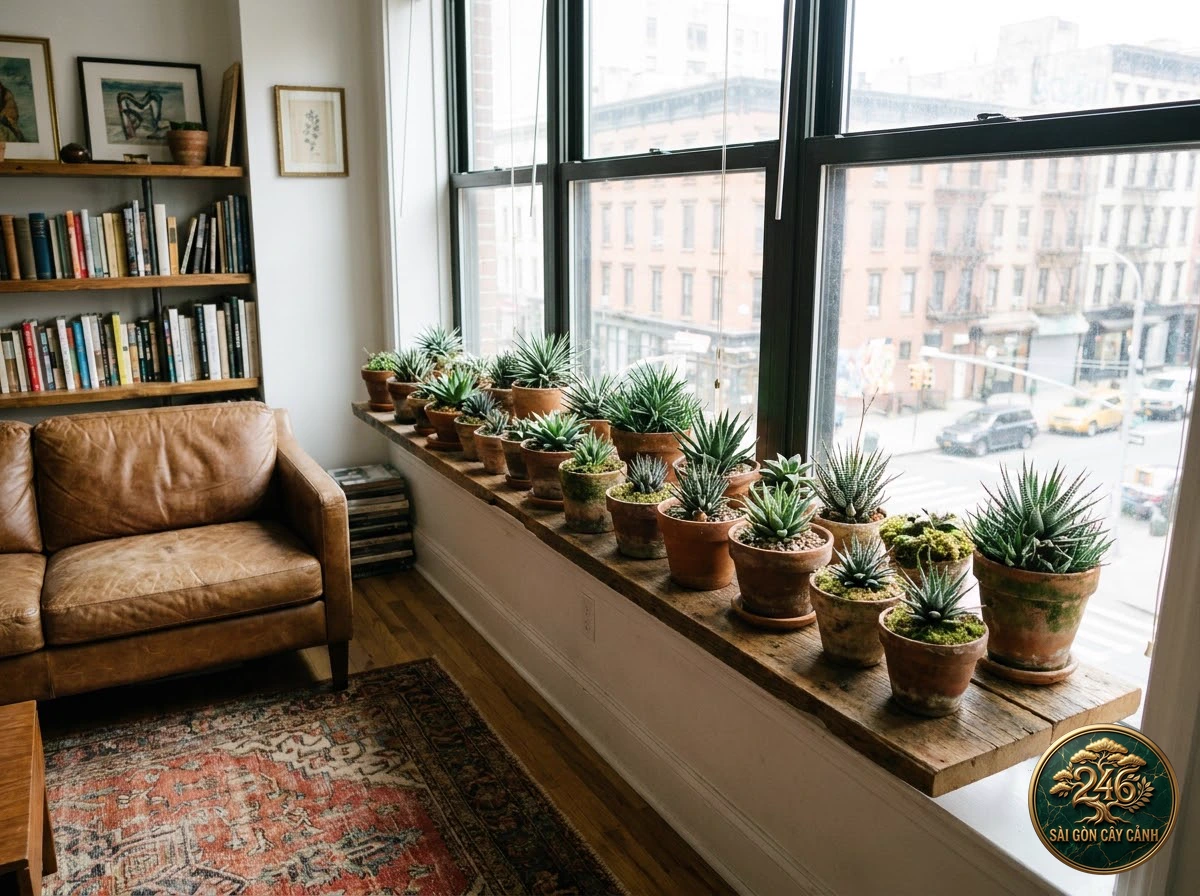
Featuring an imposing spreading rosette adorned with studded white tubercles across both foliar faces, Haworthia attenuata serves as a magnificent living sculpture for office desks, libraries, retail reception counters, or modern living rooms. It radiates strength, steadfastness, and vibrant energy when framed by raw cement pots, carved stone urns, or dark matte ceramic dishes. In cultural symbolism, it represents unwavering protection, inviting prosperity, good fortune, and enduring peace into personal and professional spaces.
Featuring an imposing spreading rosette adorned with studded white tubercles across both foliar faces like beaded leather armor, Haworthia attenuata serves as a magnificent living sculpture for executive writing desks, libraries, retail reception counters, or modern living rooms. It radiates strength, steadfastness, and vibrant energy when framed by raw cement pots, carved stone urns, or dark matte ceramic dishes. In cultural symbolism, it represents unwavering protection, inviting prosperity, good fortune, and enduring peace into personal and professional spaces.
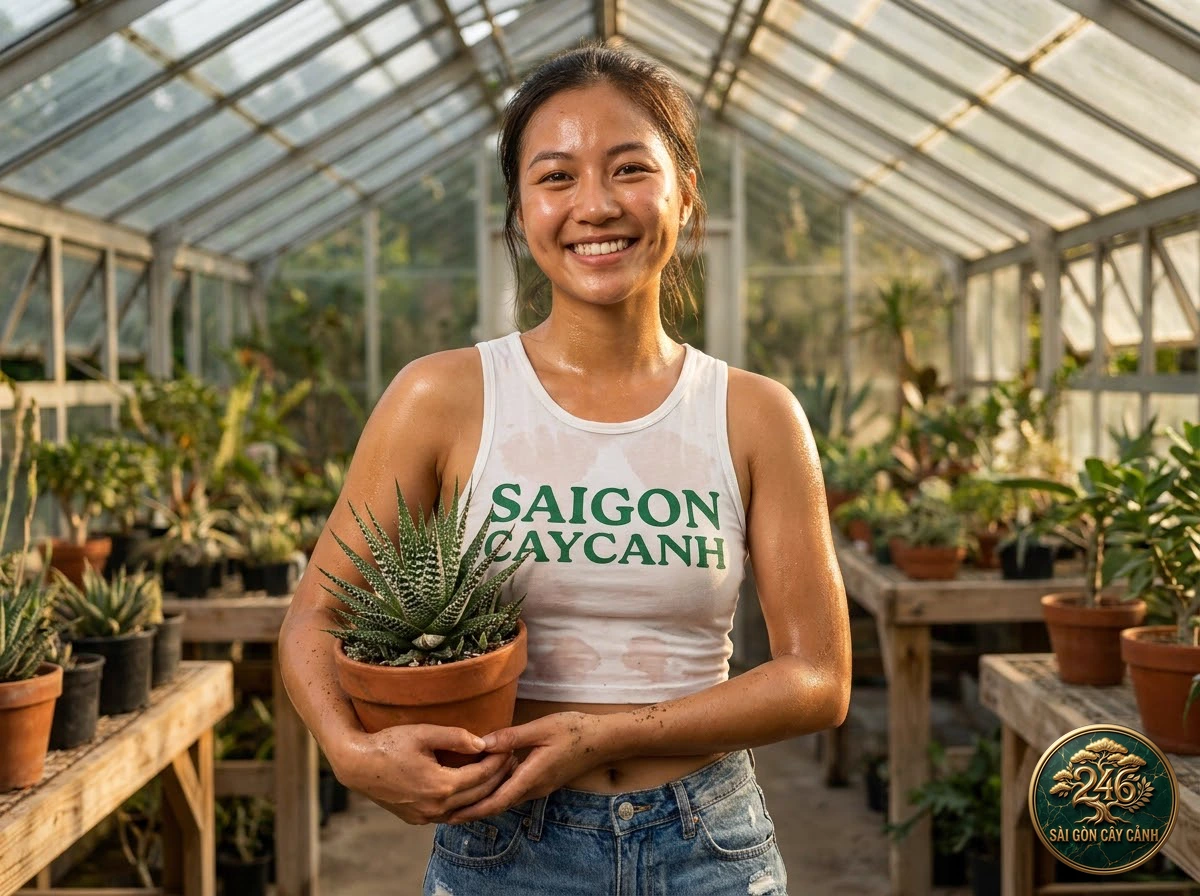
Brand Ambassador & Living Herbarium Botanical Philosophy
At Saigon Cay Canh botanical nursery, each specimen is curated and tended under the guidance of our brand ambassador, ensuring vibrant vitality and true-to-type morphology.
13. Horticultural Excellence & Living Heritage
At Saigon Cay Canh, we take pride in propagating premium specimens of Haworthia attenuata exhibiting dense, raised white tubercles across both foliar surfaces and vigorous root frameworks. We remain devoted to providing genetically authentic, 100% pet-safe succulents built for enduring resilience. Saigon Cay Canh is thrilled to accompany you on your botanical journey, sharing authentic horticultural expertise to enrich your living environments with vibrant, lasting natural beauty.