Living plant profile
Cape Aloe (Aloe ferox): Botanical Monograph, Pachycaul Architecture and Landscape Cultivation
Aloe ferox
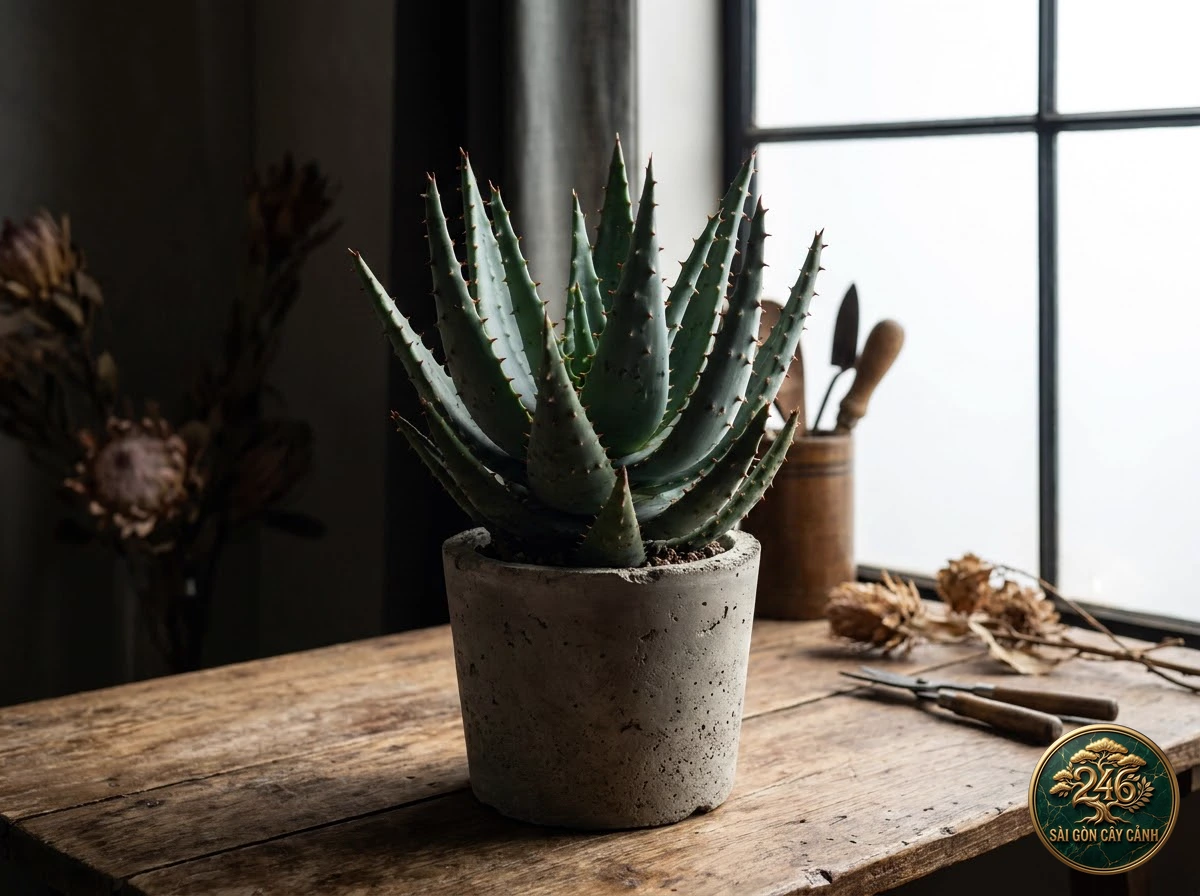
Sai Gon Cay Canh • Living Herbarium V2 Cape Aloe (Aloe ferox): Botanical Monograph, Pachycaul Architecture and Landscape Cultivation Aloe ferox is an imposing, single-stemmed arborescent aloe native to South Africa, celebrated for its ferocious reddish-brown spines, architectural pachycaul trunk, and fiery torch-like candelabra inflorescences. Record ID: SGCC-PLANT-00534 Scientific Name: Aloe ferox Mill. Family: Asphodelaceae […]
Cape Aloe (Aloe ferox): Botanical Monograph, Pachycaul Architecture and Landscape Cultivation
1. Botanical Morphology & Ecological Adaptations
Aloe ferox, widely recognized under the vernacular name Cape Aloe / Bitter Aloe, is a highly distinguished succulent perennial belonging to the family Asphodelaceae. Native to the ecologically diverse landscapes of Southern & Eastern Cape, South Africa, this species has evolved sophisticated anatomical adaptations to endure severe seasonal droughts, rocky scree terrain, and fluctuating thermal regimes.
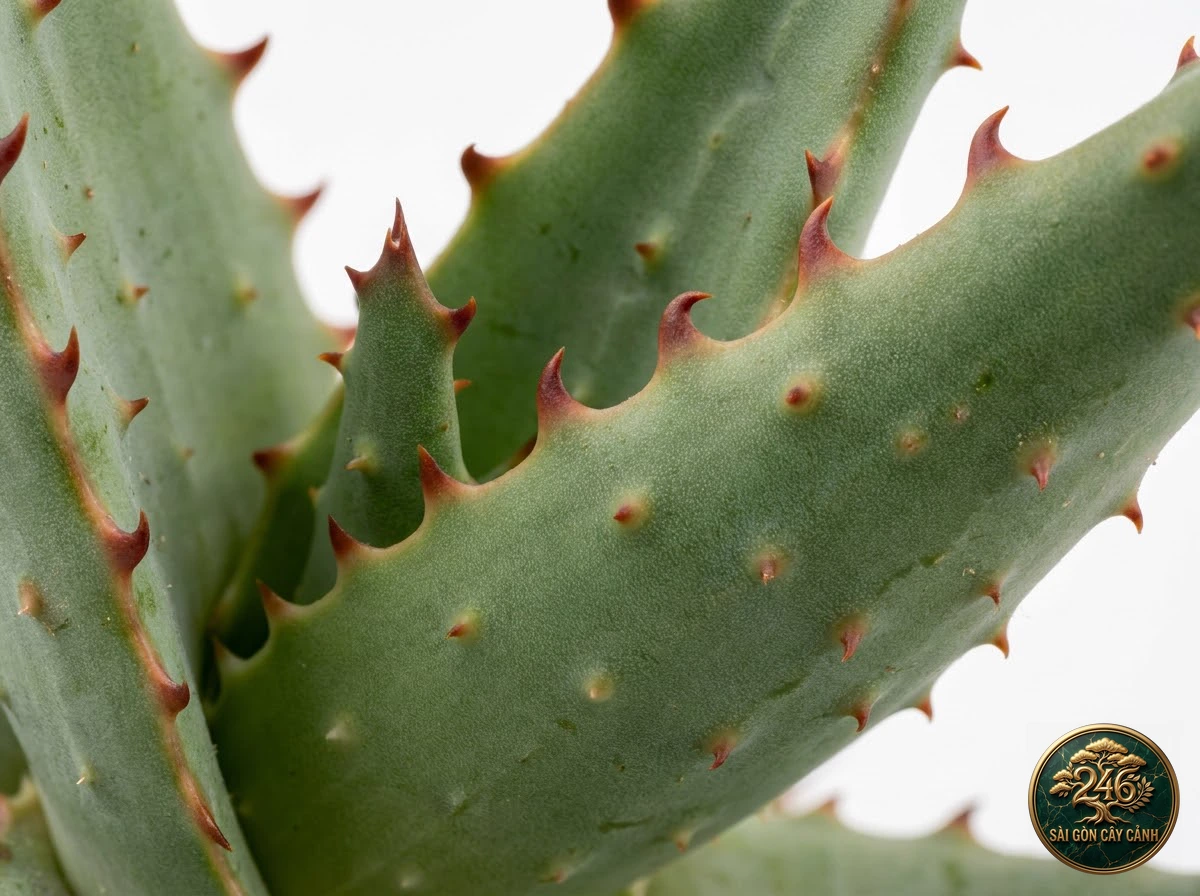
Aloe ferox forms a colossal solitary pachycaul trunk crowned by broad glaucous-green leaves. Both dorsal and ventral surfaces as well as margins bristling with formidable reddish-brown spines provide uncompromising defense against browsing herbivores.
Deep-anchoring lateral roots stabilize the massive multi-hundred-kilogram arborescent body across steep Karoo shale slopes. Branched candelabra inflorescences elevate five to eight fiery scarlet-orange floral cylinders that magnetize nectarivorous birds.
2. Taxonomic Chronicle & Botanical History
Aloe ferox (Cape Aloe or Bitter Aloe) stands as one of the most majestic iconic succulents defining the Thicket and Fynbos biomes of South Africa. Scottish botanist Philip Miller first classified it in 1768 within his renowned reference The Gardeners Dictionary. The specific epithet ferox is derived from Latin denoting fierce or ferocious, inspired by the formidable reddish-brown spines that aggressively arm both leaf surfaces and margins. For over three centuries, Aloe ferox has been the primary botanical source of celebrated Cape Aloe medicinal bitters, traditionally harvested by indigenous tappers across the Eastern Cape.
3. Histological Specialization & CAM Photosynthetic Pathway
The histological architecture of Aloe ferox represents the zenith of arborescent pachycaul succulent evolution: a massive columnar stem reaching 3 meters tall, insulated by an enveloping petticoat of persistent dried foliage that shields living tissue from brushfires. Colossal leaves up to 1 meter in length are reinforced by dense mechanical sclerenchyma fibers capable of supporting massive volumes of internal mucilage. Sub-epidermal pericyclic tubules channel dark amber latex saturated with bitter aloin anthraquinones, providing impenetrable chemical defense against insect herbivory.
4. Comprehensive Care Compass (Care Compass 360°)
La bàn chăm sóc Sài Gòn Cây Cảnh
5. Diagnostic Pathology & Clinical Horticultural Interventions
Spine pigmentation on Aloe ferox serves as a direct mirror of solar vitality: deeply colored spines and rigid epidermis confirm optimal photon saturation.
| Observed Physical Symptom | Etiological Factor / Pathology | Horticultural Intervention Protocol |
|---|---|---|
| Foliar blades droop flaccidly, spines lose vivid reddish pigmentation | Chronic deprivation of direct sunlight causing etiolation and weakening | Relocate to unobstructed full-day outdoor sun exposure (minimum 5 hours daily) |
| Root collar blackens and central trunk wobbles loosely in substrate | Waterlogged heavy soil coupled with blocked container drainage holes | Transplant into heavy terracotta with enlarged drainage holes and 80% mineral grit |
| Dry persistent dead leaves wrap tightly around lower trunk | Natural physiological formation of protective insulated foliar skirt | Leave intact for authentic wild architectural aesthetics or prune flush with trunk |
| Silvery-grey circular callused scars across thick lamina surface | Mechanical puncture trauma caused by wind-blown contact with neighboring spines | Space spiny specimen containers at least 40 cm apart to prevent mechanical damage |
6. Infrageneric Taxonomic Differentiation Matrix
The comparative table below outlines definitive distinctions between Aloe ferox and kindred taxa like Aloe marlothii and Aloe arborescens based on floral structure and spininess:
| Taxonomic Characteristic | Aloe ferox (Cape Aloe / Bitter Aloe) | Comparative Counterpart A | Comparative Counterpart B |
|---|---|---|---|
| Mature Dimensions | Colossal pachycaul arborescent trunk up to 2 – 3 meters | Acaulescent or short-stemmed low rosette | Multi-branched spreading shrub 1.5 – 2 meters tall |
| Spine Distribution | Fierce prickles on margins as well as adaxial and abaxial faces | Spines strictly confined to marginal foliar rim | Marginal teeth only; foliar faces remain smooth |
| Inflorescence Structure | Candelabra-like panicle bearing 5 – 8 stout dense racemes | Simple upright unbranched or bi-forked spike | Single dense conical terminal raceme |
| Latex Exudate | Dark amber aloin-rich latex with piercing bitterness | Pale yellowish sap with moderate bitter flavor | Translucent yellowish sap oxidizing rapidly |
7. Vegetative Propagation & Offsetting Protocols
Because Aloe ferox is strictly solitary and rarely produces basal suckers, propagation is accomplished predominantly by seed. Fresh seed harvested from dehiscing capsules in spring exhibits high germination vitality. Soak seeds in lukewarm water for 4 hours, sow across a fine substrate of sixty percent pumice and forty percent aged coir peat, covering with a 2 mm layer of washed quartz grit. Maintain ambient warmth and filtered light; uniform germination occurs within 10 to 14 days. Seedlings develop distinct protective spines within six months and may be potted individually.
8. Phytopathology & Integrated Pest Management
Aloe ferox possesses extraordinary vigor and natural immunity, yet it remains susceptible to Aloe rust (Uromyces aloes) under protracted humid, stagnant weather. The fungus manifests as raised circular dark brown or black pustules erupting across the thick foliage, compromising specimen aesthetics. Management requires excising severely blemished leaves, sanitizing pruning tools, and applying a preventative copper oxychloride fungicide across the canopy. Ensure container drainage ports remain completely unblocked to prevent basal collar fungal rot during monsoon deluges.
9. Companion Planting & Xerophytic Groupings
In expansive arid xeriscape installations, Aloe ferox serves as an authoritative solitary specimen alongside towering Euphorbia ingens candelabras, dramatic Agave americana rosettes, and clustering Aloe vera. Its soaring architectural stature and ferocious spination provide a bold structural anchor, accentuating surrounding textures while bestowing an aura of wild, untamed grandeur upon modern residential landscape architecture.
10. Spatial Placement & Interior Architectural Styling
Aloe ferox epitomizes monumental living outdoor sculpture. It is extraordinarily well-suited for luxury entry courtyards, windswept penthouse terraces, and full-sun desert landscapes. Housed in substantial cast-concrete architectural planters or custom hand-chiseled basalt urns, it projects commanding authority, primal dignity, and weather-defying fortitude, delivering an unforgettable visual statement to any architectural setting.
11. Urban Apartment Microclimates & Architectural Cultivation
Aloe ferox embodies wild desert majesty, demanding spacious outdoor exposures bathed in full sunshine. It achieves peak monumental impact in open residential courtyards, windswept penthouses, or xeriscape rockeries. Utilize heavy cast-concrete or broad-based ceramic urns to balance its substantial spiny canopy.
In residential townhouses with open courtyards or modern villas, Aloe ferox serves as a premier architectural centerpiece for prominent entryways. It requires a minimum of six hours of direct, unfiltered solar radiation daily to promote structural trunk lignification. During heavy monsoon months, elevate planters on ceramic plinths to ensure rain evacuates instantaneously through basal drainage ports.
12. Domestic Pet Safety & Household Placement Guidelines
TOXIC TO COMPANION ANIMALS (ASPCA Warning) – Contains concentrated bitter aloin latex that provokes gastrointestinal spasms and vomiting in dogs and cats if chewed.
Given its fiercely sharp spines and potent aloin bitters, handlers should always don thick puncture-proof gloves and locate specimens safely away from pets and small children.
13. In-Depth Botanical Q&A with Sai Gon Cay Canh
Frequently Asked Question: Why are the lower dry leaves of my Aloe ferox persisting tightly wrapped around the trunk instead of falling off?
Expert Diagnosis from Saigon Cay Canh: This is by no means a disease, but rather a wondrous evolutionary survival adaptation of Aloe ferox! In its native wild habitat, these desiccated leaves form an insulated ‘petticoat skirt’ that wraps tightly around the succulent trunk, shielding vital inner cambium from scorching desert heat and insulating it against brushfire flames. In botanical horticulture, this skirt lends antique wild character; however, for a clean architectural appearance, you may prune the dead foliage flush with the trunk using sharp shears.
14. Nursery Botanical Journal & Green Sanctuary Notes
Nursery observation logs at Sai Gon Cay Canh document dramatic seasonal shifts in Aloe ferox: fierce prickles gleam crimson under summer skies, while its stout trunk anchors the landscape with primeval architectural dignity.
Nursery field logs document that five-year-old Aloe ferox specimens at Sai Gon Cay Canh develop magnificent skirts of dried marcescent leaves along their trunks. At sunset, their rugged spiny silhouettes cast against architectural concrete walls evoke the wild majesty of southern African gorges.
15. Seasonal Mineral Nutrition & Micro-Nutrient Management
Cape Aloe evolved in impoverished mineral screes, requiring supplemental nutrition merely twice annually. Distribute a modest handful of mature organic compost along the pot perimeter ten centimeters away from the trunk, encouraging stout pachycaul trunk lignification and vivid spine pigmentation.
Incorporate slow-release organic pellets enriched with calcium and magnesium around the outer root zone at the start of the dry season. Ample available calcium hardens marginal spines into formidable needle-sharp armaments displaying their signature Karoo burnt-orange hue.
16. In-Situ Conservation Status & Ethical Botanical Stewardship
Although widespread in South Africa, wild harvesting for Cape bitters is regulated to prevent habitat degradation. We propagate specimens strictly from documented seed sources, observing full CITES compliance for sustainable botanical stewardship.
With commercial Cape bitters harvesting pressuring indigenous South African ecosystems, Sai Gon Cay Canh commits strictly to CITES-registered seed-grown specimens, taking an uncompromising stance against illicitly collected field plants.
17. Native Habitat Ecology & Environmental Stress Physiology
Aloe ferox stands as a majestic sentinel across the arid Karoo scrublands and rocky hillsides of South Africa’s Eastern and Western Cape provinces. Dominating steep sandstone shale screes where annual rainfall rarely exceeds 300 mm and desiccating winds prevail, this single-stemmed arborescent aloe reaches heights of 3 to 5 meters. To protect its massive succulent trunk, the plant retains a dense petticoat of persistent dried foliage (marcescent skirt) shrouding the entire pachycaul stem. This thick insulating layer acts as an impervious thermal buffer, shielding internal living tissues from natural brushfires while reducing evaporation.
Mechanically, the massive leaves of Aloe ferox are armed with fierce reddish-brown spines along both surfaces and margins, presenting an impenetrable deterrent to browsing herbivores. Its sub-epidermal latex exhibits the highest aloin concentration within the genus, imparting an intensely bitter flavor that repels pests. Immense branched candelabra inflorescences elevate five to eight brilliant crimson floral cylinders during the depths of winter, offering crucial nectar sustenance to Cape sunbirds. Cultivating this monumental succulent in domestic spaces requires full, unfiltered solar exposure and substantial containers capable of counterbalancing its impressive mass.
Nursery Care Journal & Living Greenery Moments
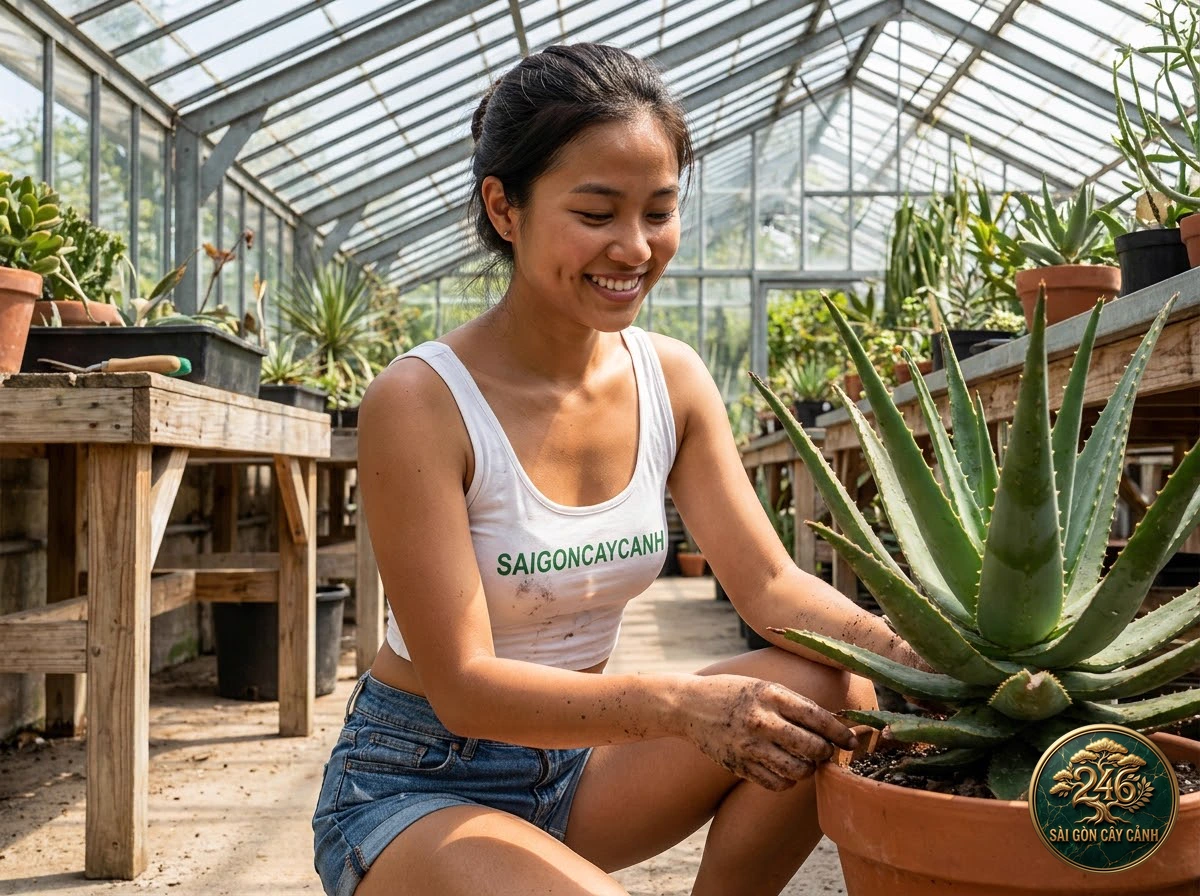
At Saigon Cay Canh greenhouse, each photograph captures genuine everyday care moments between plant lovers and living greenery, spreading a passion for nature and green-living inspiration.
18. Concluding Horticultural Appraisal
Aloe ferox introduces fearless resilience and commanding scale to residential landscapes. Sai Gon Cay Canh proudly documents this extraordinary arborescent succulent to advance botanical culture and horticultural excellence.
Aloe ferox stands as an uncompromising symbol of fearless strength, ancient endurance, and raw majesty derived from pristine southern African wilderness. Positioned prominently within villa entrances or refined architectural courtyards, this monumental tree succulent attests to sophisticated connoisseurship, botanical erudition, and elevated design taste for dedicated plant stewards.