Living plant profile
Spiral Aloe (Aloe polyphylla): Fibonacci Phyllotaxis, Alpine Ecology and High-Drainage Cultivation
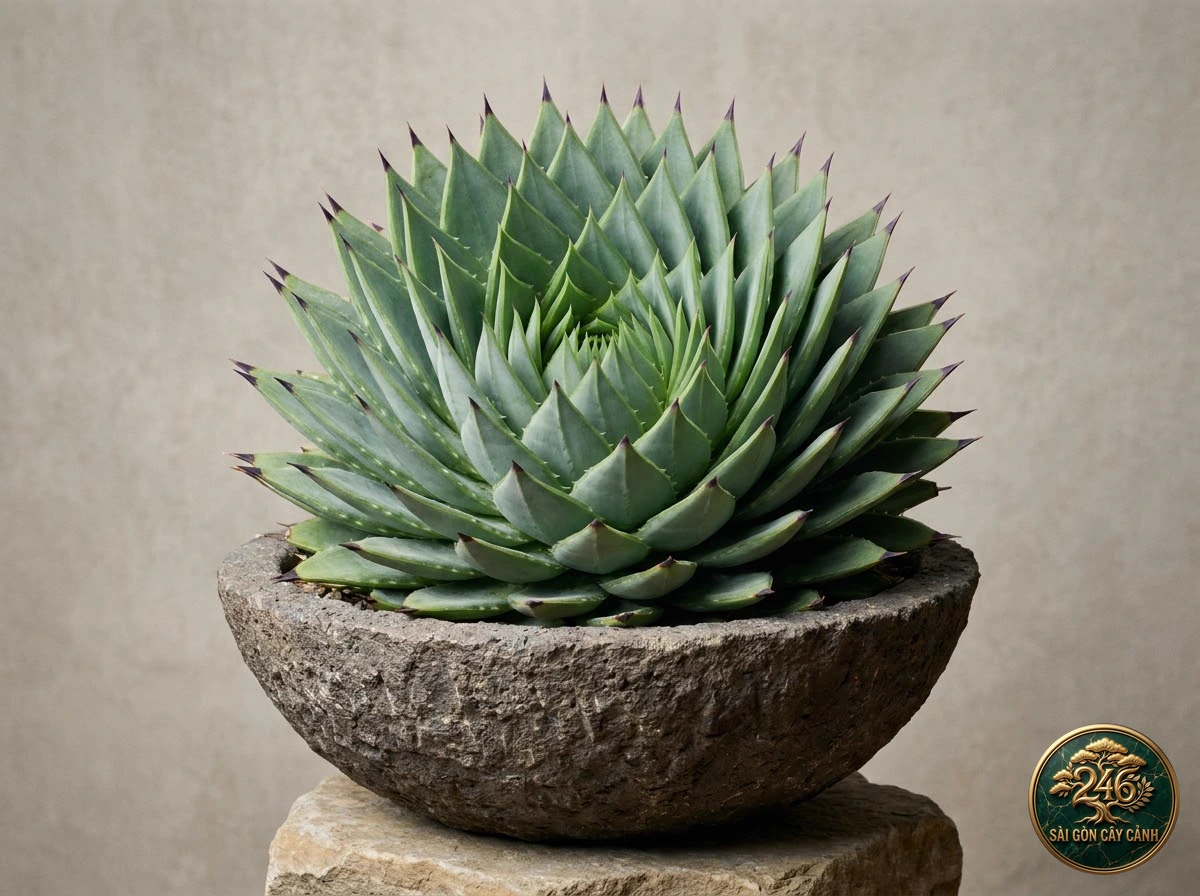
Aloe polyphylla
Sai Gon Cay Canh • Living Herbarium V2 Spiral Aloe (Aloe polyphylla): Fibonacci Phyllotaxis, Alpine Ecology and High-Drainage Cultivation Aloe polyphylla is hailed as the ultimate geometric marvel of the plant kingdom, showcasing five clockwise or counter-clockwise foliar spirals conforming to the golden Fibonacci sequence, native to the cool alpine peaks of Lesotho. Record ID: […]
Spiral Aloe (Aloe polyphylla): Fibonacci Phyllotaxis, Alpine Ecology and High-Drainage Cultivation
1. Botanical Morphology & Ecological Adaptations
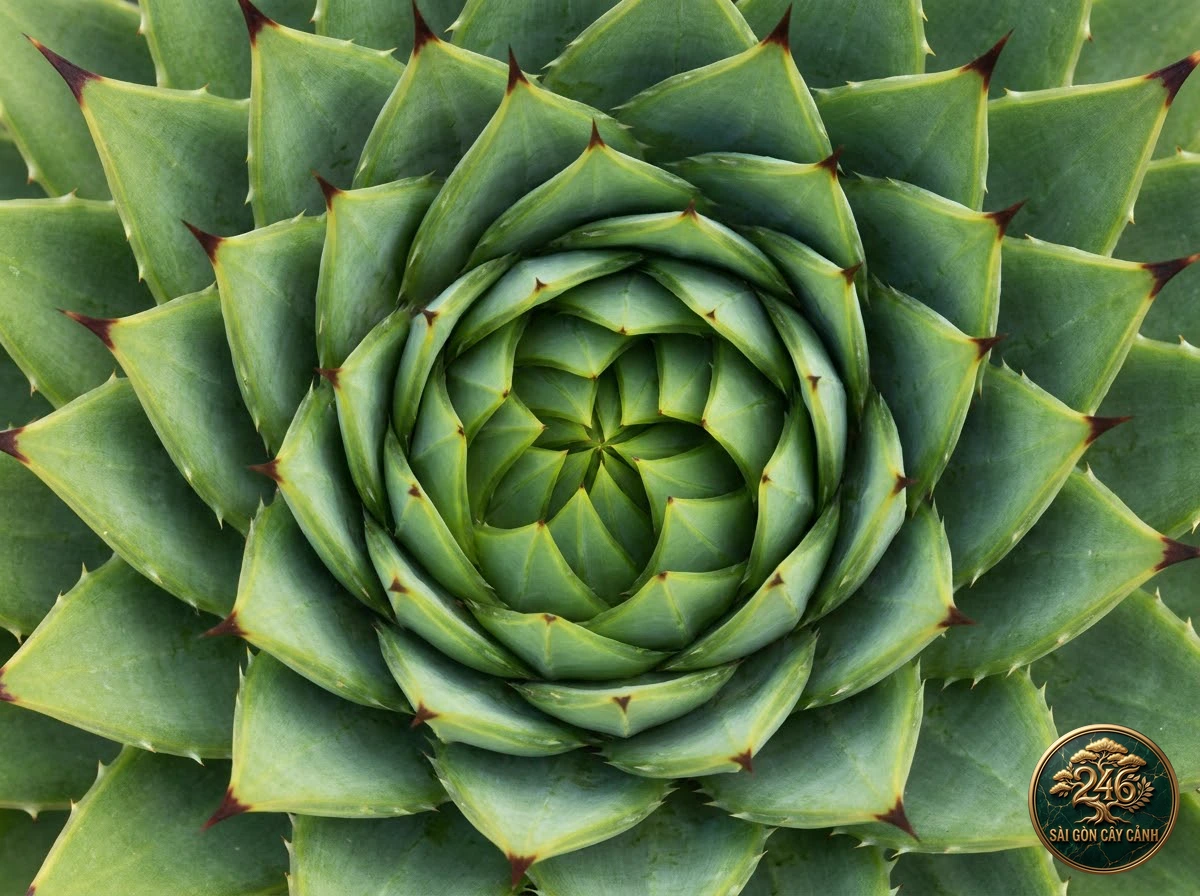
Aloe polyphylla, widely recognized under the vernacular name Spiral Aloe / Lesotho Aloe, is a highly distinguished succulent perennial belonging to the family Asphodelaceae. Native to the ecologically diverse landscapes of Maluti Mountains, Lesotho, this species has evolved sophisticated anatomical adaptations to endure severe seasonal droughts, rocky scree terrain, and fluctuating thermal regimes.
Aloe polyphylla represents a pinnacle of natural phyllotaxis, displaying a flawless five-tiered spiral rosette rotating either clockwise or counter-clockwise. Broad triangular glaucous-green leaves overlap with mathematical precision, tipped with striking purplish-brown terminal points.
Roots anchor deeply into alpine basaltic screes of Lesotho mountains kept perpetually cool and moist by melting seasonal precipitation. Reaching 80 cm across, mature specimens yield robust branched scapes of salmon-pink tubular flowers.
2. Taxonomic Chronicle & Botanical History
Aloe polyphylla (Spiral Aloe) is the revered national botanical treasure of the high-altitude Kingdom of Lesotho and one of the rarest, most celebrated succulents on Earth. South African botanist Neville Stuart Pillans first scientifically documented and published it in 1934 in South African Gardening. The specific epithet polyphylla derives from classical Greek polys (many) and phyllon (leaf), honoring the extraordinary foliar density of 150 to 200 leaves arranged in immaculate spiral perfection. It is strictly endemic to steep basalt scree slopes between 2,000 and 2,700 meters altitude in the Maluti Mountains, frequently blanketed in winter snow and swept by alpine clouds.
3. Histological Specialization & CAM Photosynthetic Pathway
Morphologically and biomathematically, Aloe polyphylla is the supreme living manifestation of the Fibonacci sequence in the botanical kingdom: mature canopies form precisely five ranks arranged in either clockwise or counter-clockwise logarithmic spirals. This spiral geometry achieves 100% light interception efficiency with zero foliar self-shading. Epidermal cells contain specialized antifreeze proteins and cold-tolerant enzymes enabling survival under freezing winter snow. Its root system forms a dense network anchoring into steep basalt scree, engineered for torrential water throughput with instantaneous gravitational runoff.
4. Comprehensive Care Compass (Care Compass 360°)
La bàn chăm sóc Sài Gòn Cây Cảnh
5. Diagnostic Pathology & Clinical Horticultural Interventions
Aloe polyphylla is acutely sensitive to root-zone heat; crown collapse or central softening emerges swiftly if substrate temperatures exceed 28 degrees Celsius under damp conditions.
| Observed Physical Symptom | Etiological Factor / Pathology | Horticultural Intervention Protocol |
|---|---|---|
| Leaves radiate outwards symmetrically without forming distinct spiral whorls | Juvenile physiological state (plant is under 3 – 4 years of age or fewer than 80 leaves) | Maintain consistent care; the iconic Fibonacci 5-spiral geometry activates automatically with maturity |
| Foliar tips develop abrupt black desiccation and brittle necrosis | Root-zone temperature exceeding 30°C during sultry tropical summer spells | Implement pot-in-pot insulated double terracotta setup, relocate to breezy shaded refuge |
| Basal crown develops sudden watery dark collapse, shedding spiral tiers | Phytophthora crown rot triggered by water pooling within leaf axils during heatwaves | Emergency unpotting: excise diseased tissue, treat with systemic fosetyl-Al, air-dry 7 days |
| Leaves emerge unnaturally thin, pale and mechanically brittle | Insufficient photosynthetic photon flux density (PPFD) | Install dedicated overhead 30W 4000K horticultural LED spotlight positioned 40 cm above crown |
6. Infrageneric Taxonomic Differentiation Matrix
The comparative review below highlights the unique five-ranked spiral phyllotaxis of Aloe polyphylla relative to symmetrical non-spiral rosettes:
| Taxonomic Characteristic | Aloe polyphylla (Spiral Aloe / Lesotho Aloe) | Comparative Counterpart A | Comparative Counterpart B |
|---|---|---|---|
| Phyllotactic Architecture | Strict pentagonal spiral clockwise or counter-clockwise whorl | Concentric radiating rosette without fixed spiral ranks | Two-ranked distichous fan arrangement |
| Foliar Density | Dense architectural rosette bearing up to 150 – 200 packed leaves | Moderate canopy typically consisting of 15 – 30 active leaves | Sparse rosette bearing only 8 – 14 mature leaves |
| Ecological Provenance | Alpine montane scree slopes above 2,000m in Lesotho | Warm temperate and subtropical lowland coastal thickets | Arid inland limestone and sandstone desert valleys |
| Vegetative Offsetting | Strictly solitary acaulescent crown; reproduces almost solely by seed | Prolific basal sucker production forming extensive mats | Produces adventitious lateral branches along aerial wood |
7. Vegetative Propagation & Offsetting Protocols
Propagating Aloe polyphylla represents the pinnacle of horticultural patience: because mature specimens remain strictly solitary with virtually zero basal offsetting, propagation is achieved almost exclusively via seed. Seeds possess dense cuticular coats and deep physiological dormancy; mechanical scarification using a sterile scalpel followed by a 24-hour warm water soak is essential before sowing. Germinate in cool alpine temperatures (15°C – 20°C) atop fine sterile pumice; seedlings emerge within 2 to 4 weeks. Young plants require 3 to 5 years of careful cultivation before initiating their iconic five-spiral geometry.
8. Phytopathology & Integrated Pest Management
The fatal vulnerability of Aloe polyphylla when cultivated in warm lowland environments is Phytophthora crown rot, triggered when root-zone temperatures exceed 28°C in damp substrate. Symptoms present as central crown collapse, tiered leaf drop, and sudden black vascular rot. Safeguarding this alpine treasure requires thick porous terracotta vessels elevated upon ventilated stands with active fan cooling, paired with non-organic scree aggregate. If symptoms emerge, immediately unpot, excise diseased tissue down to immaculate white parenchyma, treat with systemic fungicide, and nurse inside a cool air-conditioned space.
9. Companion Planting & Xerophytic Groupings
Within elite botanical conservatories and prestigious private collections, Aloe polyphylla commands premier solitary reverence. It pairs conceptually with extraordinary geometric alpine flora such as Albuca spiralis, intricate Agave victoriae-reginae, and choice montane succulents. The presence of a mature spiral specimen stands as definitive testament to supreme horticultural mastery and dedicated botanical connoisseurship.
10. Spatial Placement & Interior Architectural Styling
Aloe polyphylla transcends ordinary horticulture, functioning as a sublime masterpiece of living mathematical art. It attains museum-grade exhibition status when showcased in solitary majesty within artisan smoke-grey stoneware, carved natural sandstone, or honed granite plinths. Installed as the crowning centerpiece of an atrium, cool morning-lit skylight, or luxury penthouse foyer, it commands breathless admiration, epitomizing natural cosmic geometry.
11. Urban Apartment Microclimates & Architectural Cultivation
Aloe polyphylla represents the ultimate horticultural aspiration for discerning collectors in warm urban centers. Hailing from subalpine Lesotho peaks, the decisive cultural factor is keeping root cores below 26°C using double-insulated terracotta vessels inside climate-controlled rooms with overhead LED grow lights.
To successfully nurture the prized Aloe polyphylla within tropical urban microclimates, deploy continuous cooling fans and station the specimen beneath rain shelters receiving bright morning photons. Choose thick-walled unglazed terracotta or breathable stone urns with oversized drainage apertures. When summer temperatures climb above 35 degrees Celsius, transfer the container to air-conditioned quarters under full-spectrum horticultural lighting to buffer vulnerable alpine roots from heat stress.
12. Domestic Pet Safety & Household Placement Guidelines
TOXIC TO COMPANION PETS (ASPCA Warning) – Contains bitter secondary anthraquinone metabolites; keep out of reach of curious domestic pets.
Foliar sap carries bitter aloin compounds; wear gloves during repotting and safeguard this high-value alpine botanical treasure against pet curiosity.
13. In-Depth Botanical Q&A with Sai Gon Cay Canh
Frequently Asked Question: Why is my two-year-old Spiral Aloe growing in a regular round rosette without any visible spiral?
Expert Diagnosis from Saigon Cay Canh: Rest assured and remain patient! This is the standard developmental ontogeny of Aloe polyphylla. During its juvenile stage (bearing fewer than 70 to 80 leaves, typically the first 3 to 4 years), foliage radiates outward in conventional radial symmetry. Only when the specimen reaches roughly 20 to 25 cm in diameter and accumulates sufficient metabolic reserves does genetic biological signaling activate asymmetrical meristematic cell division, initiating the legendary 5-ranked Fibonacci spiral. Continue disciplined care with cool roots and scree drainage; your patience will be rewarded with a priceless botanical wonder.
14. Nursery Botanical Journal & Green Sanctuary Notes
Within the microclimate laboratory of Sai Gon Cay Canh, our mature Aloe polyphylla specimen exhibits synchronized clockwise Fibonacci spiral phyllotaxis. Each newly emerging leaf is a living geometric marvel that captivates visiting botanists.
Witnessing the leaves of juvenile Aloe polyphylla begin their mathematical spiral revolution into five discrete Fibonacci tiers at our research sanctuary is an unforgettable experience. The plant stands as a living testament to sacred geometry and the boundless wonder of evolutionary botany.
15. Seasonal Mineral Nutrition & Micro-Nutrient Management
Nutrition for the Spiral Aloe must remain exceptionally pure and minimal: apply mineral-infused water blended with cold kelp extract at one-tenth strength at daybreak. Basalt scree substrate must flush water instantaneously to maintain unrestricted root aeration.
Nutritional management for Spiral Aloe demands master-level finesse: apply ultra-dilute organic mineral solutions at one-eighth label strength exclusively during cool rainy spells. Never permit liquid nutrients to splash into the delicate central spiral whorl, and cease fertilization during warm weather.
16. In-Situ Conservation Status & Ethical Botanical Stewardship
Aloe polyphylla is strictly protected under CITES Appendix I due to historic commercial poaching. All living accessions at Sai Gon Cay Canh originate from legally certified nursery seed cultivation, maintaining zero tolerance for wild-collected plants.
Aloe polyphylla is strictly protected under CITES Appendix I as an endangered natural treasure. Sai Gon Cay Canh certifies that every accession originates exclusively from certified in-vitro tissue culture laboratories, standing resolutely against poaching to preserve Lesotho’s alpine heritage.
17. Native Habitat Ecology & Environmental Stress Physiology
Aloe polyphylla (Spiral Aloe) is globally celebrated as a botanical marvel, endemic exclusively to the rugged basalt precipices of the Maloti Mountains in Lesotho at altitudes between 2,000 and 3,000 meters. Its wild habitat is acutely extreme: sheer basaltic slopes cloaked in winter snowdrifts and drenched by misty summer cloudbursts. Cold snowmelt trickles continuously through porous basalt scree, delivering oxygenated moisture that drains instantly without stagnating at the root crown. Summer ambient temperatures in these alpine heights rarely surpass 22 degrees Celsius.
The crowning wonder of Aloe polyphylla is its flawless spiral phyllotaxis governed by Fibonacci mathematics: mature accessions organize over 150 leaves into five discrete geometric spirals rotating clockwise or counter-clockwise. This architecture maximizes solar photon capture without overlapping shadows while functioning as drainage flutes that divert snowmelt away from the central heart to prevent rot. The subterranean roots demand constant coolness and high dissolved oxygen. Cultivating Spiral Aloe in tropical urban environments requires master-level horticulture: coarse mineral substrates, cool watering schedules, and continuous airflow to buffer root-zone heat stress.
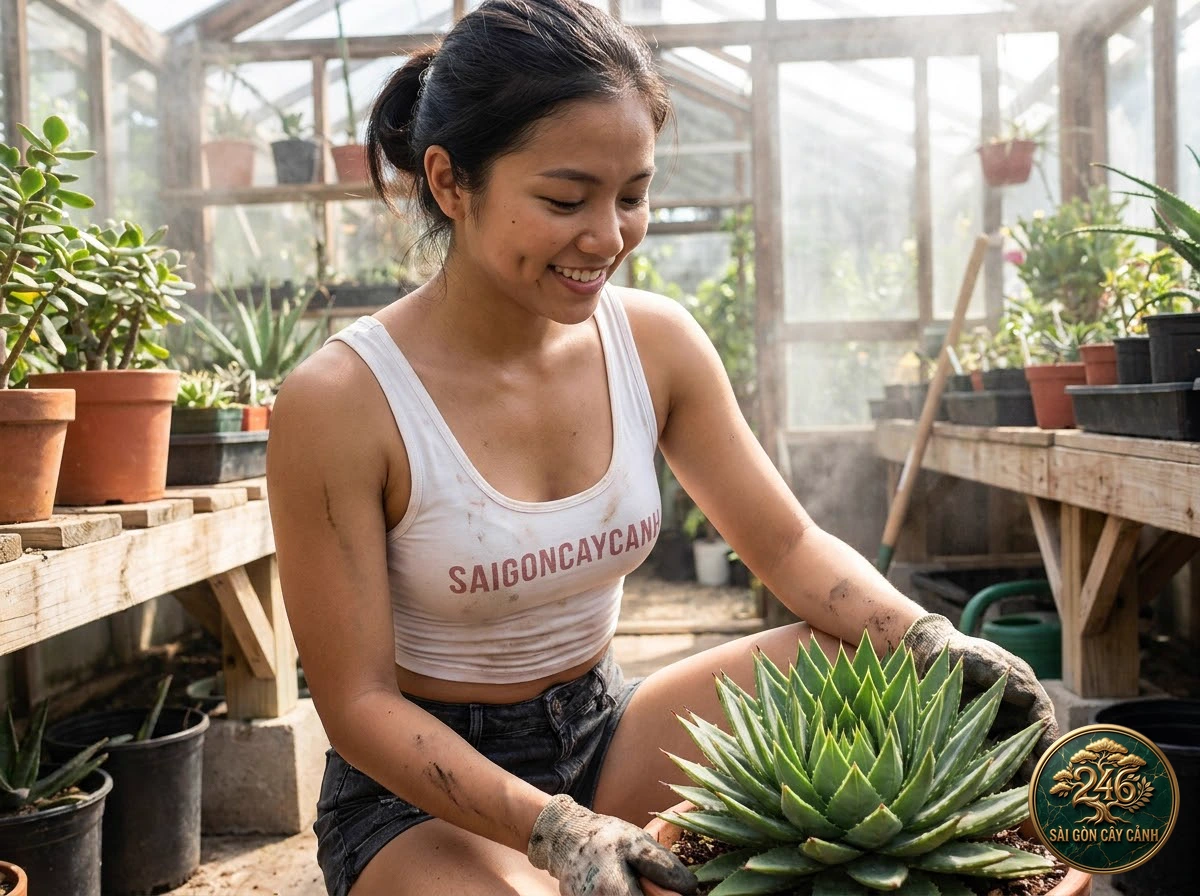
Nursery Care Journal & Living Greenery Moments
At Saigon Cay Canh greenhouse, each photograph captures genuine everyday care moments between plant lovers and living greenery, spreading a passion for nature and green-living inspiration.
18. Concluding Horticultural Appraisal
This monograph on Aloe polyphylla by Sai Gon Cay Canh represents a dedicated tribute to nature’s supreme geometric masterpiece, inspiring enduring reverence for botanical evolutionary wonders.