Living plant profile
Tiger aloe
Aloe variegata
Aloe Asphodelaceae Living Herbarium Master V2 Tiger Aloe (Aloe variegata): Trifarious Foliar Architecture, Cuticular Variegation and Xerophytic Cultivation Scientific Name: Aloe variegata L. Common Name: Tiger Aloe / Partridge Breast Aloe Family: Asphodelaceae Native Range: Karoo region, South Africa and southern Namibia Aloe variegata is an iconic dwarf succulent prized for its trifarious keel-shaped leaves […]
Tiger Aloe (Aloe variegata): Trifarious Foliar Architecture, Cuticular Variegation and Xerophytic Cultivation
Common Name: Tiger Aloe / Partridge Breast Aloe
Family: Asphodelaceae
Native Range: Karoo region, South Africa and southern Namibia
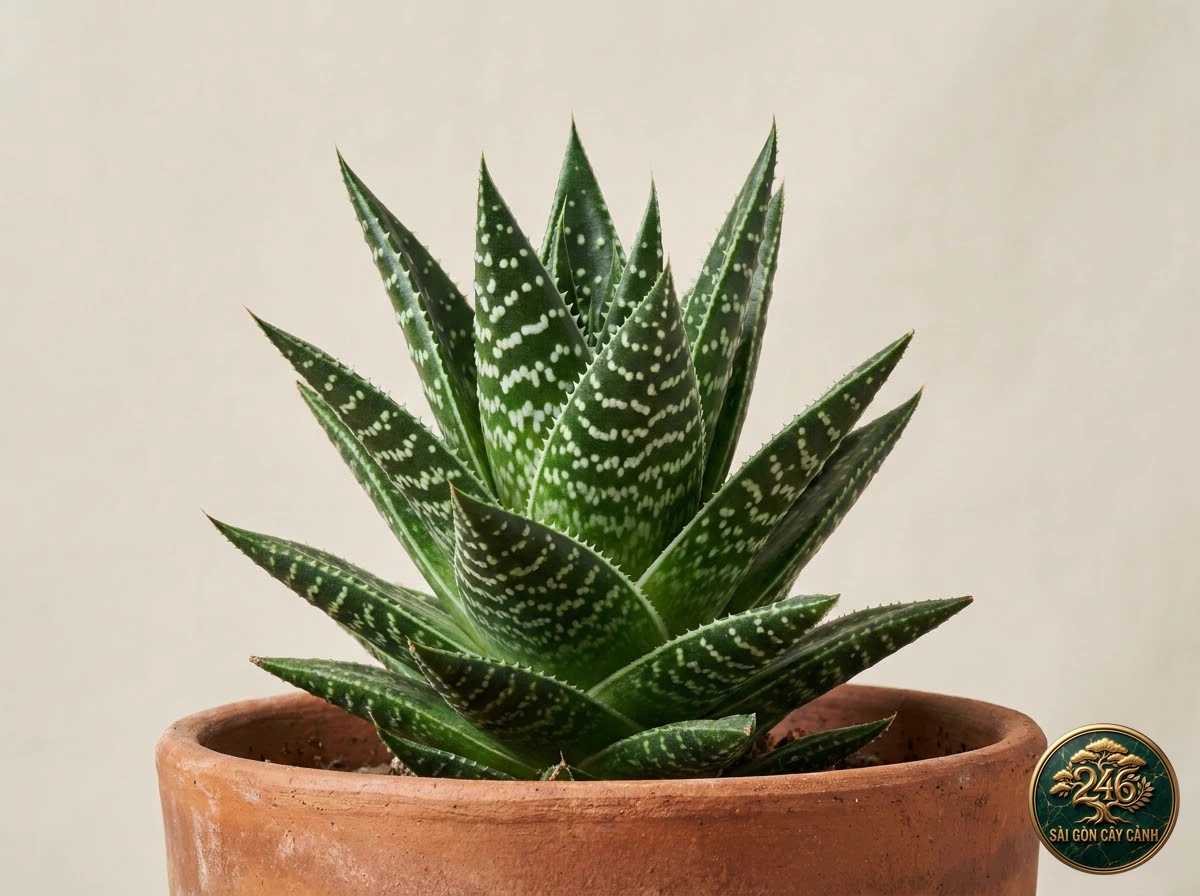
Aloe variegata is an iconic dwarf succulent prized for its trifarious keel-shaped leaves adorned with striking white transverse variegation and vibrant coral-pink blossoms well-adapted to urban living spaces.
Sài Gòn Cây Cảnh Care Compass
1. Geographic Origin & Taxonomic Nomenclature History
Aloe variegata was originally cataloged by Carl Linnaeus in 1753. Wild populations inhabit arid gravel plains of the Karoo basin across South Africa and southern Namibia, where harsh desert conditions sculpted its trifarious foliar architecture.
At the cellular level, this tiger aloe develops a dense waxy cutin shield enveloping each triangular keel blade, drastically curbing transpirational water loss under intense desert solar flux.
2. Morphological Architecture & Anatomical Specializations
Foliar anatomical analysis reveals compact assimilatory parenchyma arranged in a three-ranked prism, with transverse white mottled bands formed by specialized light-reflecting crystalline cells.
Strict nocturnal Crassulacean Acid Metabolism opens stomatal apertures during cool night hours to assimilate carbon, preserving hydraulic reserves within inner succulent leaf blades.
3. Photosynthetic Radiance & Urban Microclimate Dynamics
Lighting requirements for Aloe variegata center upon bright filtered daylight or gentle morning rays between 2,500 and 5,000 lux, maintaining high contrast between emerald green and white bands.
When displayed on office workstations or shelving, position containers near east-facing apertures with gentle airflow, avoiding harsh unshielded midday sun that scorches leaves.
4. Mineral Substrate Engineering & Fast Percolation Dynamics
Substrate formulation mandates an airy porous blend of 45% pumice, 25% perlite, 15% volcanic scoria, and 15% aged washed coco coir, ensuring fine root systems breathe continuously.
High mineral fractions guarantee irrigation water percolates instantaneously through container drain ports, preventing stagnant dampness around the delicate basal collar.
5. Biological Irrigation Protocols & Seasonal Rhythm
Hydration cycles follow strict dry-down discipline, applying deep sub-irrigation only when the root mass is 80-90% desiccated after ten to fourteen days.
During prolonged overcast periods with elevated ambient humidity, stretch intervals between watering to stimulate root vigor without fungal hazards.
6. Trace Mineral Nutrition & Slow-Release Fertility Protocols
Administer cold-pressed organic kelp extract at very mild concentrations bimonthly during spring vegetative awakening, fortifying cuticular durability.
Naturally available potassium reserves reinforce succulent cell wall turgidity, elevating resistance against urban indoor microclimate fluctuations.
7. Vegetative Propagation Protocols & Aseptic Methodology
Vegetative propagation proceeds by detaching basal suckers in early warm seasons, dusting severed surfaces with powdered activated charcoal to halt sap exudate.
Treated offsets rest in well-aerated dry shade for ten days until wound margins suberize into firm protective shields prior to rooting in moist mineral grit.
8. Botanical Toxicity Profile & Contact Protocols
Bitter yellow aloin compounds concentrated beneath the epidermal layer of Aloe variegata can induce mild gastrointestinal irritation in dogs and cats if chewed.
Keep containers elevated out of pet reach and wash hands with mild soap after performing routine grooming of withered lower leaves.
9. Physiological Diagnostics & Integrated Pest Management
The clinical physiological guide below provides early diagnostic indicators for identifying cultivation stresses on this species:
| Clinical Symptom | Primary Root Cause | Standard Corrective Protocol |
|---|---|---|
| Basal leaves soften with brownish translucent rot | Waterlogging at pot bottom or premature watering before substrate dries | Unpot immediately, excise rot, dust wounds with sulfur, air-dry 5 days |
| White mottling fades, internodes stretch and leaves loosen | Insufficient photosynthetic photon flux in dim indoor positions | Relocate near east-facing window or install 12-hour horticultural LED |
| Foliage turns dull reddish-purple and margins curl inward | Excessive scorching midday ultraviolet rays stressing epidermal cuticle | Provide 50% shade screening or pull pot 1 meter away from hot window glass |
| White cottony flocs hidden deep within tightly packed leaf sheaths | Mealybug infestation (Pseudococcidae) feeding on vascular sap | Dab directly with 70% alcohol-moistened cotton buds, follow with organic neem spray |
10. Comparative Taxonomic Evaluation Across Allied Taxa
The diagnostic matrix below clarifies morphological distinctions separating Aloe variegata from closely allied dwarf succulent aloe relatives:
| Species Taxon | Morphological Trait | Growth Architecture | Diagnostic Indicator |
|---|---|---|---|
| Foliar Arrangement | Trifarious rank forming distinct triangular prism | Multitiered radiating concentric circular rosette | Strictly distichous two-ranked planar fan |
| Coloration and Pattern | Dark green with prominent transverse white mottled bars | Glaucous blue-green with soft prickles on surfaces | Dull greyish-green with raised white verrucose pustules |
| Marginal Denticulation | Delicate cartilaginous white minutely serrulate teeth | Soft white conical spines along margins and surfaces | Smooth, cartilaginous, entire margin without spines |
| Indoor Low-Light Resilience | Exceptional form stability under bright desk lighting | Requires stronger direct morning photons to stay tight | Very shade tolerant but mandates gritty porous soil |
11. Urban Landscape Architecture & Living Display Design
The sculpted three-angled form of Aloe variegata delivers serene structural elegance when paired with handcrafted ash-grey stoneware on modern executive desks.
Its restrained growth habit and absence of sprawling limbs make this species ideal for minimalist interior landscapes and contemporary botanic spaces.
Nursery Care Journal & Living Greenery Moments
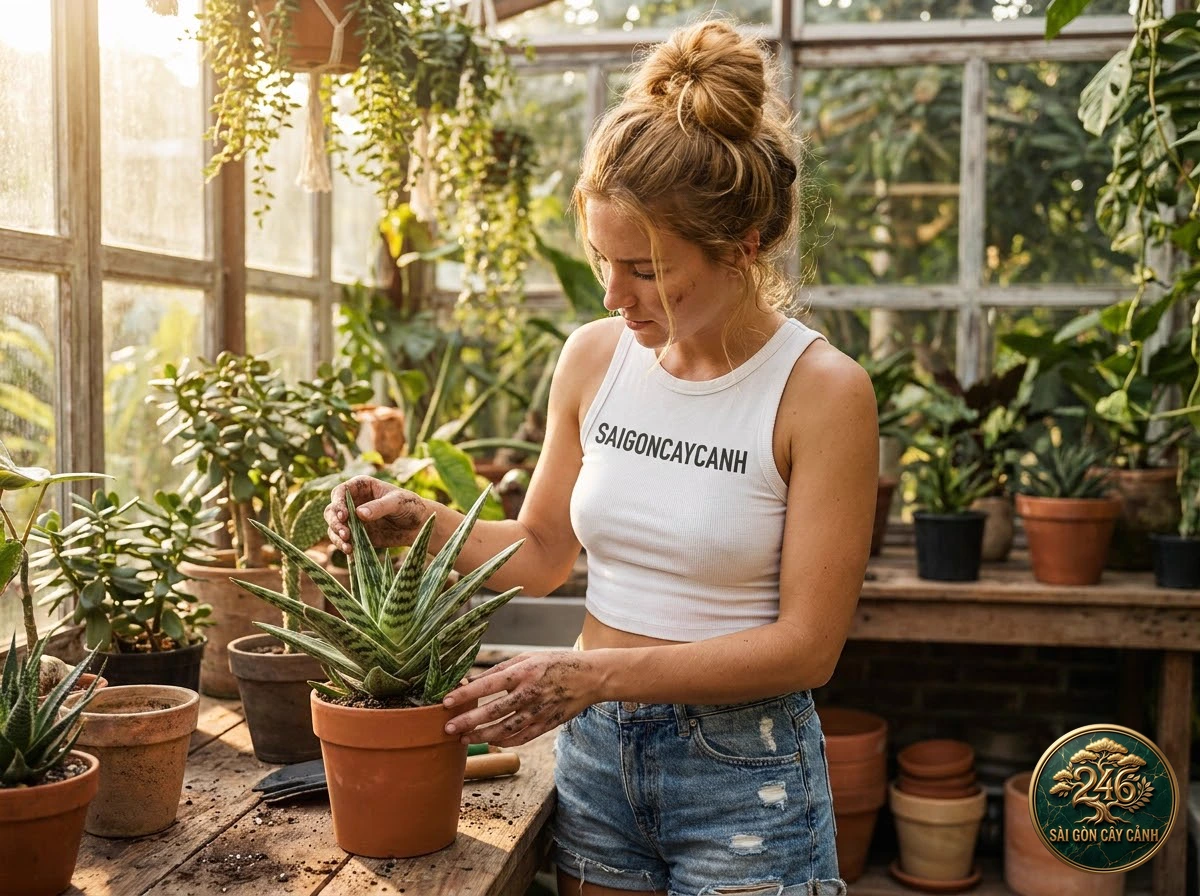
At Saigon Cay Canh greenhouse, each photograph captures genuine everyday care moments between plant lovers and living greenery, spreading a passion for nature and green-living inspiration.