Living plant profile
African milk barrel
Euphorbia horrida
Euphorbia Euphorbiaceae Living Herbarium Master V2 African Milk Barrel (Euphorbia horrida): Ribbed Barrel Architecture, Persistent Peduncular Spines and Xerophytic Longevity Scientific Name: Euphorbia horrida Boiss. Common Name: African Milk Barrel Family: Euphorbiaceae Native Range: Eastern Cape, South Africa Euphorbia horrida is a formidable barrel-like succulent featuring deeply furrowed undulating ribs coated in glaucous blue-grey wax […]
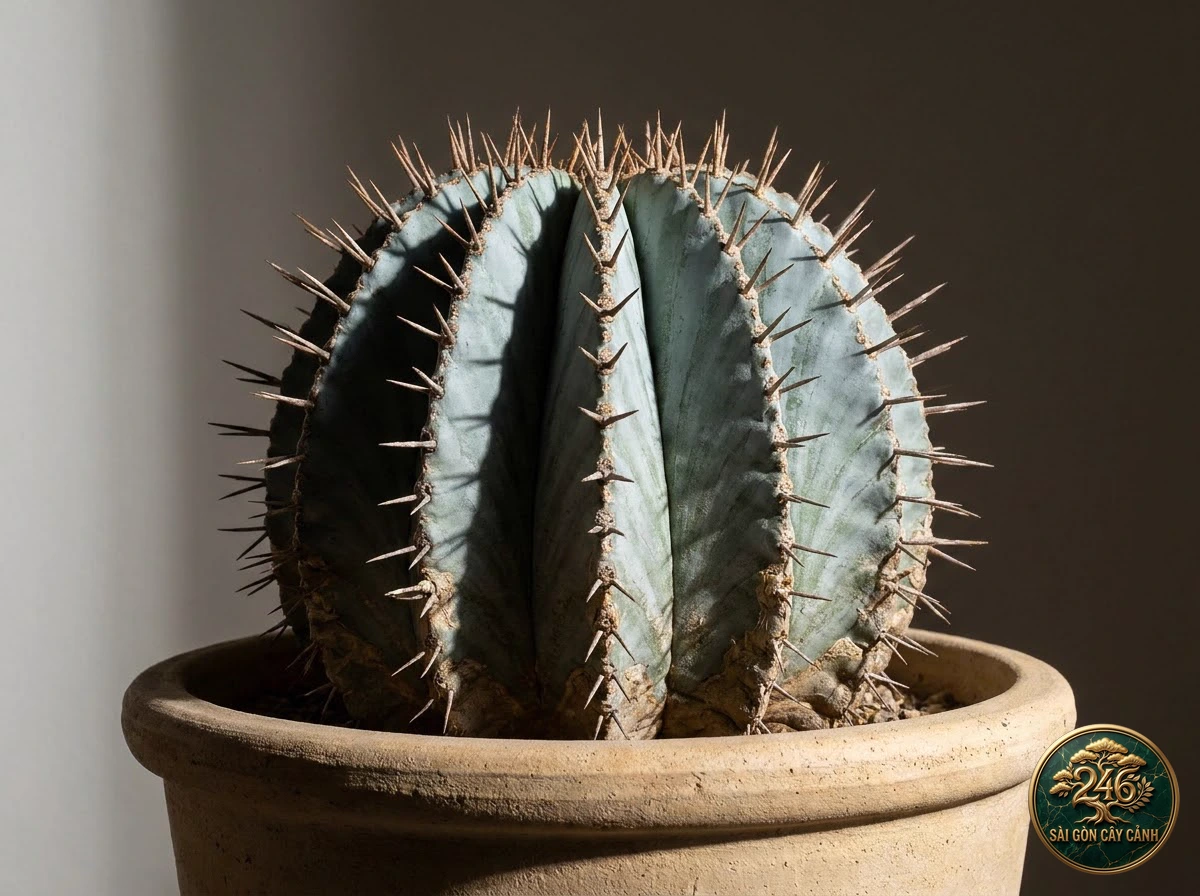
African Milk Barrel (Euphorbia horrida): Ribbed Barrel Architecture, Persistent Peduncular Spines and Xerophytic Longevity
Common Name: African Milk Barrel
Family: Euphorbiaceae
Native Range: Eastern Cape, South Africa
Euphorbia horrida is a formidable barrel-like succulent featuring deeply furrowed undulating ribs coated in glaucous blue-grey wax and fortified by persistent woody peduncular spines.
Sài Gòn Cây Cảnh Care Compass
1. Geographic Origin & Taxonomic Nomenclature History
Euphorbia horrida was cataloged by Swiss botanist Pierre Edmond Boissier in 1860. The species inhabits arid rocky slopes and sandstone outcrops across the Eastern Cape of South Africa.
Stems form heavy barrel-like columns marked by deeply furrowed undulating ribs coated in glaucous blue-grey wax and armed with rigid woody peduncular spines.
2. Morphological Architecture & Anatomical Specializations
Anatomical study reveals that deeply pleated accordion-like ribs expand and contract dynamically to store rainfall without rupturing outer cuticular tissues.
Spines represent persistent lignified flower stalks that harden after blooming, forming a permanent defensive palisade shielding fleshy succulent reserves.
3. Photosynthetic Radiance & Urban Microclimate Dynamics
Generous direct morning sun and strong diffused photons from 4,000 to 8,000 lux stimulate epidermal cells to secrete a chalky glaucous epicuticular wax layer.
Position pots on sunny balconies or open terraces; low-light positions cause the protective chalky wax to fade into plain lustrous green.
4. Mineral Substrate Engineering & Fast Percolation Dynamics
Substrate formulation utilizes coarse gritty minerals: 45% pumice, 25% red volcanic scoria, 15% perlite, and 15% aged washed coco coir.
This gravelly structure enables instant percolation through pot drainage ports, preventing damp rot at the vulnerable basal soil interface.
5. Biological Irrigation Protocols & Seasonal Rhythm
Hydration follows an extended cyclical rhythm: soak thoroughly only after 90% soil desiccation, spaced ten to fifteen days apart in summer.
During humid rainy seasons, keep the pot bone-dry; deep barrel reservoirs enable this species to thrive across prolonged periods without a drop of water.
6. Trace Mineral Nutrition & Slow-Release Fertility Protocols
Administer minute applications of diluted micronutrient wash bimonthly during spring and summer flushes to support robust barrel firmness and wax development.
Avoid excessive fertilizers that induce soft rapid swelling, preserving its classic rugged barrel silhouette and tight undulating ribbing.
7. Vegetative Propagation Protocols & Aseptic Methodology
Euphorbia horrida produces basal offsets over time; harvest side pups in spring using a sterile scalpel, dusting wounds with activated charcoal powder.
Cure pups in breezy dry shade for fourteen days until callused firmly before setting onto moist mineral grit to establish independent root systems.
8. Botanical Toxicity Profile & Contact Protocols
Milky diterpene latex in Euphorbia horrida is caustic to skin and eyes; its persistent woody spines also present severe mechanical puncture hazards.
Always wear sturdy leather gloves and safety glasses during handling; situate containers safely away from active pet and child traffic areas.
9. Physiological Diagnostics & Integrated Pest Management
The clinical monitoring rubric below outlines diagnostic symptoms and responsive corrective measures for barrel spurges:
| Clinical Symptom | Primary Root Cause | Standard Corrective Protocol |
|---|---|---|
| Chalky glaucous blue-grey epicuticular wax fades to plain green | Low light levels or accidental mechanical wiping stripping protective wax | Provide direct morning irradiance to allow epidermal cells to secrete fresh wax crystals |
| Basal zone blackens with faint acidic odor from anaerobic rot | Chronic moisture retention caused by poorly drained pot or stagnant saucer puddle | Excise necrotic tissues, dust wounds with sulfur, air-dry 7 days, replant in porous terracotta |
| Woody spine breaks off exuding droplet of caustic white sap | Physical impact during handling fracturing dried vascular peduncle base | Blot latex cleanly with sterile tissue, shield wound from water for 5 days until callused |
| Basal offsets proliferate intensely bulging container walls | Natural caespitose offsetting behavior forming an expansive specimen cluster | Upsize to shallow unglazed stoneware bowl 5-7 cm wider to provide sprawling room |
10. Comparative Taxonomic Evaluation Across Allied Taxa
The comparative analytical rubric below clarifies morphological traits distinguishing Euphorbia horrida from similar barrel succulents:
| Species Taxon | Morphological Trait | Growth Architecture | Diagnostic Indicator |
|---|---|---|---|
| Stem Form Factor | Deeply furrowed barrel with sharp undulating ribs | Smooth spherical baseball globe without deep ribs | Upright vertical 3-winged column reaching ceiling height |
| Spine Ontogeny | Derived from persistent lignified dried flower peduncles | Completely absent; devoid of spines or woody peduncles | Modified paired stipular thorns along stem edges |
| Cuticular Tone | Chalky glaucous grey-blue wax mimicking carved gypsum | Transverse purple-brown chevron stitches on green skin | Deep green marked with bold longitudinal milky chevrons |
| Offsetting Pattern | Prolifically caespitose at base forming dense multi-barrel colonies | Predominantly solitary unbranched sphere in wild form | Branches predominantly from upper trunk nodes into a tree |
11. Urban Landscape Architecture & Living Display Design
The chalky blue-grey ribbed barrel of Euphorbia horrida introduces commanding rugged sculpture when potted in rustic unglazed terracotta.
It stands as an anchor of stoic resilience on stone balconies or raw timber consoles, symbolizing steadfast fortitude in modern living spaces.
Nursery Care Journal & Living Greenery Moments
At Saigon Cay Canh greenhouse, each photograph captures genuine everyday care moments between plant lovers and living greenery, spreading a passion for nature and green-living inspiration.