Living plant profile
Red spine euphorbia
Euphorbia enopla
Euphorbia Euphorbiaceae Living Herbarium Master V2 Red Spine Euphorbia (Euphorbia enopla): Crimson Peduncular Spines, Candelabriform Branching and Succulent Display Scientific Name: Euphorbia enopla Boiss. Common Name: Red Spine Euphorbia Family: Euphorbiaceae Native Range: Willowmore district, Eastern Cape, South Africa Euphorbia enopla is a breathtaking South African succulent renowned for its profuse, vibrant crimson-red spines emerging […]
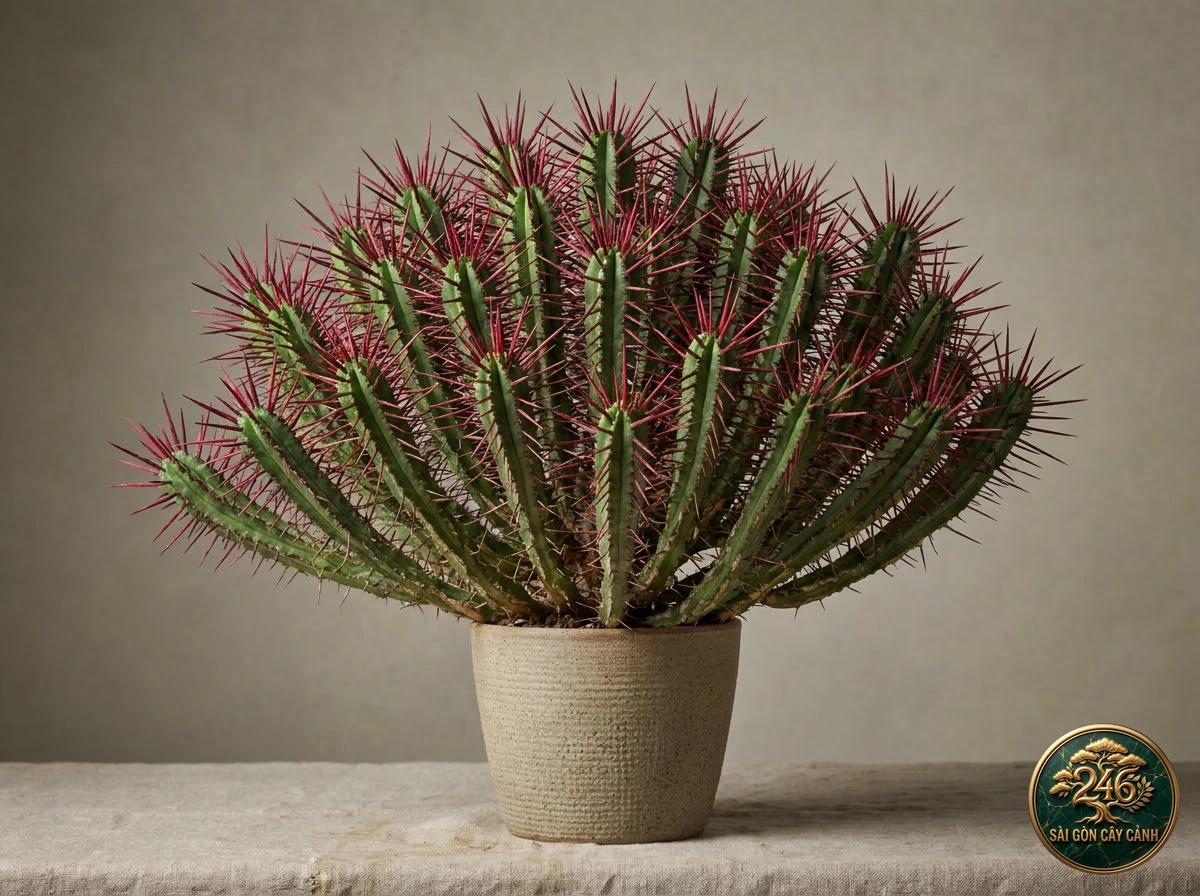
Red Spine Euphorbia (Euphorbia enopla): Crimson Peduncular Spines, Candelabriform Branching and Succulent Display
Common Name: Red Spine Euphorbia
Family: Euphorbiaceae
Native Range: Willowmore district, Eastern Cape, South Africa
Euphorbia enopla is a breathtaking South African succulent renowned for its profuse, vibrant crimson-red spines emerging along ribbed stems to create an extraordinary sculptural contrast.
Sài Gòn Cây Cảnh Care Compass
1. Geographic Origin & Taxonomic Nomenclature History
Euphorbia enopla was documented by Pierre Edmond Boissier in 1860. This dazzling succulent is native to gravelly scrub hills of the Willowmore district in the Eastern Cape, South Africa.
Its crowning botanical trait is hundreds of prominent ruby-red peduncular spines projecting along deep green ribbed stems, creating an unrivaled chromatic contrast.
2. Morphological Architecture & Anatomical Specializations
Stems branch profusely from the base into a caespitose pincushion thicket, with longitudinal ribs bearing modified floral peduncles that harden into defensive crimson spines.
The vivid red hue of juvenile spines results from concentrated anthocyanin pigments shielding tender apical meristems from ultraviolet solar stress.
3. Photosynthetic Radiance & Urban Microclimate Dynamics
Culture demands abundant direct sunlight between 4,000 and 7,500 lux; generous solar radiation is vital to sustain luminous ruby-red coloration along apical spines.
Situate pots on east-facing balconies or open terraces with breezy circulation to ensure interior branches receive adequate airflow and light penetration.
4. Mineral Substrate Engineering & Fast Percolation Dynamics
The mineral-rich substrate features 45% pumice, 25% crushed volcanic rock, 15% perlite, and 15% seasoned vermicompost free of soil-borne pathogens.
Granular porosity permits immediate drainage, keeping crowded basal joints clean and eliminating damp rot risks during wet seasons.
5. Biological Irrigation Protocols & Seasonal Rhythm
Irrigation cycles occur every ten to fourteen days during warm months, applying deep drenching strictly after substrate desiccates completely.
During humid rainy periods, widen watering intervals to three or four weeks to encourage deep root exploration and maintain firm spine turgor.
6. Trace Mineral Nutrition & Slow-Release Fertility Protocols
Apply diluted organic liquid micronutrients bimonthly in spring and summer to nourish newly emerging red spine crests along stem apices.
Avoid synthetic nitrogen fertilizers that stimulate weak elongated branchlets and cause red spines to fade prematurely into dull grey.
7. Vegetative Propagation Protocols & Aseptic Methodology
Propagate by detaching semi-hardwood basal branchlets in spring using a razor blade, rinsing in cool water to seal sap, and dusting with activated charcoal.
Rest cuttings in airy dry shade for twelve days until cut faces suberize firmly before inserting into moist mineral grit to establish root crowns.
8. Botanical Toxicity Profile & Contact Protocols
White diterpene sap in Euphorbia enopla causes intense skin burning; its sharp crimson spines also present severe mechanical puncture hazards.
Wear heavy leather gloves when repotting or pruning; keep pots positioned well away from curious pets and toddlers to avoid accidental injury.
9. Physiological Diagnostics & Integrated Pest Management
The diagnostic reference guide below details identifiable clinical symptoms and nursery remedies for red-spine spurges:
| Clinical Symptom | Primary Root Cause | Standard Corrective Protocol |
|---|---|---|
| New apical spines emerge pale greyish-brown without crimson tone | Insufficient direct solar photons to activate anthocyanin photoprotective synthesis | Relocate to direct morning sunlight for at least 3-4 hours daily |
| Elongated thin branchlets distort the compact branching framework | Etiolation stemming from stagnant low-light positioning indoors | Prune weak elongated shoots, reposition pot into bright sunny exposure |
| Inner branchlets within dense clump yellow and drop | Overly congested canopy causing internal air stagnation and light starvation | Thin out crowded interior twigs to restore continuous cross-ventilation |
| Mealybugs nestling securely around bases of sharp red spines | Pests exploiting dense spiny protection to tap into stem nutrients | Target spray using pressurized diluted 70% alcohol solution to dislodge colonies |
10. Comparative Taxonomic Evaluation Across Allied Taxa
The comparative matrix below highlights key botanical differences separating Euphorbia enopla from allied pincushion spurges:
| Species Taxon | Morphological Trait | Growth Architecture | Diagnostic Indicator |
|---|---|---|---|
| Spine Coloration | Vivid glowing crimson-red in youth, maturing to purplish-grey | Monochrome silvery-grey or weathered brown | Short dark brown or black paired prickles |
| Branching Architecture | Dense caespitose clustering forming rounded spiny hedgehog shrub | Single heavy ribbed barrel occasionally offsetting at base | Massive arborescent candelabra branching above trunk |
| Branch Caliber | Slender ribbed branches measuring 2-3 cm in diameter | Substantial barrel trunk measuring 10-15 cm in diameter | Massive columnar limbs measuring 15-30 cm across |
| Visual Accent | Unrivaled chromatic contrast of red spines on green flesh | Sculptural rugged barrel texture and deep shadows | Monolithic architectural scale and vertical dominance |
11. Urban Landscape Architecture & Living Display Design
The vivid chromatic contrast of ruby-red spines set against rich green stems transforms Euphorbia enopla into an electrifying living art piece in modern homes.
Its pincushion coral habit infuses dynamic vitality into interior collections, celebrating the boundless inventiveness of desert flora.
Nursery Care Journal & Living Greenery Moments
At Saigon Cay Canh greenhouse, each photograph captures genuine everyday care moments between plant lovers and living greenery, spreading a passion for nature and green-living inspiration.