
Living plant profile
Candelabra tree euphorbia
Euphorbia ingens
Euphorbia Euphorbiaceae Living Herbarium Master V2 Candelabra Tree Euphorbia (Euphorbia ingens): Giant Arborescent Architecture, Segmented Stems and Latex Protocol Scientific Name: Euphorbia ingens E.Mey. ex Boiss. Common Name: Candelabra Tree Euphorbia / Naboom Family: Euphorbiaceae Native Range: Southern and Eastern Africa Euphorbia ingens (Naboom) is an imposing arborescent succulent forming a massive, dense candelabrum crown […]
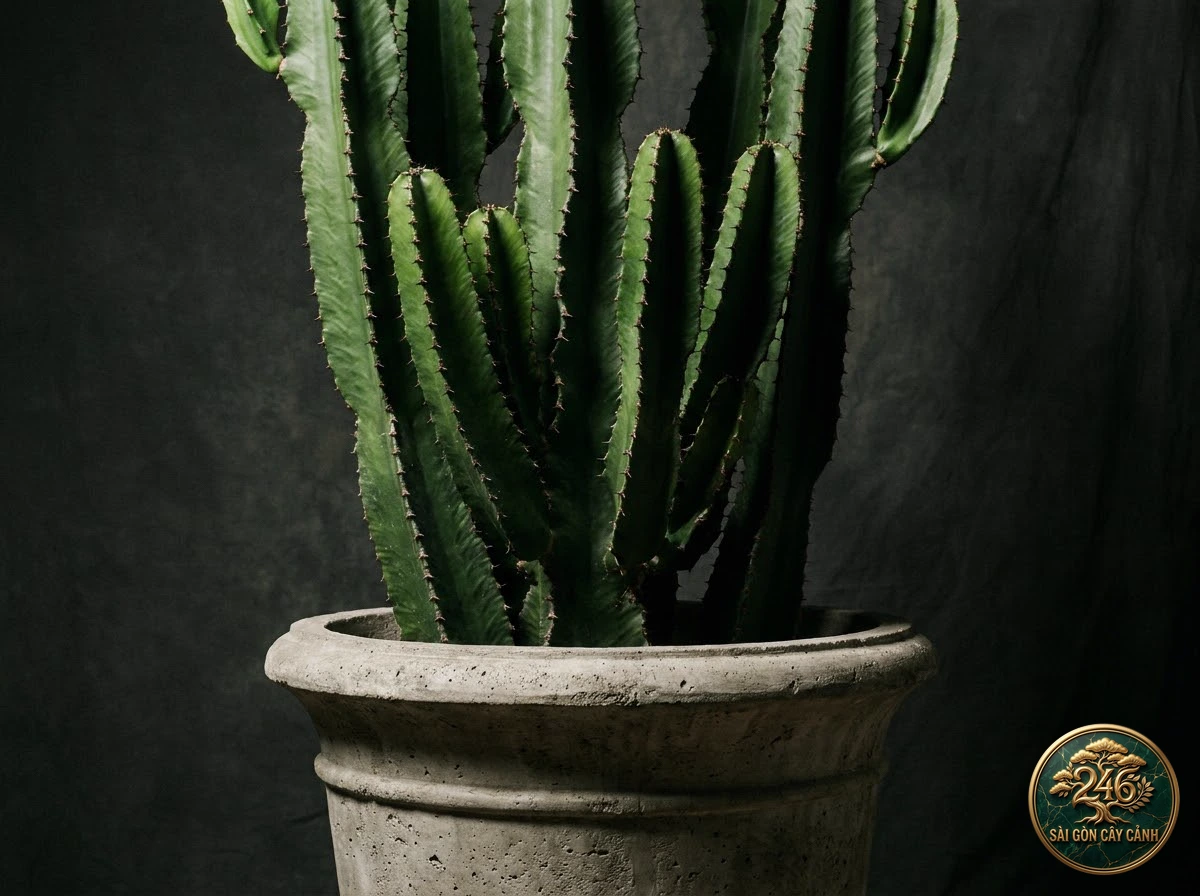
Candelabra Tree Euphorbia (Euphorbia ingens): Giant Arborescent Architecture, Segmented Stems and Latex Protocol
Common Name: Candelabra Tree Euphorbia / Naboom
Family: Euphorbiaceae
Native Range: Southern and Eastern Africa
Euphorbia ingens (Naboom) is an imposing arborescent succulent forming a massive, dense candelabrum crown of 4-angled constricted segmented branches revered in arid landscape architecture.
Sài Gòn Cây Cảnh Care Compass
1. Geographic Origin & Taxonomic Nomenclature History
Euphorbia ingens was documented by Ernst Heinrich Meyer and published by Pierre Edmond Boissier in 1862. This monumental arborescent succulent spans dry savannas of Eastern and Southern Africa.
In native habitats, mature trees attain ten to fifteen meters with constricted four-angled segmented columns branching into colossal candelabra crowns across the African veld.
2. Morphological Architecture & Anatomical Specializations
Stem segments feature distinct joint constrictions dividing limbs into swollen rounded nodes that expand water-storage capacity and enhance mechanical flex.
Massive laticifer vascular systems channel toxic diterpene latex under high hydrostatic pressure, creating an uncompromising deterrent against savanna wildlife.
3. Photosynthetic Radiance & Urban Microclimate Dynamics
Culture requires bright daylight to full tropical sun between 5,000 and 10,000 lux; mature arborescent limbs thrive under intense solar rays that drive sturdy lignification.
For interior installations, position containers in double-height atriums, grand sunny foyers, or airy rooftop conservatories with vigorous ventilation.
4. Mineral Substrate Engineering & Fast Percolation Dynamics
Substrate formulation mandates superior ballast and porosity: blend 40% coarse pumice, 25% river gravel and sharp sand, 20% rich loam, and 15% aged organic compost.
Dense mineral mass provides firm anchorage for massive taproots, preventing container tip-over as vertical branches gain substantial architectural height.
5. Biological Irrigation Protocols & Seasonal Rhythm
Hydration follows a deep drench regimen applied every twelve to sixteen days during warm dry seasons only after substrate desiccates 90%.
During cool winter months or rainy periods, withhold watering for months; massive internal reservoirs sustain the tree effortlessly through prolonged drought.
6. Trace Mineral Nutrition & Slow-Release Fertility Protocols
Apply slow-release organic fertilizer granules twice annually at early spring and mid-summer, providing steady foundation nutrients for sustained structural growth.
Avoid rapid-growth chemical boosters to maintain manageable vertical proportions beneath ceilings and preserve tight segmented node architecture.
7. Vegetative Propagation Protocols & Aseptic Methodology
Propagate by severing robust segmented branch truncheons using sterile saws, flushing copious sap with cool water, and sealing wounds generously with sulfur dust.
Allow truncheons to cure in dry shade for twenty days until callused into a firm woody plug before anchoring into dry gravel to initiate rooting.
8. Botanical Toxicity Profile & Contact Protocols
Latex of Euphorbia ingens possesses lethal-grade toxicity historically utilized for hunting arrow poisons, causing acute skin ulceration and permanent blindness upon contact.
Full protective clothing, face shields, and heavy gauntlet gloves are mandatory when pruning; never stand downwind of broken bleeding limbs.
9. Physiological Diagnostics & Integrated Pest Management
The clinical monitoring rubric below outlines physiological stress indicators and professional management protocols:
| Clinical Symptom | Primary Root Cause | Standard Corrective Protocol |
|---|---|---|
| Apical joint constrictions show soft black fungal lesions | Fungal pathogens attacking tender new joints during prolonged high ambient humidity | Excise afflicted node using sterile tool, coat with sulfur dust and enhance ventilation |
| Towering stem leans dangerously risking pot tip-over | High center of gravity paired with shallow container or overly lightweight mix | Repot into heavy wide-based concrete planter stabilized with dense volcanic ballast |
| Basal trunk suberizes into rough greyish-brown woody bark | Natural physiological lignification strengthening the trunk to support massive limb weight | No action required; this indicates healthy structural maturation into a tree form |
| Copious milky latex pours violently from storm-broken limb | High hydrostatic pressure inside massive vascular laticifer network | Dust wound generously with sulfur to seal bleeding; never position yourself downwind |
10. Comparative Taxonomic Evaluation Across Allied Taxa
The comparative matrix below outlines definitive morphological traits separating Euphorbia ingens from allied arborescent spurges:
| Species Taxon | Morphological Trait | Growth Architecture | Diagnostic Indicator |
|---|---|---|---|
| Maximum Attainable Stature | Arborescent giant reaching 10-15m in wild savanna | Succulent architectural shrub reaching 2-3m indoors | Dwarf spherical succulent remaining under 20-30cm |
| Segmented Constriction | 4-angled stems with distinct deeply constricted joint segments | 3-winged stems with continuous wavy margins without nodes | Smooth cylindrical pencil-thick twigs without wings |
| Latex Toxicity Severity | Lethal potency; historically employed as tribal hunting arrow poison | Caustic diterpenes causing severe dermal and mucosal irritation | Severe vesicant diterpenes posing acute blinding threat |
| Landscape Placement | Grand focal centerpiece for double-height atriums and luxury estates | Architectural accent for balconies and living rooms | Intimate desk or collector shelf miniature display |
11. Urban Landscape Architecture & Living Display Design
The towering presence and candelabrum majesty of Euphorbia ingens provide an architectural centerpiece for grand hotel atriums, luxury villas, and sky-lit courtyards.
It stands as a living emblem of enduring strength and timeless resilience, commanding authority and botanical grandeur within monumental architectural spaces.
Nursery Care Journal & Living Greenery Moments
At Saigon Cay Canh greenhouse, each photograph captures genuine everyday care moments between plant lovers and living greenery, spreading a passion for nature and green-living inspiration.