
Living plant profile
Candelabra spurge
Euphorbia candelabrum
Euphorbia Euphorbiaceae Living Herbarium Master V2 Candelabra Spurge (Euphorbia candelabrum): Arborescent Crown, Undulating Winged Ridges and Xeriscape Landmark Design Scientific Name: Euphorbia candelabrum Tremaux ex Kotschy Common Name: Candelabra Spurge Family: Euphorbiaceae Native Range: East Africa (Ethiopia, Kenya, Uganda, Sudan, Somalia) Euphorbia candelabrum is a monumental East African succulent tree featuring upright 4-5 winged flanged […]
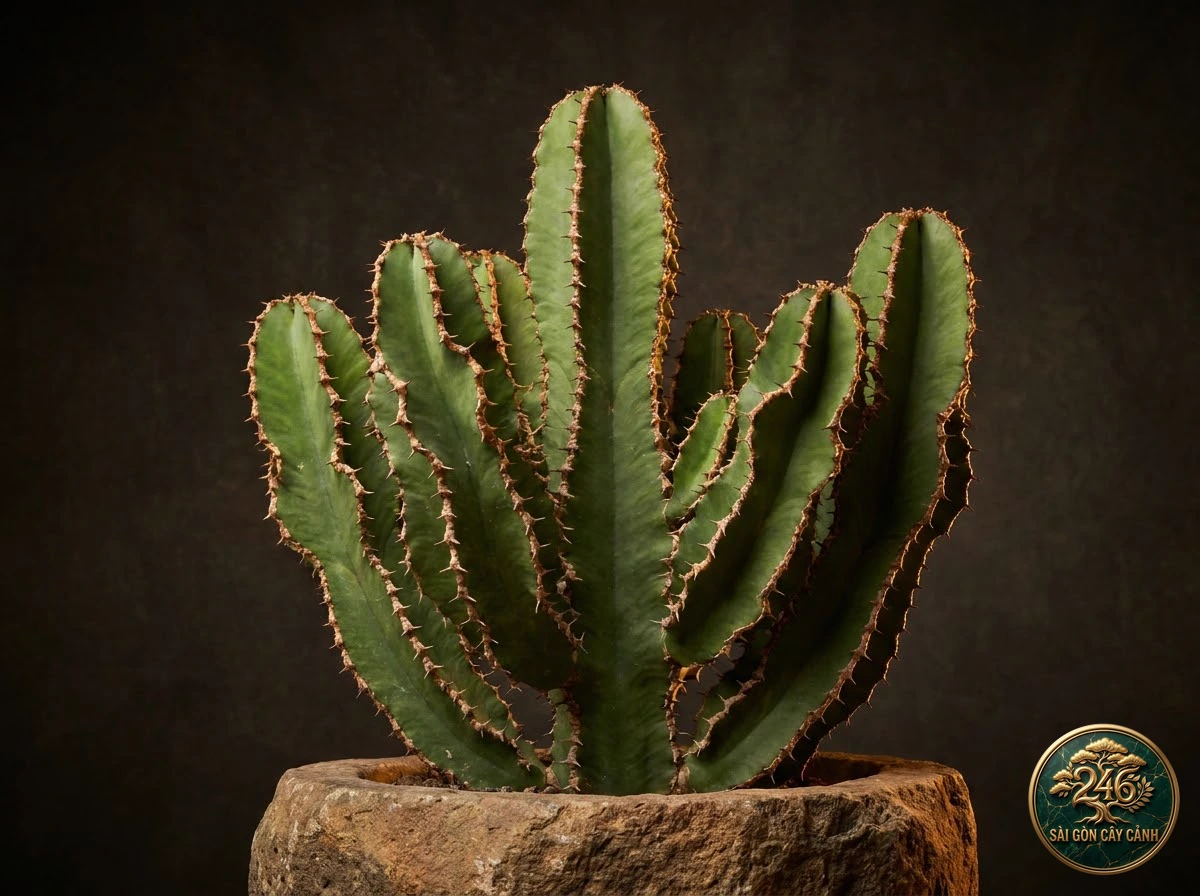
Candelabra Spurge (Euphorbia candelabrum): Arborescent Crown, Undulating Winged Ridges and Xeriscape Landmark Design
Common Name: Candelabra Spurge
Family: Euphorbiaceae
Native Range: East Africa (Ethiopia, Kenya, Uganda, Sudan, Somalia)
Euphorbia candelabrum is a monumental East African succulent tree featuring upright 4-5 winged flanged branches forming a massive candelabrum crown suited for xeriscape architecture.
Sài Gòn Cây Cảnh Care Compass
1. Geographic Origin & Taxonomic Nomenclature History
Euphorbia candelabrum was collected by French explorer Eugene Tremaux and documented by Theodor Kotschy in 1857. This iconic succulent tree is symbolic of the Great East African Rift Valley across Ethiopia, Kenya, Uganda, and Sudan.
Stems form vertical four to five-angled winged columns ascending like giant ceremonial tapers, bearing deeply sinuous flanged margins fortified by continuous horny spine bands.
2. Morphological Architecture & Anatomical Specializations
Foliar anatomy reveals deeply scalloped flanged wings that serve as natural aerodynamic cooling channels while casting self-shading shadows across ribs during intense sun.
A continuous greyish-brown horny margin bands the undulating rib crests, fusing spine shields into an impenetrable armor against browsing savanna fauna.
3. Photosynthetic Radiance & Urban Microclimate Dynamics
Optimum vigor demands brilliant sunlight between 5,000 and 9,000 lux; intense photon flux ensures rigid stem columns, deep sinuous wings, and prevents weak branch curvature.
Plant specimens in open sunny gardens, breezy terraces, or estate verandas with continuous cross-ventilation keeping epidermal surfaces dry.
4. Mineral Substrate Engineering & Fast Percolation Dynamics
Substrate specifications mandate heavy-duty mineral drainage: blend 40% pumice, 25% red volcanic scoria, 20% coarse sharp sand, and 15% mature vermicompost.
Porous mineral fractions ensure water evacuates rapidly through container drainage ports, preventing stagnant moisture from suffocating mature taproots.
5. Biological Irrigation Protocols & Seasonal Rhythm
Hydration protocols observe disciplined dry-down intervals: deep soak every ten to fourteen days during dry heat only after the medium is 80% dry.
During prolonged overcast or rainy spells, stretch irrigation intervals to three or four weeks to preserve firm stem turgor and repel fungal rot.
6. Trace Mineral Nutrition & Slow-Release Fertility Protocols
Administer cold-extracted liquid organic seaweed at mild concentrations bimonthly in spring and summer to nourish growing branchlet crests.
Avoid heavy chemical fertilizers that distort undulating wing symmetry and soften the natural protective horny margin along stem edges.
7. Vegetative Propagation Protocols & Aseptic Methodology
Propagate by taking 30-40 centimeter apical stem truncheons using sterile tools, rinsing sap cleanly under cool water, and sealing wounds with sulfur powder.
Cure cuttings in dry shaded airflow for fifteen days until cut surfaces form a hard suberized plug before inserting into barely moist mineral grit.
8. Botanical Toxicity Profile & Contact Protocols
The white latex of Euphorbia candelabrum contains concentrated ingenol diterpene esters that provoke severe dermal vesication and acute ocular injury upon contact.
Always wear sealed protective goggles and heavy gloves during pruning; strictly avoid placing specimens in areas frequented by children or pets.
9. Physiological Diagnostics & Integrated Pest Management
The clinical diagnostic guide below details recognizable physical symptoms and nursery intervention protocols:
| Clinical Symptom | Primary Root Cause | Standard Corrective Protocol |
|---|---|---|
| Undulating winged margins soften into dark soggy necrosis following heavy rain | Moisture stagnation trapped in stem crevices under sluggish ventilation | Apply mechanical fan circulation, dust sulfur powder onto softened margins |
| Basal crown turns yellowish-soft and roots lose soil grip | Phytophthora root decay induced by dense water-retentive clay substrate | Sever all necrotic roots and basal tissue, seal with lime dust, dry 14 days, reroot in gritty gravel |
| Epidermal skin pales into chlorotic yellowish-green | Micronutrient deficiency or root hair desiccation from extreme dry cycles | Drench with diluted kelp liquid fertilizer and verify substrate porosity |
| Sap from accidental scrape splashes onto clothing fabric | High resinous content in latex causing permanent indelible yellow textile staining | Launder immediately with warm soapy water before sap polymerizes into sticky rubber film |
10. Comparative Taxonomic Evaluation Across Allied Taxa
The taxonomic matrix below delineates botanical features separating Euphorbia candelabrum from neighboring arborescent spurges:
| Species Taxon | Morphological Trait | Growth Architecture | Diagnostic Indicator |
|---|---|---|---|
| Branching Symmetry | Strictly ascending parallel limbs resembling a candelabrum | Spreading lateral limbs before curving upward | Prostrate or decumbent scrambling stems |
| Wing Rib Count | Predominantly 4 to 5 winged ridges with wavy margins | Consistently 3-angled winged ribs | Multi-ribbed with 8 to 16 vertical barrel ridges |
| Horny Margin Continuousness | Continuous greyish horny margin along undulating stem crests | Isolated spine shields situated beneath each leaf | Spineless with small round floral scar cushions |
| Urban Xeriscape Role | Supreme outdoor landmark plant for windy terraces and villa entries | Indoor architectural accent requiring high ceilings | Strict moisture-controlled indoor display specimen |
11. Urban Landscape Architecture & Living Display Design
The soaring candelabrum silhouette of Euphorbia candelabrum delivers a commanding architectural focal point for estate gardens, luxury resorts, and modernist pavilions.
It stands as a breathtaking monument of botanical grandeur, symbolizing natural endurance and primeval wilderness under modern skies.
Nursery Care Journal & Living Greenery Moments
At Saigon Cay Canh greenhouse, each photograph captures genuine everyday care moments between plant lovers and living greenery, spreading a passion for nature and green-living inspiration.