Living plant profile
Canary Island spurge
Euphorbia canariensis
Euphorbia Euphorbiaceae Living Herbarium Master V2 Canary Island Spurge (Euphorbia canariensis): Quadrangular Columnar Architecture, Diterpene Latex and Xerophytic Culture Scientific Name: Euphorbia canariensis L. Common Name: Canary Island Spurge / Cardon Family: Euphorbiaceae Native Range: Canary Islands (Spain) Euphorbia canariensis (Cardon) is the iconic endemic succulent shrub of the Canary Islands, recognized for its erect […]
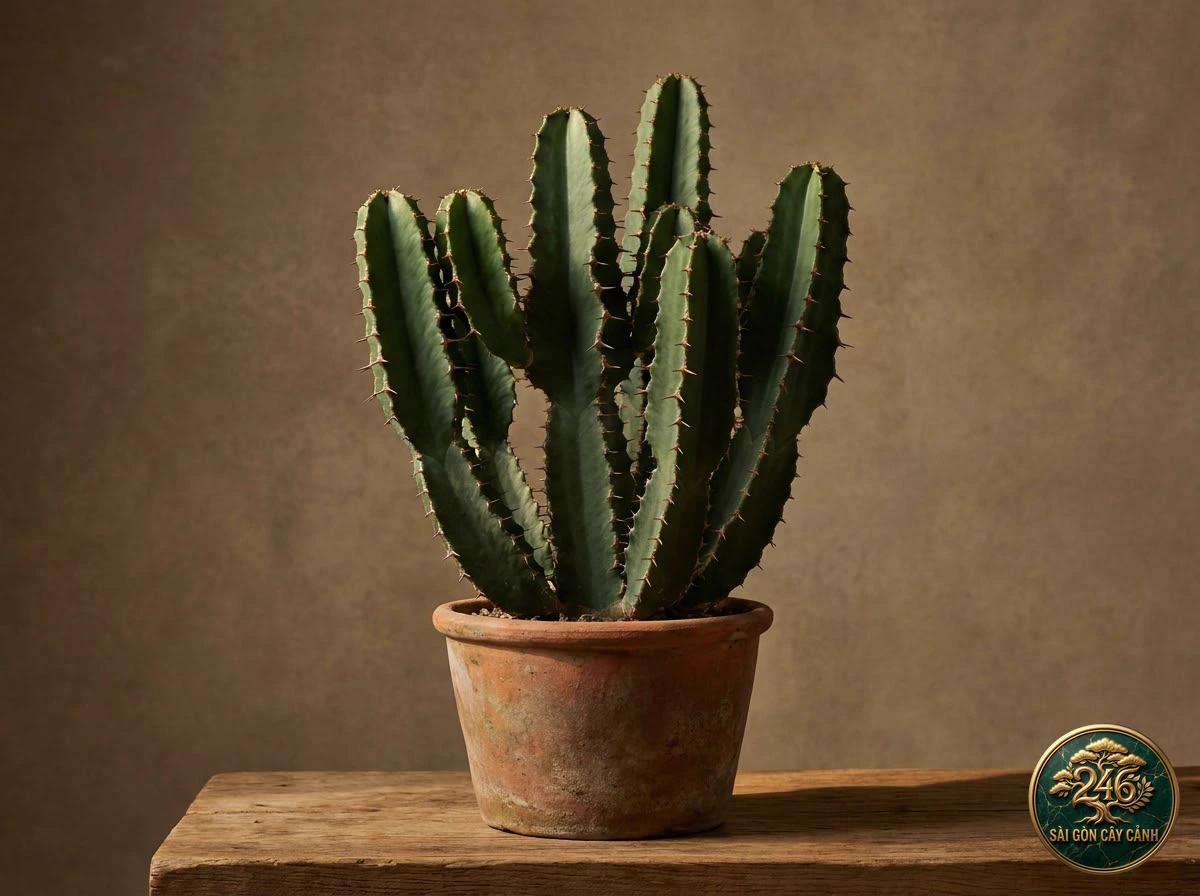
Canary Island Spurge (Euphorbia canariensis): Quadrangular Columnar Architecture, Diterpene Latex and Xerophytic Culture
Common Name: Canary Island Spurge / Cardon
Family: Euphorbiaceae
Native Range: Canary Islands (Spain)
Euphorbia canariensis (Cardon) is the iconic endemic succulent shrub of the Canary Islands, recognized for its erect quadrangular columnar stems, paired short chestnut thorns, and volcanic rock resilience.
Sài Gòn Cây Cảnh Care Compass
1. Geographic Origin & Taxonomic Nomenclature History
Euphorbia canariensis was cataloged by Carl Linnaeus in 1753. This iconic succulent shrub is strictly endemic to volcanic sea-cliffs across the Canary Islands of Spain along the Atlantic coastline.
Maritime winds and arid basaltic terrain molded its rigid quadrangular columnar architecture, sealed by a leathery waxy cutin shield that resists coastal salinity and hydraulic desiccation.
2. Morphological Architecture & Anatomical Specializations
Cross-sectional anatomy demonstrates an immaculate quadrangular square prism with sharp vertical angles lined by paired short brown spines arising from persistent spine shields.
An extensive laticifer network permeates the columnar parenchyma, circulating pressurized milky diterpene latex that establishes an unyielding biochemical defense against predators.
3. Photosynthetic Radiance & Urban Microclimate Dynamics
Photosynthetic vigor demands direct solar radiation between 5,000 and 10,000 lux; intense photon flux preserves rigid vertical column alignment and tight internodal geometry.
Position planters on sun-drenched rooftops, breezy terraces, or high-ceilinged atriums where active airflow prevents moisture entrapment between vertical stems.
4. Mineral Substrate Engineering & Fast Percolation Dynamics
Substrate engineering utilizes 45% pumice, 25% red volcanic scoria, 15% perlite, and 15% gritty loam, mirroring the porous basalt of Canary lava fields.
Coarse mineral particles ensure irrigation moisture evacuates through drain ports immediately, keeping subterranean root systems crisp and well-oxygenated.
5. Biological Irrigation Protocols & Seasonal Rhythm
Irrigation cycles observe disciplined dry-down intervals: deep soak every ten to fourteen days in warm weather only after 85-90% core substrate desiccation.
During prolonged rainy overcast periods, stretch watering intervals to three or four weeks to preserve stem firmness and protect roots from damp decay.
6. Trace Mineral Nutrition & Slow-Release Fertility Protocols
Apply clarified organic vermicompost tea at mild dilution in early summer to nourish active meristematic surges along apical stem crests.
Avoid synthetic nitrogen fertilizers that force rapid soft growth, preserving natural structural rigidity and rugged columnar contours.
7. Vegetative Propagation Protocols & Aseptic Methodology
Propagate by taking 20-30 centimeter semi-hardwood stem cuttings with a sterile blade, dipping cut ends into cold water to arrest sap and dusting with activated charcoal.
Cure cuttings in dry shaded airflow for fifteen days until cut surfaces form a tough suberized shield before anchoring into barely moist mineral grit.
8. Botanical Toxicity Profile & Contact Protocols
The white latex of Euphorbia canariensis carries corrosive diterpene esters capable of provoking severe contact dermatitis and acute keratoconjunctivitis upon eye contact.
Protective eyewear and heavy gauntlet gloves are mandatory when grooming; locate containers safely away from high-traffic family corridors and curious domestic pets.
9. Physiological Diagnostics & Integrated Pest Management
The clinical diagnostic guide below details recognizable physiological stress indicators and responsive nursery remedies for quadrangular spurges:
| Clinical Symptom | Primary Root Cause | Standard Corrective Protocol |
|---|---|---|
| Quadrangular rib crests develop black soggy lesions | Bacterial necrosis entering lesions under sluggish air circulation | Debride afflicted tissue with sterile blade, dust with sulfur, dry 7 days |
| Columnar stems stretch slender and curve awkwardly | Etiolation stemming from insufficient photon flux indoors | Relocate to 4-5 hours direct morning sunlight to restore stout upright growth |
| Basal zone becomes brown and soft with loose root anchorage | Excessive irrigation cadence before soil mass dries through | Unpot immediately, excise rot, dry 10 days, replant in pure porous pumice |
| Caustic milky latex leaks from accidental surface puncture | Mechanical abrasion rupturing internal laticifer tubes | Flush skin immediately under cold flowing water with mild soap for 15 minutes |
10. Comparative Taxonomic Evaluation Across Allied Taxa
The comparative matrix below delineates morphological benchmarks differentiating Euphorbia canariensis from neighboring columnar spurges:
| Species Taxon | Morphological Trait | Growth Architecture | Diagnostic Indicator |
|---|---|---|---|
| Rib Configuration | Strictly quadrangular 4-angled square columnar symmetry | 3 to 4 deeply scalloped undulating wings with chevron banding | Cylindrical pencil-like cladodes without ribs |
| Cuticular Markings | Uniform deep green without marbling or chevron stripes | Prominent pale V-shaped zig-zag chevron markings | Smooth green stems shifting to orange-red under sun |
| Spine Armature | Short paired brown prickles along sharp rib crests | Stout paired greyish thorns arising from prominent shields | Spineless smooth twigs lacking true prickles |
| Native Provenance | Volcanic rocky sea-cliffs of Canary Islands | Dry scrub savanna valleys of Southern Africa | Broad semi-arid habitats across Africa and Madagascar |
11. Urban Landscape Architecture & Living Display Design
The commanding quadrangular geometry of Euphorbia canariensis delivers high architectural impact when potted in rough-hewn stone planters within Mediterranean courtyards.
Its soaring silhouette stands as a living testament to primeval endurance, enriching contemporary outdoor living spaces with bold botanical character.
Nursery Care Journal & Living Greenery Moments
At Saigon Cay Canh greenhouse, each photograph captures genuine everyday care moments between plant lovers and living greenery, spreading a passion for nature and green-living inspiration.