
Living plant profile
Brazilian plume (Justicia carnea)
Justicia carnea
📌 CLINICAL & BIOLOGICAL ABSTRACT — Brazilian plume (Justicia carnea)Brazilian plume (Justicia carnea) Justicia carnea, globally known as the Brazilian plume, flamingo flower, or Jacobinia, is an aristocratic tropical evergreen shrub belonging to the Acanthaceae family. It commands attention with magnificent, dense terminal plumes of vibrant rose-pink to deep magenta flowers, arranged in regal cone-shaped […]
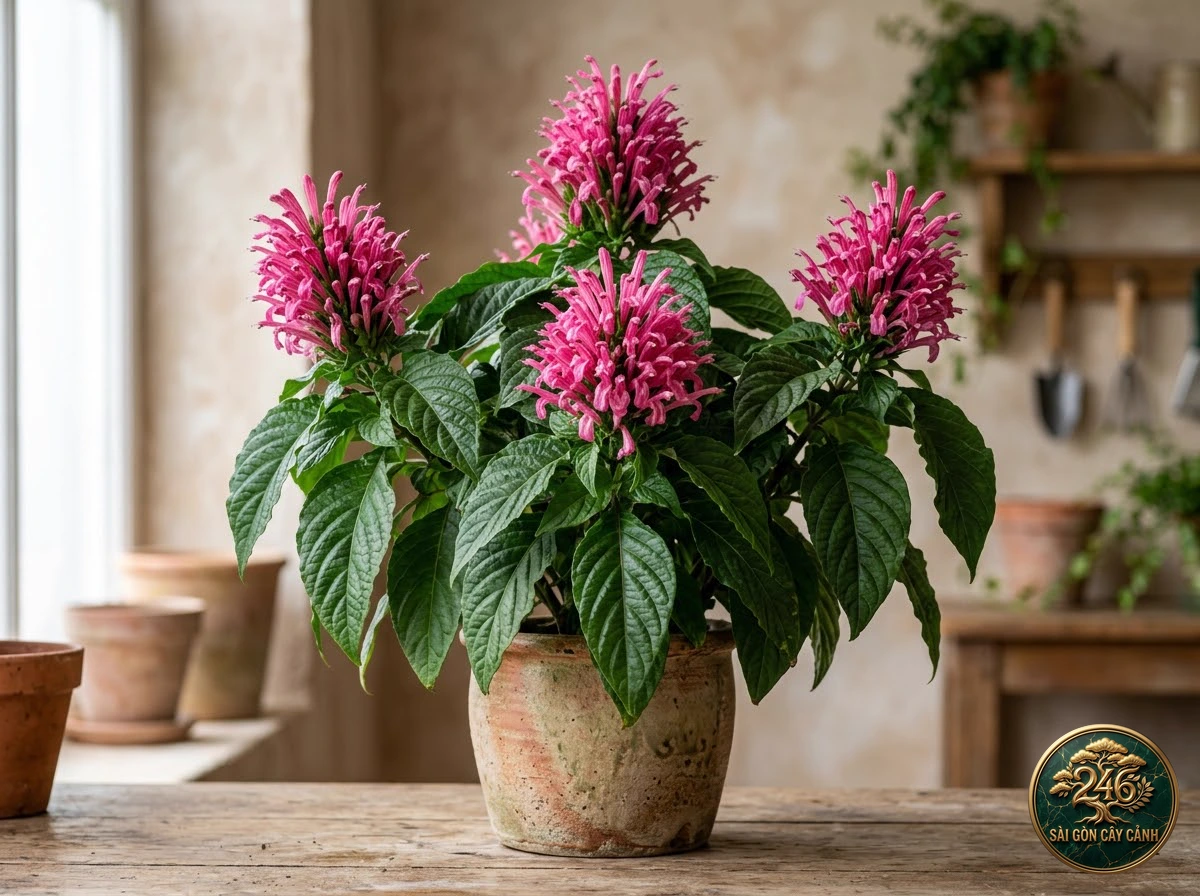
Brazilian plume (Justicia carnea)
Justicia carnea, globally known as the Brazilian plume, flamingo flower, or Jacobinia, is an aristocratic tropical evergreen shrub belonging to the Acanthaceae family. It commands attention with magnificent, dense terminal plumes of vibrant rose-pink to deep magenta flowers, arranged in regal cone-shaped thyrses that resemble opulent royal scepters or flamboyant bird plumes. Paired with lustrous, broad dark green leaves featuring deep sculpted veins, this species brings aristocratic elegance and tropical grandeur to shaded villa landscapes and luxury biophilic atriums.
Sài Gòn Cây Cảnh Care Compass
1. Botanical Identity & Taxonomic Nomenclature History
Justicia carnea was formally documented by British botanist John Lindley in 1831 within Edwards’s Botanical Register. The species held prominent historical synonymy under the name Jacobinia carnea, assigned by Augustin de Candolle when demarcating the allied genus Jacobinia. The specific epithet carnea originates from the Latin term carnosus meaning ‘flesh-colored’ or ‘rosy-pink’, perfectly capturing the exquisite blush and magenta saturation of its corolla.
Originating from the humid understory layers of the Atlantic Forest (Mata Atlantica) in southeastern Brazil, the Brazilian plume became an immediate conservatory sensation across 19th-century Europe. In modern Vietnamese luxury landscape design, it flourishes with vigor within warm, humid, semi-shaded garden microclimates, celebrated for its long-lasting floral tenure and royal architectural stature.
2. Morphological Anatomy & Structural Architecture

Morphologically, Justicia carnea develops as a robust, semi-woody evergreen shrub forming handsome, dense rounded clumps reaching 1.2 to 2.0 meters in height with a spread of 1.0 to 1.5 meters. Stems are erect, succulent-woody, distinctly quadrangular in young growth with a smooth green epidermis, maturing into grey-brown woody stems with prominent swollen nodes characteristic of Acanthaceae. Leaves are oppositely decussate; leaf blades are broad-ovate to elliptic-lanceolate, measuring 15 to 25 cm in length by 7 to 12 cm in width, with acuminate tips and undulating entire margins. The upper leaf surface is lustrous dark emerald green with deeply impressed pinnate veins creating an embossed textural relief, while undersides occasionally display faint purplish flushes.
The terminal inflorescence is a dense, erect thyrsus or pyramidal plume spanning 15 to 25 cm in height and 10 to 15 cm across. It features dozens of tubular bilabiate flowers in radiant rose-pink to deep carmine opening sequentially from base to summit. Each flower measures approximately 5 cm in length: the upper corolla lip forms an arched hooded beak protecting two stamens, while the lower lip reflexes downward into three delicate recurved lobes. The deep floral tube produces copious nectar attracting hummingbirds and pollinating lepidopterans. The fruit is a small capsule containing four flattened seeds.
3. Solar Irradiance Thresholds & Photosynthetic Dynamics
Justicia carnea is naturally an understory forest denizen requiring dappled shade or bright indirect illumination, performing optimally under photon levels ranging between 18,000 and 35,000 lux. Gentle direct early-morning sunshine (prior to 09:00) is exceptionally beneficial for triggering floral primordia development and enhancing the vivid magenta pigmentation of the corolla. However, the plant cannot tolerate direct midday or afternoon solar radiation exceeding 50,000 lux.
Intense unfiltered insolation causes rapid foliar turgor loss, bleached scorch patches on wide leaf laminae, and accelerated floral shriveling. Conversely, profound shade below 8,000 lux results in etiolated vegetative growth with weak, soft stems devoid of the signature colossal scepter plumes.
4. Mineral Substrate Mechanics & Root Aeration Porosity
The root network of the Brazilian plume spreads extensively in topsoil horizons, demanding a porous, loose potting matrix rich in decomposed organic matter that holds continuous cool moisture while draining swiftly. Compacted or poorly drained soils quickly induce root hypoxia and black rot in delicate feeder roots, triggering catastrophic lower-foliar drop within days.
The benchmark potting substrate recommended by Saigon Cay Canh contains 30% sandy alluvial loam, 30% washed coconut peat, 20% carbonized rice husks, 15% Trichoderma-fortified aged vermicompost, and 5% horticultural pumice or perlite. Substrate pH is maintained within the mildly acidic range of 5.8 to 6.5. Pots and planting pits require ample drainage apertures lined with volcanic gravel to ensure immediate drainage egress.
5. Hydraulic Equilibria & Irrigation Regimens
Given its expansive foliage and massive floral thyrses with high transpiration rates, Justicia carnea necessitates generous, consistent watering throughout active growing seasons. The established regimen maintains potting media moisture between 65% and 75%, requiring thorough soaking every morning at dawn. During arid dry spells or high-temperature days, supplementary late-afternoon irrigation is beneficial whenever surface soil becomes dry to the touch.
Water must be applied gently at the base around the root perimeter; never direct pressurized water jets onto the delicate upright flower plumes. Trapped moisture within densely clustered floral tubes causes peduncle breakage under added water weight and promotes gray mold (Botrytis cinerea) blight.
6. Nutrient Biogeochemistry & Fertilization Protocols
The Brazilian plume is a heavy feeder requiring abundant mineral nutrients to produce and sustain its enormous terminal floral plumes. Nutrient programs should be fortified with potassium, phosphorus, and humic acids to stimulate root vitality and intensify flower pigments. Top-dress monthly with 100 to 150 grams of slow-release organic pellets or aged vermicompost worked lightly into the soil surface.
Upon initiation of apical floral buds, dissolve a water-soluble high-bloom formulation (NPK 15-20-25 or NPK 12-24-12) at 1.5 grams per liter, drenching the root zone every 10 days. Spray chelated trace elements (iron, zinc, and boron) every 20 days to preserve deep emerald foliar luster and maximize the chromatic vibrancy of the magenta corollas.
7. Clonal Propagation & Germplasm Conservation
The most dependable propagation technique for Justicia carnea is semi-hardwood terminal stem cuttings taken during warm spring or early rainy periods, with rooting success exceeding 90%. Select robust vegetative shoots without flower buds measuring 12 to 18 cm with 2 to 3 distinct nodes. Using a sterile razor or pruner sanitized with 70% medical alcohol, make a 45-degree angle cut just below the basal node, reducing larger leaf blades by half to limit transpiration loss.
Dip the cut end into 1,000 ppm IBA rooting powder for several seconds and insert 4 to 5 cm deep into a propagation medium of equal parts washed coarse sand and buffered coco peat. Place under 60% shade with high relative humidity under a propagation dome or automated mist; vigorous adventitious roots develop within 15 to 20 days, signaling readiness for potting.
8. Phytochemical Toxicity & Pet Safety Standards (ASPCA)
Botanical safety profile and ASPCA pet safety standards: Classified within the Acanthaceae family (order Lamiales), Justicia carnea is officially designated as non-toxic and pet-safe under standard ASPCA companion animal toxicological registries. It poses zero chemical poisoning danger to dogs, cats, horses, or humans upon accidental ingestion or physical contact, synthesizing neither noxious mucosal irritants nor dangerous cardiac glycosides.
This makes it an exemplary ornamental candidate for luxury family residences accommodating lively companion animals and young children. Nevertheless, excessive ingestion of coarse fibrous leaf tissue may induce minor mechanical digestive discomfort; sensible landscaping suggests situating plants thoughtfully. Always sanitize pruning instruments with 70% medical alcohol when deadheading spent scepters to maintain botanical sanitation.
9. Clinical Pathology Diagnostics & Treatment Strategies
Pathology diagnostic protocol for Botrytis plume blight prevention and macronutrient feeding in Justicia carnea:
| Clinical Manifestation | Etiological Cause | Standard Treatment Protocol |
|---|---|---|
| Rose-pink floral plume develops mushy dark brown rot enveloped in powdery grey mold | Botrytis cinerea gray mold fungal infection caused by forceful overhead irrigation combined with stagnant humid air | Excise infected plume using shears sanitized with 70% alcohol and destroy, redirect water strictly to root base and enhance air circulation |
| Undersides of foliage exhibit chlorotic stippling with tiny powdery white insects fluttering when disturbed | Trialeurodes vaporariorum whitefly infestation sucking foliar phloem sap and inducing leaf chlorosis and curling | Hang yellow sticky monitoring traps near canopy, wash leaf undersides with diluted potassium soap and apply organic neem-garlic extract |
| Older basal leaves turn uniformly chlorotic from margins inward and drop heavily | Root hypoxia and root suffocation caused by compacted soil or obstructed drainage holes following prolonged rains | Clear drainage holes immediately, withhold irrigation for 3 days, aerate topsoil gently, and drench with Trichoderma biocontrol to stimulate feeder roots |
10. Comparative Morphology & Allied Taxa Diagnosis
Taxonomic comparative matrix distinguishing massive upright magenta scepter plumes and rugose foliar venation of Justicia carnea:
| Diagnostic Parameter | Justicia carnea (Brazilian plume) | Comparative Specimen A | Comparative Specimen B |
|---|---|---|---|
| Inflorescence Form and Color | Massive upright conical plume 15-25 cm, brilliant rose-pink to deep magenta blossoms | Nodding arched spike 8-15 cm with overlapping terracotta-salmon imbricate bracts | Terminal erect thyrse 10-18 cm with fiery scarlet tubular corollas protruding from green bracts |
| Foliar Dimensions and Texture | Broad expansive leaves 15-25 cm, deeply rugose-impressed veins with prominent textural relief | Modest ovate leaves 4-8 cm, thin blade with entire margins clothed in soft pubescence | Oblanceolate leaves 12-20 cm, lustrous glabrous surface with mildly undulating margins |
| Photoperiod and Shade Tolerance | Strictly semi-shade sciophyte 18,000-35,000 lux, highly sensitive to midday solar scorch | Adaptable to bright filtered light and gentle morning sun 25,000-45,000 lux | Moderate shade to dappled light 20,000-40,000 lux, demanding constant high ambient humidity |
11. Biophilic Design Harmony & Contemporary Spatial Aesthetics

Within architectural landscape design and symbolic biophilic aesthetics, the Brazilian plume embodies royal majesty, refined dignity, high executive authority, and an overflowing fountain of auspicious life energy. The commanding, upright scepter-like inflorescence serves as an architectural metaphor for career ascent, steadfast fortitude, and enduring domestic luxury.
The plant serves with distinction as a shaded understory focal anchor within private estate gardens, luxurious foundation borders beneath portico arcades, shaded courtyard borders, or planted in high-end terrazzo urns commanding presence at entrance halls and sunlit interior atriums.
12. Saigon Cay Canh Provenance & Cultivation Assurance
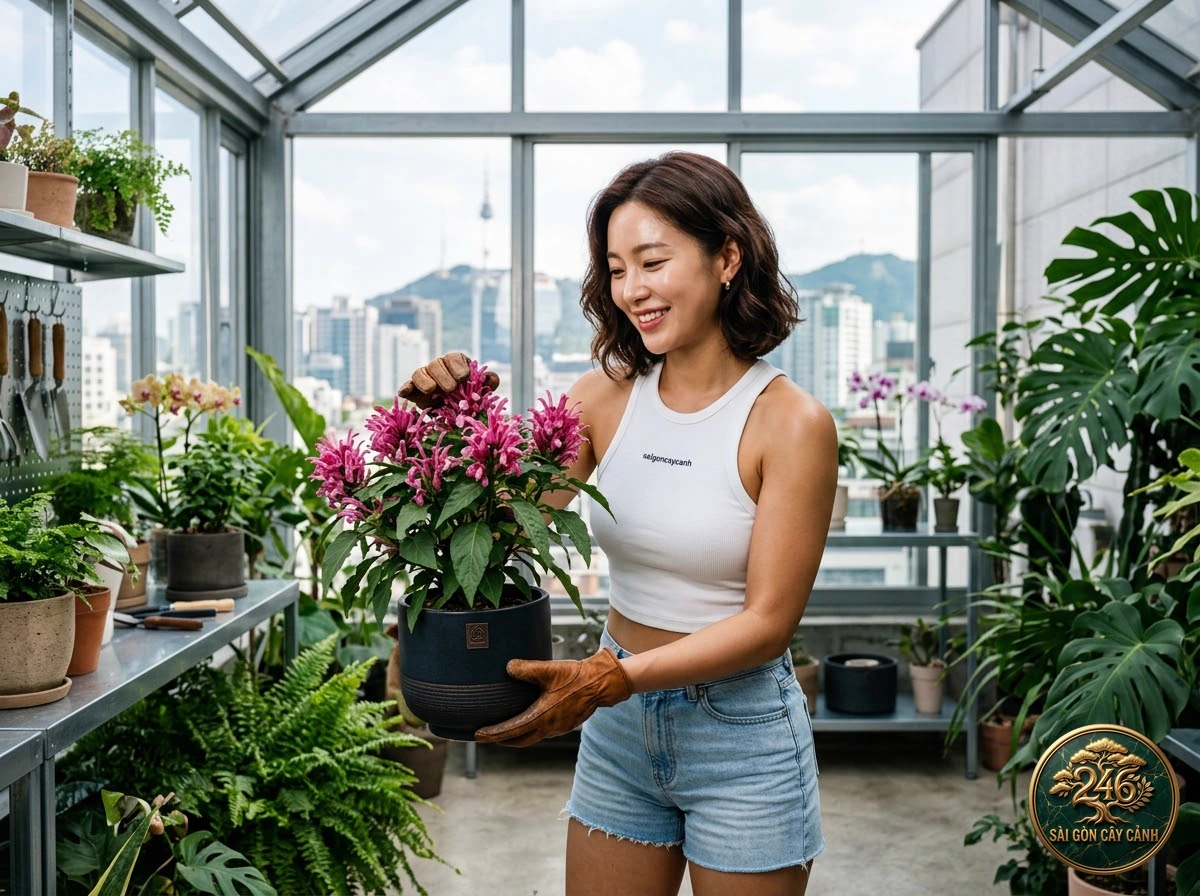
Saigon Cay Canh curates and cultivates premium-grade specimens of Justicia carnea, featuring voluminous rounded shrub canopies, tightly established root balls, and magnificent upright plumes in peak magenta bloom ready for elite landscape installation.
We provide 100% verified scientific taxonomy, comprehensive agronomic guidance for multi-flush floral induction throughout the year, and complete living health guarantees for luxury private villas, boutique resorts, and prestige commercial developments.
💬 Góc Tư Vấn & Hướng Dẫn Kỹ Thuật SGCC
Chuẩn E-E-A-T Kinfolk❓ Chăm sóc Brazilian plume (Justicia ca cần lưu ý điều gì quan trọng nhất?
💡 Dạ điều quan trọng nhất là giữ môi trường sống ổn định, tránh sốc nhiệt hay dao động thông số đột ngột, đồng thời cung cấp khẩu phần ăn sạch và tươi mới ạ.
❓ Làm thế nào để phòng ngừa bệnh tật hiệu quả cho các bé?
💡 Dạ anh chị nên giữ vệ sinh chuồng/hồ nuôi sạch sẽ, thay nước hoặc dọn dẹp định kỳ và bổ sung vitamin, men tiêu hóa đều đặn để tăng sức đề kháng ạ.
🌿 Trang Thiết Bị, Đất Trồng & Dụng Cụ Bonsai Tuyển Chọn
Dụng cụ tỉa, giá thể hữu cơ & phân bón chuyên dụng cho cây cảnh.
Cây Cẩm Nhung Lá May Mắn (Fittonia) Để Bàn, Nhiều Màu T…

Tinh Trichoderma BioSun Đậm Đặc – Chế Phẩm Vi Sinh Đối …

Phân trùn quế viên nén, tan chậm, 1 kg – phân bón hữu c…

Kéo cắt cành Nhật Bản Kapusi Japan thép Sk5, Kéo cắt cà…

Xơ dừa nén 5kg, Mụn dừa nén, Đất trồng nén 5kg trồng câ…

Chậu đất nung cổ điển, chậu sen đá, chậu cây basic, chậ…

1Lít Giá thể sen đá Pumice (Chưa lọc bụi) – Đất sen đá,…
1kg Đất sét nung Akadama Grand nhập khẩu Nhật Bản trộn …

… combo 10 Chậu Nhựa Trồng Cây Cao Cấp Monrovia 3GAL …
Dụng cụ làm vườn mini,Bộ dụng cụ làm vườn mini cao cấp …

kệ kê cây cảnh bằng gỗ tự nhiên, đôn gỗ để chậu cây đầy…
Gói 100 Hạt giống Hoa Hồng Leo Pháp mix nhiều màu _chuẩ…

Greater periwinkle
Vinca major, celebrated in international horticulture as greater periwinkle, bigleaf periwinkle, or large periwinkle, is a vigorous, semi-woody...
Read Monograph →
Globe amaranth (Gomphrena globosa)
Globe amaranth (Gomphrena globosa) Gomphrena globosa, universally celebrated as globe amaranth, bachelor’s button, or immortelle, is a charming...
Read Monograph →
French hydrangea (Hydrangea macrophylla)
French hydrangea (Hydrangea macrophylla) Hydrangea macrophylla, internationally celebrated as French hydrangea, bigleaf hydrangea, or hortensia, is a magnificent...
Read Monograph →
Moss rose (Portulaca grandiflora)
Moss rose (Portulaca grandiflora) Portulaca grandiflora, universally treasured as moss rose, sun plant, or eleven o’clock, is a...
Read Monograph →Expert Q&A, Recommended Supplies & Article Feedback
Tap once to connect instantly via Google, Facebook or TikTok — no long forms required!
No questions yet for this article. Tap Google / Facebook / TikTok above to ask the first question!