
Living plant profile
Golden chalice vine (Solandra maxima)
Solandra maxima
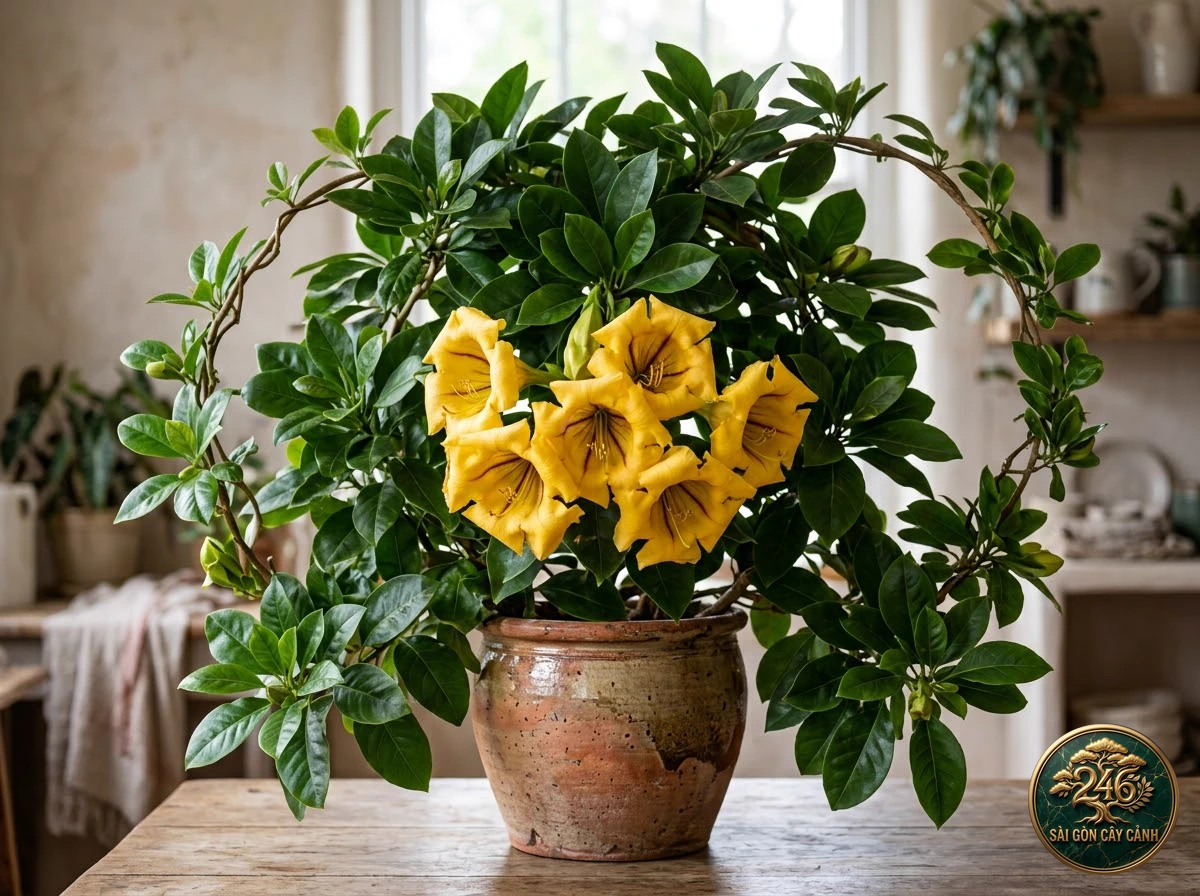
Golden chalice vine (Solandra maxima) Solandra maxima, universally acclaimed as the golden chalice vine, cup of gold, or Hawaiian lily, is among the most colossal and magnificent woody lianas on the planet, belonging to the nightshade family (Solanaceae). This Neotropical giant inspires awe through its gargantuan chalice-shaped blossoms measuring 15 to 20 cm in diameter, […]
Golden chalice vine (Solandra maxima)
Solandra maxima, universally acclaimed as the golden chalice vine, cup of gold, or Hawaiian lily, is among the most colossal and magnificent woody lianas on the planet, belonging to the nightshade family (Solanaceae). This Neotropical giant inspires awe through its gargantuan chalice-shaped blossoms measuring 15 to 20 cm in diameter, opening creamy-yellow before intensifying into saturated antique gold, exquisitely marked inside with five purplish-brown longitudinal nectar stripes and releasing a rich aroma evocative of ripe bananas and coconut at night. With its immense climbing vigor and opulent glossy foliage, it serves as the ultimate botanical statement of tropical grandeur across luxury estates.
Sài Gòn Cây Cảnh Care Compass
1. Botanical Identity & Taxonomic Nomenclature History
Solandra maxima was first documented by Mexican naturalists Martin Sesse y Lacasta and Jose Mariano Mocino in the late 18th century as Datura maxima within Flora Mexicana. In 1967, British taxonomist Peter Shaw Green officially reclassified it under the genus Solandra in Curtis’s Botanical Magazine. The generic name Solandra commemorates Swedish botanist Daniel Carl Solander (1733–1782), an illustrious apostle of Carl Linnaeus who sailed on Captain James Cook’s historic first voyage aboard the HMS Endeavour. The specific epithet maxima translates from Latin as ‘largest’ or ‘greatest’, highlighting the unmatched dimensions of its colossal blooms.
Within pre-Columbian Mesoamerican cultures, particularly among the Huichol and Aztec peoples, the plant occupied sacred ceremonial significance. Introduced to global botanical gardens and luxury tropical resorts, Solandra maxima has attained premier status as an aristocratic climber, gracing grand pergolas, monumental estate entryways, and luxury living walls across southern Vietnam’s sun-drenched estates.
2. Morphological Anatomy & Structural Architecture
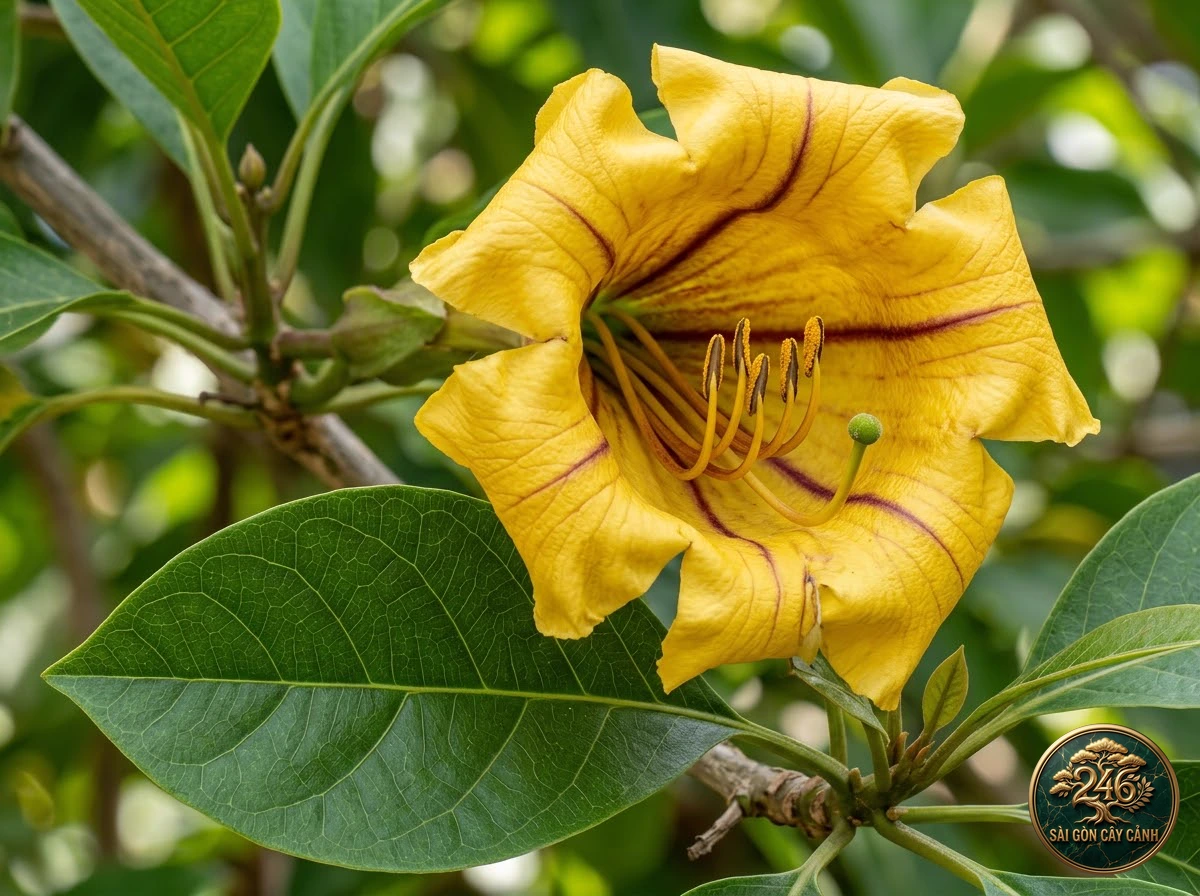
Morphologically, Solandra maxima manifests as a massive, heavy-wooded evergreen climbing liana capable of ascending 10 to 15 meters or sprawling horizontally across substantial pergolas. Stems are extraordinarily thick and succulent-woody when juvenile, transitioning into heavy, greyish-brown gnarly woody trunks attaining basal diameters of 10 to 20 cm. Foliage is alternately arranged; leaf blades are broad-elliptic to obovate-oblong, measuring 12 to 22 cm in length by 6 to 12 cm in width, with short-acuminate apices, obtuse to cuneate bases, and undulating entire margins. The lamina is thick, leathery-coriaceous, lustrous deep emerald green adaxially with prominently sculpted pinnate venation, borne on robust petioles 2.5 to 6 cm long.
Flowers arise solitary at the tips of short lateral spurs on stout pedicels 1.5 to 3 cm long. The tubular-angled calyx spans 7 to 10 cm in length with five prominent costae terminating in short acute teeth. The colossal chalice-shaped corolla spans 15 to 22 cm in length, expanding into five broad, rounded, reflexed lobes creating a floral opening 15 to 20 cm across. Opening creamy-yellow, the petals rapidly deepen into rich, saturated antique gold; five prominent purplish-brown to crimson nectar lines traverse each lobe down into the throat. Flowers exude a potent, intoxicating aroma reminiscent of ripe bananas and coconut from dusk throughout the night. The fruit is a large subglobose fleshy berry 5 to 7 cm in diameter enclosing numerous seeds.
3. Solar Irradiance Thresholds & Photosynthetic Dynamics
Solandra maxima is an obligate full-sun heliophyte requiring intensive solar irradiance between 50,000 and 90,000 lux to stimulate the formation of its gigantic floral chalices. Direct, unfiltered sunlight of at least 6 to 8 hours daily is an essential prerequisite; abundant tropical insolation hardens woody branches, shortens internodes, and triggers prolific floral evocation on short lateral spurs.
When positioned in partial shade below 30,000 lux, the vine produces luxuriant vegetative foliage and rank stems but completely fails to bloom, while juvenile shoots become brittle and weak. The plant demonstrates extraordinary drought and thermal tolerance; indeed, a mild dry spell coupled with intense sunshine serves as the primary environmental trigger inducing synchronized flowering flushes.
4. Mineral Substrate Mechanics & Root Aeration Porosity
The root architecture of golden chalice vine comprises massive, deep-penetrating woody taproots and extensive lateral anchors extending many meters through the soil profile, demanding ample soil volume, loose structure, and rapid gravitational drainage. The species cannot abide waterlogged, anaerobic conditions; root saturation quickly rots substantial taproots and induces systemic canopy wilt.
The benchmark planting pit formulation engineered by Saigon Cay Canh includes 40% rich alluvial loam, 25% carbonized rice husks for gas exchange, 20% washed coco peat, 10% Trichoderma-fortified composted cattle manure, and 5% coarse volcanic pumice or gravel. Soil pH should be maintained between 6.0 and 7.2. A basal drainage course of coarse rubble or gravel measuring 10 to 15 cm depth is mandatory at the bottom of planting pits.
5. Hydraulic Equilibria & Irrigation Regimens
Solandra maxima demands generous hydration during juvenile vegetative training to establish its structural frame; however, once mature and lignified, water requirements decrease significantly, revealing outstanding drought resilience. For established vines, the baseline protocol involves deep watering when the top 3 to 5 cm of soil dries out, irrigating 2 to 3 times weekly at dawn during dry seasons.
Significantly, to induce heavy blooming, horticulturists employ a strategic ‘water-stressing’ regimen: withhold irrigation for 2 to 3 weeks in late rainy periods until foliage slightly flags, then resume deep soaking coupled with high phosphorus and potassium fertilization; this sudden rehydration triggers immediate, profuse floral bud evocation across all spur tips.
6. Nutrient Biogeochemistry & Fertilization Protocols
To nourish and support colossal 20 cm floral chalices and fuel intoxicating nocturnal scent production, Solandra maxima requires disciplined mineral nourishment with strictly regulated nitrogen to prevent excessive foliar growth at the cost of blooms. Top-dress every two months with 2 to 3 kg of well-aged composted manure or vermicompost worked into the root zone perimeter.
During floral evocation cycles, apply a water-soluble high-phosphate and high-potassium formula (NPK 10-30-20 or NPK 6-30-30) at 2 grams per liter every 12 to 15 days. Supplement with foliar sprays containing chelated boron, zinc, and calcium to reinforce pedicel tensile strength, enabling branches to bear the heavy weight of massive golden chalices without snapping.
7. Clonal Propagation & Germplasm Conservation
Solandra maxima is propagated primarily through semi-hardwood stem cuttings or air-layering during warm, humid monsoon flushes, with rooting success exceeding 90%. Select vigorous finger-thick semi-lignified shoots measuring 15 to 25 cm in length. Using shears sterilized with 70% medical alcohol, make a 45-degree angle cut just beneath a node and reduce large leaf blades by two-thirds to minimize transpirational stress.
Dip the basal cut into 1,500 to 2,000 ppm IBA rooting powder for several seconds, then insert 5 to 7 cm deep into moist sharp sand and coco coir. Maintain under 50% shade with regular misting; stout adventitious white root systems emerge within 25 to 30 days, followed by vigorous climbing shoots ready for field planting.
8. Phytochemical Toxicity & Pet Safety Standards (ASPCA)
Botanical safety profile and ASPCA pet safety standards: Classified within the Solanaceae family, Solandra maxima is officially classified as HIGHLY TOXIC and perilous to companion animals under ASPCA toxicological registries. All vegetative tissues, including the sap, woody stems, foliage, flowers, and berries, synthesize high concentrations of hazardous tropane alkaloids, primarily atropine, scopolamine, hyoscyamine, and noratropine.
Accidental ingestion by dogs, cats, horses, or humans causes severe anticholinergic toxidrome characterized by extreme mydriasis (unresponsive dilated pupils), severe dry mucous membranes, tachycardia, hallucinations, delirium, muscular ataxia, violent convulsions, and potential fatal respiratory paralysis without prompt veterinary intervention and antidotal therapy (physostigmine). Furthermore, contact of plant sap with ocular tissues induces temporary blindness and pupil dilation lasting several days. Consequently, gardeners MUST wear protective gloves and safety goggles during maintenance, sanitize tools with 70% medical alcohol, and train vines on high overhead pergolas strictly beyond reach of children and domestic pets.
9. Clinical Pathology Diagnostics & Treatment Strategies
Biosafety pruning protocols for tropane protection and strategic water-stress blooming regimes in Solandra maxima:
| Clinical Manifestation | Etiological Cause | Standard Treatment Protocol |
|---|---|---|
| The vine produces rampant leafy growth and thick branches but fails to set floral chalices for years | Excessive nitrogen fertilization coupled with over-watering and insufficient direct sunlight below 30,000 lux | Halt nitrogen fertilizers, enforce 2 to 3 weeks of strategic water-stress until leaves flag, then resume watering with high phosphorus-potassium NPK 6-30-30 |
| Plant sap contacts skin or eyes causing irritation, followed by extreme pupil dilation and blurred vision | Direct dermal or ocular exposure to sap containing hazardous tropane alkaloids (atropine) during pruning | Flush eyes and skin immediately with running water for 15 minutes; always don protective rubber gloves and goggles during pruning |
| Companion animal ingests vine tissues or flowers, exhibiting severe dilated pupils, vomiting, and tremors | Acute anticholinergic poisoning caused by toxic tropane alkaloids (atropine, scopolamine) present in the plant | Transport pet immediately to emergency veterinary hospital for antidotal treatment with physostigmine, and elevate vine onto high trellis |
10. Comparative Morphology & Allied Taxa Diagnosis
Morphological comparative matrix evaluating colossal 20 cm golden chalice corollas with purple stripes and tropane toxicity of Solandra maxima:
| Diagnostic Parameter | Solandra maxima (Golden chalice vine) | Comparative Specimen A | Comparative Specimen B |
|---|---|---|---|
| Floral Architecture and Dimensions | Colossal chalice-shaped flower 15 to 20 cm across in radiant golden-yellow with five internal purplish-brown stripes | Slender tubular flower 2 to 4 cm long clustered in pendulous panicles, greenish-white, powerfully fragrant at night | Expansive salverform flower 5 to 7 cm across in pristine chalk-white, sweetly vanillic at night |
| Growth Habit and Canopy Reach | Massive heavy-wooded climbing liana ascending 10 to 15 meters with thick gnarly woody trunks | Erect to sprawling woody shrub 2 to 4 meters tall with slender arching branches | Soft sprawling-cascading herbaceous perennial 30 to 70 cm tall |
| Toxicological Hazard Profile | HIGHLY TOXIC (contains tropane alkaloids atropine and scopolamine inducing violent poisoning) | TOXIC (contains solasonine alkaloids and saponins causing neurological and gastrointestinal distress) | NON-TOXIC and pet-safe under ASPCA protocols, completely safe for companion animals |
11. Biophilic Design Harmony & Contemporary Spatial Aesthetics
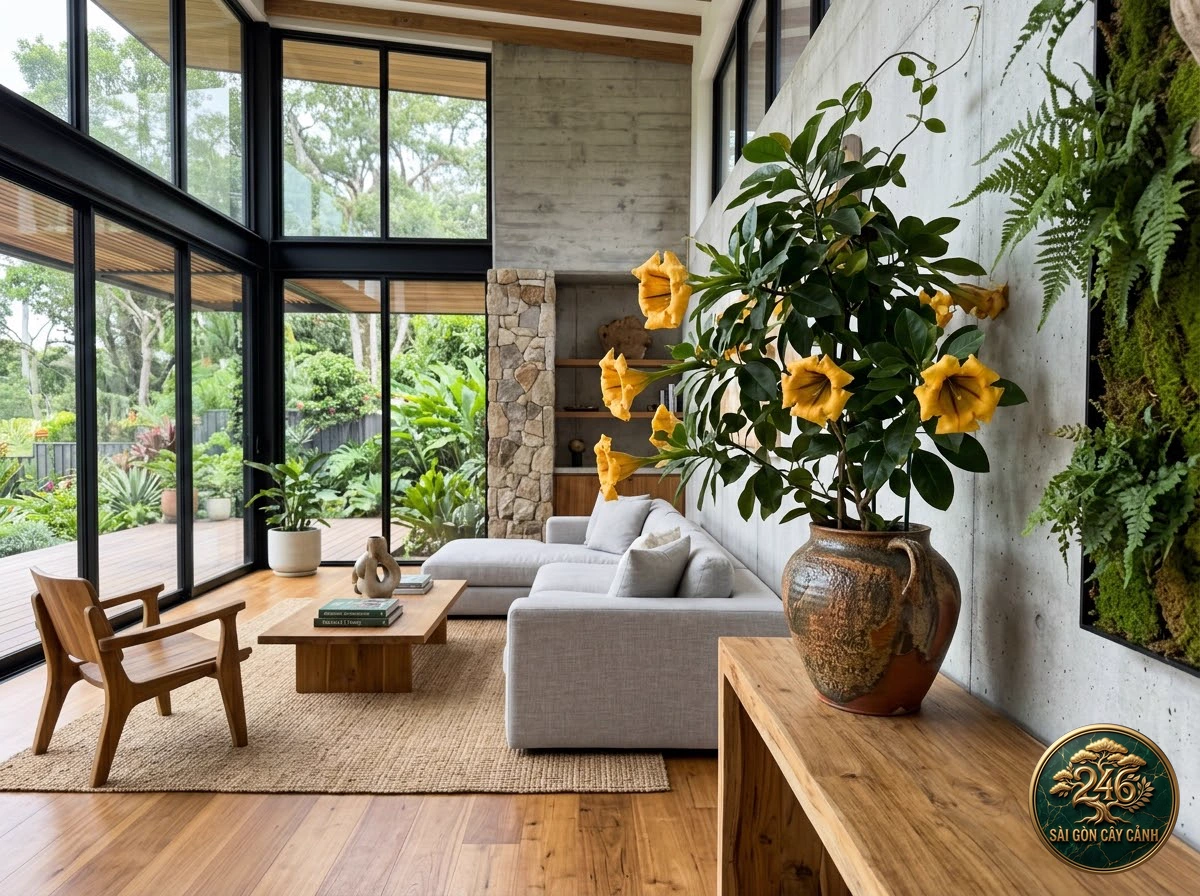
Within architectural landscape design and regal biophilic philosophy, the golden chalice vine embodies supreme authority, boundless wealth, radiant prestige, and triumphant celebration through its colossal antique-gold chalices resembling ceremonial royal vessels. The glowing golden hue channels potent elemental vitality, energizing spaces with luxury and auspicious prosperity.
Solandra maxima serves with unmatched architectural grandeur atop monumental pergolas flanking grand villa approaches, sweeping over archways of private estates, adorning perimeter structures of elite tropical eco-resorts, or anchoring grand focal exhibits in expansive botanical gardens.
12. Saigon Cay Canh Provenance & Cultivation Assurance
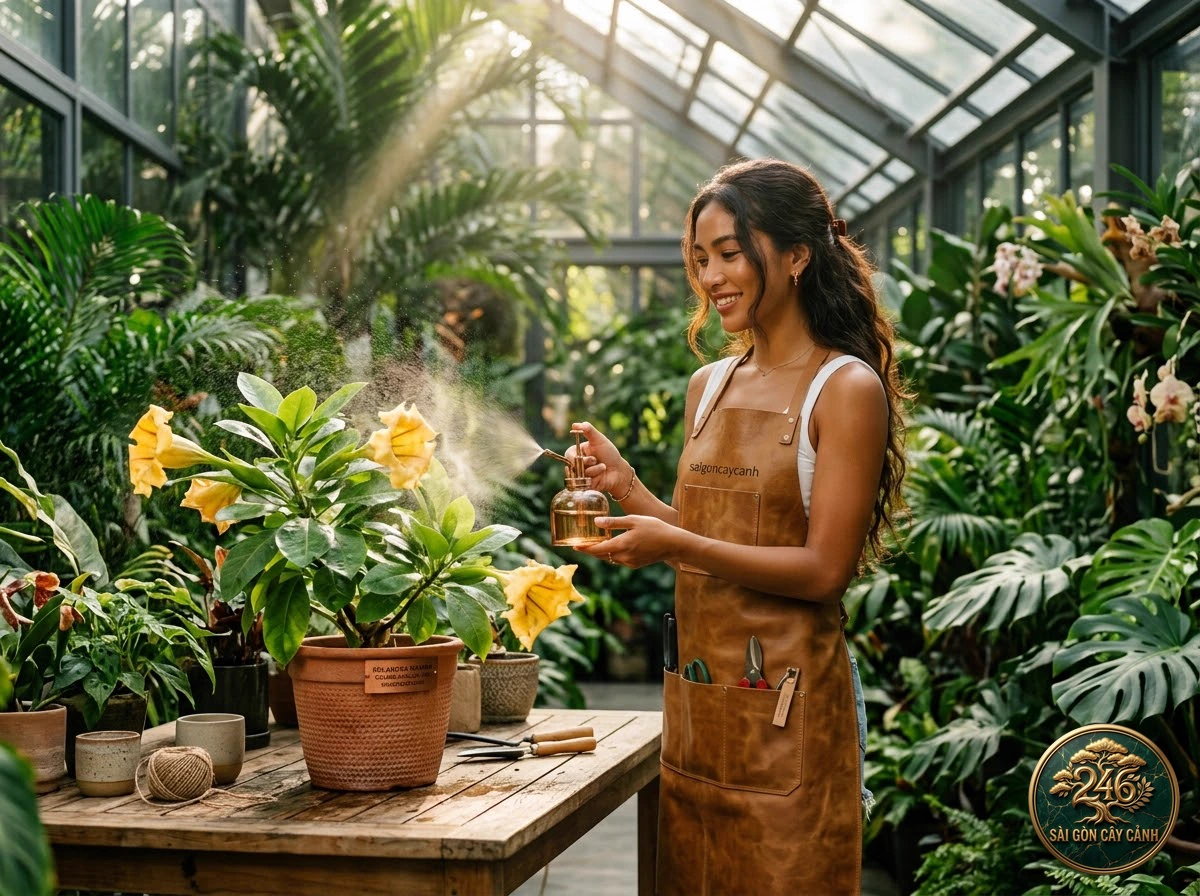
Saigon Cay Canh curates and delivers mature, heavy-wooded specimens of Solandra maxima, featuring thick gnarly trunks, extensive root systems, and vigorous lateral branches primed to bear colossal golden blooms for monumental landscape projects.
We guarantee 100% verified scientific taxonomy, provide professional structural pergola load engineering advice and water-stressing blooming guidance, and offer complete living health guarantees across luxury private estates, palatial villas, and world-class tropical resorts.
💬 Góc Tư Vấn & Hướng Dẫn Kỹ Thuật SGCC
Chuẩn E-E-A-T Kinfolk❓ Chăm sóc Golden chalice vine (Solandr cần lưu ý điều gì quan trọng nhất?
💡 Dạ điều quan trọng nhất là giữ môi trường sống ổn định, tránh sốc nhiệt hay dao động thông số đột ngột, đồng thời cung cấp khẩu phần ăn sạch và tươi mới ạ.
❓ Làm thế nào để phòng ngừa bệnh tật hiệu quả cho các bé?
💡 Dạ anh chị nên giữ vệ sinh chuồng/hồ nuôi sạch sẽ, thay nước hoặc dọn dẹp định kỳ và bổ sung vitamin, men tiêu hóa đều đặn để tăng sức đề kháng ạ.
🌿 Trang Thiết Bị, Đất Trồng & Dụng Cụ Bonsai Tuyển Chọn
Dụng cụ tỉa, giá thể hữu cơ & phân bón chuyên dụng cho cây cảnh.

![Chậu Đất Nung Nhiều SIZE Có Lỗ Thoát Nước - Trồng Sen Đá Và Cây Cảnh Mini [CHẬU ĐẤT NUNG]](https://saigoncaycanh.com/shop/images/products/4432574854.webp)