Living plant profile
Indian chrysanthemum (Chrysanthemum indicum)
Chrysanthemum indicum
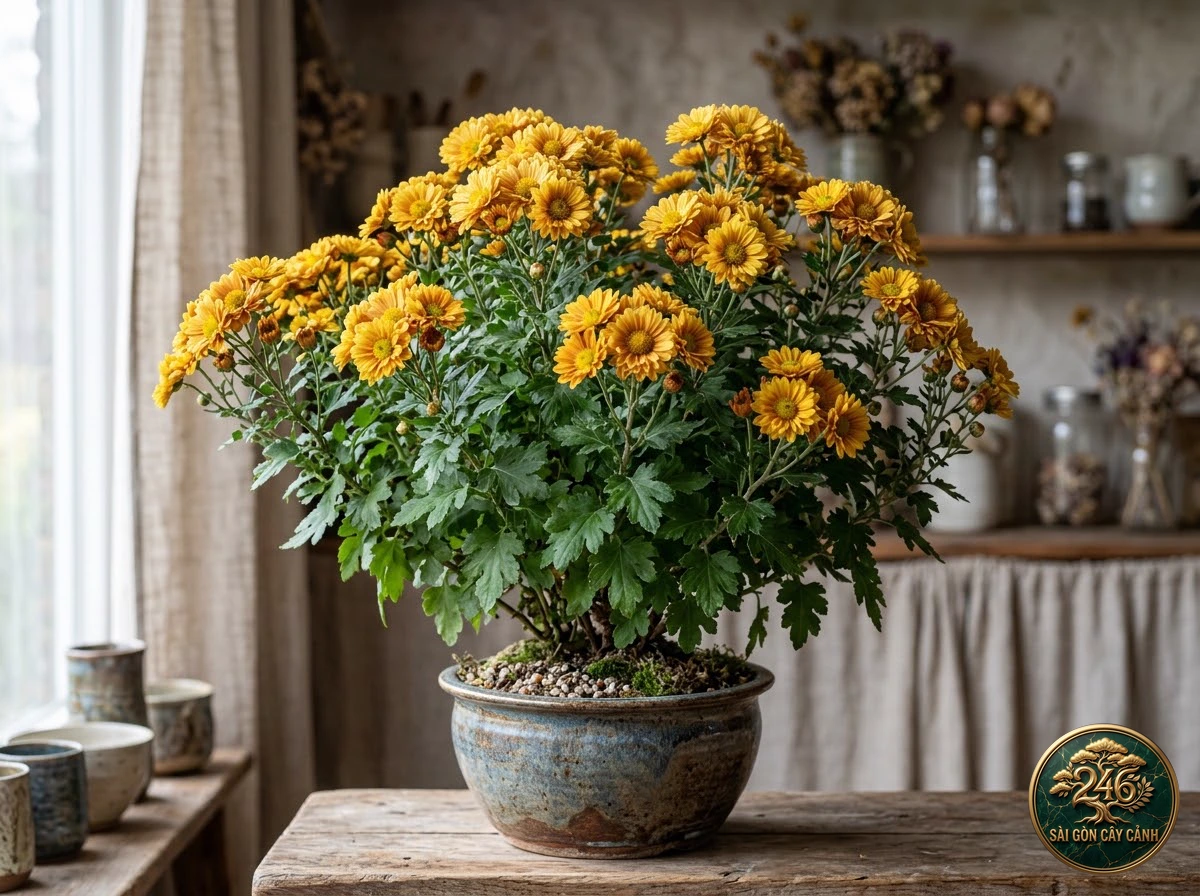
Indian chrysanthemum (Chrysanthemum indicum) Chrysanthemum indicum, widely celebrated as Indian chrysanthemum, wild chrysanthemum, or royal yellow mum, is an illustrious and venerable herbaceous perennial within the Asteraceae family. Indigenous to the mountain slopes of East Asia, it commands ancient botanical reverence across Asian herbalism and tea culture for its charming composite flower heads measuring 1.5 […]
Indian chrysanthemum (Chrysanthemum indicum)
Chrysanthemum indicum, widely celebrated as Indian chrysanthemum, wild chrysanthemum, or royal yellow mum, is an illustrious and venerable herbaceous perennial within the Asteraceae family. Indigenous to the mountain slopes of East Asia, it commands ancient botanical reverence across Asian herbalism and tea culture for its charming composite flower heads measuring 1.5 to 2.5 cm across, rendered in luminous golden-yellow, blooming in graceful loose corymbs that diffuse a remarkably pure, sweet-camphoric perfume in crisp autumn air. Renowned as a sovereign imperial herbal tea supporting hepatic detoxification and ocular vitality, its fresh tissues nonetheless contain sesquiterpene lactones hazardous to companion pets. Within Saigon Cay Canh landscape collections, Indian chrysanthemum serves as an exquisite medicinal accent evoking contemplative Zen serenity.
Sài Gòn Cây Cảnh Care Compass
1. Botanical Identity & Taxonomic Nomenclature History
Chrysanthemum indicum was officially established by Swedish botanist Carl Linnaeus in 1753 within his foundational monument Species Plantarum. The generic name Chrysanthemum derives from Greek roots chrysos (‘golden’) and anthemon (‘flower’). The specific epithet indicum means ‘of India’ in Latin, an archaic geographical convention widely utilized by 18th-century European naturalists to designate plants originating from eastern and southern Asia.
Documented in the ancient Chinese pharmacopoeia Shennong Bencao Jing over two millennia ago, Indian chrysanthemum was hailed as a superior medicinal tonic that prolongs life and clears heat. In Vietnam, the traditional herbal village of Nghia Trai in Hung Yen province has preserved centuries of heritage cultivating royal yellow chrysanthemums, where golden fields are harvested meticulously at dawn to produce revered imperial herbal teas celebrated for calming the nervous system and purifying the body.
2. Morphological Anatomy & Structural Architecture
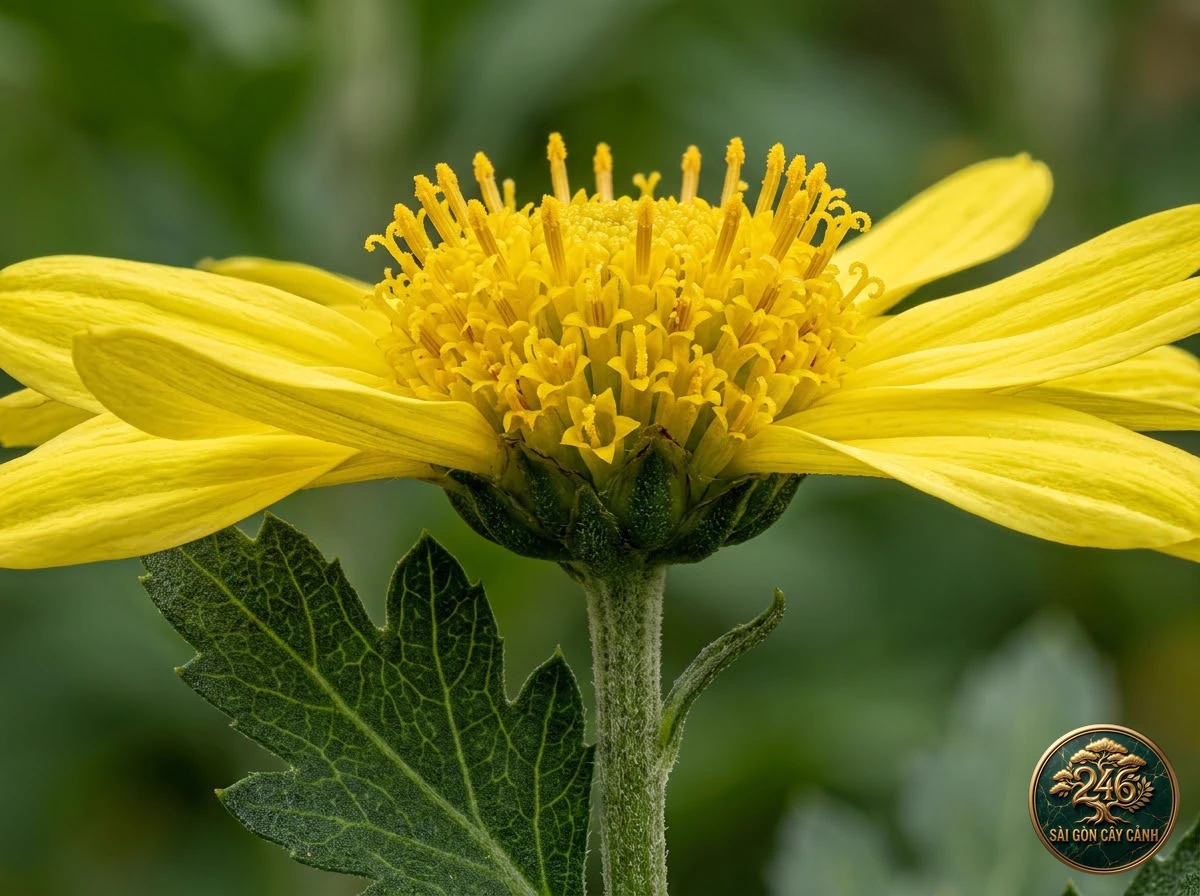
Morphologically, Chrysanthemum indicum develops as an erect to sprawling, much-branched semi-woody herbaceous perennial attaining heights of 0.6 to 1.0 meters with a lateral spread of 0.5 to 0.8 meters. Stems branch freely from the base; slender flexible branchlets are purplish-green, longitudinally grooved, and covered in fine greyish-white puberulence. Leaves are alternately arranged; blades are ovate to oblong-ovate, measuring 3 to 7 cm long by 2 to 4 cm wide, deeply pinnatifid into 3 to 5 sharply lobed segments with coarsely serrate margins and cuneate bases. The adaxial surface is deep emerald green, emitting a refreshing camphoraceous herbal fragrance when bruised, while the abaxial surface is paler and densely gland-dotted, borne on slender petioles 1 to 2.5 cm long.
Inflorescences arise as loose terminal corymbose panicles holding numerous small, starry composite heads (capitula) measuring 1.5 to 2.5 cm across, rendered in intense golden-yellow. The capitulum comprises a single peripheral whorl of female ligulate ray florets with spreading golden petals 0.8 to 1.2 cm long, encircling a central disc packed with bisexual, diminutive tubular disc florets 5-toothed and dark orange-yellow. Flowering is prolific throughout late autumn and winter, dispersing a crisp, sweet camphoric perfume. The fruit is a miniature ribbed cypsela 1 mm long lacking a pappus, ripening to brownish-grey.
3. Solar Irradiance Thresholds & Photosynthetic Dynamics
Chrysanthemum indicum is an adaptable heliophyte performing best under abundant direct sunlight to bright partial insolation between 35,000 and 70,000 lux. A daily duration of at least 5 to 7 hours of direct sunlight is essential to keep stems compact, maximize essential oil concentration within epidermal glands, and promote prolific golden flower flushes.
As a classic photoperiodic short-day species, floral bud initiation triggers reliably when daylight diminishes below 12 hours in late autumn. Under heavy shade below 20,000 lux, stems become weak, floppy, and prone to lodging, internodes stretch, and floral heads emerge sparse and pale. The plant possesses excellent cold tolerance down to cool winter temperatures but benefits from high-canopy filtration during scorching midday heat exceeding 38 degrees C.
4. Mineral Substrate Mechanics & Root Aeration Porosity
The root architecture of Indian chrysanthemum incorporates a dense shallow fibrous root system complemented by adventitious roots emerging from lower stem nodes, demanding fertile, friable, humus-enriched loam engineered for rapid gravity drainage without pooling. Stagnant waterlogged conditions persisting beyond 24 hours suffocate delicate rootlets, inciting root rot and triggering widespread basal foliar chlorosis.
The benchmark potting substrate crafted by Saigon Cay Canh contains 40% clean alluvial loam, 25% carbonized rice hulls for root zone aeration, 20% washed coco coir, 10% Trichoderma-inoculated aged vermicompost, and 5% horticultural perlite. Soil pH is maintained within 6.0 to 6.8. Planting beds and decorative containers must feature unobstructed drainage ports.
5. Hydraulic Equilibria & Irrigation Regimens
With lush branching foliage and perpetual floral bud flushes, Chrysanthemum indicum requires steady, measured hydration. The baseline watering protocol mandates soaking the root perimeter thoroughly at dawn whenever the upper 2 cm of soil dries. During dry summer heat, water once daily; during cool rainy months, suspend watering until surface soils drain.
Direct water around the base; never blast overhead streams into open golden blossom clusters, as lingering water drops cause petal discoloration and invite fungal blight. Following severe downpours, verify that drainage channels around garden beds remain completely free of obstruction.
6. Nutrient Biogeochemistry & Fertilization Protocols
To sustain dense branching growth and fuel hundreds of starry golden-yellow composite florets diffusing sweet camphoric perfume, Indian chrysanthemum requires disciplined mineral nutrition. Top-dress with aged vermicompost or slow-release organic pellets (NPK 6-8-12) monthly at 1 to 2 kg worked into the perimeter drip line.
Following routine pinching cuts and upon terminal bud initiation, dissolve a water-soluble balanced formula (NPK 15-20-25 or NPK 16-16-16) at 1.5 grams per liter every 10 to 12 days. Complement with foliar sprays containing chelated calcium, boron, and zinc every 20 days to ensure pedicel tensile elasticity, holding golden flower heads proudly aloft against wind and weather.
7. Clonal Propagation & Germplasm Conservation
Chrysanthemum indicum propagates with exceptional ease through apical stem cuttings or division of rooted clumps, achieving success rates above 95%. The ideal season spans warm spring or early monsoon months when shoots are expanding actively. Select vigorous semi-ripe shoots 8 to 10 cm long with 3 to 4 nodes. Using shears sanitized with 70% medical alcohol, make a 45-degree angle cut below a node and remove lower leaves.
Dip the basal cut into 500 to 1,000 ppm IBA rooting powder for several seconds and insert 3 to 4 cm deep into moist sand, coco coir, and perlite. Maintain under 50% shade with regular misting; adventitious roots establish within 8 to 12 days, followed by rapid lateral shoot development ready for potting.
8. Phytochemical Toxicity & Pet Safety Standards (ASPCA)
Botanical safety profile and ASPCA pet safety standards: Classified within the Asteraceae family, Chrysanthemum indicum is officially categorized as TOXIC to companion animals (dogs, cats, horses) under ASPCA toxicological criteria. While dried flowers are celebrated globally as a safe and therapeutic herbal tea for human consumption, fresh vegetative tissues synthesize sesquiterpene lactones, natural pyrethrins, and irritant volatile oils dangerous to companion animals.
Accidental ingestion of fresh foliage or flower heads by domestic pets triggers acute gastrointestinal distress manifesting as vomiting, diarrhea, hypersalivation, lethargy, and contact dermatitis upon dermal exposure to sap. Horticulturists should wear protective gloves during pruning, sanitize shears with 70% medical alcohol, and cultivate this medicinal herb behind decorative garden borders inaccessible to domestic pets.
9. Clinical Pathology Diagnostics & Treatment Strategies
Pathology inspection protocol for rust fungus mitigation and medicinal floral harvest in Chrysanthemum indicum:
| Clinical Manifestation | Etiological Cause | Standard Treatment Protocol |
|---|---|---|
| Stems become etiolated and floppy, internodes stretch excessively, and golden heads emerge sparse and pale | Severe light deprivation caused by growing in dense shade below 20,000 lux for extended periods | Prune leggy shoots with shears sanitized with 70% alcohol, move plant to receive 5 to 7 hours of direct sun daily |
| Foliar undersides develop raised rusty-brown pustules expanding rapidly and causing premature leaf desiccation | Puccinia chrysanthemi rust outbreak fueled by high humidity and stagnant air circulation around foliage | Clip infected leaves, sanitize shears with 70% alcohol, and apply bio-copper fungicide or wettable sulfur twice 5 days apart |
| Potting soil is waterlogged, lower leaves turn yellow and drop prematurely, and shoots wilt | Root asphyxiation and rot induced by poor drainage or clogged container drainage ports | Suspend watering immediately, clear container drainage holes, aerate surface soil, and drench with Trichoderma |
10. Comparative Morphology & Allied Taxa Diagnosis
Taxonomic comparative matrix isolating miniature golden capitula and tisane aroma of Chrysanthemum indicum:
| Diagnostic Parameter | Chrysanthemum indicum (Indian chrysanthemum) | Comparative Specimen A | Comparative Specimen B |
|---|---|---|---|
| Capitulum Architecture and Fragrance Profile | Delicate composite heads 1.5 to 2.5 cm across of bright yellow florets in loose corymbs with rich herbal aroma | Dense hemispherical composite flower heads 3 to 6 cm across packing hundreds of yellow florets into a massive dome | Colossal rounded composite heads 6 to 10 cm across of ruffled orange or golden ray florets on stout peduncles |
| Stem Morphology and Practical Utility | Erect semi-woody herbaceous perennial 0.6 to 1.0 meters tall, loose branching habit, traditional tisane herb | Compact mounding herbaceous perennial 0.4 to 0.8 meters tall, branching into a symmetrical spherical dome | Stout erect herbaceous annual 0.5 to 1.0 meters tall with grooved stems and strongly aromatic pungent foliage |
| Companion Animal Safety and ASPCA Profile | TOXIC (contains sesquiterpene lactones provoking gastrointestinal distress and hypersalivation in pets) | TOXIC (synthesizes sesquiterpene lactones and pyrethrins causing emesis, diarrhea, and dermatitis in pets) | MILDLY TOXIC / CAUTION (contains phototoxic thiophenes provoking mild digestive upset and contact dermatitis) |
11. Biophilic Design Harmony & Contemporary Spatial Aesthetics

Within Asian biophilic philosophy and traditional tea garden aesthetics, Indian chrysanthemum symbolizes contemplative tranquility, enduring longevity, enlightened clarity, and harmonious unity with the natural world. Its radiant golden-yellow florets and delicate camphoric aroma introduce calming spiritual energies, washing away environmental tension and nurturing peaceful residential sanctuaries.
Owing to its delicate stature and venerable medicinal prestige, Chrysanthemum indicum serves with understated grace across garden compositions: massed as naturalistic borders within Zen-inspired meditation cloisters, planted surrounding outdoor tea pavilions, integrated into educational herbal arboretums, or cultivated in rustic ceramic containers on sunny verandas.
12. Saigon Cay Canh Provenance & Cultivation Assurance
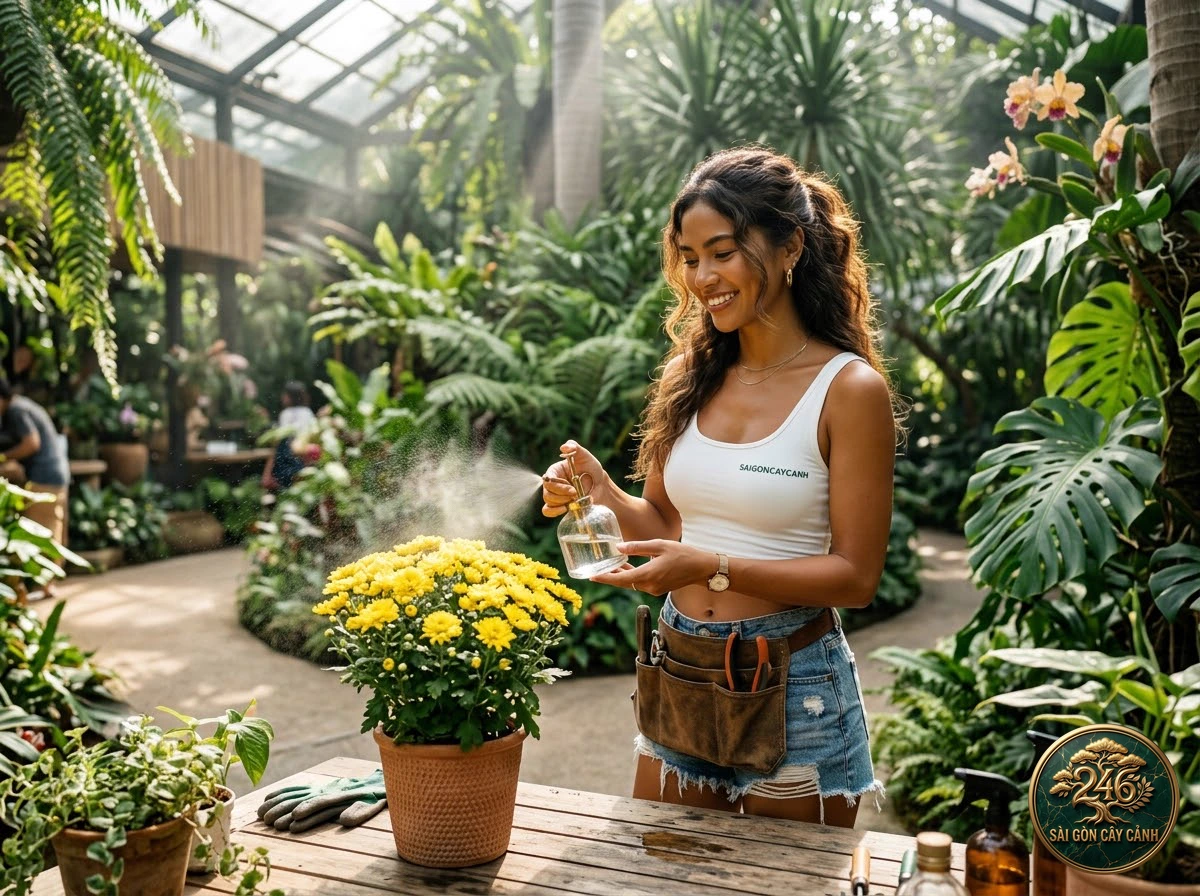
Saigon Cay Canh delivers premium, nursery-acclimated specimens of pure Chrysanthemum indicum, featuring vigorous branching crowns, well-established root systems, and abundant floral buds prepared to burst into fragrant golden blooms across premier herbal sanctuaries and meditation landscapes.
We provide 100% botanical taxonomic verification, comprehensive living plant health warranties, sustainable cultivation advisory, and dedicated biophilic landscape design guidance for private estates and luxury tea retreat sanctuaries.
💬 Góc Tư Vấn & Hướng Dẫn Kỹ Thuật SGCC
Chuẩn E-E-A-T Kinfolk❓ Chăm sóc Indian chrysanthemum (Chrysa cần lưu ý điều gì quan trọng nhất?
💡 Dạ điều quan trọng nhất là giữ môi trường sống ổn định, tránh sốc nhiệt hay dao động thông số đột ngột, đồng thời cung cấp khẩu phần ăn sạch và tươi mới ạ.
❓ Làm thế nào để phòng ngừa bệnh tật hiệu quả cho các bé?
💡 Dạ anh chị nên giữ vệ sinh chuồng/hồ nuôi sạch sẽ, thay nước hoặc dọn dẹp định kỳ và bổ sung vitamin, men tiêu hóa đều đặn để tăng sức đề kháng ạ.
🌿 Trang Thiết Bị, Đất Trồng & Dụng Cụ Bonsai Tuyển Chọn
Dụng cụ tỉa, giá thể hữu cơ & phân bón chuyên dụng cho cây cảnh.

![Chậu Đất Nung Họa Tiết Vintage Xuất Khẩu Nhiều Kích Thước [Hỏa tốc]](https://saigoncaycanh.com/shop/images/products/27000508637.webp)
![Hạt giống hoa cúc họa mi trắng dễ trồng F1 dễ chăm siêu bông hoa nở đẹp [300 hạt] - nongsans](https://saigoncaycanh.com/shop/images/products/28702182313.webp)