
Living plant profile
Common sunflower (Helianthus annuus)
Helianthus annuus
📌 CLINICAL & BIOLOGICAL ABSTRACT — Common sunflower (Helianthus annuus)Common sunflower (Helianthus annuus) Helianthus annuus, universally celebrated as common sunflower, annual sunflower, or mirassol, is a magnificent, towering annual herbaceous forb within the Asteraceae family. Indigenous to the fertile prairies of North America, it commands global botanical admiration for its majestic upright stature reaching 1.0 […]
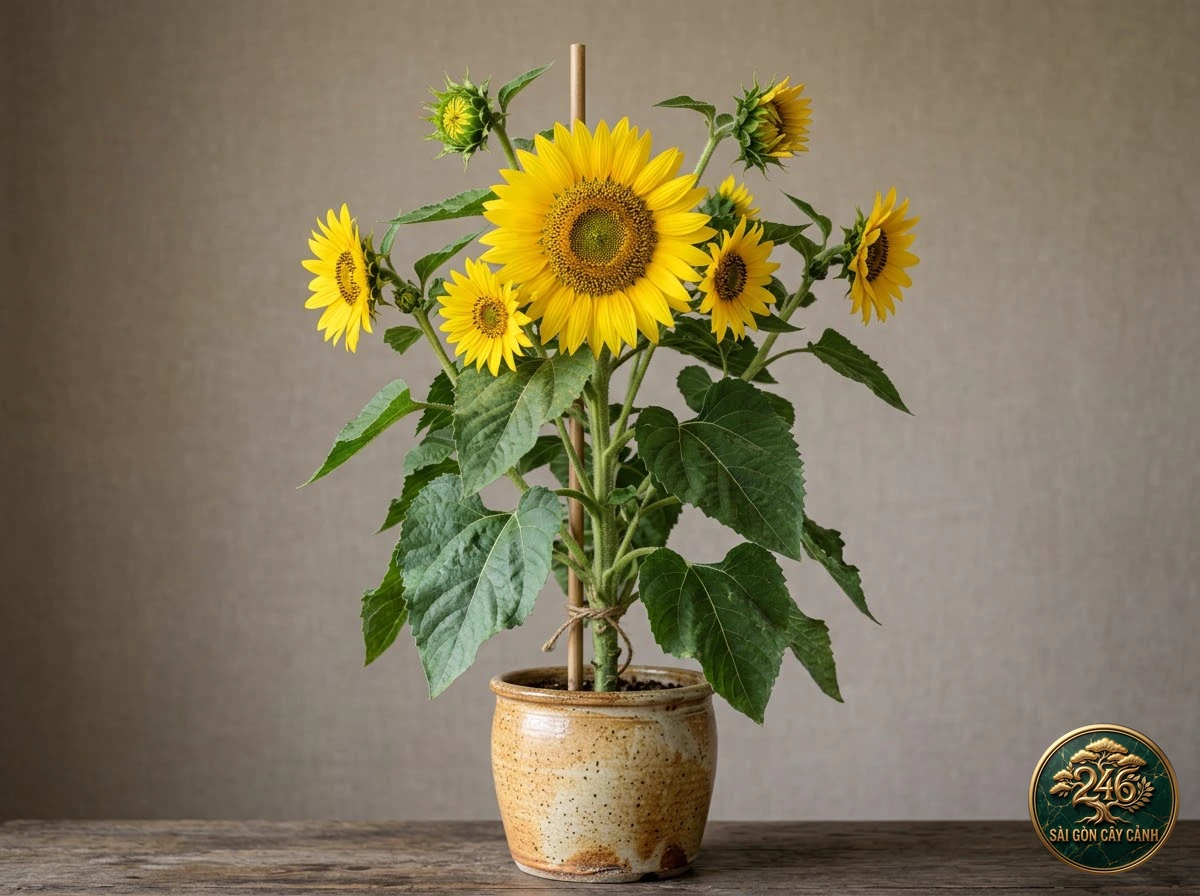
Common sunflower (Helianthus annuus)
Helianthus annuus, universally celebrated as common sunflower, annual sunflower, or mirassol, is a magnificent, towering annual herbaceous forb within the Asteraceae family. Indigenous to the fertile prairies of North America, it commands global botanical admiration for its majestic upright stature reaching 1.0 to over 3.0 meters in height, crowned by colossal composite flower heads spanning 15 to 35 cm across that blaze in brilliant solar golden-yellow. Its celebrated juvenile heliotropic movement—tracking the sun’s trajectory across the daily sky—has rendered it an immortal emblem of unwavering devotion, optimism, and boundless vital energy. Within Saigon Cay Canh landscape architecture, common sunflower symbolizes ascending wealth and radiant positivity, serving as a sovereign centerpiece for eco-tourism estates and private villa gardens.
Sài Gòn Cây Cảnh Care Compass
1. Botanical Identity & Taxonomic Nomenclature History
Helianthus annuus was officially established by Swedish botanist Carl Linnaeus in 1753 within his foundational monument Species Plantarum. The generic name Helianthus derives from Greek helios (‘sun’) and anthos (‘flower’), capturing both its solar floral geometry and iconic solar-tracking biology. The specific epithet annuus signifies ‘annual’ in Latin, denoting its rapid, vigorous lifecycle completing from seed to mature seed-bearing head within a single growing season.
Native to North America, the sunflower was domesticated and cultivated by indigenous American nations over 4,000 years ago as a staple food crop providing lipid-rich nutritious seeds. Introduced to Europe in the early 16th century by Spanish explorers as a royal ornamental novelty, it subsequently spread to Russia and evolved into one of the four dominant oilseed crops globally. Acclimatized across Vietnam by Saigon Cay Canh through elite dwarf potted and ornamental cut-flower cultivars, it offers dependable year-round solar displays across eco-tourism parks and luxury residential estates.
2. Morphological Anatomy & Structural Architecture

Morphologically, Helianthus annuus develops as a massive, erect annual herbaceous forb reaching heights between 1.0 and 3.0 meters in standard selections and 0.4 to 0.8 meters in dwarf container selections. The central stem is stout, cylindrical, longitudinally grooved, heavily lignified with age, and cloaked in dense, coarse whitish hispid trichomes. Leaves are alternately arranged along the stem; blades are broadly cordate to ovate measuring 15 to 35 cm long by 10 to 25 cm wide, featuring acute apices, cordate bases, and coarsely serrate margins. Both foliar surfaces are intensely scabrous with prominent reticulate venation beneath, supported by stout channeled petioles 5 to 20 cm long.
Inflorescences occur as massive solitary terminal capitula spanning 15 to 35 cm in diameter. The floral head is borne on a robust peduncle and enclosed by multiple imbricate tiers of lanceolate green phyllaries with bristly margins. The peripheral perimeter features 20 to 70 sterile ligulate ray florets blazing in golden-yellow like solar flares; the expansive central disc accommodates thousands of fertile, tubular disc florets rendered in dark brownish-purple arranged in mathematically flawless Fibonacci logarithmic spirals. Disc florets mature centripetally into edible, lipid-rich cypselae (sunflower seeds) 8 to 15 mm long with black or striped pericarps high in polyunsaturated fatty acids and vitamin E.
3. Solar Irradiance Thresholds & Photosynthetic Dynamics
Helianthus annuus is a quintessential obligate heliophyte performing best under intense, unfiltered direct sunlight with luminous intensities between 50,000 and 100,000 lux. A daily duration of at least 6 to 8 hours of unfiltered direct solar radiation is mandatory to ensure heavy stem lignification, promote protective trichome density, and maximize expansive flower head diameter and seed filling.
When grown in shaded microclimates below 25,000 lux, stems become weak, fragile, and highly prone to lodging during winds, internodes stretch excessively, and inflorescence diameter drops severely with poor seed set. The species exhibits phenomenal resistance to tropical heat exceeding 38 degrees C, supported by a deep penetrating taproot system and leathery scabrous leaves that effectively minimize transpirational stress.
4. Mineral Substrate Mechanics & Root Aeration Porosity
The root architecture of common sunflower consists of a massive central taproot penetrating 1.0 to 2.0 meters deep coupled with an extensive lateral fibrous network, demanding deep, fertile, humus-enriched topsoil engineered for rapid gravity drainage without pooling. Stagnant anaerobic waterlogging persisting beyond 24 hours suffocates delicate feeder rootlets, triggering shoot wilt and widespread foliar abscission.
The benchmark potting substrate crafted by Saigon Cay Canh contains 40% clean alluvial loam, 25% carbonized rice hulls for root zone aeration, 20% washed coco coir, 10% Trichoderma-fortified composted manure, and 5% horticultural perlite. Soil pH is maintained within 6.0 to 7.5. Planting pits and large containers must feature reliable, unobstructed drainage channels.
5. Hydraulic Equilibria & Irrigation Regimens
During rapid biomass accumulation and vertical stem expansion, Helianthus annuus consumes substantial water volumes, requiring consistent deep root-zone irrigation. The baseline watering protocol calls for soaking the root zone thoroughly at dawn whenever the upper 2 to 3 cm of substrate feels dry. During dry tropical summer spells, irrigate once daily; during the monsoon season, suspend watering until surface soils drain.
Deliver water directly to the soil perimeter; avoid forceful overhead spraying into expansive floral discs to prevent pollen washing and fungal disc rot. Following torrential downpours, verify that drainage trenches around garden beds remain completely unobstructed.
6. Nutrient Biogeochemistry & Fertilization Protocols
To sustain towering lignified stems and fuel colossal 35 cm golden floral discs across garden beds, Helianthus annuus demands disciplined mineral nutrition. Top-dress with aged vermicompost or slow-release organic pellets (NPK 6-8-12) monthly at 1 to 2 kg worked into the perimeter drip line.
Following vegetative establishment and during terminal floral bud initiation, dissolve a water-soluble balanced formula (NPK 15-20-25 or NPK 16-16-16) at 2.0 grams per liter, drenching the root zone every 10 to 12 days. Complement with foliar sprays rich in chelated calcium, boron, and potassium every 20 days to ensure peduncle tensile rigidity, holding colossal floral discs proudly aloft against wind and rain.
7. Clonal Propagation & Germplasm Conservation
Helianthus annuus propagates with exceptional ease from seed, achieving germination rates exceeding 95%. Sowing can proceed year-round in tropical climates, requiring only 60 to 75 days from germination to magnificent floral anthesis. Plump, mature cypselae harvested from fully desiccated flower heads are cleaned and stored in dry cloth bags.
Sow seeds directly into germination flats or planting pits filled with washed coco coir, carbonized rice hulls, and perlite, inserting seeds 1.5 to 2 cm deep and watering thoroughly. Placed in a warm, bright shaded nursery, germination occurs synchronously within 3 to 5 days. When seedlings reach 10 to 12 days of age bearing 2 true leaf pairs, transplant into deep garden soil to allow uninterrupted taproot development.
8. Phytochemical Toxicity & Pet Safety Standards (ASPCA)
Botanical safety profile and ASPCA pet safety standards: Classified within the Asteraceae family, Helianthus annuus is recognized as completely NON-TOXIC and safe around companion animals (dogs, cats, horses) and humans under standard ASPCA toxicological benchmarks. The entire plant—including rough hispid stems, golden petals, and nutritious seeds—synthesizes zero dangerous alkaloids or injurious plant toxins.
Accidental ingestion of petals or snacking on fallen seeds by domestic pets provokes zero toxicological harm or systemic distress. Sunflower seeds actually serve as a wholesome, nutrient-dense treat rich in healthy unsaturated fats for companion birds and small domestic pets. Horticulturists should practice routine hygiene, sanitize cutting shears with 70% medical alcohol, and maintain routine biophilic care to keep garden plantings flourishing safely.
9. Clinical Pathology Diagnostics & Treatment Strategies
Biosafety and rust mitigation along with structural wind staking protocols in Helianthus annuus:
| Clinical Manifestation | Etiological Cause | Standard Treatment Protocol |
|---|---|---|
| Stems become etiolated and fragile, internodes stretch excessively, and floral discs shrink severely | Severe solar deficiency caused by positioning in dense shade below 25,000 lux for extended periods | Prune leggy shoots with shears sanitized with 70% alcohol, move plant to receive 6 to 8 hours of direct sunlight daily |
| Foliar undersides develop raised rusty-brown pustules expanding rapidly and causing premature leaf desiccation | Puccinia helianthi rust outbreak fueled by high humidity and stagnant air circulation around foliage | Clip infected leaves, sanitize shears with 70% alcohol, and apply bio-copper fungicide or wettable sulfur twice 5 days apart |
| Potting soil is waterlogged, lower leaves turn yellow and drop prematurely, and shoots wilt | Root asphyxiation and rot induced by poor drainage or clogged container drainage ports | Suspend watering immediately, clear container drainage holes, aerate surface soil, and drench with Trichoderma |
10. Comparative Morphology & Allied Taxa Diagnosis
Morphological comparative matrix evaluating giant Fibonacci floral discs and juvenile heliotropic movement of Helianthus annuus:
| Diagnostic Parameter | Helianthus annuus (Common sunflower) | Comparative Specimen A | Comparative Specimen B |
|---|---|---|---|
| Capitulum Architecture and Diameter | Colossal composite heads 15 to 35 cm across of brilliant yellow ray florets exhibiting heliotropic movement | Compact daisy heads 3 to 5 cm across in orange, yellow, or white, naturally self-cleaning spent florets | Symmetrical composite flower heads 8 to 12 cm across perched on leafless scapes above a basal rosette |
| Growth Habit and Structural Stature | Giant erect solitary annual forb 1.0 to 3.0 meters tall, stout hispid stem heavily lignified with age | Low mounding spreading carpet annual forb 0.2 to 0.4 meters tall, wiry flexible self-branching stems | Acaulescent perennial rosette forb 0.3 to 0.5 meters tall with upright leafless scapes |
| Companion Animal Safety and ASPCA Profile | NON-TOXIC (certified completely benign and safe for companion animals under ASPCA non-toxic benchmarks) | NON-TOXIC (certified completely benign and safe for companion animals under ASPCA non-toxic benchmarks) | NON-TOXIC (certified completely benign and safe for companion animals under ASPCA non-toxic benchmarks) |
11. Biophilic Design Harmony & Contemporary Spatial Aesthetics

Within botanical symbolism and biophilic landscape aesthetics, common sunflower stands as a sovereign emblem of unwavering faith, radiant optimism, eternal devotion, and ascending wealth. Its colossal golden discs greeting the morning sun introduce uplifting vital energy, dissolving gloom and blessing residential spaces with joyful serenity.
Boasting majestic architectural scale and vibrant color persistence, Helianthus annuus serves as a premier commercial cut flower and agro-tourism landscape specimen: massed in expansive golden fields across eco-resorts, planted along villa property perimeters, arranged in grand interior floral centerpieces, or cultivated in deep containers on sun-drenched verandas.
12. Saigon Cay Canh Provenance & Cultivation Assurance

Saigon Cay Canh delivers magnificent, nursery-grown specimens of pure Helianthus annuus F1 selections, featuring stout lignified stems, robust root systems, and massive floral buds prepared to burst into brilliant golden discs across estate landscapes and floral exhibitions.
We provide 100% botanical taxonomic verification, comprehensive plant health warranties, prompt large-scale delivery services, and professional structural wind-staking advisory for luxury private estates and civic hospitality venues.
💬 Góc Tư Vấn & Hướng Dẫn Kỹ Thuật SGCC
Chuẩn E-E-A-T Kinfolk❓ Chăm sóc Common sunflower (Helianthus cần lưu ý điều gì quan trọng nhất?
💡 Dạ điều quan trọng nhất là giữ môi trường sống ổn định, tránh sốc nhiệt hay dao động thông số đột ngột, đồng thời cung cấp khẩu phần ăn sạch và tươi mới ạ.
❓ Làm thế nào để phòng ngừa bệnh tật hiệu quả cho các bé?
💡 Dạ anh chị nên giữ vệ sinh chuồng/hồ nuôi sạch sẽ, thay nước hoặc dọn dẹp định kỳ và bổ sung vitamin, men tiêu hóa đều đặn để tăng sức đề kháng ạ.
🌿 Trang Thiết Bị, Đất Trồng & Dụng Cụ Bonsai Tuyển Chọn
Dụng cụ tỉa, giá thể hữu cơ & phân bón chuyên dụng cho cây cảnh.

Chậu cây cẩm nhung may mắn,cây fittonia nhiêu mầu sắc

Chậu Nhựa Monrovia, Chậu gallon Họa Tiết Rồng Phụng, Ch…
#50 Hạt Giống Hoa Hồng Leo Pháp Đủ Màu có hướng dẫn các…

BS74 Combo 7 chậu bonsai mini men xanh hỏa biến gốm Bát…

Bộ 2 Cây Mini – 10x10x15 Cm – Dáng Bán Cầu – Sen Đá Chu…
Đá Perlite,Đá Trân Châu nhập khẩu,đá xốp trộn giá thể,t…

Phân bón lá NPK 500gr Growmore 30-10-10 +Te

Ang trồng cây men hỏa biến Bát Tràng cao cấp – Chậu bon…

Kéo cắt tỉa cành Kapusi tay dạ, kéo cắt cây cảnh, kéo c…
DAO XẾP 2 LƯỠI- CHUYÊN CHIẾT CÀNH, RỌC, TÁCH VỎ CÂY, GH…

Chậu trồng cây Bonsai, Cây tiểu cảnh mini bằng chất liệ…
MK NPK 15-7-17 TE Gói 1kg Phân bón chuyên dùng cho h…

Globe amaranth (Gomphrena globosa)
Globe amaranth (Gomphrena globosa) Gomphrena globosa, universally celebrated as globe amaranth, bachelor’s button, or immortelle, is a charming...
Read Monograph →
Scarlet wrightia
Wrightia coccinea, celebrated among connoisseurs of rare tropical flora as scarlet wrightia or red jasmine tree, is a...
Read Monograph →
Nile crossandra
Crossandra nilotica, celebrated internationally as the Nile crossandra or East African firecracker flower, is an aristocratic, evergreen tropical...
Read Monograph →
Panicle hydrangea (Hydrangea paniculata)
Panicle hydrangea (Hydrangea paniculata) Hydrangea paniculata, universally known as panicle hydrangea or peegee hydrangea, is a majestic, cold-hardy,...
Read Monograph →Expert Q&A, Recommended Supplies & Article Feedback
Tap once to connect instantly via Google, Facebook or TikTok — no long forms required!
No questions yet for this article. Tap Google / Facebook / TikTok above to ask the first question!