
Living plant profile
Creeping philodendron decursiva
Rhaphidophora decursiva
Comprehensive botanical dossier for Creeping philodendron decursiva (Rhaphidophora decursiva). Identification, lighting calibration, porous substrate formulation, and cultivation guide by Saigon Cay Canh.
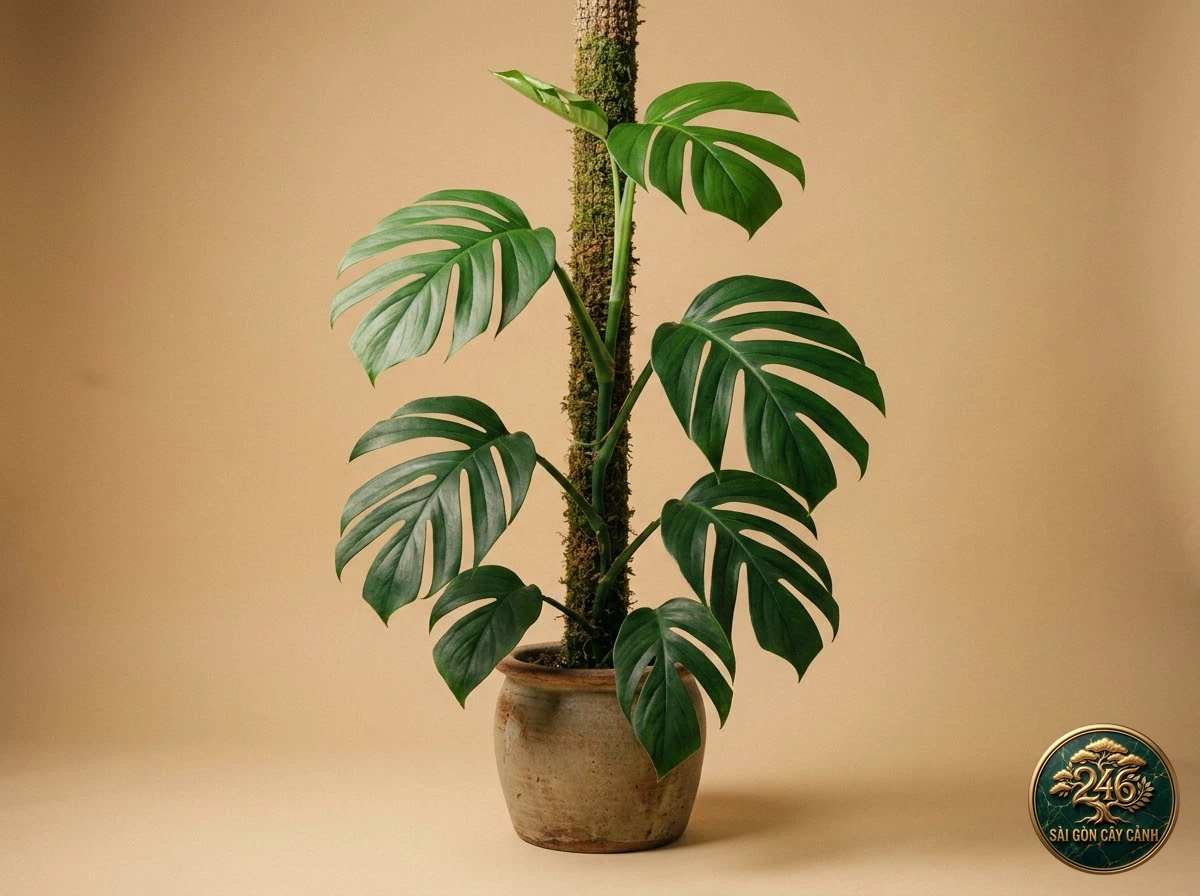
Creeping philodendron decursiva (Rhaphidophora decursiva) is the magnificent ‘Dragon Tail’ of the tropical foliage realm, celebrated for its spectacular ontogenetic transformation from compact juvenile foliage into massive, deeply pinnatisect blades spanning up to a meter in length. With stout climbing stems and vigorous architectural presence, this Himalayan and Indochinese liana brings primordial rainforest grandeur into modern curated atriums.
1. Core Botanical Taxonomy & Cultural Specifications
| Scientific Name | Rhaphidophora decursiva |
|---|---|
| Botanical Family | Araceae (Aroid Family) |
| Native Distribution | Subtropical and tropical montane forests of the Himalayas, Indochina, and southern China |
| Growth Demeanor | Massive robust hemi-epiphytic liana reaching 5 – 10 m, producing large pinnatisect foliage |
| Lighting Threshold | Bright indirect diffused daylight (2,000 – 4,000 lux); tolerates gentle early morning sun |
| Hydration Cadence | Water when top 30% substrate dries; demands porous drainage without standing moisture |
| Substrate Formulation | 40% coarse pumice, 25% chunky pine bark, 20% coarse perlite, and 15% washed coco chips |
| Thermal Range | 18°C – 30°C (64°F – 86°F; exhibits superior cold resilience compared to lowland aroids) |
| Relative Humidity | 65% – 85% (Elevated ambient humidity promotes adventitious root adhesion and blade sizing) |
| Cultivation Difficulty | Moderate (Requires substantial vertical climbing support and expansive domestic space) |
| Pet Safety Profile | Toxic (Contains insoluble calcium oxalate raphide crystals irritating to companion pets) |
Cataloged extensively within the Royal Botanic Gardens Kew (POWO) taxonomy, Rhaphidophora decursiva represents one of the most structurally imposing hemi-epiphytic lianas in the entire genus. Distributed across submontane valleys spanning the Himalayan foothills, Northern Vietnam, and Southern China, it displays exceptional evolutionary resilience across steep rocky terrain and wider thermal amplitudes.
The liana initiates life on the shaded forest floor as a compact runner, bearing small juvenile elliptic leaves appressed tightly against forest detritus. Upon contacting a host tree trunk or vertical limestone crag, its stem thickens dramatically, discharging stout adventitious climbing roots that anchor tenaciously into tree bark, propelling the vine into the canopy.
Mature climbing axes reach three to five centimeters in diameter, storing substantial moisture and starch reserves across closely spaced nodes, which buffers the plant against seasonal rainfall deficits.
2. Morphological Identification & Foliar Architecture
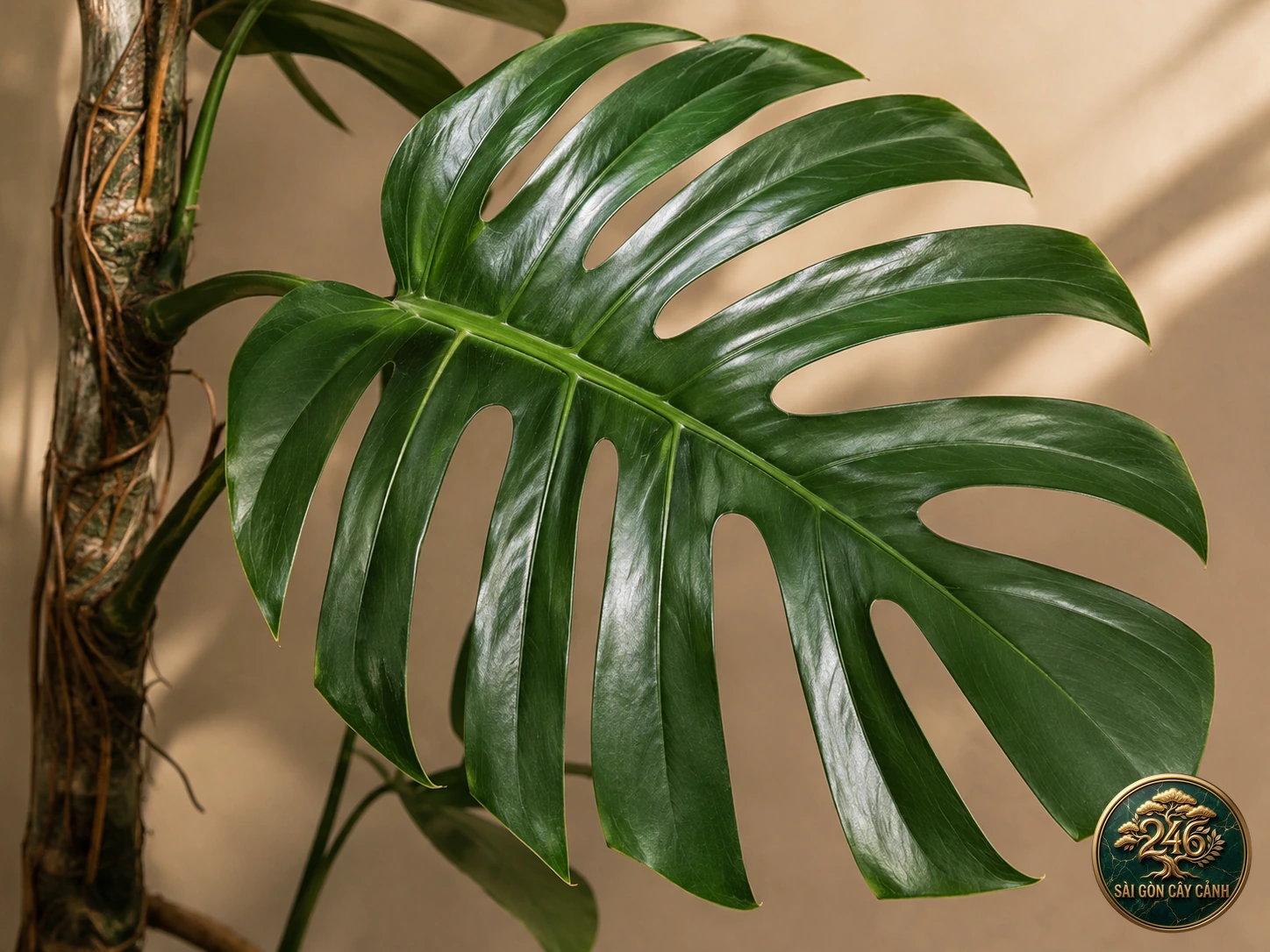
The foliage of Rhaphidophora decursiva undergoes dramatic morphological transformation. Upon achieving vertical ascent, mature blades attain lengths of 50 to 100 cm, deeply pinnatisect with symmetrical, forward-sweeping lanceolate lobes that evoke the silhouette of a soaring dragon tail. The leaf surface is thick, coriaceous, and lustrous dark green with a subtle metallic sheen.
Robust, channeled petioles sheath the climbing axis tightly at their base, angling the foliage outward into an expansive architectural crown. Elevated midribs reinforce each blade against gravitational sag.
Biomechanical analysis of mature Rhaphidophora decursiva foliage demonstrates an elevated primary midrib acting as a rigid structural beam that holds half-meter-long pinnatisect lobes horizontally without mechanical sagging. The thick, lustrous adaxial cuticle deflects intense solar radiation and suppresses non-stomatal transpiration during submontane droughts.
3. Photometric Calibration & Window Exposure Optimization
The robust liana requires bright diffused daylight between 2,000 and 4,000 lux to support its expansive foliage. Thanks to its thicker, leathery epidermis, it tolerates gentle direct morning sunlight for an hour or two without foliar stress.
Under prolonged lighting deficits, the vine ceases developing pinnate clefts, regressing toward small, entire juvenile blades. Staging within sunlit atriums, multi-story stairwells, or covered east-facing balconies provides ideal photon exposure.
In its mature phase, the photon saturation threshold of Creeping philodendron decursiva approaches 250 umol/m2/s. High photosynthetic capacity enables dramatic vegetative flushes when displayed near illuminated lightwells or east-facing glazed atriums.
4. Structural Vining Architecture & Support Dynamics
Irrigate thoroughly when the upper 30% of the substrate depth feels dry to the touch. Saturate the entire root ball until water drains freely, concurrently moistening the climbing totem to sustain aerial feeder roots along the vine.
Its thick climbing stem offers superior drought resilience; nevertheless, protracted moisture accumulation in collection saucers must be prevented to avoid root rot.
Optimal thermal conditions span 18°C to 30°C. Stemming from submontane slopes, it exhibits commendable cold tolerance, withstanding brief drops to 12°C without tissue breakdown.
Atmospheric humidity should remain steady at 65% to 85%. Sustained humidity stimulates aerial root penetration into vertical totems, triggering genetic cues for expanded leaf sizing and deep pinnatifid clefts.
5. Engineered High-Porosity Substrate Formulation
Substrate demands coarse aggregate structuring composed of 40% coarse pumice, 25% chunky aged pine bark, 20% coarse perlite, and 15% washed coconut coir chips. This structural porosity guarantees continuous subterranean oxygenation.
A buffered pH between 5.8 and 6.8 supports vigorous nutrient absorption and strong mechanical tissue formation.
The massive climbing axis and vigorous root system demand coarse aggregate potting mix containing 40% coarse pumice and 25% chunky pine bark. This structurally durable substrate resists decomposition and compaction over time, sustaining subterranean oxygenation over years of cultivation.
6. Organic Bio-Fertilization & Mineral Management
Apply balanced organic liquid fertilizer monthly during warm active months to nourish stout climbing stems. Supplement with slow-release organic granules across the soil surface in spring.
Taper fertilization during cooler winter months when growth rates diminish, avoiding fertilizer salt accumulation.
Sustaining giant pinnatisect leaves exceeding 60 cm demands generous organic nutrition throughout warm months. Monthly top-dressings of aged compost blended with kelp meal and calcium silicate fortify cell wall rigidity, supporting massive foliar weight without structural collapse.
7. Clinical Diagnostic Matrix & Horticultural Resolutions
| Clinical Symptom | Root Pathology | Diagnostic Method | Targeted Resolution |
|---|---|---|---|
| New leaves emerge entire without clefts, sizing regresses | Insufficient illumination or absence of vertical support | Relocate to brighter exposure >2,500 lux and provide moist climbing pole | Juvenile regression |
| Long internodal spacing, slender climbing stem | Etiolation stress from low ambient lighting | Move closer to expansive window or install full-spectrum LED fixtures | Unbalanced growth |
| Aerial root tips turn black and desiccate | Ambient humidity below 50% or dry climbing pole | Mist climbing pole daily and maintain ambient relative humidity above 70% | Aerial root desiccation |
| Brown spots with yellow halos expanding on leaves | Fungal foliar blight from standing overnight water | Excise infected foliage, cease evening misting, improve room ventilation | Fungal disease |
8. Pest Mitigation Protocols & Foliar Sanitation
Its thick foliage exhibits strong natural pest resistance, though mealybugs and spider mites may appear under arid indoor conditions. Rinse foliage periodically with gentle water sprays.
Root rot occurs only under persistent soil saturation; check drainage holes periodically to ensure unhindered water outflow.
The thick leathery foliage possesses natural resistance against common pests. Nonetheless, wiping dust deposits from the expansive lustrous blades with damp cloths bi-weekly ensures unhindered stomatal gas exchange and maximizes photosynthetic assimilation.
9. Asexual Propagation Methodology
Propagate by harvesting semi-woody stem cuttings containing viable nodes and active aerial rootlets. Use sterile pruning saws or shears to take cuttings fifteen to twenty centimeters in length.
Root cuttings in damp sphagnum moss or a pumice-perlite mix in a warm shaded setting; axillary shoots awaken within three to four weeks.
Maintenance for this vigorous liana involves gently hosing dust from thick leathery foliage during early morning. Fasten heavy stems securely to sturdy hardwood totems using padded ties, preventing mechanical damage to vascular tissues as the vine gains substantial weight.
10. Veterinary Toxicology & Domestic Safety Safeguards
Its vertical climbing habit allows owners to train the vigorous vine upward, keeping foliage well beyond pet reach.
11. Biophilic Interior Design & Architectural Styling
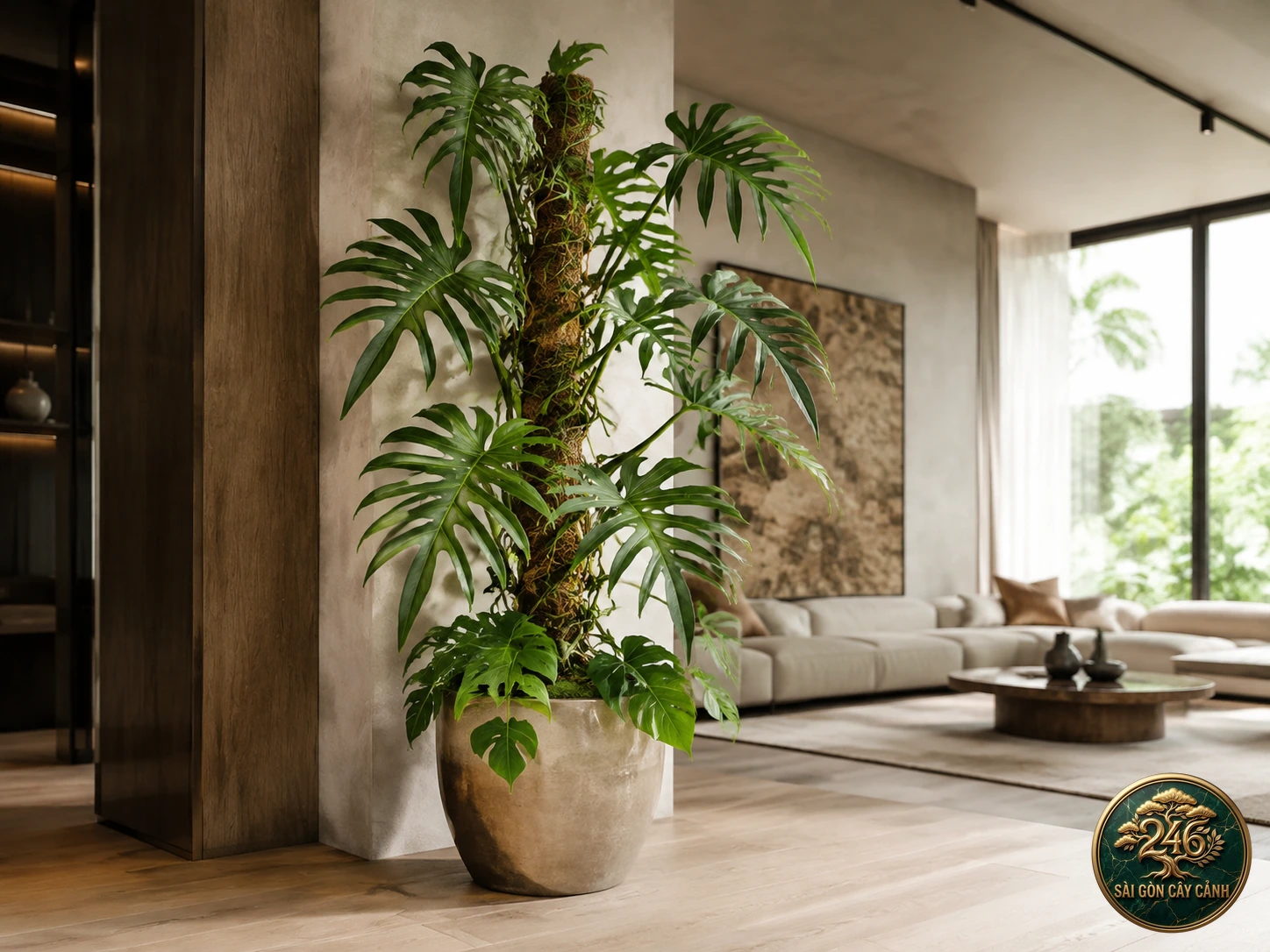
Within large-scale Biophilic architecture, Creeping philodendron decursiva serves as a majestic statement plant for luxury hotel lobbies, residential atriums, and multi-story corporate halls. Its soaring dragon-tail foliage projects botanical power, prosperity, and primordial rainforest grandeur.
Training vines onto rustic driftwood logs or textured interior walls creates a timeless living sculpture of commanding visual impact.
Within large-scale tropical interior architecture, Creeping philodendron decursiva serves as an imposing statement plant for luxury hotel atriums, grand residential stairwells, and multi-story corporate halls. Its soaring dragon-tail foliage projects monumental botanical presence and primordial rainforest majesty.
12. Master Cultivation Axioms
Three master horticultural axioms for cultivating monumental Rhaphidophora decursiva specimens:
- Hydration axiom: Provide heavy-duty vertical timber supports or large moss poles for aerial roots to anchor, triggering giant dragon-tail leaf clefting.
- Illumination axiom: Deliver abundant diffused daylight between 2,000 and 4,000 lux, allowing gentle morning sun to fuel vigorous photosynthesis.
- Sanitation axiom: Saturate thoroughly when the top 30% dries, mist the climbing pole daily, and maintain warmth above 18°C (64°F) for steady growth.
13. Frequently Asked Botanical Questions (FAQs)
Is Rhaphidophora decursiva a true Philodendron species?
No. Despite the common trade name ‘Creeping philodendron’, it belongs to the Asian genus Rhaphidophora within Araceae, while true Philodendrons originate strictly from the Americas.
How long does it take for juvenile leaves to develop mature dragon-tail clefts?
Given bright light and consistent moisture on a climbing pole, foliage initiates pinnate clefting within one to two years once stem diameter exceeds two centimeters.
Can I prune the vine if it grows too tall for my ceiling?
Yes. Pruning the terminal apex stimulates dormant lateral buds below to produce bushy secondary stems, and the severed apical cutting roots readily.
How cold-tolerant is this species during winter?
It withstands temporary dips to 12°C (54°F) without damage, though sustained temperatures above 18°C (64°F) are recommended for active growth.
What is the best climbing support for this robust liana?
Because of its heavy stem and vigorous aerial roots, a large-diameter (10-15 cm) moss totem or rustic hardwood log provides ideal mechanical support.
How long does Rhaphidophora decursiva take to transition from entire to pinnatisect leaves?
When supported by a sturdy climbing pole under high indirect light, the vine typically begins transitioning from entire juvenile leaves to pinnatisect adult blades after climbing 4 to 6 firmly rooted nodes, taking approximately 8 to 12 months.