
Living plant profile
Darth vader begonia
Begonia darthvaderiana
Comprehensive botanical dossier for Darth vader begonia (Begonia darthvaderiana). Identification, lighting calibration, porous substrate formulation, and cultivation guide by Saigon Cay Canh.
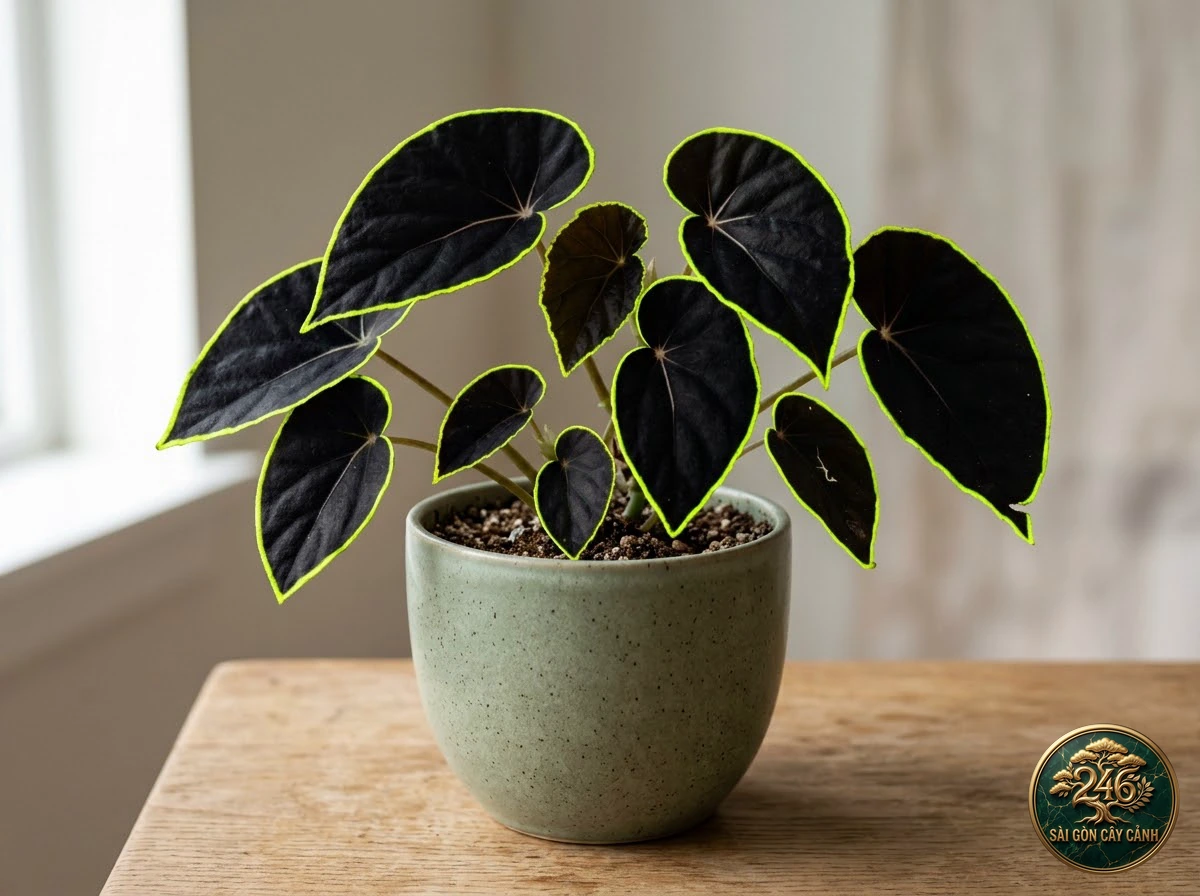
Darth vader begonia (Begonia darthvaderiana) is a legendary and exceptionally elusive botanical treasure, strictly endemic to shaded, hyper-humid river canyons flanking waterfalls in West Kalimantan, Indonesian Borneo. The species is revered for near-total obsidian-black foliar pigmentation with a satin-matte sheen, framed by an electric chartreuse marginal halo that evokes the mythic dark armor and luminous lightsabers of cosmic lore.
1. Core Botanical Taxonomy & Cultural Specifications
| Scientific Name | Begonia darthvaderiana |
|---|---|
| Botanical Family | Begoniaceae (Begonia Family) |
| Native Distribution | Borneo Island (West Kalimantan, Indonesia) |
| Growth Demeanor | Erect succulent herbaceous perennial growing 25 to 45 cm tall |
| Lighting Threshold | Gentle, low-to-medium filtered irradiance (800 – 1,500 lux) |
| Hydration Cadence | Maintain gentle, airy moisture with pure water, avoiding sogginess |
| Substrate Formulation | 40% pumice, 25% mini bark, 20% Chilean sphagnum, 15% worm castings |
| Thermal Range | 22°C – 27°C (72°F – 81°F), intolerant of chill below 18°C (64°F) |
| Relative Humidity | Optimal relative humidity 80% – 98% |
| Cultivation Difficulty | Expert (Strictly requires high-tech terrarium or climate cabinet) |
| Pet Safety Profile | Toxic to companion animals (Contains soluble organic salts) |
Discovered in remote primary rainforests of Kapuas Hulu Regency, West Kalimantan by Taiwanese botanist Ching-I Peng and colleagues, and formally published in 2014, Begonia darthvaderiana became an instant global sensation. The specific epithet ‘darthvaderiana’ pays homage to iconic Star Wars character Darth Vader, celebrating the plant’s enigmatic obsidian mantle and imposing cinematic presence.
In nature, this begonia dwells exclusively upon vertical sandstone walls lining shaded waterfall gorges beneath ancient equatorial rainforests. This hyper-humid riparian microclimate features perennial airborne spray, continuous relative humidity between 85% and 98%, and faint ambient light filtering through multi-tiered jungle canopies.
According to Kew’s Plants of the World Online (POWO), Begonia darthvaderiana belongs to section Petermannia. Cytologically, its epidermal cells concentrate hyper-dense anthocyanin and polyphenol matrices, manifesting the deepest, purest near-black foliar pigmentation recorded across the entire 2,000-species genus Begonia.
2. Morphological Identification & Foliar Architecture

Laminas of Darth vader begonia display an asymmetrical obovate-elliptic form, measuring 14 to 22 cm in length and 8 to 13 cm across. The foliar background is saturated in an astonishing metallic obsidian to deep ebony, possessing a matte leather sheen highlighted by subtly incised venation.
Rimming the entire laminar perimeter is a crisp, electric chartreuse marginal pinstripe spanning 0.5 to 1.5 mm, establishing a sensational chromatic boundary that frames the ebony center. The abaxial surface exhibits a saturated deep port-wine burgundy, held by stout succulent crimson petioles.
Cytological analysis of Begonia darthvaderiana reveals the highest concentration of anthocyanin and polyphenol matrices recorded in genus Begonia. Upper epidermal cells are saturated with deep purple-black pigment vacuoles absorbing nearly 99% of visible light wavelengths. Conversely, the electric chartreuse marginal halo lacks dark pigments, exposing active chlorophyll a and b that glow radiantly under diffuse photons.
3. Photometric Calibration & Window Exposure Optimization
Begonia darthvaderiana is attuned to low-to-moderate diffuse lighting, peaking at PPFD levels between 35 and 65 µmol/m²/s. Because its near-black pigment matrix absorbs virtually the entire visible light spectrum, the plant metabolizes efficiently even in the dim twilight of secluded rainforest chasms.
Irradiance exceeding 1,800 lux must be rigorously avoided. Intense photon flux rapidly degrades the sensitive dark pigment complex, fading ebony tissues into muddy reddish-brown and precipitating irreversible epidermal necrosis.
Biological light saturation for Darth vader begonia occurs within an optimal PPFD threshold of 35 to 65 µmol/m²/s. Benefiting from pan-chromatic light absorption across its near-black matrix, the plant metabolizes effectively within the dim twilight of deep waterfall gorges. Sustained irradiance exceeding 85 µmol/m²/s triggers photochemical breakdown, fading ebony tissues into dull reddish-brown.
4. Near-Black Pigmentation Light Harvesting & Riparian Humidity Microclimate
The erect succulent habit of Begonia darthvaderiana ascends 25 to 45 cm, featuring dark burgundy-claret nodes sheathed in protective stipules. The succulent stem stores substantial aqueous reserves, demanding gentle staking and superior substrate aeration to facilitate deep root penetration without asphyxiation.
The near-black pigmentation represents a masterclass in evolutionary light-harvesting: dense adaxial pigments capture faint photons across all wavelengths, while abaxial anthocyanins act as a biological mirror reflecting transmitted light back through chloroplasts, maximizing photosynthetic efficiency in deep shade.
Optimal cultivation temperatures for Begonia darthvaderiana range strictly from 22°C to 27°C (72°F – 81°F). The species tolerates zero cold; if temperatures drop beneath 18°C (64°F), vegetative arrest, foliar wilt, and fatal collar rot ensue rapidly.
Atmospheric humidity is a non-negotiable imperative: relative humidity must remain between 80% and 98%. This taxon strictly demands cultivation within smart plant cabinets or sealed terrariums equipped with automated environmental controls.
The target vapor pressure deficit (VPD) for Begonia darthvaderiana is bounded between 0.45 and 0.65 kPa with relative humidity maintained between 80% and 98%. Inside smart plant cabinets or sealed terrariums, steady VPD paired with gentle convective circulation keeps the satin-matte ebony epidermis taut, completely preventing edge scorch.
The erect succulent habit of Begonia darthvaderiana features thick collenchyma tissues that store rich aqueous reserves, stabilizing upright canes along sheer wet sandstone cliffs flanking West Kalimantan waterfalls. Abaxial wine-burgundy surfaces act as an optical mirror reflecting transmitted photons back through mesophyll layers, maximizing light harvesting in deep jungle shade.
5. Porous Aggregate Substrate Engineering & Aeration Dynamics
Substrate architecture for Darth vader begonia demands an ultra-aerated granular framework with air-filled porosity surpassing 40%. A master formula comprises 40% Indonesian pumice (3-6mm), 25% mini sanitized pine bark, 20% premium Chilean sphagnum, and 15% pasteurized vermicompost.
Substrate pH must be preserved in a slightly acidic to neutral range of 6.0 to 6.8. Never allow container bases to sit in standing water; hydrate gently using distilled or pure rainwater in early morning, maintaining an airy sponge-like moisture level.
Substrate architecture for Darth vader begonia demands an ultra-aerated granular framework exceeding 40% air porosity and unimpeded drainage. Combining 40% mini pumice (3-6mm) with 25% pasteurized mini pine bark and 20% Chilean sphagnum establishes a spongy organic matrix, enabling delicate feeder roots to respire freely under saturated humidity.
6. Organic Nutrition Schedules & Periodic Micronutrient Priming
Nutritional regimens for this ultra-rare begonia must remain minimal. Apply biological liquid nutrients diluted to one-eighth strength every 4 to 5 weeks during active foliar emergence, supplemented with essential amino acids to fortify cellular membranes.
Never deploy synthetic mineral fertilizers, as delicate root hairs suffer fatal osmotic shock. Flush container media monthly with pure reverse osmosis (RO) effluent to maintain an immaculate rhizosphere.
Biological nutritional management must remain exceptionally restrained: apply liquid biological organic fertilizer diluted to one-eighth strength every 4 to 5 weeks at an EC strictly below 0.4 mS/cm. This gentle trace feeding supplies essential amino acids that fortify cellular membranes without provoking osmotic root shock.
7. Clinical Diagnostic Matrix & Rapid Correction Protocols
| Clinical Symptom | Primary Etiology | Diagnostic Evaluation | Corrective Prescription |
|---|---|---|---|
| Ebony blades turning dull reddish-brown, halo fading | Excessive illumination degrading delicate dark pigment complexes | Photometer indicates light intensity surpassing 1,800 lux | Relocate specimen to gentler shade or dim specialized botanical LEDs by 40% |
| Foliage collapsing limp within a 24-hour window | Chilling thermal shock below 18°C inducing cellular membrane collapse | Thermometer reveals an unseasonal nocturnal cold drop | Activate dedicated thermostatic heating to stabilize ambient warmth at 24°C |
| Rapidly spreading water-soaked brown rot lesions | Bacterial soft rot from stagnant condensation trapped on blades | Visual inspection confirms expanding translucent liquefied tissue | Promptly excise afflicted foliage, elevate circulation fan speed, and mist biological colloidal silver |
| Laminar margins curling and crisping inward | Cabinet relative humidity abruptly plunging beneath 70% | Ultrasonic humidifier water reservoir found completely depleted | Refill humidifier with distilled water and calibrate automated shutoff at 85% |
8. Cryptic Pest Prophylaxis & Foliar Surface Sanitation
In saturated enclosure atmospheres, bacterial soft rot and Pythium root decay represent mortal hazards. The primary defense is installing continuous 24/7 micro-convective circulation fans, ensuring air circulates gently without allowing standing condensation droplets on ebony blades.
Routinely inspect leaf axils and cleanse foliar surfaces using sterile cotton swabs dampened with distilled water, strictly avoiding abrasive wipes that scratch delicate satin-matte cuticles.
Defending against bacterial soft rot in saturated enclosure atmospheres relies strictly on continuous 24/7 micro-convective airflow. Never permit condensation droplets to stand overnight on ebony foliar surfaces, and apply quarterly preventative misting with 10 ppm biological colloidal silver.
9. Asexual Propagation Methodology & Root Strike Protocols
Propagating Begonia darthvaderiana represents an elite horticultural endeavor, accomplished via stem tip or nodal cuttings under rigorous sanitary protocols. Using a sterile surgical scalpel, excise a 6-10 cm cutting bearing 2 healthy nodes.
Insert cuttings into moist perlite-sphagnum within an incubator maintaining 95% relative humidity and 24°C warmth; adventitious roots initiate over a 25 to 35 day developmental interval before tiny black leaves unfurl.
During sterile nodal cane propagation, dusting severed ends with activated charcoal powder protects cuttings from Pythium and Erwinia bacterial soft rot. Maintaining cuttings in warm 24°C chambers at 95% relative humidity over 25 to 35 days achieves 100% root strike and black shoot emergence.
10. Companion Animal Toxicology Profile & ASPCA Safety Evaluation
Its prerequisite for extreme 85%+ humidity mandates cultivation within sealed terrariums or professional plant cabinets, thereby naturally establishing an absolute protective enclosure for household pets.
11. Biophilic Curation & Contemporary Interior Design Styling
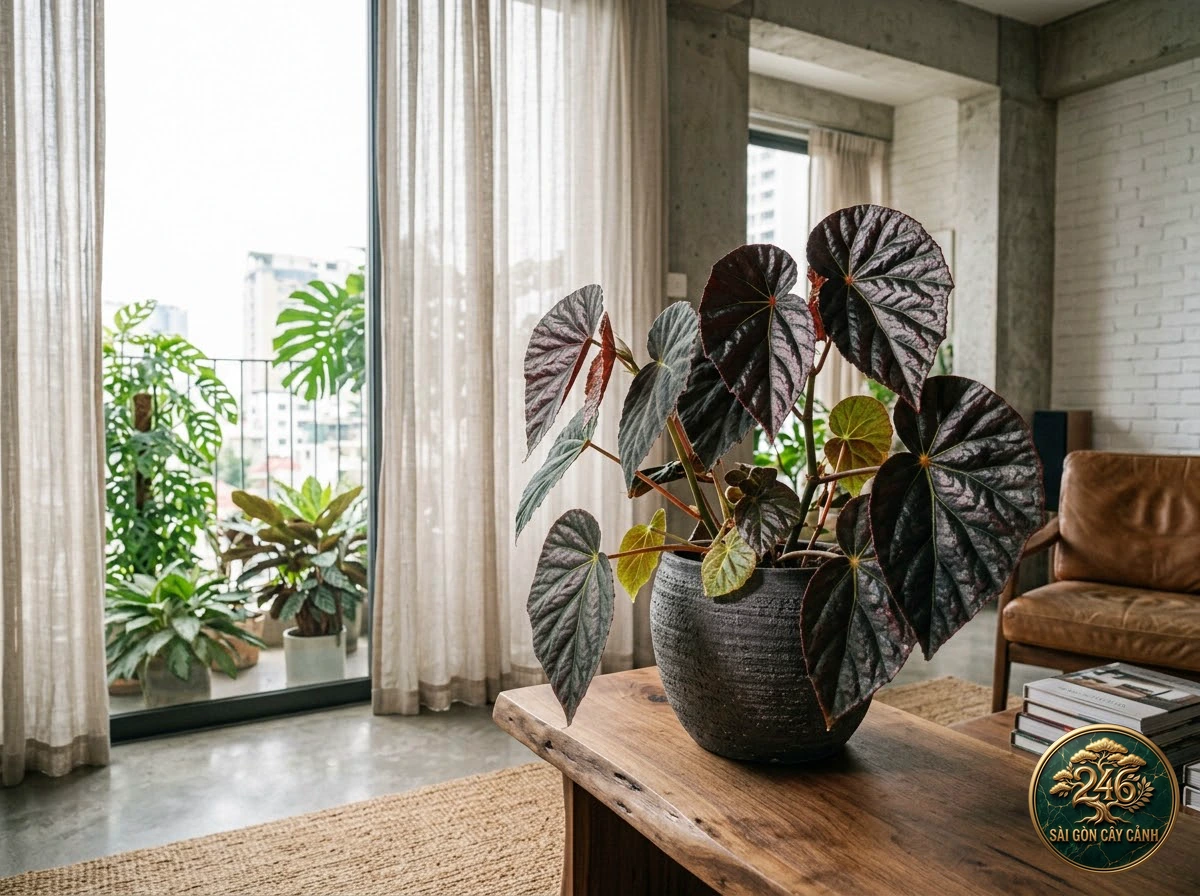
Begonia darthvaderiana is hailed as one of the most legendary botanical masterpieces of the twenty-first century. Its mystical obsidian mantle and electric fluorescent halo transform containers into the ultimate focal centerpiece across luxury Biophilic vitrines and world-class private collections.
Cultivating this elusive dark sovereign successfully represents the zenith of tropical horticultural mastery, delivering unmatched prestige and an awe-inspiring communion with nature’s most enigmatic creations.
Within elite tropical botanical curation, Begonia darthvaderiana reigns as the legendary sovereign of the dark. Its mystical obsidian mantle and electric chartreuse halo introduce infinite visual depth, transforming display vitrines into the most prestigious and enigmatic living museum showcases on Earth.
12. Master Principles for Sustainable Indoor Acclimatization
Three cardinal survival axioms for Begonia darthvaderiana:
- Hydration axiom: Saturated Humidity Axiom: Sustain 80% – 95% relative humidity inside smart cabinets paired with continuous 24/7 micro-convective airflow.
- Illumination axiom: Tropical Warmth Axiom: Preserve steady warmth between 23°C – 26°C, strictly preventing cold exposure below 18°C.
- Maintenance axiom: Demineralized Hydration Axiom: Exclusively hydrate with pure distilled or RO water, never permitting standing droplets on ebony blades.
13. Frequently Asked Questions Regarding Darth vader begonia (FAQs)
Can Begonia darthvaderiana survive on an ordinary open desk?
Absolutely not; foliage wilts and collapses within 24 to 48 hours in open room air. It strictly mandates an enclosed terrarium or smart cabinet.
What produces the near-black coloration of the leaves?
The ebony hue arises from hyper-concentrated anthocyanins and polyphenols within epidermal cells, evolved to harvest all available light in deep river chasms.
Does Begonia darthvaderiana flower in cultivation?
Yes, mature specimens project slender scapes bearing pale peach-pink to blush florets, producing a striking chromatic contrast against black foliage.
What water quality is non-negotiable for this species?
Pure distilled water or reverse osmosis (RO) effluent is strictly mandatory; chlorinated municipal tap water causes immediate root burn.
How rapidly does the plant unfurl new leaves?
Under optimized parameters (24°C, 85% humidity, 1,000 lux illumination), a specimen unfurls a fresh, fully developed leaf every 3 to 5 weeks.
What produces the near-total obsidian-black coloration of the leaves?
The ebony hue arises from hyper-concentrated anthocyanin and polyphenol matrices within upper epidermal cells; this evolutionary adaptation absorbs virtually 99% of visible light wavelengths within deep waterfall chasms.