
Living plant profile
Dumb cane
Dieffenbachia seguine
Comprehensive botanical dossier for Dumb cane (Dieffenbachia seguine). Identification, lighting calibration, porous substrate formulation, and cultivation guide by Saigon Cay Canh.
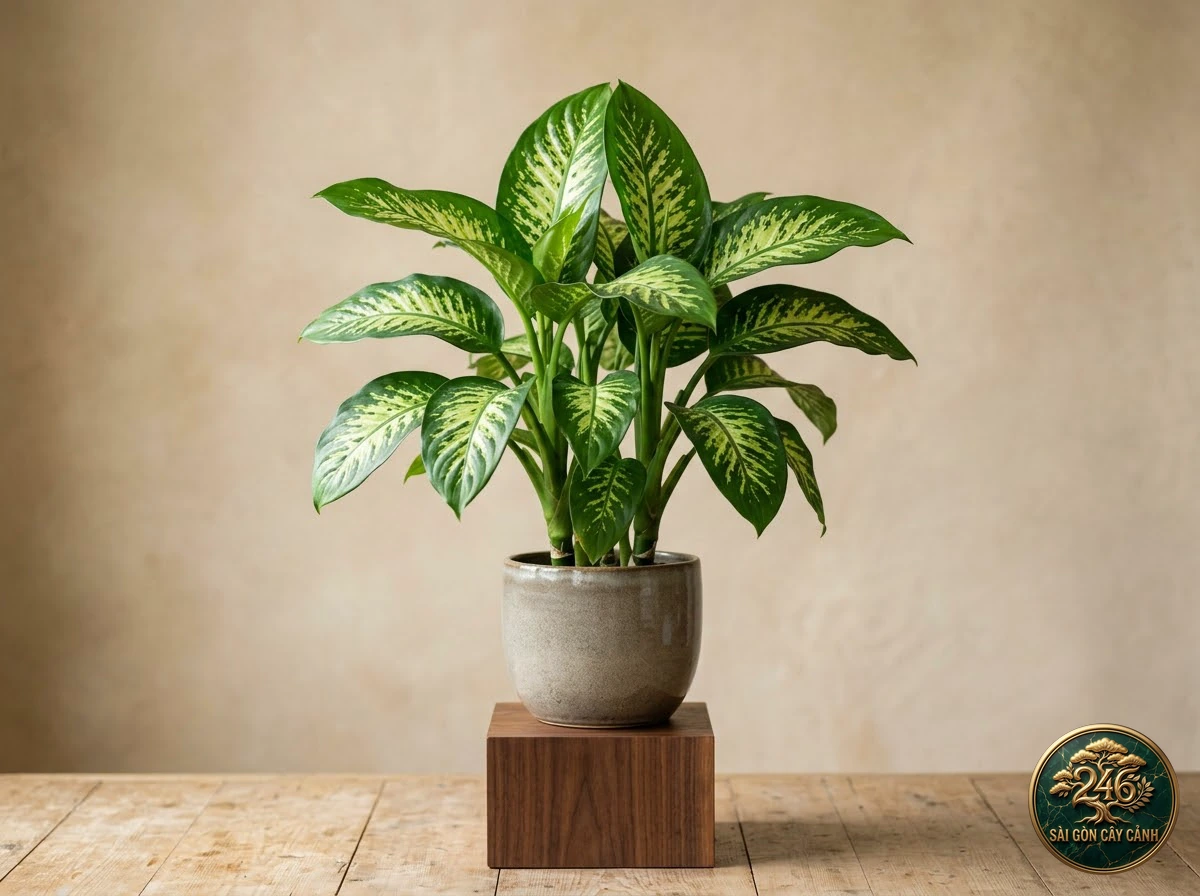
Dumb cane (Dieffenbachia seguine) is an iconic Neotropical foliage classic originating across tropical America, celebrated for monumental broad leaves splashed with radiant creamy-gold blotches atop muscular cane-like stems. It introduces commanding presence and lush botanical vitality to indoor spaces.
1. Core Botanical Taxonomy & Cultural Specifications
| Scientific Name | Dieffenbachia seguine |
|---|---|
| Botanical Family | Araceae (Aroid Family) |
| Native Distribution | Tropical rainforest understories across the Amazon basin, Central America, and the Caribbean islands |
| Growth Demeanor | Upright thick-caned herbaceous perennial with fleshy cane-like stems storing substantial cellular moisture |
| Lighting Threshold | Bright indirect diffused daylight (1,500 – 3,000 lux); maintains high creamy-white foliar contrast |
| Hydration Cadence | Irrigate once upper 4 cm substrate feels dry; succulent canes navigate transient dry intervals safely |
| Substrate Formulation | 35% aged pine bark, 25% coarse perlite, 25% volcanic pumice, and 15% coarse coconut husk chips |
| Thermal Range | 19°C – 31°C (66°F – 88°F; notably sensitive to cold drops below 15°C) |
| Relative Humidity | 65% – 85% (Elevated ambient humidity preserves large foliar turgor and glossy luster) |
| Cultivation Difficulty | Easy to Moderate (Adaptable vegetative grower requiring strict pet safety protocols) |
| Pet Safety Profile | Highly Toxic (Insoluble calcium oxalate crystals paired with proteolytic enzymes; strict isolation) |
Formally cataloged in taxonomic databases of the Royal Botanic Gardens Kew (POWO), Dieffenbachia seguine serves as the quintessential type species of its genus, distributed widely across tropical rainforest understories from southern Mexico through the Amazon river basin to the Caribbean islands. It flourishes within rich alluvial topsoils heavily carpeted by decomposing tropical foliage.
Its physiological architecture is defined by stout, succulent canes functioning as internal water and carbohydrate reservoirs. This structural adaptation allows Dumb cane to navigate transient dry periods gracefully, sustaining firm foliar turgor throughout shifting environmental conditions.
Ecological surveys across Amazonian riparian reserves indicate that this species adapts vigorously to seasonal hydrological pulses. During heavy flood seasons, fibrous root systems expand rapidly to uptake dissolved humic nutrients; during drier spells, thickened cuticular layers seal stem tissues against transpiration losses.
2. Morphological Identification & Foliar Architecture
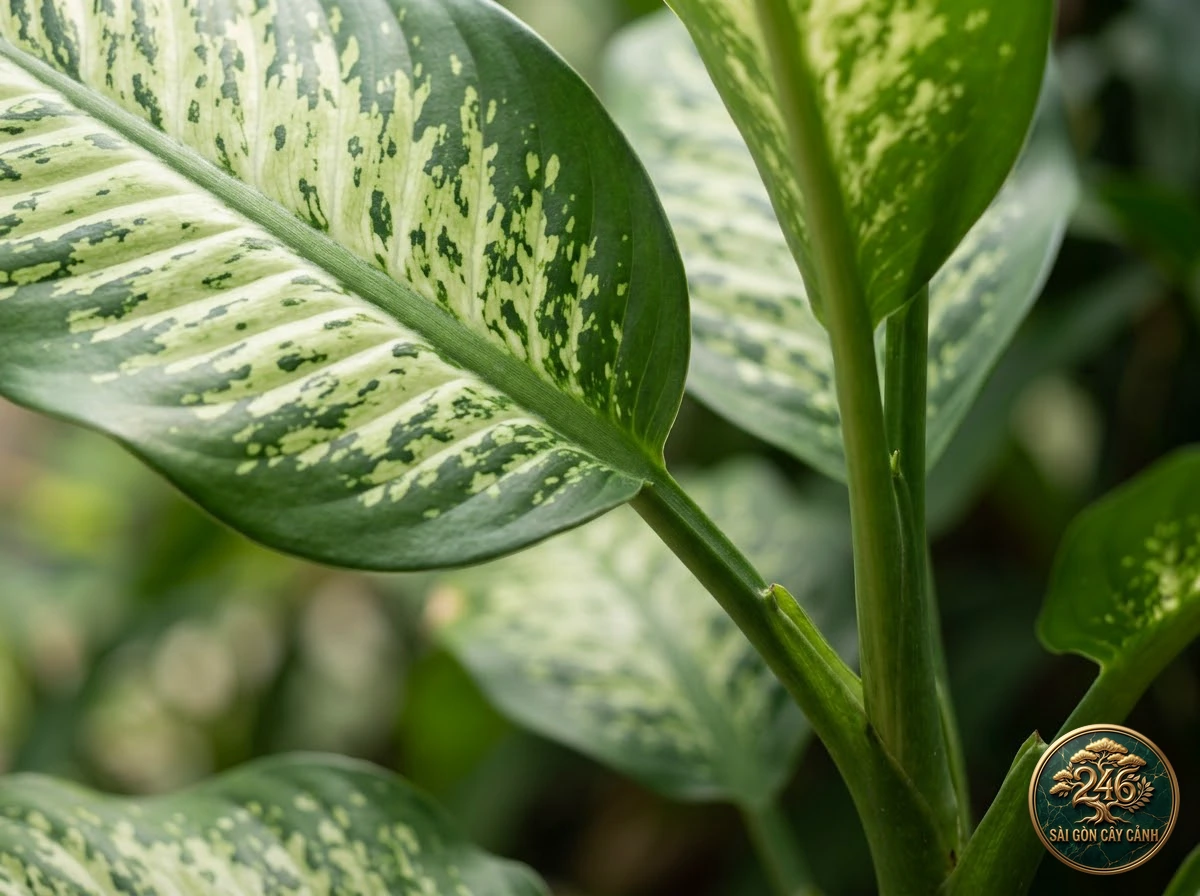
Leaves achieve monumental dimensions, presenting broad ovate-oblong blades 30 to 50 cm long and 15 to 25 cm wide. Saturated forest green backgrounds contrast boldly against irregular sprays of creamy ivory and pale gold splashes radiating outward from the central midrib along lateral venation lines.
The adaxial leaf surface possesses a substantial leathery thickness protected by a natural waxy cuticular barrier. Thick, channeled petioles clasp the cylindrical cane securely, forming rigid mechanical unions that hold the massive leaf blades horizontally aloft.
3. Photometric Calibration & Window Exposure Optimization
Maintaining vivid creamy-gold variegation requires generous diffused daylight calibrated between 1,500 and 3,000 lux. Positioning the specimen 1 to 1.5 meters back from a curtain-filtered south or east-facing domestic window delivers ideal photon density for leaf pigment expression.
Direct intense solar exposure singes the tender, pigment-free ivory patches within hours, causing irreparable paper-like brown burn lesions. Conversely, prolonged placement in deep shade causes emerging leaves to emerge smaller with faded contrast.
4. Structural Cane Dynamics & Form Optimization
Dumb cane produces a self-supporting, columnar cane structure characterized by conspicuous horizontal nodal rings. Throughout early and mature vegetative phases, the stout trunk supports the massive foliage crown without mechanical props.
When specimens surpass 1.5 meters and shed aged lower foliage, exposing a bare cane trunk, the top-heavy crown may lean. Cultivators can provide an unobtrusive bamboo stake or execute an apical rejuvenate heading cut to induce fresh basal tillering.
5. Engineered High-Porosity Substrate Formulation
Thick tuberous adventitious roots demand an engineered coarse substrate with outstanding aeration. Fine, moisture-retaining loam soils quickly compact, creating anaerobic subterranean pockets that encourage catastrophic bacterial and fungal soft rots.
A field-proven potting formulation incorporates 35% medium aged pine bark nuggets, 25% coarse perlite, 25% volcanic pumice, and 15% washed coarse coconut chips. This structural medium evacuates surplus irrigation smoothly, ensuring rich oxygen diffusion throughout the root zone.
Substrate air porosity exceeding 35% allows air currents to circulate unhindered to every feeder rootlet. Water cascading through bark nuggets and coarse minerals leaves behind only a thin hydration mantle, entirely eliminating waterlogged bottom layers and suppressing Pythium fungal pathogens.
6. Organic Bio-Fertilization & Mineral Management
Dumb cane exhibits vigorous vegetative growth during warm seasons, demanding steady nutritional support. Administering diluted organic fish hydrolysate or microbial bio-fertilizer every three weeks during active spring and summer flushes sustains continuous large leaf production.
Avoid scattering granular chemical fertilizers in direct contact with the cane base to prevent chemical burning of epidermal tissues. Every three months, leach the container thoroughly with pure water to flush away residual mineral fertilizer crusts.
7. Clinical Diagnostic Matrix & Horticultural Resolutions
| Clinical Symptom | Root Pathology | Diagnostic Method | Targeted Resolution |
|---|---|---|---|
| Lower cane collapses soft and mushy, foliage wilts | Bacterial soft rot triggered by substrate waterlogging | Gently press lower cane base to test firmness | Excise rotten sections, disinfect with 70% alcohol, propagate healthy top |
| Crispy brown foliar margins with curled tips | Ambient atmospheric humidity severely depressed | Examine room hygrometer and air conditioning currents | Relocate away from direct drafts, add pebble moisture trays |
| Emerging leaves emerge solid green with faint spots | Inadequate light levels at plant staging area | Check light intensity with a lux meter | Move closer to bright filtered daylight or add horticultural LED grow lamp |
| White cottony wax deposits along lower leaf midribs | Mealybug colonies taking root in stagnant air | Inspect petiole junctions and undersides | Dab clean using cotton swabs dampened in 70% alcohol, spray organic neem |
| Young foliar blades show pale interveinal chlorosis | Micronutrient iron or magnesium deficiency in media | Measure pH of bottom leachate solution | Administer dilute chelated trace element drench |
8. Pest Mitigation Protocols & Foliar Sanitation
Within enclosed domestic spaces with reduced airflow, mealybugs and spider mites constitute the primary pests. They congregate beneath broad leaves to siphon nutrients. Wipe initial colonies off immediately with a soft rag moistened in 70% alcohol to halt escalation.
Monumental foliar surfaces naturally attract household dust layers. Wiping both leaf surfaces monthly with a warm damp microfiber cloth restores striking gloss and clears microscopic stomata for optimal photosynthetic performance.
9. Asexual Propagation Methodology
Propagation is straightforward via cane cuttings or terminal shoot excision. Using a sterilized knife treated with 70% alcohol, section the cane into 10 to 15 cm segments containing at least two dormant nodes. Apply botanical sealant to cut margins and air-dry for 24 hours.
Bed cane segments horizontally or vertically halfway into a moist blend of perlite and coco coir for 4 to 6 weeks. Maintained in warm ambient shade between 24°C and 28°C, vigorous adventitious roots and fresh green shoots will emerge from nodal eyes.
10. Veterinary Toxicology & Domestic Safety Safeguards
House containers in designated pet-free rooms or on sturdy elevated platforms entirely out of animal reach. Wear protective waterproof gloves during pruning or potting procedures, washing thoroughly with soap afterwards to prevent accidental ocular or dermal irritation.
11. Biophilic Interior Design & Architectural Styling
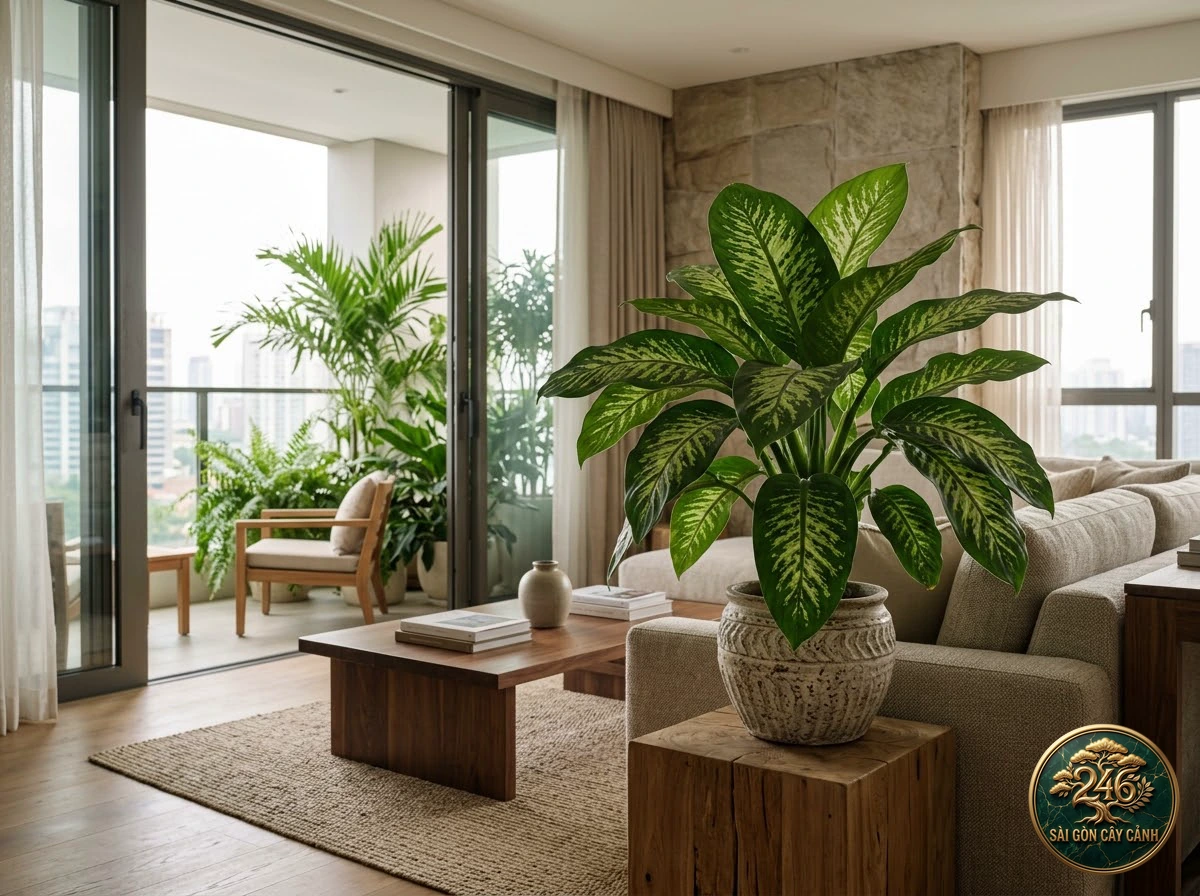
With grand architectural stature and bold variegated foliage, Dumb cane serves as a show-stopping focal element within expansive living areas, hotel atriums, biophilic commercial lounges, and modern executive suites.
It displays dramatic harmony staged inside textured concrete containers, sleek charcoal composite pots, or deep glazed navy planters, infusing modern architectural environments with bold tropical exuberance and living tranquility.
The commanding scale of this botanical titan symbolizes thriving vitality and natural abundance. Positioned within bright residential atriums or welcoming commercial foyers, its golden-splashed leaves diffuse organic warmth, connecting urban spaces to the elemental pulse of Neotropical forests.
12. Master Cultivation Axioms
Distilled from professional tropical plant nursery practice at Saigon Cay Canh, observe these three essential care principles:
- Hydration Precision: Irrigate only after the top 4 cm of substrate dries down; confirm moisture depth with a wooden probe before watering.
- Solar Management: Provide ample diffused daylight between 1,500 and 3,000 lux; protect foliage from harsh midday solar radiation at all times.
- Foliar Care: Wear protective gloves during pruning and wipe foliage monthly with a soft damp cloth to maintain hygiene and stomatal exchange.
13. Frequently Asked Botanical Questions (FAQs)
Why is this plant commonly referred to as ‘Dumb cane’ in English?
The colloquial name stems from the intense oral swelling and laryngeal paralysis induced by calcium oxalate crystals and proteolytic enzymes if chewed, temporarily rendering victims unable to speak.
How should one manage specimens that have grown overly tall and leggy?
Execute an apical stem heading cut to root the crown into a fresh container; the remaining stump will sprout multiple compact offshoots from dormant basal nodes within weeks.
Are early morning water droplets on leaf tips toxic?
This represents natural nocturnal guttation driven by root pressure in high humidity. While mineral droplets carry trace enzyme dilutions, wipe them away and prevent companion animals from licking foliage.
What container type provides the best stability for mature specimens?
Heavy ceramic stoneware or cast terrazzo pots with wide bases furnish essential ballast against the leverage of elevated heavy crowns.
Is Dumb cane suitable for enclosed domestic bedrooms?
It is better suited to spacious, airy living rooms or well-ventilated bright atriums rather than confined bedrooms due to its grand scale and high toxicity profile.
Does the plant produce flowers and fruit in cultivation?
Mature specimens develop spadix inflorescences sheathed in pale green spathes. When pollinated, they produce clusters of small orange-red berries containing botanical seeds.