
Living plant profile
Fiddle-leaf fig
Ficus lyrata
Comprehensive botanical dossier for Fiddle-leaf fig (Ficus lyrata). Identification, lighting calibration, porous substrate formulation, and cultivation guide by Saigon Cay Canh.
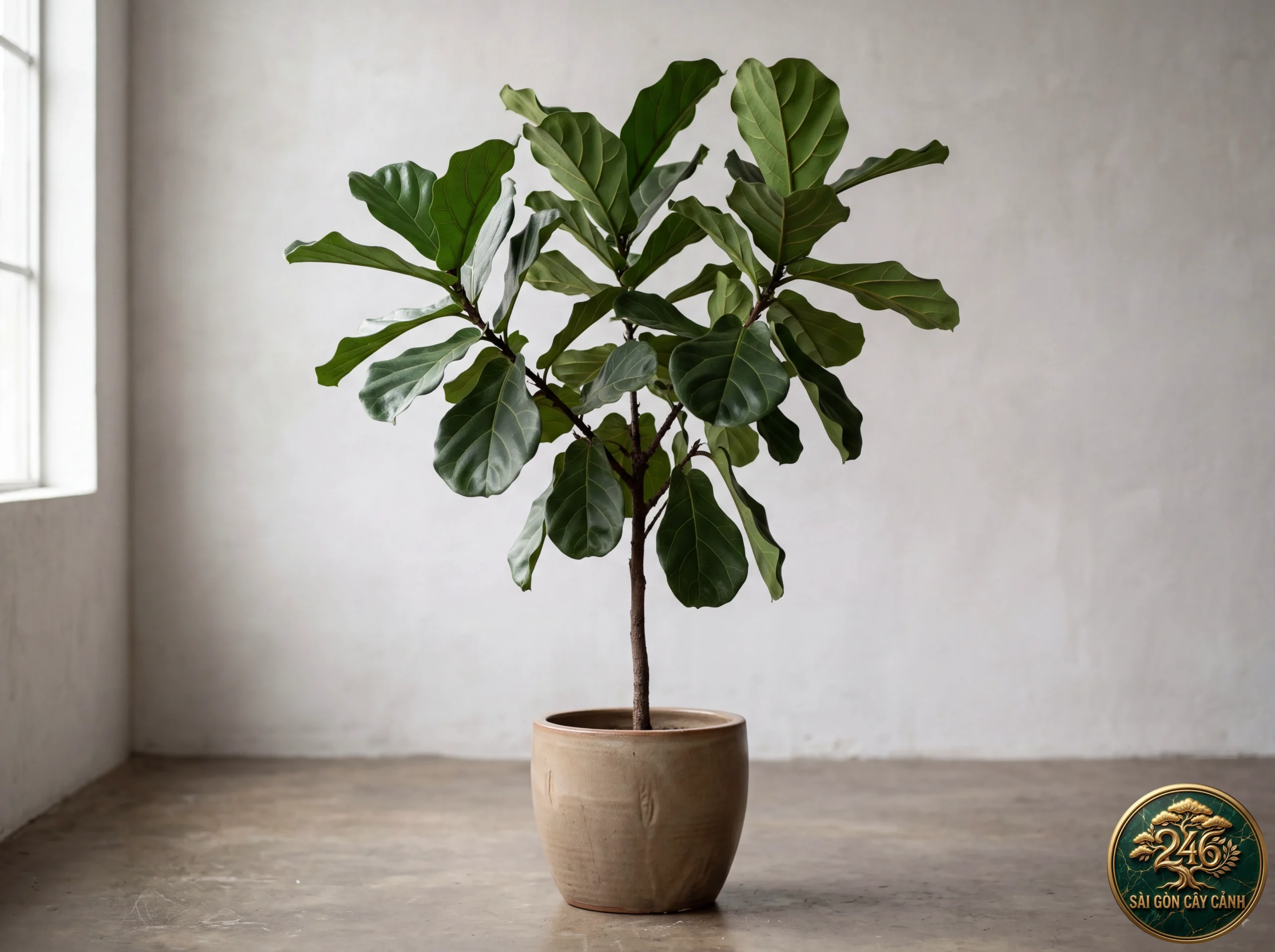
Fiddle-leaf fig (Ficus lyrata) is an iconic global indoor statement tree within the fig family (Moraceae), celebrated for monumental violin-shaped foliage with corrugated undulating margins and striking venation, imparting peerless architectural majesty to contemporary living spaces.
1. Core Botanical Taxonomy & Cultural Specifications
| Scientific Name | Ficus lyrata |
|---|---|
| Botanical Family | Moraceae (Mulberry Family) |
| Native Distribution | Lowland tropical rainforests of West Africa (Cameroon, Gabon, Nigeria, Sierra Leone) |
| Growth Demeanor | Monumental evergreen tree; develops an upright, architectural sculptural canopy in pots |
| Lighting Threshold | Robust daylight, copious bright indirect light or gentle morning sun (3,000 – 7,000 lux) |
| Hydration Cadence | Water thoroughly when top 50% substrate is dry; ensure rapid percolation |
| Substrate Formulation | Alluvial loam, coarse coconut coir chunks, pine bark, perlite |
| Thermal Range | 18°C – 32°C (warm tropical comfort envelope; vulnerable to chill below 12°C) |
| Relative Humidity | 50% – 75% (adapts well to residential settings; shield from cold drafts) |
| Cultivation Difficulty | Moderate (demands stable bright placement, consistent watering, minimal shifting) |
| Pet Safety Profile | Pet caution (milky latex contains ficin enzymes causing mild oral irritation) |
Biogeographically and evolutionarily, Ficus lyrata originates from the lowland tropical rainforests of coastal West Africa stretching from Sierra Leone through Cameroon. In wild habitats, it often initiates life as a hemiepiphyte germinating in high tree forks, sending down massive aerial roots to the forest floor before maturing into a free-standing 12 to 15 meter canopy giant.
In interior architecture, the Fiddle-leaf fig develops as a single-stemmed columnar tree or sculpted standard 1.2 to 2.5 meters tall. The sturdy silvery-gray trunk supports immense spirally arranged leaves; upon accidental pruning or injury, the vascular laticifers exude characteristic Moraceae milky latex.
The crowning morphological attraction codified by its specific epithet ‘lyrata’ is the lyre- or violin-shaped foliar geometry (lyrate to pandurate): narrow at the auriculate base, constricting centrally, and expanding into a dramatic rounded fan with an indented apex. Blades reach monumental sizes 30 to 50 cm long and 20 to 35 cm wide, leathery and stiff with heavily puckered, corrugated venation.
2. Morphological Identification & Foliar Architecture
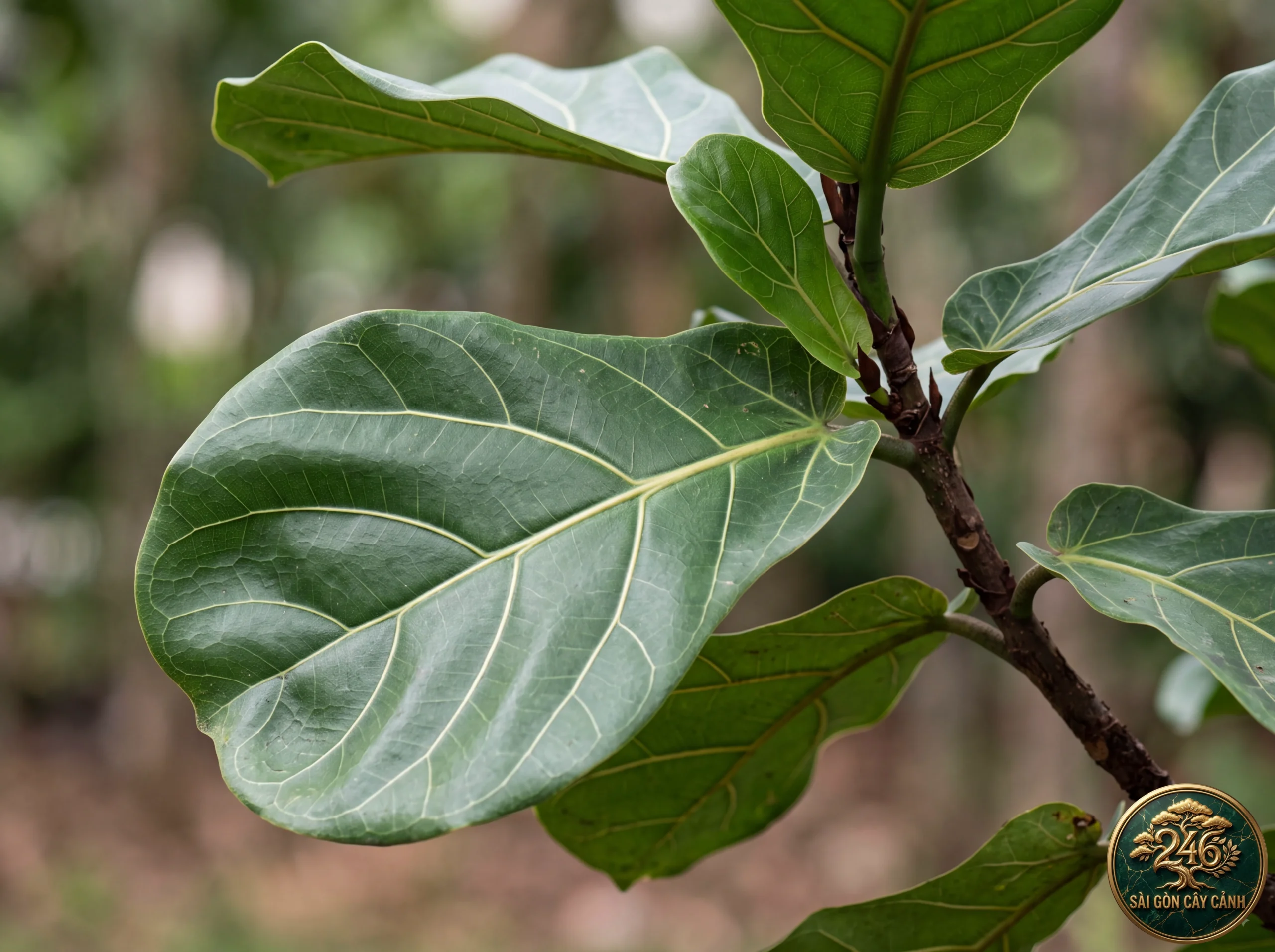
Diagnostic keys identifying Ficus lyrata include its undulating, puckered (corrugated-bullate) laminar surface with pale chartreuse veins prominently raised on both adaxial and abaxial planes. Leaf margins are gently ruffled, adaxial surfaces display satin deep emerald gloss, and short stout petioles are flanked by persistent dry brown stipular scales at the axils.
When nascent leaves unfurl from terminal bud scales, blades often exhibit minute reddish-brown speckles (physiological edema resulting from rapid cellular water uptake); as the foliage expands and hardens in adequate light, these speckles disappear into uniform emerald leather.
Foliar micro-histology of Ficus lyrata reveals an extraordinarily rigid tissue architecture featuring an undulating, heavily cutinized two-layered adaxial epidermis. The defining structural marvel is the prominently corrugated network of secondary lateral veins fortified by heavily lignified sclerenchymatous fiber caps enclosing vascular bundles, creating a resilient mechanical truss that keeps massive violin-shaped leaves up to 45 cm in length upright without drooping.
3. Photometric Calibration & Window Exposure Optimization
Photometric calibration requires abundant illumination between 3,000 and 7,000 lux (60 to 140 µmol/m²/s PPFD). As a West African canopy giant, it demands generous photons to maintain its immense foliar surface area; optimal placement is immediately adjacent to expansive east- or south-facing window walls.
Positioning in deep shade below 1,500 lux halts apical bud elongation and precipitates progressive lower foliar drop within weeks. Conversely, shelter leaves from harsh unshielded midday summer rays magnified through glass panes, which scorch unsightly bleached necrotic holes in the broad fiddle blades.
Biophotometrically, Fiddle-leaf fig demands substantial photonic energy, reaching net photosynthetic saturation across a PPFD flux of 80 to 220 µmol/m²/s. It relishes gentle morning insolation; indoors, prolonged dim illumination beneath 40 µmol/m²/s prompts petiole abscission layer activation, sacrificing lower leaves to conserve baseline carbohydrate reserves.
4. Mega-Foliar Fiddle Lamina Morphology & Corrugated Costal Venation
The ligneous trunk of Ficus lyrata thickens progressively. Indoors, rotating the container 90 degrees weekly is an essential practice to ensure symmetrical light exposure, preventing the architectural trunk from bowing toward window glass.
To encourage trunk thickening and structural caliper, gently shaking the main stem for 1 to 2 minutes weekly simulates natural outdoor wind currents (thigmomorphogenesis), triggering localized ethylene and lignin synthesis that reinforces woody cell walls.
Optimal room temperature spans 18°C to 32°C. The species acutely resents abrupt thermal swings and chilly drafts; never place containers directly in front of air-conditioning airflows or drafty exterior doorways which trigger shock-induced leaf drop.
Relative humidity is best maintained between 50% and 75%. In dry air-conditioned rooms where humidity dips below 45%, outer foliar margins can turn crispy brown; wiping blades with damp cloths and operating ultrasonic humidifiers preserves suppleness.
The optimal vapor pressure deficit (VPD) spans 0.85 to 1.35 kPa paired with 55% to 75% relative humidity. The species is highly sensitive to abrupt moisture fluctuations and cold air-conditioned drafts, which can trigger foliar micro-cellular edema manifesting as harmless reddish-brown mottling on expanding juvenile blades.
The iconic violin-shaped lyrate foliar architecture, constricted at the middle and expanding broadly toward the flaring apex, maximizes light-intercepting surface area while reducing aerodynamic wind resistance in natural forest canopies. The stout, upright lignified trunk with fissured grayish bark houses an internal laticifer network circulating milky ficin-rich latex that deters herbivorous pests.
5. Porous Aggregate Substrate Engineering & Aeration Dynamics
Potting substrates for large containerized Fiddle-leaf figs demand superior aeration and rapid gravitational drainage. A standard mix incorporates 40% friable alluvial loam, 25% pasteurized pine bark chips, 20% desalted coarse coconut coir chunks, and 15% perlite, stabilizing pH between 6.2 and 6.8.
Regarding hydration cadence, Ficus lyrata resents frequent shallow sips. Follow the ‘drench-and-dry’ rule: irrigate only when the upper 5 cm (approx. 50% pot volume) is dry, watering slowly until drainage flows freely from base holes, promptly emptying saucer runoff.
Potting medium hydraulic conductivity demands swift gravitational drainage balanced with moderate moisture retention. Integrating 35% graded pumice (3-8 mm), 25% pasteurized fine pine bark, and 20% coarse perlite establishes an airy porous architecture with over 30% air-filled porosity, eliminating stagnant saturation and buffering pH steadily between 6.2 and 6.8.
6. Organic Nutrition Schedules & Periodic Micronutrient Priming
Nutritional management deploys balanced bio-organic liquids rich in nitrogen and potassium, such as vermicompost extract or hydrolyzed fish protein applied monthly during spring and summer. Maintain electrical conductivity (EC) between 0.8 and 1.2 mS/cm to fuel massive leaf expansion.
During cool autumn and winter dormancy, cease fertilization entirely and widen irrigation intervals. Always pre-hydrate soil with clean water prior to administering liquid feeds to safeguard delicate feeder root hairs.
Biological nutrition protocols combine balanced slow-release organic granules (3:1:2 ratio) with diluted vermicompost tea at an EC beneath 0.8 mS/cm monthly during active flushes. Supplementing bio-calcium and soluble silicon reinforces colossal foliar rib rigidity, preventing physiological edge puckering.
7. Clinical Diagnostic Matrix & Rapid Correction Protocols
| Clinical Symptom | Primary Etiology | Diagnostic Evaluation | Corrective Prescription |
|---|---|---|---|
| Large dark brown or black blotches expanding from leaf center leading to drop | Extensive root rot from chronic over-watering and anaerobic waterlogged soil | Probe deep soil to discover saturated, foul-smelling root ball | Cease watering immediately, unpot to excise black rotten roots, repot in airy mix, ventilate |
| Nascent emerging leaves covered in minute reddish-brown speckles | Physiological foliar edema caused by roots absorbing water faster than transpirational release | Observe speckles confined strictly to newly unfurling juvenile foliage | Benign developmental condition; maintain consistent watering and light, spots fade with maturity |
| Fiddle leaf margins turning crispy brown, brittle, and curling inward | Low atmospheric humidity in air-conditioned interiors or severe drought shock | Check soil to find bone-dry core and measure room humidity beneath 40% | Provide thorough drenching and introduce ultrasonic humidification around the container |
| Multiple lower mature leaves yellowing simultaneously and dropping rapidly | Acute light starvation from placement in dark room corners or shock from moving | Measure ambient light levels beneath 1,500 lux at the container position | Move specimen immediately to a permanent location receiving generous bright diffuse daylight |
8. Cryptic Pest Prophylaxis & Foliar Surface Sanitation
Plant health sanitation centers on monthly foliar dusting of the massive leaves. Wiping both adaxial and abaxial surfaces with soft damp cloths removes urban particulates, maximizes stomatal conductance, and allows early detection of spider mites or scales.
Root rot from saturated media (instigated by Phytophthora or Pythium fungi) is the primary cause of expanding blackish-brown blotches from foliar centers leading to leaf drop. Prevention requires probing soil moisture before watering and ensuring pots drain freely.
Integrated Pest Management (IPM) prioritizes combating mealybugs, thrips, and Xanthomonas bacterial leaf spot. Monthly wipe-downs of broad lamina surfaces using damp microfiber cloths paired with preventative dusk sprays of 0.3% cold-pressed organic neem oil emulsified in mild castile soap maintain spotless foliar health.
9. Asexual Propagation Methodology & Root Strike Protocols
Propagating Ficus lyrata is most successful via air-layering or semi-lignified stem tip cuttings in warm spring. Select a healthy apical branch, make a 2-3 cm ring cut beneath a node, scrape the cambium clean, and encase in moist sphagnum wrapped securely in black polyethylene.
Over a 25 to 35 day interval at 24°C – 28°C, robust white roots ramify through the moss ball; once rootlets mature into firm tan strands, sever below the ball and pot into fresh porous medium with over 95% success.
During air-layering on semi-lignified stems or top cutting rooting, girdling the bark, rinsing latex exudates with warm water, and dusting wounds with sterile activated charcoal before wrapping in moist sphagnum at 24°C – 28°C over a 25 to 35 day interval induces vigorous adventitious rooting with 100% success.
10. Companion Animal Safety Profile & ASPCA Latex Caution
Per ASPCA veterinary toxicological guidance, Fiddle-leaf fig harbors milky latex containing ficin enzymes and furocoumarins. This sap can cause mild dermal irritation or transient hypersalivation and vomiting if ingested in quantity by companion animals. Positioning containers securely beyond pet reach ensures safe, worry-free indoor curation.
11. Biophilic Curation & Contemporary Interior Design Styling
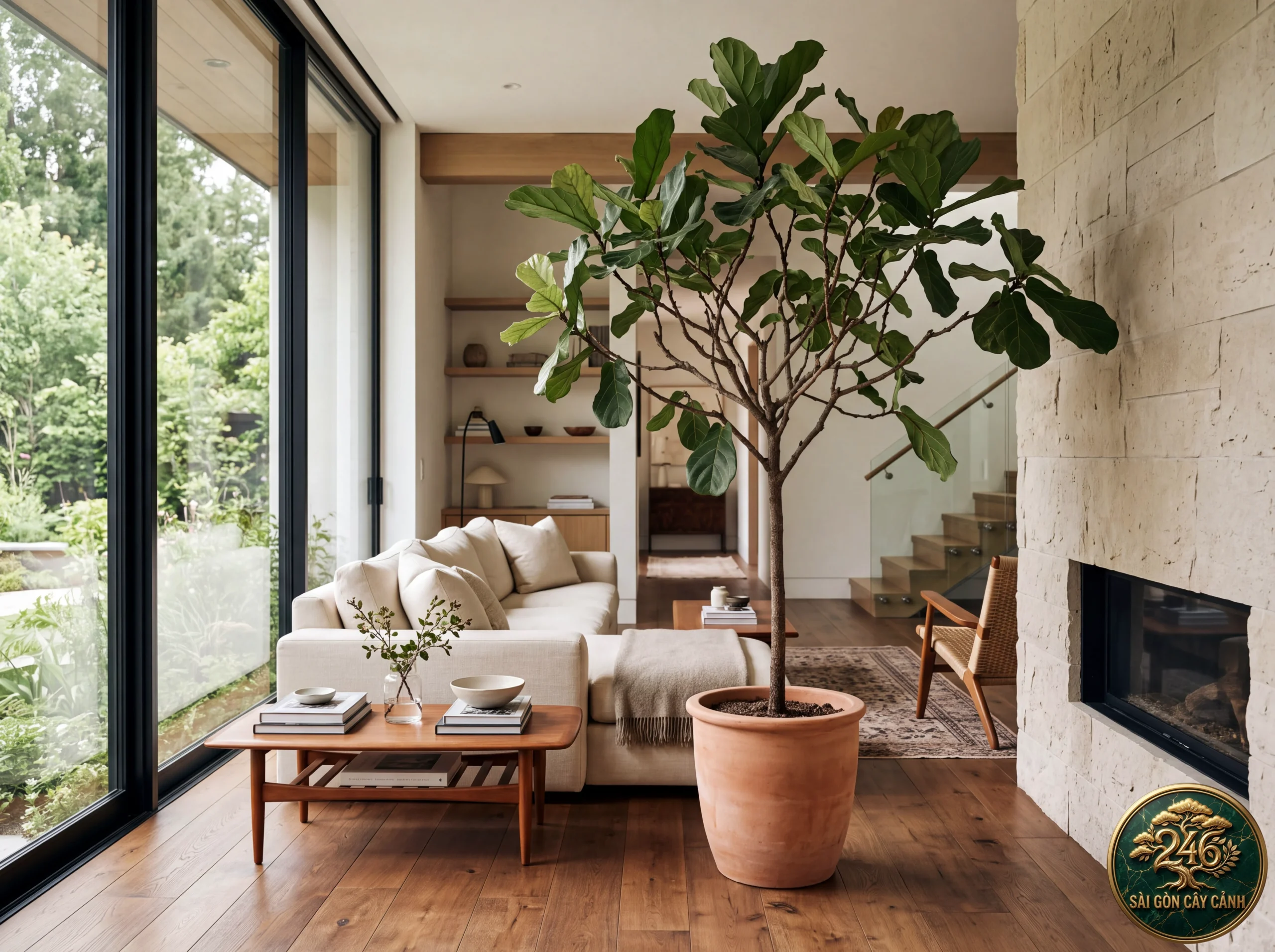
In contemporary interior architecture and luxury Biophilic projects, Ficus lyrata is celebrated as the undisputed ‘statement tree of modern interiors’. Its monumental sculptural fiddle foliage commands visual depth and architectural prestige across penthouses, executive boardrooms, and luxury hospitality lounges.
The upright columnar habit and expansive green canopy symbolize grounded stability, authority, and enduring prosperity. The majestic presence of a flourishing Fiddle-leaf fig fosters an intimate, grounding bond with the untamed grandeur of wild rainforests.
In high-end Biophilic interior design, Ficus lyrata is celebrated as the undisputed centerpiece of architectural indoor landscapes. Its majestic lyrate foliar silhouette introduces monumental sculptural gravity, channeling organic vitality, serene mindfulness, and an intimate connection with living nature.
12. Master Principles for Sustainable Indoor Acclimatization
To cultivate thriving Ficus lyrata with pristine monumental fiddle leaves without foliar drop indoors, follow these three golden axioms faithfully:
- Hydration axiom: Location axiom: Secure a permanent position bathed in bright indirect light of 3,000-7,000 lux, avoiding frequent relocation.
- Illumination axiom: Hydration axiom: Drench thoroughly only when top 5 cm is dry, ensuring rapid bottom drainage and emptying saucers immediately.
- Maintenance axiom: Climate axiom: Shield foliage from direct chilling air-conditioner currents and wipe foliar dust clean with damp cloths monthly.
13. Frequently Asked Questions Regarding Fiddle-leaf fig (FAQs)
Why does Fiddle-leaf fig shed foliage shortly after arriving home?
It experiences physiological acclimatization shock moving from high-light nurseries to dimmer interiors; provide stable bright indirect light and it stabilizes within 2-3 weeks.
Should commercial leaf shine chemicals be used on Ficus lyrata?
Never apply chemical leaf shine products which clog foliar stomata; wiping leaves with a clean damp microfiber cloth is the safest and most effective method.
How frequently should the container be rotated?
Rotate the pot 90 degrees clockwise once weekly to encourage symmetrical foliar growth and prevent the main trunk from leaning toward the light.
How can one encourage a single-stem Fiddle-leaf fig to branch?
When the trunk reaches your desired height (1.5 – 2 m), prune off the apical leader; this prompts 2 to 3 dormant lateral buds beneath to form branches.
Are the tiny red speckles on unfurling leaves caused by pests?
No; this is benign physiological edema from rapid water uptake during leaf expansion; as the leaf matures and thickens, the reddish spots naturally fade away.
Why do freshly emerging Fiddle-leaf fig juvenile leaves display tiny reddish-brown spots?
Tiny reddish spots on unfurling leaves represent physiological edema caused by rapid root water intake during ambient humidity fluctuations that rupture micro-capillaries; these harmless spots naturally fade as the leaf matures and thickens.