Living plant profile
Iron cross begonia
Begonia masoniana
Comprehensive botanical dossier for Iron cross begonia (Begonia masoniana). Identification, lighting calibration, porous substrate formulation, and cultivation guide by Saigon Cay Canh.
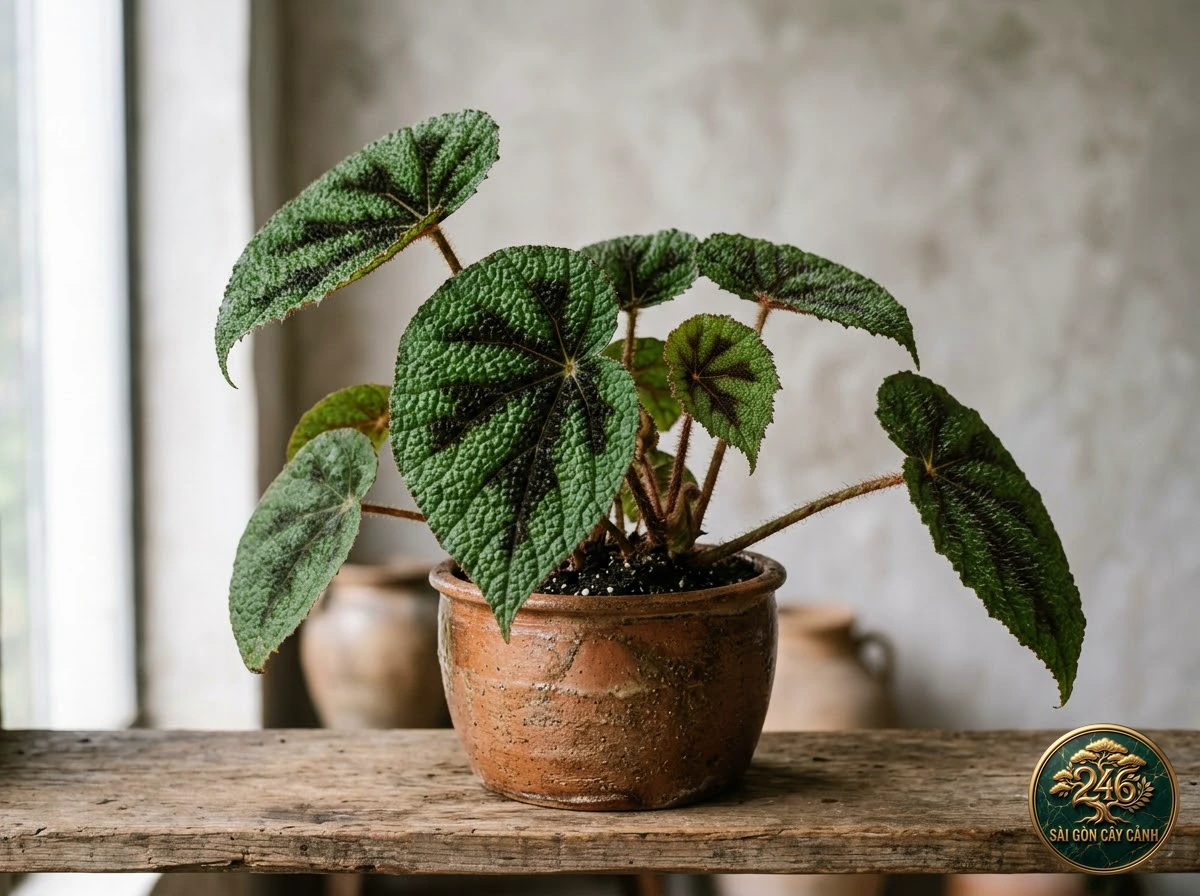
Iron cross begonia (Begonia masoniana) is celebrated as one of the most structurally astounding botanical wonders native to the humid limestone karst forests of southern China (Guangxi) and northern Vietnam. The species astounds observers with heavily bullate, pebbled apple-green leaf surfaces clad in reddish bristles, prominently stamped at the center with a bold chocolate-brown to black Maltese cross motif.
1. Core Botanical Taxonomy & Cultural Specifications
| Scientific Name | Begonia masoniana |
|---|---|
| Botanical Family | Begoniaceae (Begonia Family) |
| Native Distribution | Southern China (Guangxi) and Northern Vietnam (Moist limestone karst forests) |
| Growth Demeanor | Rhizomatous clumping perennial forming dense spreading rosettes |
| Lighting Threshold | Medium to bright indirect diffused illumination (1,000 – 1,800 lux) |
| Hydration Cadence | Hydrate once upper 2-3cm of substrate dries; never water onto bullate foliage |
| Substrate Formulation | 35% pumice, 25% shredded moss, 20% mini pine bark, 20% perlite |
| Thermal Range | 18°C – 27°C (64°F – 80°F), decline and rot occur below 14°C (57°F) |
| Relative Humidity | Optimal relative humidity 65% – 80% |
| Cultivation Difficulty | Moderate (Demands elevated humidity paired with constant air movement) |
| Pet Safety Profile | Toxic to companion animals (ASPCA warning for oral mucosal irritation) |
Begonia masoniana was formally described by German botanist Edgar Irmscher in 1959. The specific epithet commemorates Maurice Mason (1912–1993), an acclaimed British plant explorer who discovered cultivated specimens in Singapore and introduced them to European collections prior to scientific confirmation of its wild limestone karst origin in East Asia.
In its native limestone karst habitat across southern China and northern Vietnam, the species clings to moist calciferous cliffs and humus pockets beneath evergreen forest canopies. It develops a succulent surface rhizome anchoring broad, spreading blades into mounds standing 25 to 45 cm high with spreads spanning 40 to 55 cm.
Taxonomic records from Kew POWO confirm Begonia masoniana as an accepted distinct species within section Coelocentrum. The plant received the prestigious Award of Garden Merit (AGM) from the Royal Horticultural Society (RHS), honoring its unique bullate epidermal morphology and dramatic visual architecture.
2. Morphological Identification & Foliar Architecture
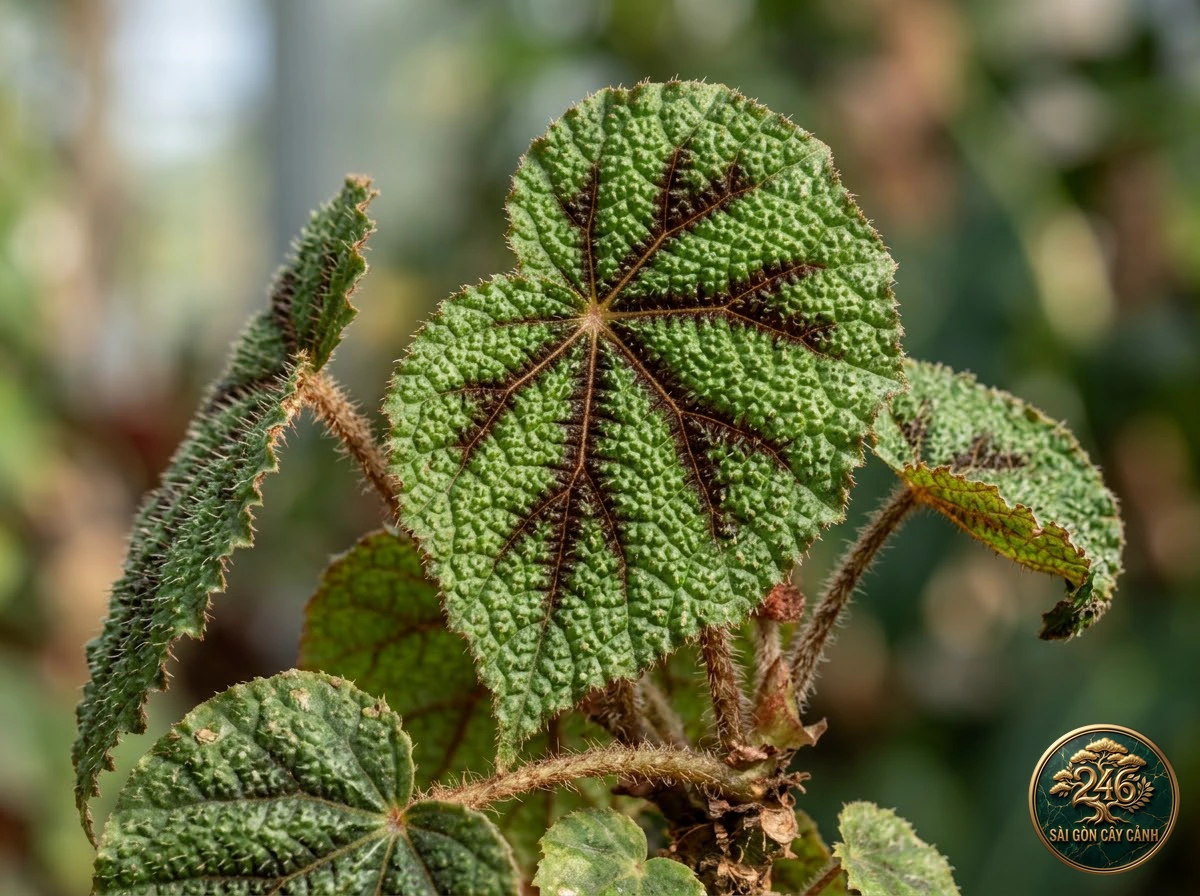
The definitive morphological hallmark of Begonia masoniana is its heavily bullate, pustular leaf surface. Each raised conical pustule terminates in a tiny reddish-brown bristle. Blades exhibit broad asymmetric ovate contours measuring 15 to 25 cm in length and 12 to 18 cm across, colored in vivid apple-green.
Stamped boldly across the apple-green field is an iconic chocolate-brown to black cross radiating from the petiole junction, closely resembling a medieval iron cross. The abaxial surface shows pale green with reddish markings along raised veins, supported by fleshy petioles densely clad in coarse reddish-purple trichomes.
The foliar surface of Begonia masoniana represents a botanical marvel of densely packed bullate pustules, each conical peak crowned by a stiff multicellular reddish trichome. The central Maltese iron cross marking in deep chocolate-black arises from hyper-concentrated anthocyanins and protective tannins, which shield primary leaf veins from ultraviolet radiation while aiding thermal absorption within shadowed karst rock crevices.
3. Photometric Calibration & Window Exposure Optimization
Adapted to shaded limestone clefts beneath dense forest canopies, the Iron cross begonia favors gentle diffused indirect light from 1,000 to 1,800 lux. Position containers 1.5 to 2 meters away from sheer-veiled windows to shield its bullate texture from harsh solar scorch.
The critical irrigation rule mandates that water must never pool inside the pustular pockets of the leaf blade. Its textured depressions trap moisture easily, promoting fungal rot and bacterial decay. Always bottom-water or apply gentle perimeter irrigation using dechlorinated soft water.
Originating from shaded limestone karst outcrops across the Sino-Vietnamese border, Begonia masoniana is exquisitely adapted to low-to-moderate diffuse irradiance, reaching photosynthetic saturation at PPFD levels between 35 and 70 µmol/m²/s. Direct sunlight rapidly scorches foliar trichomes and bleaches the dramatic chocolate-black Maltese cross insignia.
4. Bullate Surface Anatomy & Epipetric Rhizome Structural Adaptations
The bullate epidermal anatomy of Begonia masoniana represents an evolutionary adaptation. The raised pustules expand surface area to capture diffuse photons in dim understory microclimates, while apical bristles deter small herbivores.
Its thick rhizome creeps horizontally along the substrate surface, radiating long petioles that hold heavy leaves in an outward-facing rosette. Rotating the pot weekly ensures balanced light capture across all quadrants, fostering a symmetrical specimen.
Optimal room temperatures span 18°C to 27°C (64°F – 80°F). It relishes cool, stable warmth; prolonged exposure beneath 14°C (57°F) induces dormancy, defoliation, and heightened root rot susceptibility.
Atmospheric relative humidity should be steadily maintained between 65% and 80%. To supply high humidity without wetting leaves, place an ultrasonic humidifier 1 meter away paired with gentle convective air movement.
Optimal vapor pressure deficit (VPD) is tightly bounded between 0.6 and 0.8 kPa with ambient relative humidity held between 70% and 85%. Arid drafts from air conditioners dehydrate bullate pustules, deflating their taut conical peaks and diminishing the signature tactile roughness of the leaf.
The stout epipetric rhizome of Begonia masoniana creeps horizontally over limestone fissures and mossy leaf litter, serving as a resilient reservoir of water and carbohydrate reserves. Its fine adventitious roots anchor securely into rock crevices; top-dressing indoor containers with crushed pumice or horticultural limestone replicates this lithophytic micro-habitat.
5. Porous Aggregate Substrate Engineering & Aeration Dynamics
Originating from naturally drained limestone crevices, Begonia masoniana demands exceptionally porous, aerated potting aggregate with mild calcium buffering. The standard recipe blends 35% pumice gravel, 25% sterile sphagnum moss, 20% boiled mini pine bark fines, and 20% horticultural perlite.
High granular porosity enables surplus water to evacuate rapidly through container drainage ports without ponding, supplying abundant pore oxygen to rootlets and completely preventing subterranean rhizome rot.
Potting mix for Iron Cross begonia requires an exceptionally airy granular structure exceeding 35% porosity and a neutral-to-slightly alkaline pH between 6.5 and 7.2 to mirror native limestone substrates. Incorporating 15% crushed horticultural limestone or calcified grit with pumice provides enduring calcium to support robust bullate cell walls.
6. Organic Nutrition Schedules & Periodic Micronutrient Priming
Nutritional needs are modest. Administer mild biological organic liquid fertilizer (such as kelp extract or worm casting tea) diluted to quarter-strength every 3 to 4 weeks during active spring and summer months.
Never apply synthetic fertilizer granules near rhizomes. Flush the container thoroughly with pure water every 2 to 3 months to leach out accumulated mineral salts.
Apply mild biological organic fertilization monthly utilizing diluted vermicompost tea or fermented soybean amino extract at an EC strictly below 0.5 mS/cm. This gentle organic feeding sustains thick rhizomes without burning tender root tips or softening the bristly epidermal architecture.
7. Clinical Diagnostic Matrix & Rapid Correction Protocols
| Clinical Symptom | Primary Etiology | Diagnostic Evaluation | Corrective Prescription |
|---|---|---|---|
| Bullate foliar depressions turn brown, soft, and necrotic | Water droplets trapped inside textured pockets paired with stagnant air | Inspect foliar surfaces for pooled moisture and evaluate room ventilation | Cease foliar spraying immediately, dry leaves with gentle fan airflow, and switch to bottom-watering |
| Iron cross motif fades and foliage turns pale yellow-green | Chronic light starvation beneath 700 lux suppressing dark pigmentation | Measure ambient lux levels with digital photometer | Relocate planter to bright indirect daylight measuring 1,200 to 1,800 lux |
| Creeping rhizome softens with complete canopy collapse | Waterlogged aggregate causing anaerobic rhizome rot and decay | Unpot root ball to inspect rhizome firmness and evaluate substrate odor | Excise decayed rhizome tissue, dust cuts with lime powder, and repot in fresh airy pumice aggregate |
| Leaf margins turn crisp brown, curl inward, and crack | Ambient humidity dropping beneath 50% or proximity to dry HVAC draft streams | Verify room humidity with digital hygrometer | Deploy ultrasonic misting to sustain humidity above 65% and relocate away from AC vents |
8. Cryptic Pest Prophylaxis & Foliar Surface Sanitation
Chief health hazards include gray mold (Botrytis) and mealybugs. The bullate surface traps domestic dust; cultivators should use an ultra-soft camel-hair brush to gently dust foliage monthly rather than wiping with damp cloths.
Promptly remove senescent basal leaves using sterilized bypass shears to maintain an airy, dry rhizome environment, minimizing fungal infection vectors.
Because deeply furrowed bullate surfaces readily trap standing water, overnight moisture risks rapid bacterial soft rot (Erwinia carotovora). The cardinal rule is to water solely at the substrate line and maintain 24/7 gentle convective airflow within the display environment.
9. Asexual Propagation Methodology & Root Strike Protocols
Propagation of Iron cross begonia is rewarding and highly successful via triangular leaf wedge cuttings containing a primary vein during spring.
Using a sterile blade, slice healthy leaves into wedge sections bearing a primary vein, inserting the point into moist perlite and sphagnum. Maintained under warm, humid shade above 75% humidity, adventitious plantlets emerge over a 25 to 35 day period.
Propagate Begonia masoniana via rhizome cuttings or wedge-shaped leaf sections. When taking leaf wedges, slice the blade into triangular segments each anchored by a major vein fork and insert them vertically into moist perlite-sphagnum; tiny plantlets emerge from vein bases over a 25 to 35 day developmental interval.
10. Companion Animal Toxicology Profile & ASPCA Safety Evaluation
Positioning specimen planters on elevated bookshelves or display pedestals showcases the sculptural bullate architecture while ensuring complete safety for domestic companion animals.
11. Biophilic Curation & Contemporary Interior Design Styling
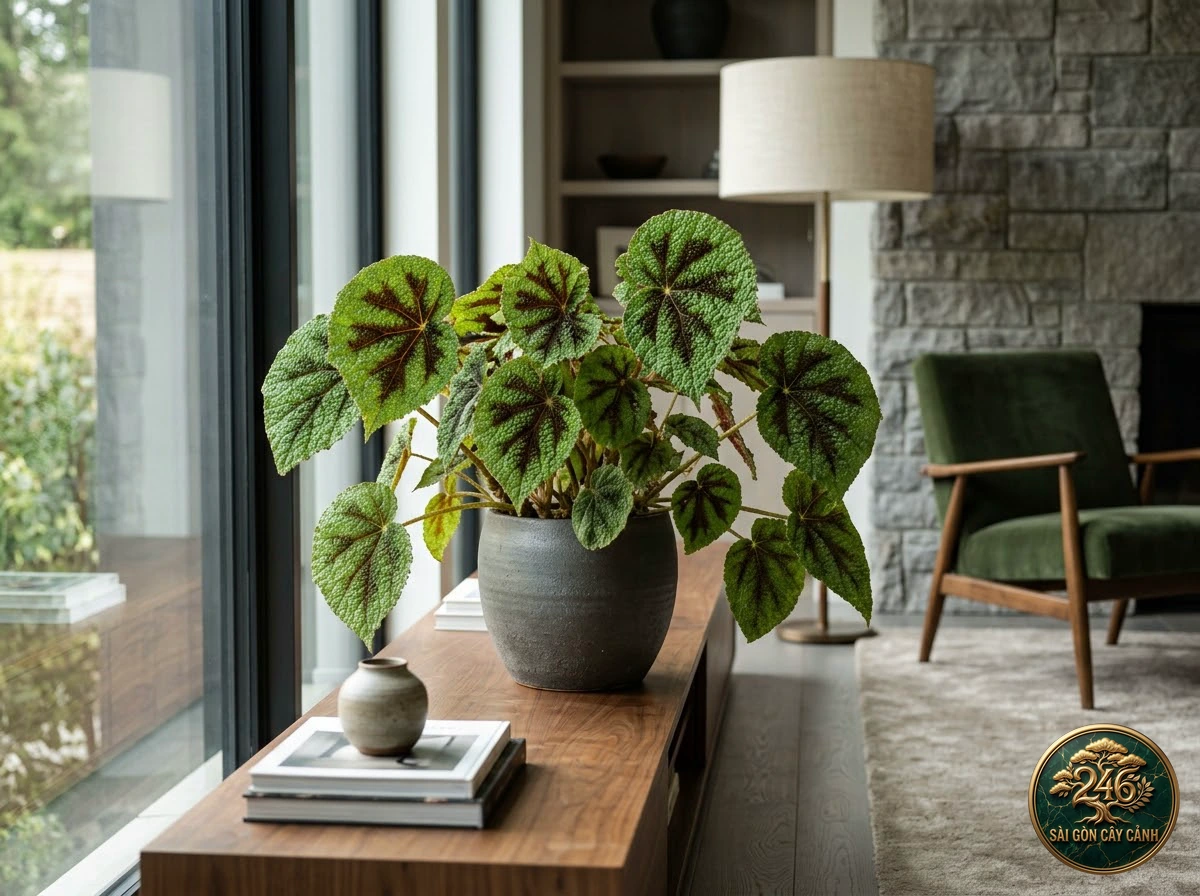
Showcasing jaw-dropping bullate texture and an iconic iron cross motif, Begonia masoniana serves as a living treasure for rare plant collectors, classic libraries, architectural ateliers, and bespoke tropical terrariums.
Its dramatic presence and meditative poise introduce artistic depth and botanical intrigue into modern interiors, inspiring contemplative wonder and biophilic connection.
In contemporary Biophilic architectural design, Begonia masoniana functions as a tactile and visual masterpiece. Its rugged bullate texture and commanding iron cross emblem evoke antique botanical majesty, commanding rapt curiosity and reverence in any curated plant gallery.
12. Master Principles for Sustainable Indoor Acclimatization
Three foundational axioms for sustaining peak health in Begonia masoniana indoors:
- Hydration axiom: Sub-Irrigation Axiom: Strictly avoid wetting bullate foliar surfaces; bottom-water with soft water once potting soil dries.
- Illumination axiom: Gentle Photonic Calibration: Supply 1,200 lux diffused indirect light; shield strictly from direct sun that burns raised pustules.
- Maintenance axiom: Atmospheric Ventilation Standard: Maintain 70% relative humidity paired with gentle air movement to suppress fungal mold.
13. Frequently Asked Questions Regarding Iron cross begonia (FAQs)
Why does Begonia masoniana possess heavily bullate, pebbled foliage?
The bullate pustules expand photosynthetic surface area in dim limestone forest understories, while apical bristles deter herbivorous pests.
Can foliage be cleaned with a damp cloth?
No. Abrasive wet wiping crushes delicate bristles and bruises raised pustules. Use an ultra-soft camel-hair brush to sweep away dry dust.
Is Iron cross begonia safe around cats and dogs?
No. The ASPCA warns that Begonias contain soluble organic salts causing oral irritation and vomiting. Keep elevated.
What style of planter is best suited for this species?
Unglazed terracotta or wide, shallow ceramic containers with generous drainage ports best accommodate the prostrate creeping rhizome.
When should repotting occur?
Repot every 12 to 18 months in spring as the creeping rhizome colonizes the pot surface.
What ecological purpose does the rugged bullate texture of Begonia masoniana serve?
The conical pustules significantly expand laminar surface area for efficient thermal dissipation and moisture condensation from forest mists, while the apical reddish trichomes mechanically deter crawling herbivorous insects.