
Living plant profile
Korthals’ shingle vine
Rhaphidophora korthalsii
Comprehensive botanical dossier for Korthals’ shingle vine (Rhaphidophora korthalsii). Identification, lighting calibration, porous substrate formulation, and cultivation guide by Saigon Cay Canh.
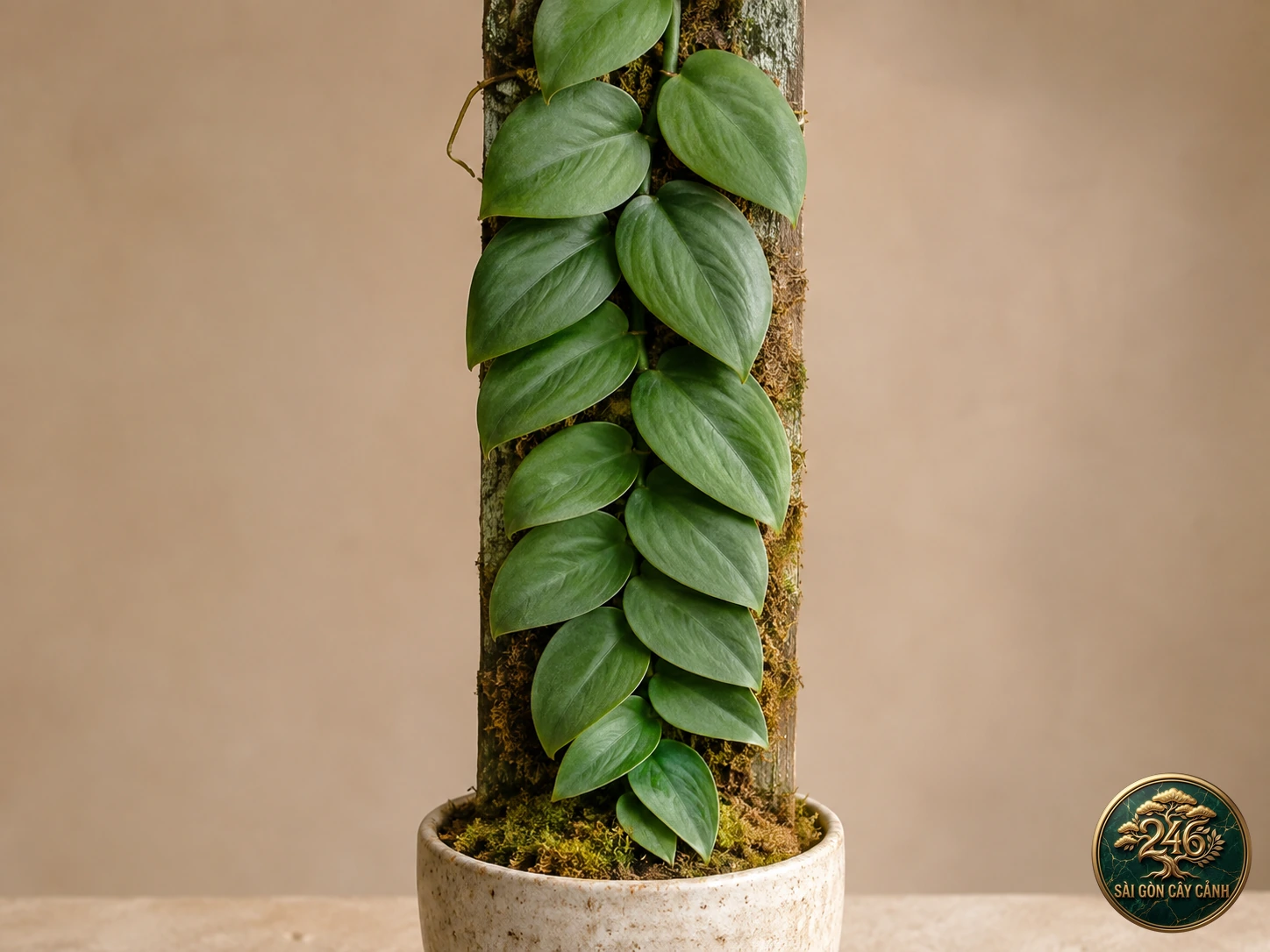
Korthals’ shingle vine (Rhaphidophora korthalsii) is an extraordinary botanical marvel named in honor of Dutch botanist Pieter Willem Korthals, standing as an iconic living demonstration of extreme ontogenetic heteroblasty. In its juvenile phase, it produces rounded, overlapping shingle leaves that press flush against host trunks like living jade armor, before transforming in mature canopy heights into magnificent, free-hanging pinnate foliage.
1. Core Botanical Taxonomy & Cultural Specifications
| Scientific Name | Rhaphidophora korthalsii |
|---|---|
| Botanical Family | Araceae (Aroid Family) |
| Native Distribution | Tropical rainforests of Southeast Asia, across Peninsular Malaysia, Sumatra, Borneo, and the Philippines |
| Growth Demeanor | Extreme heteroblastic hemi-epiphyte: juvenile phase shingles flat; adult phase branches with pinnate leaves |
| Lighting Threshold | Bright diffused daylight (1,500 – 3,000 lux); avoid intense unfiltered solar exposure |
| Hydration Cadence | Consistently moist climbing mount; water when surface substrate dries, ensure free drainage |
| Substrate Formulation | 40% medium pumice, 25% fine pine bark, 20% coarse perlite, and 15% washed coco coir |
| Thermal Range | 21°C – 31°C (70°F – 88°F; flourishes consistently in warm tropical climates, stasis below 16°C/60°F) |
| Relative Humidity | 70% – 85% (High ambient humidity preserves shingle adhesion and adventitious root anchoring) |
| Cultivation Difficulty | Moderate (Demands flat climbing board during juvenile phase and reliable ambient humidity) |
| Pet Safety Profile | Toxic (Contains insoluble calcium oxalate raphide crystals hazardous to pets) |
Formally cataloged in the Royal Botanic Gardens Kew (POWO) archives, Rhaphidophora korthalsii is a widespread hemi-epiphytic liana indigenous to Southeast Asian tropical rainforests across Malaysia, Indonesia, and the Philippines. Its most remarkable evolutionary trait is extreme heteroblasty: restructuring its foliar and stem anatomy completely across developmental stages to maximize photon capture and reproduction.
In its juvenile phase, slender stems scale shaded forest trunks, producing flattened, overlapping leaves that lack petioles, acting as a moisture-retaining shield over subterranean climbing roots. Upon reaching the upper canopy bathed in bright illumination, the vine transitions into its adult phase, producing pendulous flowering stems with long-petioled, deeply pinnatifid foliage.
Its adventitious climbing root system secretes powerful adhesive compounds that cement the vine permanently to host bark, absorbing dissolved nutrients from stemflow runoff.
2. Morphological Identification & Foliar Architecture
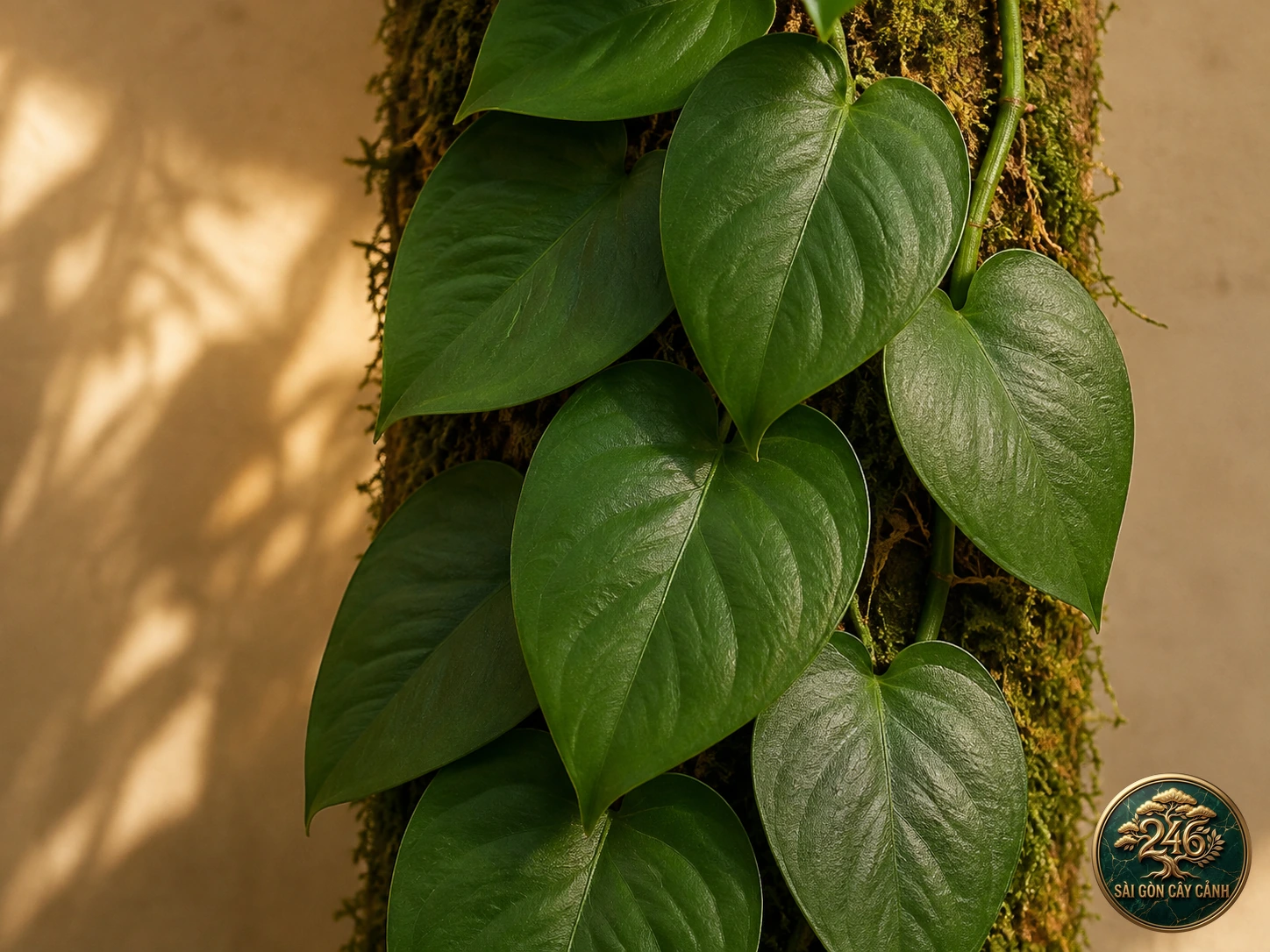
Juvenile foliage displays an orbicular to reniform outline measuring 8 to 15 cm across, tightly overlapping in alternate rows along a single vertical plane. The surface is smooth, fresh jade-green with subtle depressed venation, clasping the climbing substrate like polished living armor.
The abaxial surface remains flush against wood, releasing hundreds of microscopic feeder rootlets into the mount. When reaching the top of its support under high illumination, leaves develop petioles and unfold dramatic pinnate clefts.
The pronounced ontogenetic heteroblasty of Rhaphidophora korthalsii represents a classic botanical study in developmental cell differentiation. In the juvenile phase, sessile rounded leaves press flush to conserve moisture; once high photon flux is reached atop forest canopies, adult phase genes activate, altering cell division to produce elongated petioles and deeply pinnatifid clefts.
3. Photometric Calibration & Window Exposure Optimization
The specimen thrives under diffused daylight between 1,500 and 3,000 lux. Moderate illumination preserves the lush juvenile shingling phase indoors. Direct midday sun must be shielded to prevent epidermal scorch.
To stimulate transition into the pinnate adult phase, illumination must be elevated above 3,500 lux alongside vertical supports exceeding two meters in height.
Photon management determines whether Korthals’ shingle vine remains in its juvenile armor phase or transitions to adult foliage. A steady diffuse flux of 70 to 120 umol/m2/s sustains the tightly appressed jade shingle habit across vertical timber mounts over consecutive years.
4. Structural Vining Architecture & Support Dynamics
Keep the vertical moss mount or cedar plank consistently moist, hydrating daily so adventitious roots beneath each shingle absorb water. Potted root balls should be saturated thoroughly whenever the top two centimeters dry out.
During rainy or cooler seasons, extend watering intervals, ensuring unobstructed drainage through bottom container holes.
The physiological comfort envelope extends from 21°C to 31°C. Originating from equatorial rainforests, it thrives in warm humid climates and slows dramatically below 16°C (60°F).
Relative atmospheric humidity should stay high at 70% to 85%. High humidity is strictly required to keep juvenile leaves sealed flat against the wooden mount without edge curling.
Warm equatorial temperatures between 25°C and 29°C stimulate natural adhesive mucilage from anchor rootlets, cementing each juvenile scale firmly to wood grain. Shield mounted specimens from dry fan drafts that lift leaf edges.
5. Engineered High-Porosity Substrate Formulation
The potting mix requires optimal aeration comprising 40% medium pumice, 25% fine pine bark, 20% washed coco coir, and 15% coarse perlite. The climbing mount should be a wide cedar plank or flat rectangular moss board.
A buffered pH between 5.8 and 6.8 supports robust adhesive root vigor and fungal resistance.
Potting substrate paired with flat wooden climbing boards requires steady capillary moisture without standing water. Blending pumice, fine pine bark, and washed coco coir creates an airy root environment that fuels both subterranean roots and hundreds of aerial anchor rootlets.
6. Organic Bio-Fertilization & Mineral Management
Apply diluted organic liquid fertilizer monthly through spring and summer to nourish climbing axes and stimulate robust adhesive root networks.
Taper nutrient supplementation during slower winter months to prevent fertilizer salt build-up.
Nutritional care for Korthals’ shingle vine prioritizes anchor root vitality across the timber board. Misting the mount monthly with ultra-diluted plant amino acids and trace zinc-manganese stimulates natural root mucilage, ensuring successive jade scales remain tightly overlapping.
7. Clinical Diagnostic Matrix & Horticultural Resolutions
| Clinical Symptom | Root Pathology | Diagnostic Method | Targeted Resolution |
|---|---|---|---|
| Leaves curl at margins and lift away from mount | Ambient humidity below 65% or desiccated climbing board | Increase misting frequency and sustain relative humidity >75% | Loss of shingle habit |
| Stem extends into slender leafless runner | Lack of flat vertical mounting support | Secure vine apex against a flat cedar board to re-engage shingling | Etiolation distortion |
| Leaves turn yellow, root tips darken | Waterlogging from standing water or poor drainage | Extend dry intervals, inspect drainage apertures, improve ventilation | Root rot risk |
| Gray scorch patches on leaf blades | Direct intense midday solar radiation | Install sheer window shading or move into filtered diffused daylight | Solar burn damage |
8. Pest Mitigation Protocols & Foliar Sanitation
Manage mealybugs and spider mites by inspecting leaf margins and wiping with diluted botanical soap or applying organic neem oil.
Basal rot from fungal pathogens arises from waterlogged substrate; always ensure rapid drainage.
Maintain mount cleanliness by misting fine water droplets across the shingled tiers in morning light. Periodically inspect leaf margins along the timber interface; if white mold spots appear, gently cleanse the area using soft brushes dipped in diluted isopropyl alcohol.
9. Asexual Propagation Methodology
Propagate by harvesting stem cuttings bearing two to three firmly rooted shingle leaves. Use a sterile razor to separate the rooted stem section carefully from the mount.
Secure the cutting against a new wooden plank using soft ties in high humidity; growth resumes within ten to fifteen days.
Foliar maintenance for juvenile shingle armor involves regular morning misting with fine nozzles to wash airborne dust from glossy green scales. When the climbing stem reaches the board summit, attach an extension plank above or prune the apex for propagation.
10. Veterinary Toxicology & Domestic Safety Safeguards
Mount planks on high walls or tall totems well out of reach of household pets.
11. Biophilic Interior Design & Architectural Styling
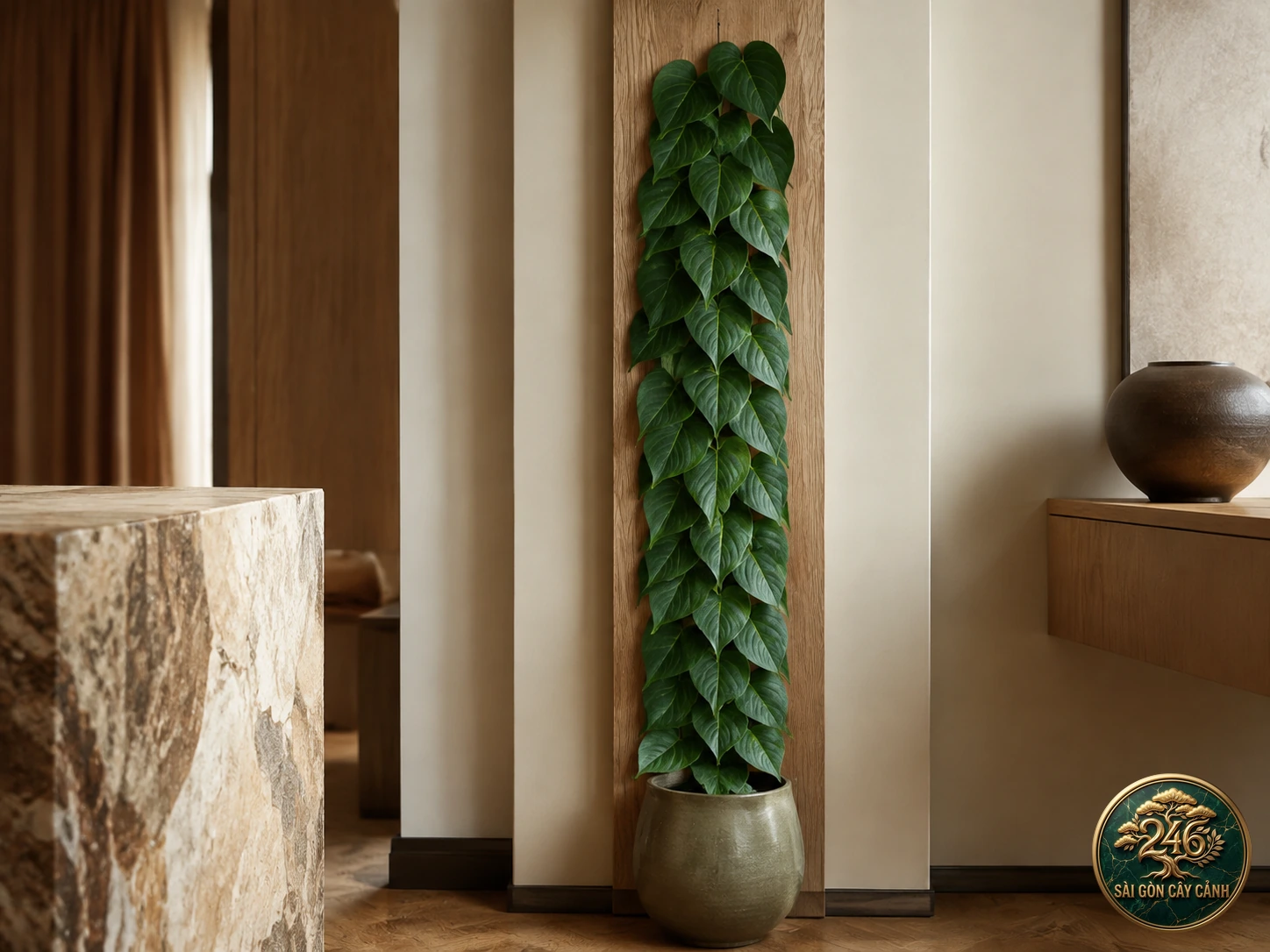
Within modern Biophilic interior architecture, Korthals’ shingle vine serves as a captivating living sculpture. Its alternating jade armor ascending a timber mount introduces tranquil geometric elegance across executive offices and contemporary living spaces.
The vertical green ascent softens architectural wall lines and celebrates refined minimalist aesthetics.
Within high-end Biophilic interior design, Korthals’ shingle vine serves as an extraordinary living sculpture of tranquil geometric beauty. Its alternating jade armor ascending a timber mount introduces a unique architectural focal point that softens rigid concrete walls and celebrates refined minimalist luxury.
12. Master Cultivation Axioms
Three master horticultural rules for cultivating thriving Korthals’ shingle vine specimens:
- Hydration axiom: Strictly provide a flat wooden mounting plank for juvenile foliage to clasp flush, never allowing vines to trail freely.
- Illumination axiom: Deliver bright diffused daylight between 1,500 and 3,000 lux, shielding tender juvenile foliage from direct midday sun.
- Sanitation axiom: Maintain ambient relative humidity above 70% and keep the climbing mount consistently moist to prevent root detachment.
13. Frequently Asked Botanical Questions (FAQs)
Can Rhaphidophora korthalsii be kept permanently in its shingle form?
Yes. Indoors under moderate diffused light (1,500 – 2,500 lux) and constrained support height, it remains indefinitely in its juvenile shingling phase.
What should I do when the vine reaches the top of the plank?
You can attach an extension board above to allow continued ascent, or prune the apex to propagate a new mounted specimen.
How does it differ from Rhaphidophora cryptantha?
Rhaphidophora cryptantha displays striking crystalline silver venation on dark velvety foliage, whereas Rhaphidophora korthalsii features uniform glossy jade-green blades with depressed matching veins.
What wood is best for mounting this species?
Porous cedar planks, treated pine boards, or compressed cork panels provide superior natural traction for climbing roots.
How can I water a wall-mounted specimen without wetting domestic walls?
Take the plank down, hydrate in a shower or basin, allow excess water to drain for ten minutes, and return to its display wall.
What occurs when the climbing shoot of Rhaphidophora korthalsii surpasses the timber mount?
Without an extension board, the terminal apex outgrows its planar support and loses its shingling habit, producing spaced-out, diminutive foliage. Fasten an extension plank above or prune the shoot to propagate a fresh mount.