
Living plant profile
Living Pebbles (Conophytum bilobum)
Conophytum bilobum
Conophytum bilobum is an enchanting miniature succulent pebble within the Aizoaceae family, celebrated for heart-shaped chalky-blue bilobed succulent bodie
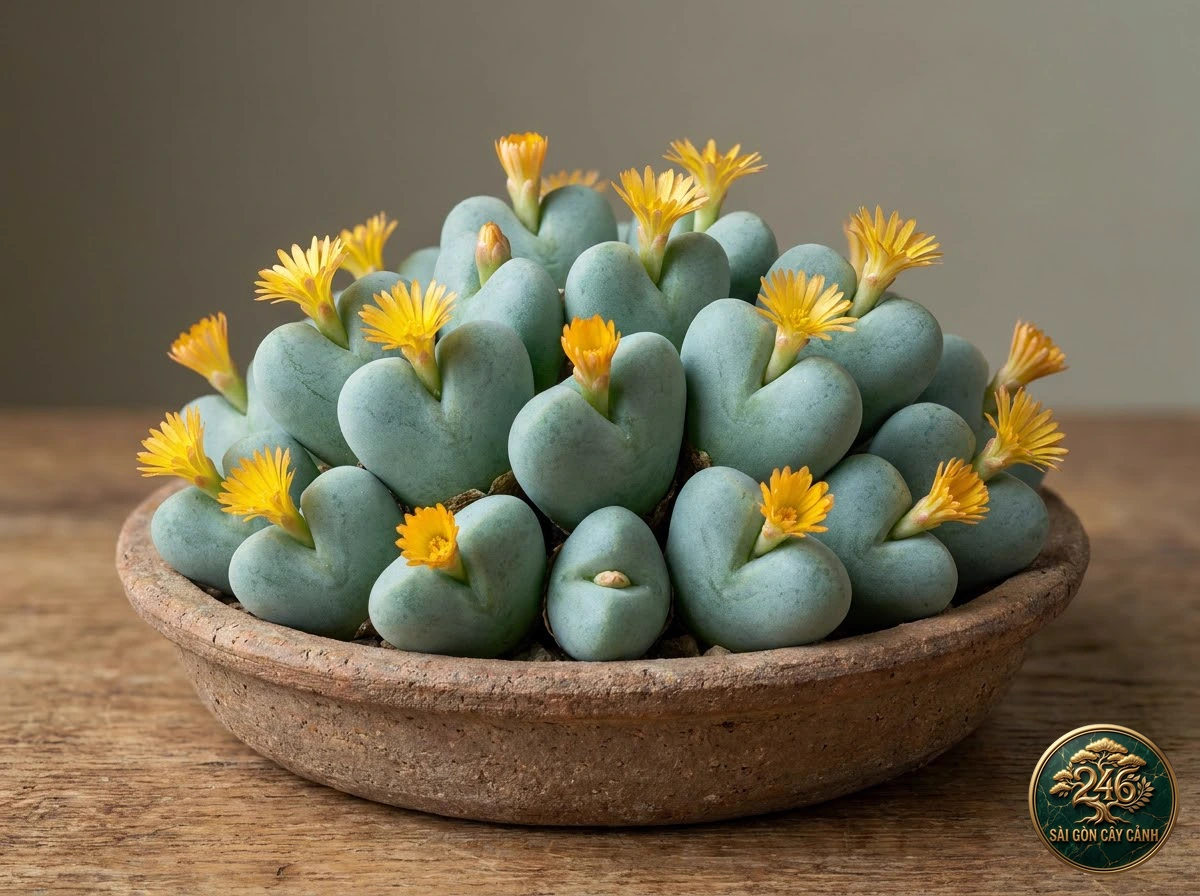
Living Pebbles Conophytum (Conophytum bilobum): Bilobed Fused Leaf Habit and Summer Estivation Guide
Conophytum bilobum is an enchanting miniature succulent pebble within the Aizoaceae family, celebrated for heart-shaped chalky-blue bilobed succulent bodies and bright golden-yellow autumnal blossoms.
Sài Gòn Cây Cảnh Care Compass
1. Botanical Nomenclature & Taxonomic History
Conophytum bilobum was first documented by Rudolf Marloth in 1907 before Nicholas Edward Brown transferred it to Conophytum in 1922. It represents one of the largest and most widespread species of the genus across the Namaqualand desert in South Africa.
Wedged tightly into blazing white quartzite crevices, it survives on winter rainfall and ocean fogs, retreating beneath a paper-dry protective tunic during scorching summer dormancy.
2. Morphological Architecture & Anatomical Specializations

The plant body forms an obovate fleshy bilobed cushion two to five centimeters tall and two to three centimeters broad, composed of fully fused opposite leaves terminating in two distinct keeled lobes separated by a central fissure.
The chalky glaucous green epidermis carries subtle carmine margins along lobe ridges; late autumn brings solitary yellow flowers two to three centimeters across that open during midday warmth.
3. Photosynthetic Photoperiod & Radiation Dynamics
Requires bright filtered light of 6,000 to 12,000 lux or four to five hours of gentle morning sun during active autumn and winter growing months to spur flowering.
Shield completely from intense summer solar radiation; during summer estivation, store containers in an airy, dry, shaded location with continuous ventilation.
4. Mineral Substrate Matrix & Aeration Dynamics
Demands pure mineral drainage (90% mineral grit): 55% fine washed pumice, 25% crushed volcanic scoria, 10% perlite, and 10% coarse desert sand with minimal organic matter.
Topdress with white quartz pea grit to reflect harsh radiant heat and isolate the fragile neck from surface condensation.
5. Hydraulic Equilibrium & Precision Irrigation Protocol
Watering strictly obeys a winter-rainfall regime: bottom-soak lightly every ten to twelve days from autumn through early spring when plants awaken and flower.
Cease irrigation entirely from late spring through mid-summer as outer leaves papery sheath hardens to encapsulate developing interior bodies.
6. Nutrient Management & Mineral Supplementation
Apply specialized low-nitrogen cactus nutrition at one-eighth dilution once in early autumn solely when nascent floral buds push through the central cleft.
7. Vegetative Propagation & Conservation Protocols
Propagate by autumn seed sowing at 16C to 20C or by carefully dividing mature multi-headed clumps after winter leaf regeneration.
When dividing, excise rooted bilobed bodies with a sterilized scalpel, curing wounds for two days before seating upright in aerated pumice grit.
8. Biochemical Toxicity Evaluation & Pet Safety Standards (ASPCA)
Conophytum bilobum holds verified non-toxic certification under ASPCA standards, posing zero chemical or physical threat to domestic pets and humans.
Smooth and free of thorn hazards, it represents a completely safe miniature living pebble for household tabletops.
9. Physiological Diagnostic Matrix & Targeted Intervention
Clinical identification of physiological stresses and targeted remedies for Conophytum bilobum:
| Clinical Diagnostic Sign | Primary Root Cause | Corrective Horticultural Protocol |
|---|---|---|
| Outer leaf body shrivels into a dry papery brown tunic | Natural summer estivation protecting internal newly formed bodies | Withhold water entirely; maintain in dry breezy shade until autumn cues awakening |
| Fleshy lobes swell excessively and rupture at base | Excessive water intake following severe drought stress | Suspend watering; position in airy morning-sun spot to allow fissures to suberize naturally |
| Bodies stretch tall and lose chalky glaucous hue | Insufficient photosynthetic light during active winter growth | Relocate planter to receive four to five hours of gentle direct morning sunshine |
| Fleshy lobes collapse into watery brown sludge | Fungal root rot caused by wet substrate during hot dormant periods | Fatal tissue collapse; discard affected plant and sterilize mineral potting mix |
10. Comparative Diagnostic Matrix & Allied Xerophyte Differentiation
Morphological diagnostic matrix distinguishing Conophytum bilobum from allied living pebble taxa:
| Diagnostic Parameter | Conophytum bilobum (Target Taxon) | Allied Congeneric Relative A | Allied Congeneric Relative B |
|---|---|---|---|
| Apical lobe habit | Distinct bilobed heart shape with keeled carmine margins | Flat truncate apex with translucent window network | Spotted fleshy leaves bordered with sharp teeth |
| Floral timing | Diurnal golden blooms appearing in late autumn | Nocturnal or crepuscular scented blossoms | Mid-winter daytime daisy blooms |
| Corolla coloration | Bright luminous golden yellow petals | Ivory white or pale magenta | Vibrant copper to golden orange |
| Body scale | 2 to 5 cm tall (one of the largest in genus) | Miniature 1 to 2 cm pebble globules | Clustering rosettes spanning 5 to 10 cm |
11. Biophilic Interior Aesthetics & Architectural Display

Conophytum bilobum exemplifies refined Japanese wabi-sabi aesthetics, creating poetic tranquility when arranged in cracked-glaze clay dishes or dark slate coasters.
Its sculptural heart-shaped contours and delicate floral show bring mindful stillness and natural warmth to modern living spaces.
🌿 Trang Thiết Bị, Đất Trồng & Dụng Cụ Bonsai Tuyển Chọn
Dụng cụ tỉa, giá thể hữu cơ & phân bón chuyên dụng cho cây cảnh.

Đất trồng Sen Đá, Xương Rồng trộn sẵn 85% đá cao cấp,gi…

Chậu gốm đất nung Men Hỏa Biến Dáng Đẹp -Trồng cây Sen …

Chế Phẩm Trichoderma Bacillus Phân Bón Bầu Trời Xanh 1k…

Chậu nhựa trồng cây cao cấp Monrovia số 1 kèm đĩa lót đ…

Hạt giống Cây Hương Thảo Rosemary 230 (0,03g~35 hạt) dù…
1 kg Đất trồng, giá thể cho cây Kiểng lá – Monstera (ản…

Cây kim tiền vàng mô hinh cây vàng may mắn cây tài lộc …

Dây nhôm trần 1KG chuyên dùng uốn cây ,quấn cây cảnh bo…

Phân bón phân hữu cơ trùn quế cao cấp dạng viên nén giú…

Cây Cau Tiểu Trâm kèm chậu để bàn làm việc, phòng khách…
Đất trồng sen đá xương rồng trộn sẵn kèm phân bón cao c…
Chậu Trắng Sẵn – 2-3 Gốc Cây Hương Thảo Rosemary Khoẻ, …
Nursery Care Journal & Living Greenery Moments
At Saigon Cay Canh greenhouse, each photograph captures genuine everyday care moments between plant lovers and living greenery, spreading a passion for nature and green-living inspiration.

💬 Góc Tư Vấn & Hướng Dẫn Kỹ Thuật SGCC
Chuẩn E-E-A-T Kinfolk❓ Chăm sóc Living Pebbles (Conophytum b cần lưu ý điều gì quan trọng nhất?
💡 Dạ điều quan trọng nhất là giữ môi trường sống ổn định, tránh sốc nhiệt hay dao động thông số đột ngột, đồng thời cung cấp khẩu phần ăn sạch và tươi mới ạ.
❓ Làm thế nào để phòng ngừa bệnh tật hiệu quả cho các bé?
💡 Dạ anh chị nên giữ vệ sinh chuồng/hồ nuôi sạch sẽ, thay nước hoặc dọn dẹp định kỳ và bổ sung vitamin, men tiêu hóa đều đặn để tăng sức đề kháng ạ.
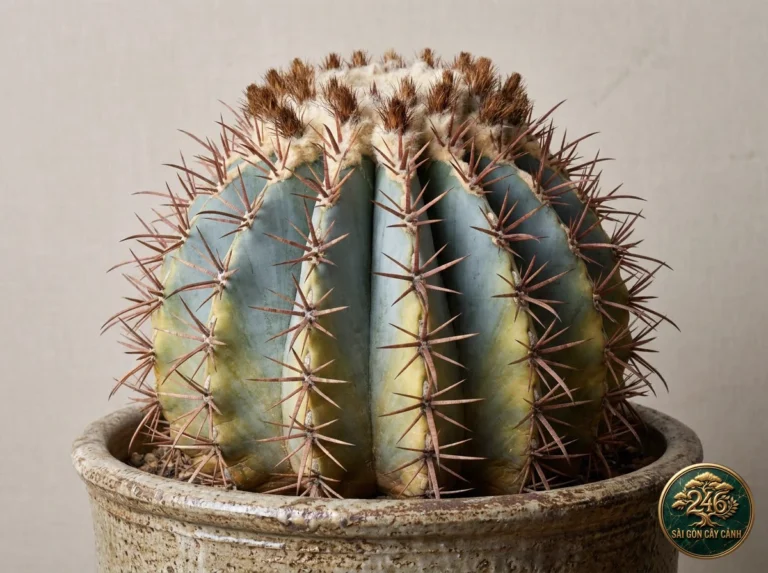
Giant Barrel Cactus (Echinocactus platyacanthus)
Echinocactus platyacanthus is the monumental giant barrel cactus of the Mexican plateau, legendary for multi-century lifespans, colossal slate-blue ribbed
Read Monograph →
Golden Barrel Cactus (Echinocactus grusonii)
Echinocactus grusonii is the world-renowned Golden Barrel cactus native to central Mexico, celebrated for its flawless ribbed spherical geometry, dense clo
Read Monograph →
Giant Starfish Flower (Stapelia gigantea)
Stapelia gigantea, the Giant Starfish Flower, is an extraordinary South African succulent producing colossal five-pointed star-shaped blossoms up to 40 cm
Read Monograph →
Fishhook Barrel Cactus (Ferocactus wislizeni)
Ferocactus wislizeni is the legendary fishhook barrel cactus of the Sonoran and Chihuahuan deserts, celebrated for its unique southward-leaning compass ori
Read Monograph →Expert Q&A, Recommended Supplies & Article Feedback
Tap once to connect instantly via Google, Facebook or TikTok — no long forms required!
No questions yet for this article. Tap Google / Facebook / TikTok above to ask the first question!