
Living plant profile
Living stone lesliei
Lithops lesliei
Comprehensive botanical dossier for Living stone lesliei (Lithops lesliei). Identification, lighting calibration, porous substrate formulation, and cultivation guide by Saigon Cay Canh.
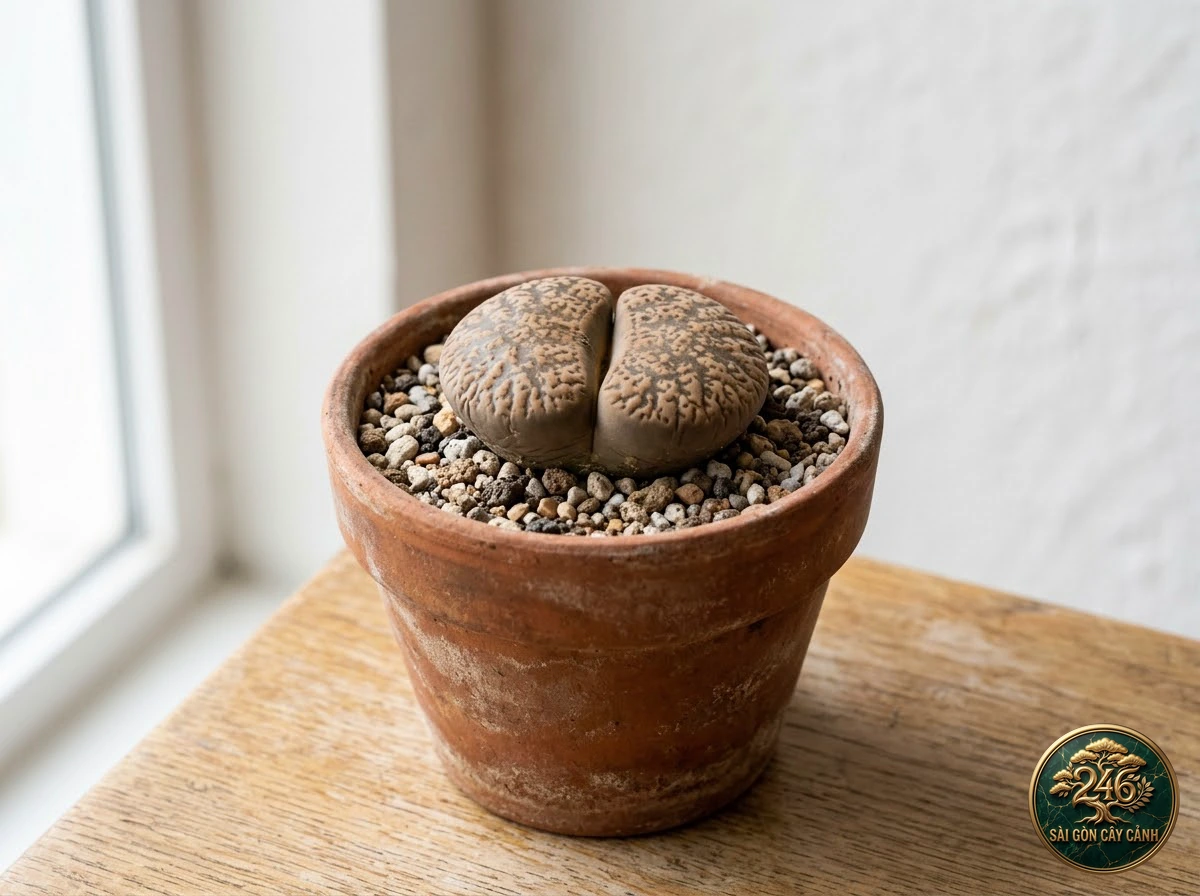
Living stone lesliei (Lithops lesliei) is the ultimate biological camouflage marvel of the succulent kingdom in the ice plant family Aizoaceae, indigenous to arid stony karoo grasslands of South Africa. Celebrated worldwide as ‘Living Stones’, it captivates collectors with extraordinary morphology: a single fused pair of succulent cone leaves resembling river pebbles, intricately patterned with translucent brown epidermal windows and bright golden daisy-like blossoms erupting from the central fissure.
1. Core Botanical Taxonomy & Cultural Specifications
| Scientific Name | Lithops lesliei |
|---|---|
| Botanical Family | Aizoaceae (Ice Plant Family) |
| Native Distribution | Arid stony plateau grasslands of South Africa |
| Growth Demeanor | Cryptic geophytic pebble succulent, subterranean stem habit |
| Lighting Threshold | Direct gentle sun 4-5 hours or intense LED grow light (2,500 – 6,000 lux) |
| Hydration Cadence | Ultra-low hydration; water only when wrinkled, withhold during leaf molt |
| Substrate Formulation | 80-90% gritty minerals (pumice, akadama, perlite, coarse gravel) + 10% organic |
| Thermal Range | 15°C – 32°C (heat tolerant when dry; intolerant of frost below 8°C) |
| Relative Humidity | 30% – 50% (prefers arid, buoyant air; intolerant of stagnant humidity) |
| Cultivation Difficulty | Moderate to challenging (demands strict leaf-shedding cycle comprehension) |
| Pet Safety Profile | Certified 100% pet safe (non-toxic to companion animals) |
Morphologically, Lithops lesliei represents an extreme evolutionary triumph in xerophytic crypsis. The entire aerial stem is reduced to a solitary pair of fused, obconical succulent leaves joined at the base and demarcated across the flattened apex by a narrow central fissure.
Individual plants measure merely 2 to 4 cm in height and 2 to 3.5 cm across the apical plane. The fleshy bulk remains buried subterraneanly to evade herbivore detection and intense desert heat; only the flattened top surface sits flush with surrounding gravel to capture light.
The definitive architectural marvel is the translucent ‘epidermal window’ spanning the leaf top: clear, chlorophyll-free cells patterned with intricate dendritic channels in rust-brown and olive tones. Light entering these optical windows is transmitted deep into subterranean palisade layers for CAM photosynthesis without overheating outer tissues.
2. Morphological Identification & Foliar Architecture
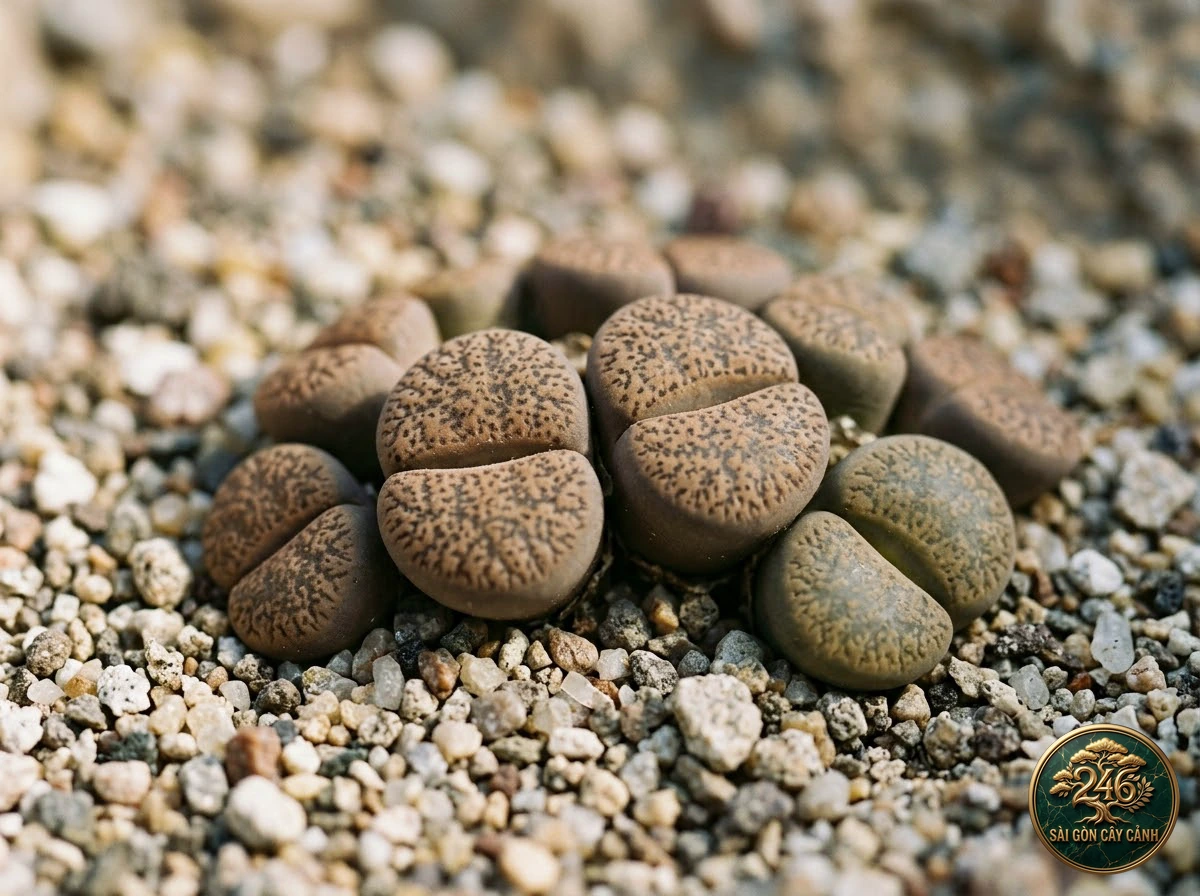
Diagnostic keys for Lithops lesliei center on its finely branched dendritic network of rust-brown to chestnut-olive channels across ash-gray to greenish-gray matrices. In autumn, a solitary brilliant golden daisy-like flower spanning 2.5-3.5 cm pushes through the central fissure, opening dramatically during sunny afternoons.
The annual leaf-molting cycle is an astonishing biological phenomenon: in winter, a fresh pair of leaves develops within the fissure, steadily absorbing all water and nutrients from the plump outer pair until the old leaves deflate into paper-thin husks, completing renewal without external water.
Microscopic examination of Lithops lesliei unveils an obconical succulent cone consisting of a single pair of fleshy leaves fused basally, separated only by a narrow apical fissure. The planar top is an optical biophysical marvel: an achlorophyllous, translucent epidermal ‘window’ patterned with cryptic grey-brown reticulations that diffuses intense sunlight deep into subterranean chlorophyllous mesophyll tissues shielded safely beneath the arid soil line.
3. Photometric Calibration & Window Exposure Optimization
Photobiologically, Living stones require intense solar energy. They demand at least 4 to 5 hours of direct morning sun or high-intensity horticultural grow lights delivering photon flux densities (PPFD) between 150 and 350 µmol/m²/s to preserve flat leaf contours and high-contrast window markings.
Chronic shade beneath 1,000 lux induces irreversible etiolation: the fused leaves stretch abnormally tall above the soil, losing signature brown maculations and splitting; conversely, unventilated greenhouse sun can boil internal water-storage parenchyma.
Photobiological adaptation to the harsh South African semi-desert requires intense solar radiation, with Lithops lesliei flourishing under a PPFD flux between 500 and 1000 µmol/m²/s. It demands at least 4 to 5 hours of direct sunlight daily to maintain its squat, pebble-mimicking habit; inadequate illumination below 250 µmol/m²/s causes unnatural cauline elongation, ruining its cryptic rock morphology.
4. Cryptic Succulent Cone Morphology & Optical Epidermal Window Histology
Morphological curation in Lithops lesliei eschews physical training, centering entirely on naturalistic mimicry top-dressing. Cultivators surround plants with angular quartz gravel or volcanic grit matching the foliage tones, rendering the living stones practically invisible among authentic pebbles.
To accommodate its elongated taproot, containers must offer a depth of at least 8 to 10 cm, despite the aerial body measuring merely 2 cm. The taproot contracts actively to pull the plant deeper underground during desert droughts.
Irrigation strictly follows biological seasonal cycles: in autumn during bud development, water thoroughly once every 2-3 weeks; in winter as the new leaf pair develops, withhold water 100% to let the plant absorb its old leaves; in spring when old leaves become papery husks, resume light watering.
During scorching summer spells exceeding 35°C, plants enter semi-dormancy; during this phase, only lightly mist surface gravel at dusk once a month to keep hair roots viable without stimulating active growth.
Thermal adaptability in Lithops lesliei spans from 38°C daytime desert heat down to 10°C chilly nights. Target VPD ranges between 1.2 and 1.8 kPa in arid, breezy conditions; irrigation must cease completely during the seasonal leaf-splitting interval (winter to early spring), allowing nascent inner leaves to absorb all moisture from the desiccating outer leaf pair.
The cryptic pebble-mimicry architecture of Lithops lesliei provides extraordinary evolutionary defense against desert herbivores. Stems are virtually non-existent, anchored by a deep taproot penetrating rocky fissures for subterranean moisture. In late autumn, a solitary golden-yellow daisy-like flower erupts from the central fissure, completely cloaking the stony leaf pair in vibrant brilliance.
5. Porous Aggregate Substrate Engineering & Aeration Dynamics
Substrate formulation for Living stones is a matter of life or death: media must comprise 80% to 90% coarse inorganic mineral grit and a maximum of 10% organic matter. An optimal mix blends 40% pumice (2-4 mm), 30% hard akadama, 15% perlite, 5% biochar, and 10% screened peat loam.
Never use moisture-retentive field clay or raw coco peat; any soggy subterranean condition persisting past 24 hours invites fatal bacterial soft rot that liquefies succulent tissues overnight.
Substrate architecture for living stones demands an overwhelmingly mineral-dominated profile to eliminate any fungal rot risk. The professional mix consists of 85% graded inorganic mineral aggregates (2-4 mm pumice, red volcanic scoria, and washed quartz grit) blended with only 15% lean organic soil, ensuring instantaneous gravity percolation without ponding and holding a circumneutral to alkaline pH of 6.8 to 7.5.
6. Organic Nutrition Schedules & Periodic Micronutrient Priming
Living stones have near-zero fertilizer demands, having evolved to survive in resource-starved desert gravels. Apply ultra-dilute organic cactus feed with an EC strictly beneath 0.3 mS/cm only 1-2 times annually in early autumn as flower buds surface.
Never administer nitrogen-rich fertilizers; excessive nitrogen forces unnatural rapid ballooning of succulent tissues, rupturing window surfaces and inducing immediate tissue liquefaction.
Nutritional requirements for living stones are exceptionally austere. Fertilization is restricted to once or twice annually in early autumn using ultra-dilute bio-organic potassium and trace minerals mixed at an EC beneath 0.3 mS/cm. Nitrogenous fertilizers must be strictly avoided, as excess nitrogen triggers cellular ballooning and catastrophic rot.
7. Clinical Diagnostic Matrix & Rapid Correction Protocols
| Clinical Symptom | Primary Etiology | Diagnostic Evaluation | Corrective Prescription |
|---|---|---|---|
| Plant body turns mushy, translucent, and water-logged | Severe overwatering or suffocating wet aggregate inducing fatal bacterial soft rot | Touch foliage gently to feel liquefaction and detect decay odor | Fatal if core rot spread; if confined to roots, unpot, excise rot, dry 7 days, repot in pure grit |
| Plant body stretching unnaturally tall into elongated cylinders | Severe light starvation from deep interior placement beneath 1,000 lux | Check whether aerial height exceeds 4 cm | Introduce high-intensity LED grow lights gradually; compact stature restores in next leaf molt |
| Top window surface developing deep horizontal wrinkles in autumn | Normal physiological dehydration during prolonged dry, warm spells | Feel leaf top for soft texture and horizontal creases | Apply a moderate drenching at dusk; turgidity restores within 24 hours |
| Stacking: two leaf pairs coexist and old leaves refuse to dry | Overwatering during the winter molting cycle preventing old leaf resorption | Observe old outer leaves remaining plump while new pair emerges | Withhold water 100% for the next 2-3 months until outer husks desiccate completely |
8. Cryptic Pest Prophylaxis & Foliar Surface Sanitation
The prime adversary is fungal root rot and subterranean root mealybugs sucking sap from the taproot. Incorporating biochar and diatomaceous earth into the mineral aggregate deters subterranean pests organically.
If localized soft rot appears, immediately unpot the plant, excise decayed tissue with a sterile blade, dust the wound with sulfur powder, and air-dry in a cool breezy spot for 7 days before replanting in dry grit.
Plant defense centers entirely on moisture regulation and 24/7 convective airflow. Routine surveillance around root collars detects cryptic root mealybugs (Rhizoecus); if found, unpotting the specimen, gently washing roots in tepid water, trimming damaged rootlets, and drying in shade for several days before repotting in sterile mineral grit restores complete health.
9. Asexual Propagation Methodology & Root Strike Protocols
Classic propagation of Lithops lesliei is achieved via autumn seed sowing. Seeds are minute sand-like dust grains; scatter evenly over moist, fine mineral substrate within a transparent humidity chamber held at 18°C – 22°C.
Germination produces microscopic emerald specks within 7-14 days; over a 25 to 35 day post-germination developmental interval under cool diffuse light, miniature seedlings establish their primary taproots and adapt to open air.
Multiplying Lithops lesliei is most effectively achieved via micro-seed sowing harvested from dried dehiscent capsules. Broadcasting seeds over moist, sterilized fine mineral sand beneath transparent humidity covers under warm filtered light over a 25 to 35 day interval induces synchronous germination of tiny, spherical succulent green seedlings.
10. Companion Animal Safety Profile & ASPCA Non-Toxic Verification
Though biochemically harmless, because of their miniature pebble size, enthusiasts should display containers on elevated shelving or desks to prevent playful pets from digging up the mineral substrate.
11. Biophilic Curation & Contemporary Interior Design Styling
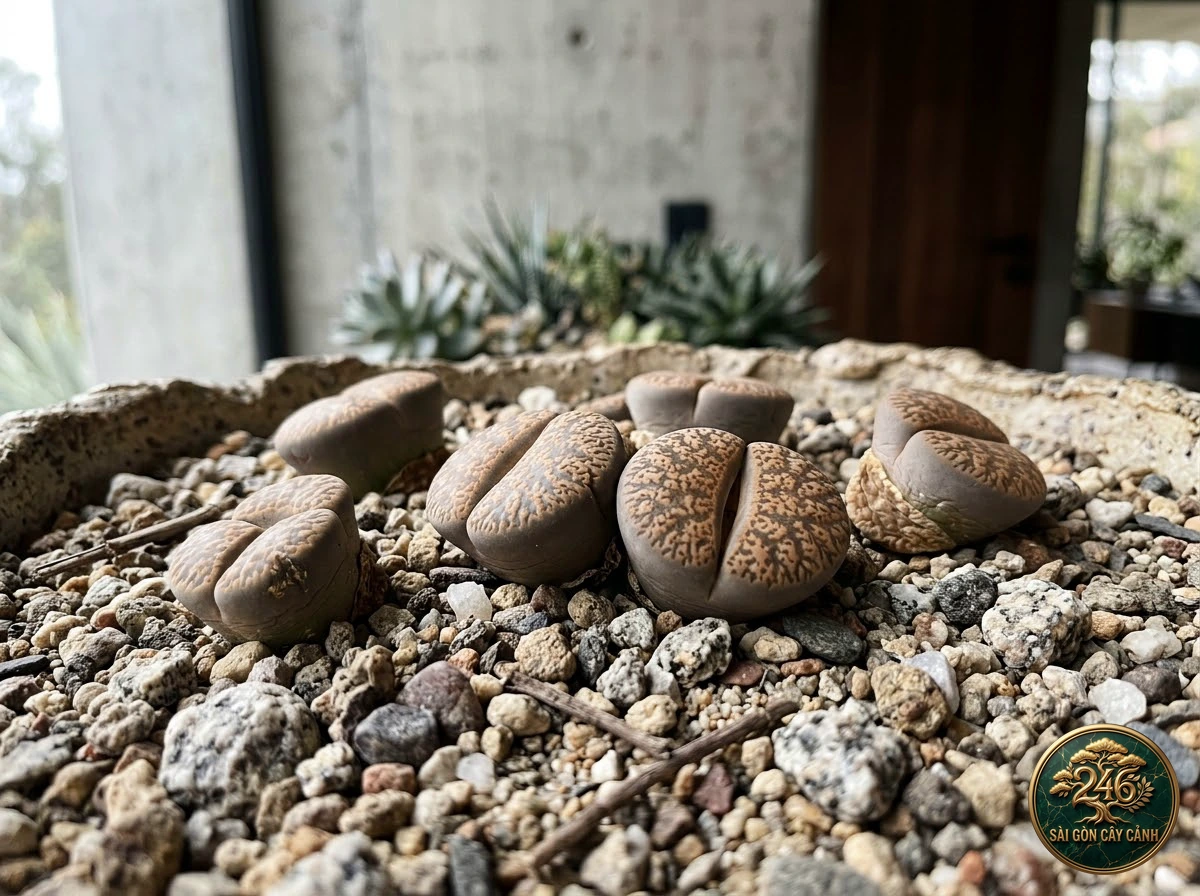
In Minimalist plantscaping and modern executive desktop curation, Living stones symbolize perseverance, patience, micro-architectural perfection, and cosmic harmony. Their stone-like stillness concealing dynamic internal life offers profound meditative contemplation.
A cluster of Lithops lesliei in an unglazed earthen vessel top-dressed with river grit forms a captivating living miniature sculpture, relieving digital stress and inspiring endless botanical wonder.
In artistic Biophilic succulent collections, Lithops lesliei stands as a testament to biological resilience and exquisite minimalism. A shallow artisanal ceramic dish housing these cryptic living jewels on an executive desk sparks intellectual fascination and contemplative appreciation for nature’s extraordinary evolutionary adaptations.
12. Master Principles for Sustainable Indoor Acclimatization
Preserving pristine form, preventing split bodies, and ensuring annual golden floral flushes in indoor Living stones requires three inviolable axioms:
- Hydration axiom: Use 80-90% gritty coarse mineral aggregate in pots at least 8-10 cm deep with generous drainage apertures.
- Illumination axiom: Never water during the winter leaf-molting phase; irrigate only after old outer leaves become completely papery.
- Maintenance axiom: Provide at least 4-5 hours of robust illumination daily to maintain flush top planes and prevent etiolation.
13. Frequently Asked Questions Regarding Living stone lesliei (FAQs)
How many times a year do Living stones need watering?
Depending on climate, properly cultivated Lithops need watering merely 5 to 8 times across the entire year.
Why is watering strictly forbidden during leaf molt?
Because the inner new leaves must absorb water from the outer pair; watering prevents old leaves from desiccating, causing ‘stacking’.
What is the potential lifespan of a Lithops plant?
In wild habitats and indoor culture, Lithops can live 20 to 50 years, molting and flowering annually.
What time of day do the golden blossoms open?
Blossoms typically expand around 2 to 3 PM beneath warm afternoon sun, closing gracefully as dusk arrives.
Is the succulent safe around domestic pets?
Completely non-toxic; certified 100% pet safe by ASPCA guidelines, posing zero hazard to companion animals.
Why do living stone bodies turn squishy and rot following irrigation?
Tissue mushiness post-watering indicates saturated anaerobic substrate or improper watering during the seasonal leaf absorption cycle, enabling rot pathogens to invade; immediately cease irrigation and place the pot in bright, breezy sun.