Living plant profile
Mother of Thousands (Kalanchoe daigremontiana)
Kalanchoe daigremontiana
Mother of Thousands (Kalanchoe daigremontiana) The Mother of thousands (botanical binomial: Kalanchoe daigremontiana Raym.-Hamet & H.Perrier, frequently classified under Bryophyllum daigremontianum) stands as one of the most astonishing evolutionary wonders within the stonecrop family (Crassulaceae). Universally renowned across global horticulture as the alligator plant, Mexican hat plant, or devil’s backbone, this architectural succulent demonstrates an […]
Mother of Thousands (Kalanchoe daigremontiana)
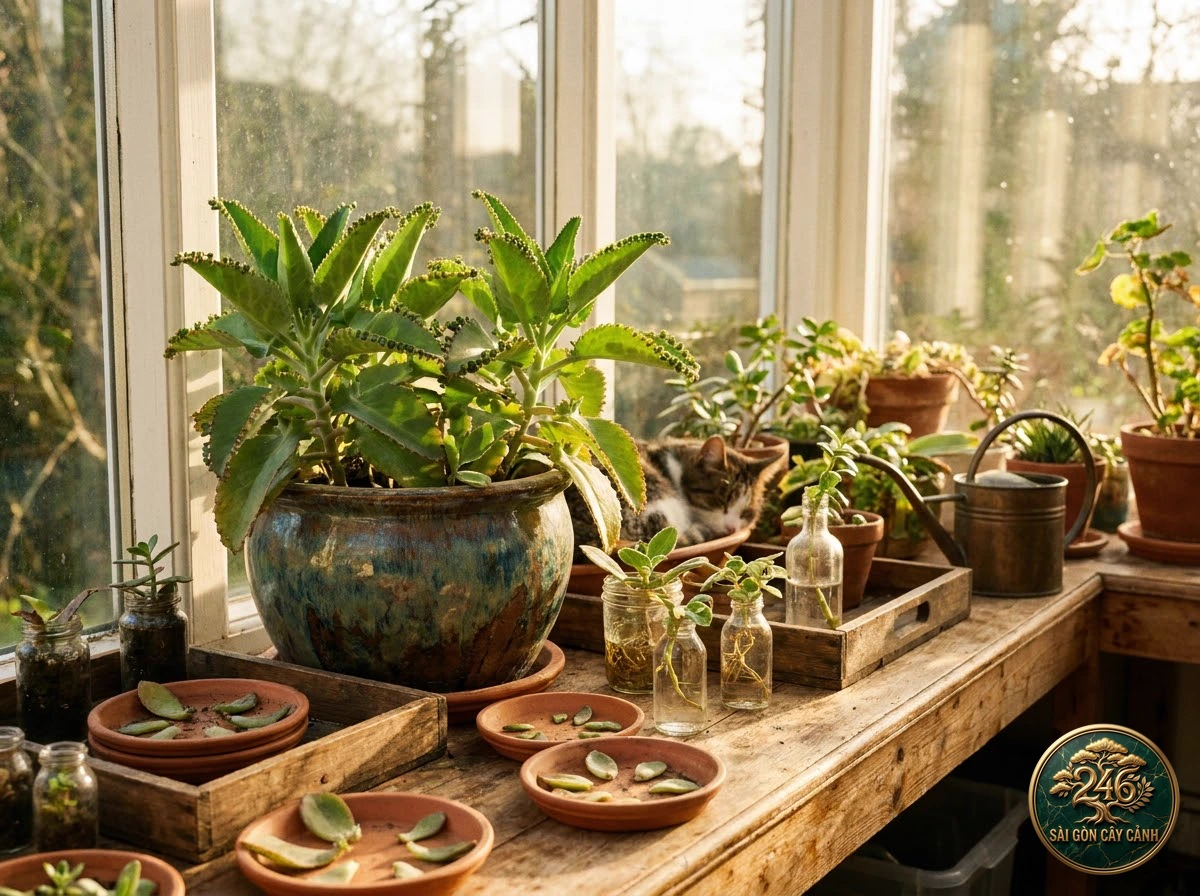
The Mother of thousands (botanical binomial: Kalanchoe daigremontiana Raym.-Hamet & H.Perrier, frequently classified under Bryophyllum daigremontianum) stands as one of the most astonishing evolutionary wonders within the stonecrop family (Crassulaceae). Universally renowned across global horticulture as the alligator plant, Mexican hat plant, or devil’s backbone, this architectural succulent demonstrates an extraordinary biological phenomenon termed foliar vivipary: the continuous production of hundreds of embryonic plantlets along the serrated margins of its expansive spear-shaped leaves, each miniature clone equipped with tiny functional rootlets and opposite succulent leaflets.
Endemic to the arid limestone ravines flanking the Fiherenana River valley in southwestern Madagascar, this remarkable perennial was scientifically described in 1914 by French botanists Raymond-Hamet and Henri Perrier de la Bathie. Equally revered as a classical subject for developmental genetics and an arresting architectural accent with purple-banded underleaves, the species symbolizes boundless maternal fecundity, relentless tenacity, and the miraculous ingenuity of plant survival.
Sài Gòn Cây Cảnh Care Compass
1. Comprehensive Botanical Taxonomy & Key Specifications
To deliver an empirical benchmark for botanists, researchers, and botanical collectors, Saigon Cay Canh compiles the core morphological specifications below:
| Taxonomic Marker & Botanical Metric | Empirical Specification & Observed Profile |
|---|---|
| Accepted Botanical Binomial | Kalanchoe daigremontiana Raym.-Hamet & H.Perrier (Ann. Mus. Colon. Marseille 1914) |
| Widely Recognized Botanical Synonym | Bryophyllum daigremontianum (Raym.-Hamet & H.Perrier) A.Berger |
| Phylogenetic System (APG IV) | Order Saxifragales / Family Crassulaceae / Genus Kalanchoe |
| Horticultural Classification & Habit | Architectural viviparous succulent perennial, collector novelty |
| International Trade Vernaculars | Mother of thousands, Alligator plant, Mexican hat plant, Devil’s backbone |
| Native Geographical Origin | Fiherenana River basin, semi-arid rocky escarpments of southwest Madagascar |
| Growth Habit & Stature | Upright monocarpic or polycarpic succulent herb reaching 40-120 cm in height |
| Foliar Structure & Plantlets | Triangular-lanceolate leaves with marginal notches bearing viviparous bulbils |
| Inflorescence & Blossom Color | Terminal nodding cyme of tubular bell-shaped pinkish-mauve flowers |
| Veterinary Toxicity Status (ASPCA) | HIGHLY TOXIC TO PETS (accumulates lethal daigremontianin cardiac glycosides) |
Due to its prolific asexual reproductive cadence, this living specimen demands disciplined horticultural management. At Saigon Cay Canh, parent plants are curated under controlled conservatory settings to showcase their immaculate foliar geometry.
2. Morphological Identification Keys & Anatomy
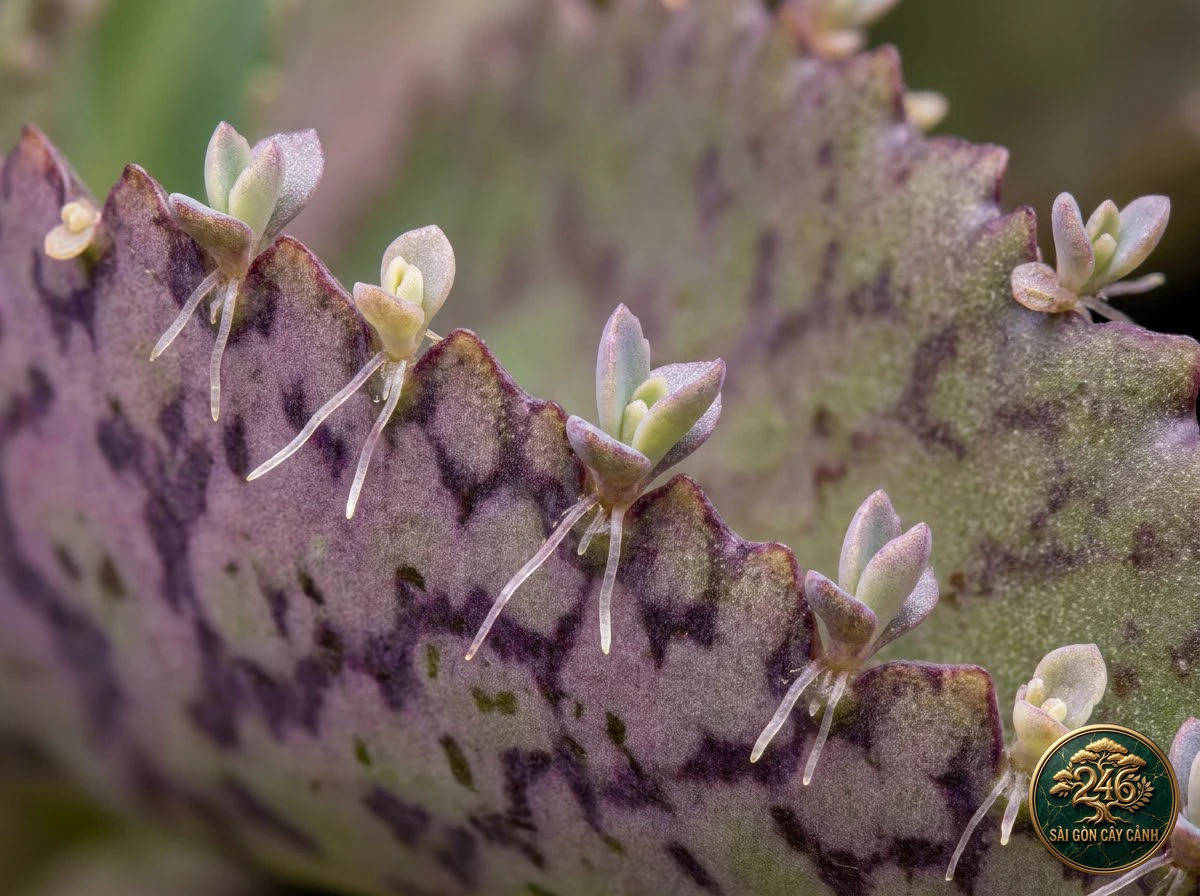
The specialized anatomical architecture of Kalanchoe daigremontiana represents an exquisite convergence of water-conserving tissue and vegetative propagation:
Lanceolate Foliage & Anthocyanic Mottling: Leaves are arranged in decussate opposite pairs, thick and fleshy, measuring 12 to 25 cm in length and 3 to 6 cm in width. The upper surface exhibits a glaucous emerald or olive-gray tint coated in smooth epicuticular wax. In striking contrast, the abaxial (lower) surface displays distinct irregular transverse chevrons and spots of intense maroon, violet, or dark purple anthocyanin pigmentation, evoking the rugged hide of a crocodilian reptile.
Foliar Vivipary & Meristematic Notches: The defining marvel of the species resides within the serrated leaf margins. In each notch between leaf teeth, specialized somatic meristematic cells undergo spontaneous organogenesis without requiring sexual fertilization. These meristems differentiate into fully formed plantlets (bulbils), featuring minute paired leaves and slender white aerial rootlets. At the slightest mechanical disturbance or wind gust, these plantlets dislodge, dropping to the substrate below where they immediately root.
Erect Caulescent Stem: The central stem is stout, unbranched during initial growth, measuring 1.5 to 3 cm in diameter. The pale grayish-green stem surface carries prominent crescent-shaped leaf scars where older foliage has cleanly abscised.
Pendulous Campanulate Blooms: During winter short-day photoperiods, mature specimens project an elevated terminal inflorescence extending 60 to 100 cm aloft. The branched cyme bears dozens of pendulous, bell-shaped flowers shaded in dusky rose, pale coral, or violet-gray, with flared petals surrounding inner golden anthers.
3. Botanical Taxonomy & Nomenclature History
The species was collected during expeditions in Madagascar and formally published in 1914 by French botanists Raymond-Hamet and Henri Perrier de la Bathie in the Annales du Musee Colonial de Marseille. The specific epithet daigremontiana commemorates Monsieur and Madame Daigremont, prominent French benefactors of botanical science who maintained rich succulent living collections.
German botanist Alwin Berger later placed the species within the resurrected genus Bryophyllum as Bryophyllum daigremontianum, emphasizing its foliar vegetative reproduction (derived from the Greek bryo meaning to sprout and phyllon meaning leaf). Modern molecular phylogenetics under the APG IV framework retains Bryophyllum as an infrageneric section or subgenus within Kalanchoe, establishing Kalanchoe daigremontiana as the accepted botanical binomial in international databases including Plants of the World Online.
In developmental plant physiology, this species serves as a world-renowned model organism. Research into its genome has unlocked critical understandings of how the ectopic expression of SHOOT MERISTEMLESS and LEAFY COTYLEDON homeobox genes enables somatic tissue along leaf serrations to trigger complete organogenesis.
4. Native Habitat & CAM Photosynthetic Physiology
In its native Malagasy territory, Kalanchoe daigremontiana colonizes arid limestone bluffs, crumbling talus, and open thorn scrub within the Fiherenana River drainage basin of southwestern Madagascar. This region experiences severe, prolonged droughts where scorching afternoon heat is tempered only by episodic oceanic night mists.
To triumph over severe water deficits, the plant employs specialized Crassulacean Acid Metabolism (CAM):
Throughout intense sunlit hours, foliar stomata remain tightly closed, shielding internal hydrenchyma storage reserves from desiccating evaporative loss. Waxy cuticle layers reflect infrared thermal radiation, preventing overheating of the voluminous mesophyll tissues.
Under nightfall, when ambient temperatures decline and relative humidity rises, stomata open wide to capture carbon dioxide. Phosphoenolpyruvate carboxylase (PEPC) rapidly converts CO2 into four-carbon malic acid, which is sequestered within deep cellular vacuoles. With the return of daylight, stomata seal shut once more; vacuolar malate is decarboxylated internally to flood the Calvin-Benson cycle with CO2 for sugar synthesis by RuBisCO without exposing internal water to the dry outside atmosphere.
5. Photosynthetic Irradiance & Purple Chevron Expression
Direct luminous radiation is the fundamental environmental stimulant governing compact foliar stacking and vivid anthocyanin patterning. Provide a robust luminous intensity between 4,500 and 9,500 lux for optimal structural health.
An east, southeast, or southern balcony receiving 5 to 6 hours of unfiltered morning sunshine constitutes the ideal domestic setting. Direct morning photons encourage vigorous plantlet organogenesis and trigger deep purple pigment synthesis across abaxial leaf bands, creating dramatic contrast against the silvery-green upper surface.
In dim indoor quarters receiving under 2,500 lux, plants rapidly etiolate: central stems stretch thin, internodes widen, leaves droop limply, purple markings fade to dull green, and marginal plantlet formation ceases entirely. In scorching tropical summer conditions exceeding 38°C, provide gentle 20% shade netting during blistering midday hours to maintain lush foliar turgidity.
6. Hydraulic Dynamics & Soil Desiccation Protocol
Equipped with enormous water-storing parenchyma cells inside its fleshy leaves, the mother of thousands tolerates lengthy dry intervals with ease, but its fibrous root system easily succumbs to persistent moisture saturation.
Implement the proven soak-and-dry watering protocol. Water thoroughly only when the entire substrate volume has become bone-dry throughout. During warm dry seasons, irrigation cycles typically range from 9 to 14 days apart. Test substrate dryness by inserting a clean wooden dowel deep into the pot base: irrigate only when it withdraws completely dry.
Apply water gently around the inner container perimeter or allow water to absorb from below via shallow tray soaking for 15 minutes. Never drench the plant from overhead: forceful water cascades dislodge delicate plantlets prematurely and pool moisture inside leaf axils, providing an entry portal for soft rot bacteria.
7. Inorganic Mineral Substrate & Rhizosphere Porosity
The root system of Kalanchoe daigremontiana is shallow and requires generous air movement to satisfy aerobic respiratory demands. Dense clay soils inevitably suffocate delicate feeder roots.
Saigon Cay Canh formulates an optimized 65:35 mineral-to-organic potting substrate:
- 65% Coarse Inorganic Aggregates: 35% porous volcanic pumice (3-6 mm grain size creating extensive interconnected macro-pores), 15% crushed red scoria rich in iron minerals, and 15% expanded white perlite.
- 35% Aerobic Organic Amendments: 20% thoroughly rinsed, tannin-free coconut coir peat and 15% screened vermicompost providing slow-release humic nutrition.
This gritty blend allows excess irrigation water to evacuate freely from drainage holes in moments, maintaining oxygen-rich rhizosphere conditions that suppress pathogenic Fusarium fungi. Maintain substrate pH between 6.2 and 6.9 for optimal nutrient bioavailability.
8. Thermal Tolerances, Humidity & Ventilation Dynamics
The species prospers within an ambient thermal band of 20°C to 34°C, flourishing naturally in the warmth of Southern Vietnam’s tropical microclimates.
Thermal hardiness dips safely to approximately 6°C, provided the soil mix remains entirely dry. Cold moisture triggers severe tissue collapse and black foliar necrosis across thick succulent tissues.
Relative humidity is best maintained between 35% and 60%. High ambient airflow is critical: continuous gentle air movement disperses stagnant moisture pockets around crowded leaf crowns, accelerates drying of accidental water splashes, and provides abundant ambient carbon dioxide for nighttime CAM fixation.
9. Clinical Diagnostic Matrix & Cultural Remediation
Consult this empirical clinical diagnostic matrix to identify and correct physiological abnormalities in Kalanchoe daigremontiana:
| Observed Clinical Symptom | Etiological Cause & Pathology | Remedial Horticultural Protocol |
|---|---|---|
| Stem base turns mushy, water-soaked, and dark brown; lower leaves detach cleanly | Over-watering or poor pot drainage leading to hypoxic root suffocation and Erwinia soft rot | Immediately amputate healthy upper stem above rot using a sterile scalpel; callus for 3 days and re-root in dry pumice grit; discard old soil |
| Stems stretch excessively tall and thin; leaves turn pale green with fading purple chevrons | Prolonged insufficient light levels causing dramatic etiolation and meristem dormancy | Relocate container to receive 5-6 hours of direct morning sun; prune apex to promote dense lateral branching from dormant leaf axils |
| Leaves become thin, wrinkled, and curved inward; plantlets drop off before root emergence | Severe prolonged dehydration depleting internal water reserves within foliar parenchyma | Provide a thorough root soak around the perimeter or bottom soak for 15 minutes; foliage will plump up and regain turgor within two days |
| Marginal plantlets turn yellow and rot; circular brown necrotic spots form across leaf blades | Water droplets remaining on foliage under hot, stagnant indoor air sparking anthracnose fungus | Prune heavily spotted leaves; discontinue overhead watering completely; enhance ambient ventilation and apply mild organic copper spray |
Observing the crisp, upright stance of marginal plantlets serves as an immediate barometer of specimen vitality.
10. Integrated Pest Management & Sanitation
Due to high concentrations of cardiotoxic steroids throughout its tissues, the mother of thousands is naturally immune to common foliage-chewing insects. Nonetheless, citrus mealybugs (Planococcus citri) may colonize sheltered leaf bases or root zones.
When white powdery mealybug colonies appear, apply 70% medicinal alcohol directly using a cotton swab. The alcohol instantly breaks down the insect’s protective waxy coating, eliminating pests without damaging the resilient succulent cuticle.
Nursery maintenance involves clearing away shed foliage and administering an occasional preventative evening mist of diluted cold-pressed organic neem oil emulsion to deter crawling insect vectors.
11. Specialized Asexual Propagation Protocols
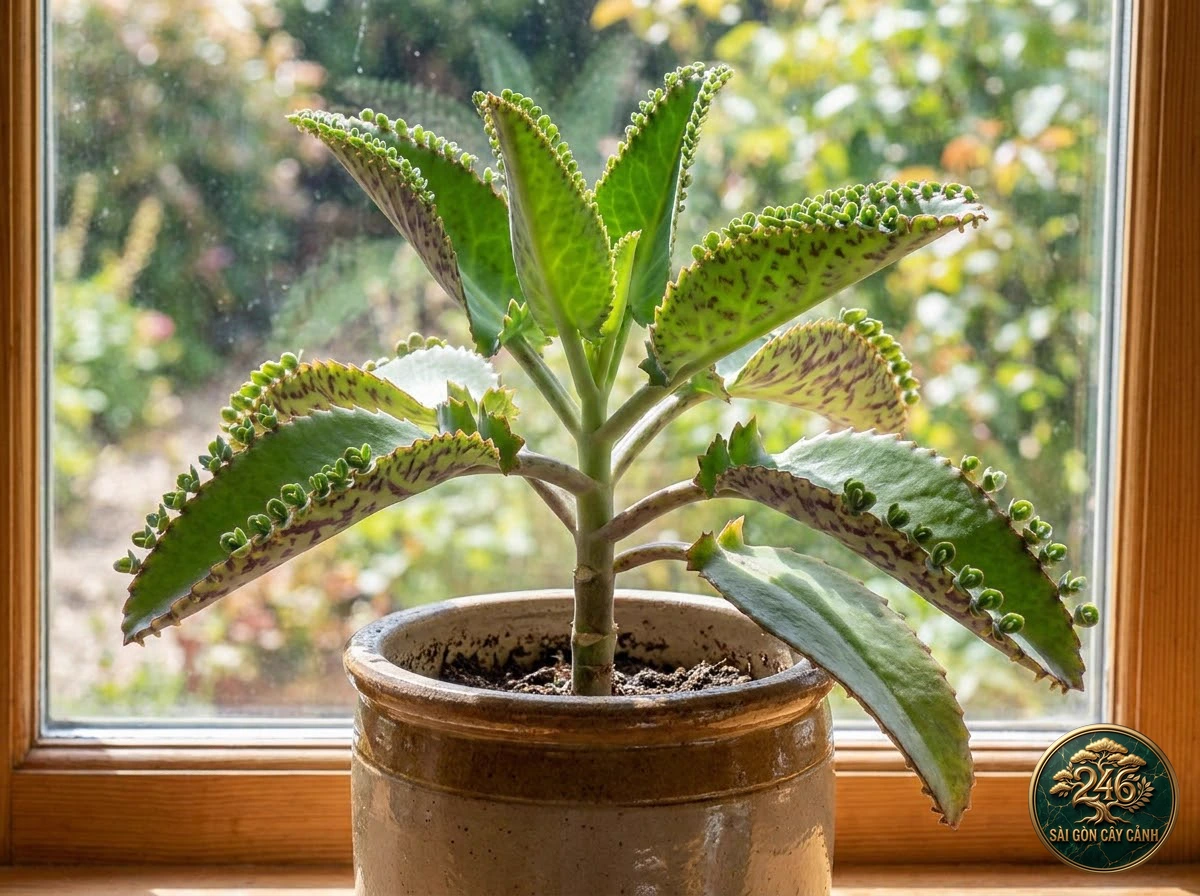
Propagating the mother of thousands is one of the simplest procedures in horticulture, owing to its perpetual vegetative bulbil production.
Favorable Season: Year-round in warm tropical conditions, with peak vigor during spring and the onset of the wet monsoon season.
Bulbil Harvesting Technique:
- Gently brush mature plantlets bearing 2 to 4 leaves and visible root filaments from the mother leaf margin into a collection dish.
- Scatter harvested bulbils across the surface of a shallow tray filled with fine pumice sand or well-draining seed-starting grit.
- Place the propagation tray in bright, indirect light and mist the surface lightly twice weekly to sustain root-zone humidity.
- Within three to four weeks, plantlets establish extensive root anchors and develop into vigorous juvenile plants.
Containment Advisory: Because dropped plantlets root aggressively wherever they land, keep mother specimens isolated or use drip trays to prevent spontaneous colonization of adjacent potted plants.
12. Companion Animal Safety & ASPCA Toxicity Disclosure
All vegetative and floral organs—especially the inflorescences and tiny marginal bulbils—contain dense concentrations of potent cardiotoxic bufadienolide cardiac glycosides, primarily daigremontianin and bersaldegenin. These steroid toxins irreversibly disrupt the myocardial sodium-potassium ATPase pump in mammalian cardiac tissues.
Ingestion of foliage or shed plantlets by domestic carnivores induces acute clinical poisoning: hyper-salivation, persistent emesis, violent diarrhea with severe abdominal cramping, profound lethargy, hazardous cardiac arrhythmias (tachycardia followed by severe heart block), muscle tremors, and potential cardiac arrest in severe cases.
Critical Domestic Protocols: Never place specimens on low floors, patios, or anywhere pets roam unmonitored. Restrict cultivation to elevated display pedestals, hanging macrame cradles, or enclosed greenhouses. Regularly sweep away fallen bulbils from surrounding surfaces. In any instance of suspected ingestion, transport the animal immediately to a veterinary emergency hospital with a sample of the plant for gastric decontamination and cardiac monitoring.
13. Biophilic Design & Interior Curation
With its dramatic aerodynamic foliage and living fringes of tiny plantlets, Kalanchoe daigremontiana provides an arresting sculptural focal point in contemporary interior architecture.
Solitary Architectural Display: Staged within a minimalist matte charcoal, raw terracotta, or basalt container, a mature mother of thousands commands attention in minimalist galleries, modern home offices, and sun-drenched atrium alcoves. The geometric precision of its spear-shaped leaves and deep purple chevrons injects bold organic dynamism into interior environments.
Gothic & Arid Desert Terrarium Styling: In stylized desert vignettes paired alongside upright columnar cacti and dark lava rock, the mysterious profile of the alligator plant evokes the wild, untamed splendor of remote Malagasy landscapes.
14. Brand Ambassador & Cultivation Ethos
At Saigon Cay Canh, we cherish the astonishing biological adaptations of the plant kingdom, bridging rigorous horticultural stewardship with aesthetic excellence for contemporary living spaces.

The dedication reflected in hands dusted with mineral pumice embodies our genuine pledge to living botanical artistry: providing resilient, ethically nurtured plants that inspire wonder and connection with the natural world.
15. Frequently Asked Questions (FAQs)
Why do the tiny plantlets drop off so easily when I brush against the leaf?
This is the plant’s natural vegetative dispersal mechanism. Once bulbils mature and develop embryonic roots, they naturally detach so they can colonize surrounding soil.
How do I maintain the vivid purple chevrons on the underside of the leaves?
Purple chevron pigmentation is sunlight-dependent. Ensure your plant receives at least 5 hours of direct morning sunlight daily; abundant photons stimulate rich anthocyanin synthesis.
Does mother of thousands produce flowers indoors?
Flowering occurs primarily on mature plants (2 to 3 years old) kept outdoors where natural winter short-day photoperiods trigger elevated clusters of dusky pink, bell-shaped flowers.
Can this plant spread invasively in a home garden?
Yes, dropped bulbils root very readily in garden beds. To control spread, grow the plant in a solitary container placed on a paved surface where fallen plantlets can be swept up easily.