
Living plant profile
Mottled spurge
Euphorbia lactea
Euphorbia Euphorbiaceae Living Herbarium Master V2 Mottled Spurge (Euphorbia lactea): Variegated Winged Rib Morphology, Diterpene Latex and Architectural Culture Scientific Name: Euphorbia lactea Haw. Common Name: Mottled Spurge / Dragon Bones / False Cactus Family: Euphorbiaceae Native Range: Tropical Asia (India, Sri Lanka) Euphorbia lactea is an architectural succulent shrub known for its undulating 3-4 […]
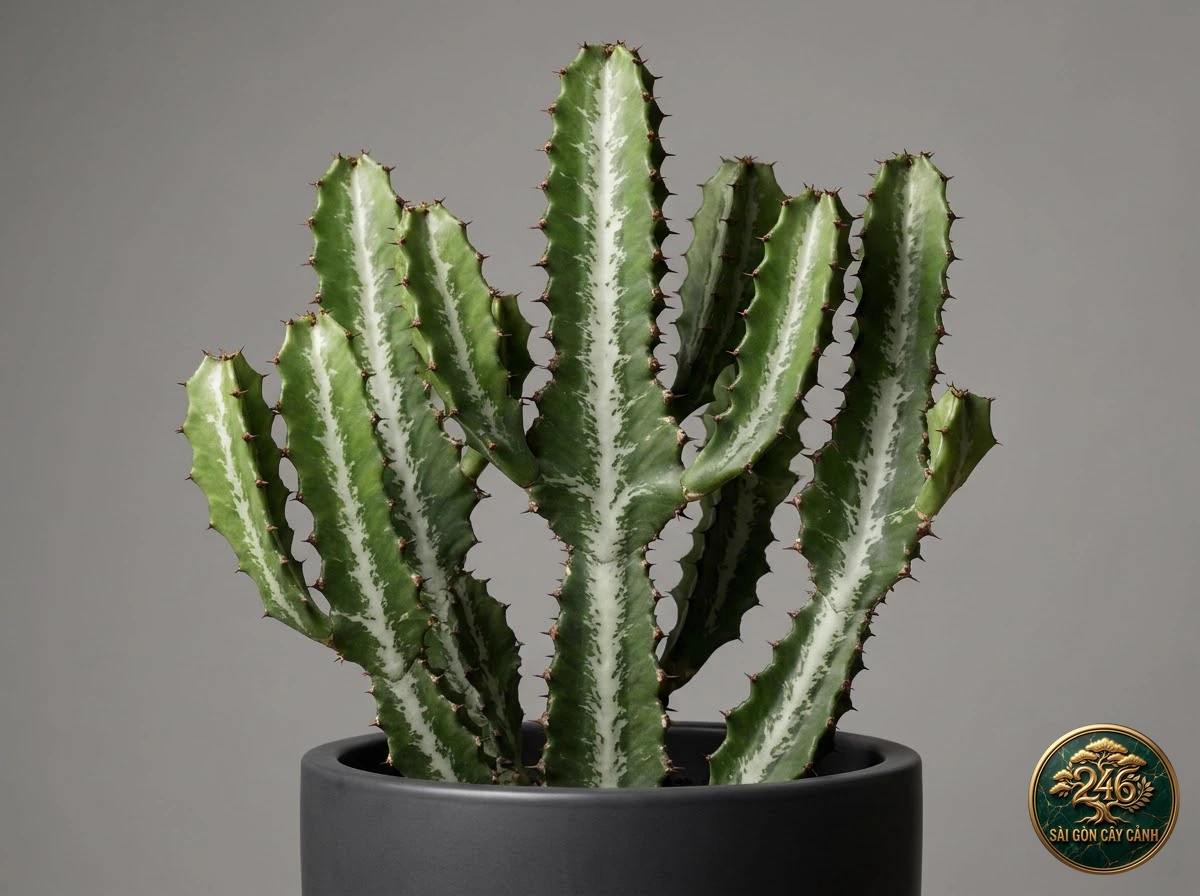
Mottled Spurge (Euphorbia lactea): Variegated Winged Rib Morphology, Diterpene Latex and Architectural Culture
Common Name: Mottled Spurge / Dragon Bones / False Cactus
Family: Euphorbiaceae
Native Range: Tropical Asia (India, Sri Lanka)
Euphorbia lactea is an architectural succulent shrub known for its undulating 3-4 angled stems banded by a prominent milky-white marbled stripe and defensive paired chestnut spines.
Sài Gòn Cây Cảnh Care Compass
1. Geographic Origin & Taxonomic Nomenclature History
Euphorbia lactea was documented by Adrian Hardy Haworth in 1812. This majestic variegated spurge is indigenous to tropical dry deciduous woodlands of India and Sri Lanka.
Stems feature three to four undulating winged ridges bearing an ethereal milky-white marbled stripe down the center, flanked by deep green margins and sharp chestnut spines.
2. Morphological Architecture & Anatomical Specializations
Epidermal cells of Euphorbia lactea contain reflective crystalloid inclusions that generate its pure milky marbling, shielded by a dense cutin layer buffering thermal radiation.
Assimilatory chloroplast tissues are concentrated along green wing perimeters, sustaining steady photosynthetic production despite reduced chlorophyll across central marbled bands.
3. Photosynthetic Radiance & Urban Microclimate Dynamics
Light demands center upon generous indirect sunlight or gentle morning rays between 3,000 and 6,000 lux; shield from scorching midday sun to protect sensitive white tissues.
Locate pots in bright living areas with generous window exposure or shaded patios to preserve sharp marbled contrast and prevent foliar reversion.
4. Mineral Substrate Engineering & Fast Percolation Dynamics
The dedicated growing medium blends 40% pumice, 25% perlite, 20% volcanic scoria, and 15% sandy loam enriched with aged compost.
Coarse mineral particles ensure irrigation moisture percolates rapidly through drainage ports, preventing soggy root zones during humid seasons.
5. Biological Irrigation Protocols & Seasonal Rhythm
Apply deep cyclical drenching every ten to fourteen days during dry warm months, watering only after substrate dries 80% through the pot.
During cool spells or prolonged rainstorms, minimize water application to maintain root systems in an uncompromised dry state.
6. Trace Mineral Nutrition & Slow-Release Fertility Protocols
Supply slow-release organic microbial pellets enriched with natural calcium bimonthly around root zones, preserving pristine luminescent clarity across marbled bands.
Micronutrient nourishment reinforces cell wall rigidity, preserving undulating sculptured stem geometry through years of container culture.
7. Vegetative Propagation Protocols & Aseptic Methodology
Sever branch segments on dry mornings using a sterile blade, rinsing white sap under cool water before dusting wounds with powdered activated charcoal.
Allow cuttings to cure in airy dry shade for fifteen days until a tough suberized shield forms before anchoring in damp mineral grit.
8. Botanical Toxicity Profile & Contact Protocols
Milky latex in Euphorbia lactea contains caustic diterpene esters capable of provoking severe oral mucosal irritation and dermal blistering upon unshielded contact.
Always wear goggles and gloves when pruning; prevent toxic latex splashes from touching skin, eyes, or household furnishings.
9. Physiological Diagnostics & Integrated Pest Management
The diagnostic pathological table below assists growers in detecting and correcting common cultivation challenges:
| Clinical Symptom | Primary Root Cause | Standard Corrective Protocol |
|---|---|---|
| Central milky-white marbled band shows brown scorched blotches | Photochemical burn from abrupt exposure to intense midday UV without acclimation | Relocate to 40% filtered shade to encourage healthy unblemished new growth |
| Winged rib crest softens into amber watery decay | Bacterial soft rot penetrating moist physical lesions under poor airflow | Excise afflicted margin using sterile blade, dust with sulfur powder, dry for 10 days |
| New offsets produce plain pale green stems without white marbling | Reversion induced by deficient photosynthetic illumination | Boost bright indirect photon levels to stimulate characteristic variegation patterns |
| Brown hemispherical scale insects clustered along spine crests | Armored scale infestation (Coccidae) tapping into succulent vascular channels | Scrub gently using soft toothbrush dipped in 70% alcohol, spray with horticultural oil |
10. Comparative Taxonomic Evaluation Across Allied Taxa
The taxonomic rubric below delineates diagnostic distinctions separating Euphorbia lactea from neighboring columnar succulents:
| Species Taxon | Morphological Trait | Growth Architecture | Diagnostic Indicator |
|---|---|---|---|
| Foliar Variegation Pattern | Distinct milky-white marbled dragon-bone spine down stem center | White chevron markings radiating from spine shields on dark green | Uniform powdery glaucous grey-blue skin devoid of marbling |
| Winged Ridge Profile | 3 to 4 heavily undulating sinuous scalloped wings | 3 straight vertical winged ribs with persistent seasonal leaflets | Deeply furrowed barrel with 8 to 16 vertical undulating ridges |
| Cristate Cresting Habit | Famous for fan-shaped crested mutated forms (var. cristata) | Rarely cristate; typically maintains strict vertical columns | Occasionally forms monstrous or caespitose multi-headed domes |
| Humidity Tolerance | Tolerates tropical monsoon air better than arid Karoo xerophytes | Moderate moisture sensitivity requiring dry soil cycles | Strictly adapted to bone-dry porous mineral substrate |
11. Urban Landscape Architecture & Living Display Design
The ethereal marbled silhouette of Euphorbia lactea introduces majestic architectural character when paired with matte stoneware planters in grand entrance atriums.
Its sinuous dragon-bone wings generate arresting visual momentum, enhancing high-end interior spaces with sculptural refinement.
Nursery Care Journal & Living Greenery Moments
At Saigon Cay Canh greenhouse, each photograph captures genuine everyday care moments between plant lovers and living greenery, spreading a passion for nature and green-living inspiration.