Living plant profile
Never-never plant
Ctenanthe oppenheimiana
Comprehensive botanical dossier for Never-never plant (Ctenanthe oppenheimiana). Identification, lighting calibration, porous substrate formulation, and cultivation guide by Saigon Cay Canh.
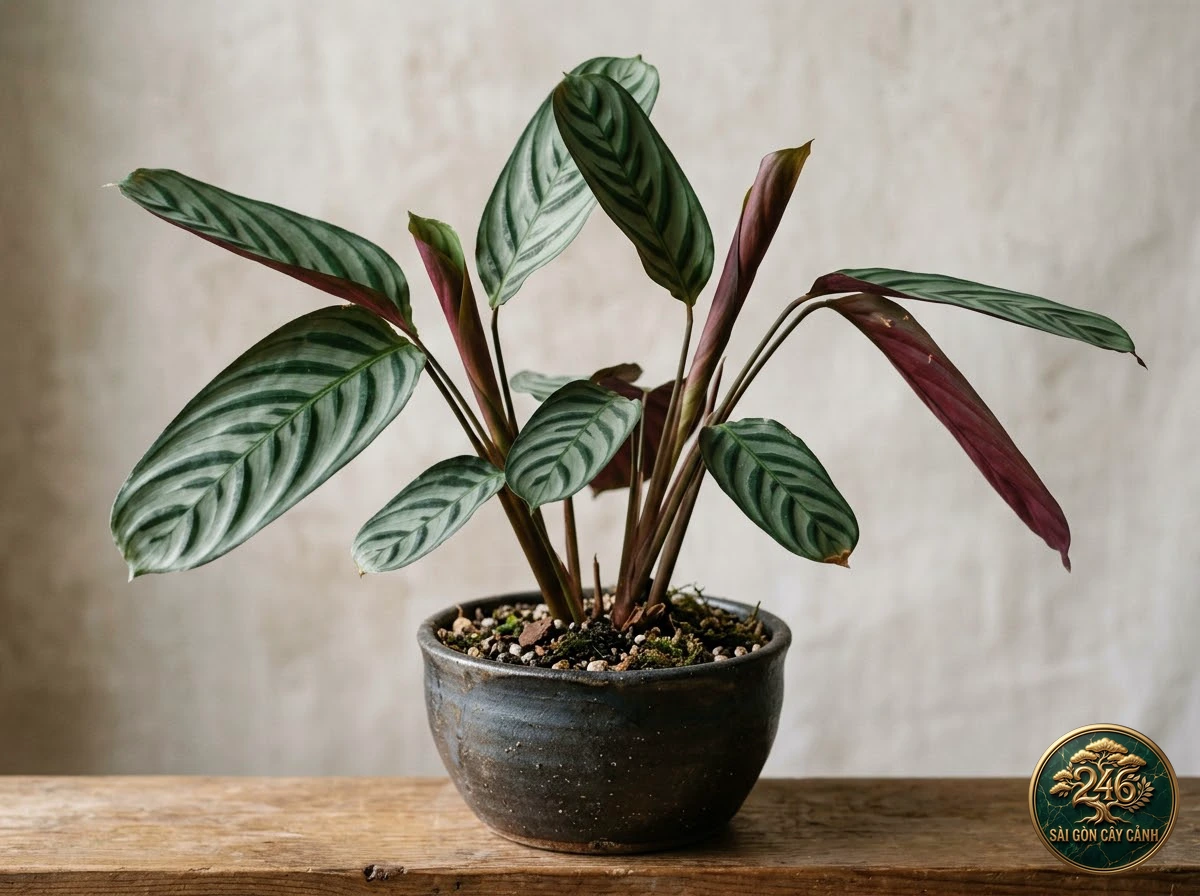
Never-never plant (Ctenanthe oppenheimiana) is one of the grandest and most statuesque members of the Marantaceae family originating from eastern Brazilian tropical rainforests. Featuring erect bamboo-like branching canes reaching over 1 meter and elongated lanceolate blades variegated with silvery-white mosaic bands over deep green with scarlet-purple undersides, it functions as a living sculpture in modern spaces.
1. Core Botanical Taxonomy & Cultural Specifications
| Scientific Name | Ctenanthe oppenheimiana |
|---|---|
| Botanical Family | Marantaceae (Prayer Plant Family) |
| Native Distribution | Eastern Brazil (Atlantic Coastal Rainforests) |
| Growth Demeanor | Tall clumping herbaceous perennial with erect branching cane-like stems |
| Lighting Threshold | Medium to bright diffused indirect illumination (1,200 – 2,000 lux) |
| Hydration Cadence | Hydrate with soft water once upper third of container profile turns dry |
| Substrate Formulation | 40% pumice, 20% conditioned bark fines, 20% washed coir, 20% perlite |
| Thermal Range | 20°C – 29°C (68°F – 84°F), requires protection below 16°C (60°F) |
| Relative Humidity | Ideal atmospheric humidity 60% – 80% |
| Cultivation Difficulty | Easy to Moderate (Notably more resilient than thin-leaved Calatheas) |
| Pet Safety Profile | Completely non-toxic to companion animals (ASPCA validated) |
Ctenanthe oppenheimiana was scientifically described by German botanist Karl Schumann in the late nineteenth century, cataloged from botanical expeditions across the lush Atlantic forest bioclimates of Brazil. Belonging to genus Ctenanthe, it showcases distinct node-branching cauline architecture that diverges from the acaulescent rosulate habits seen in Goeppertia.
In its native wild habitat, the species colonizes semi-open light gaps along secondary rainforest clearings, attaining commanding heights of 90 to 120 cm. Canes develop pronounced elongated internodes with dormant axillary meristems that branch into fan-like foliar crowns.
Taxonomic records from Kew POWO and NC State Extension validate Ctenanthe oppenheimiana as one of the most culturally resilient species within the Marantaceae family. Its tolerance to mild microclimatic fluctuations positions it as an exceptional candidate for commercial and residential greening.
2. Morphological Identification & Foliar Architecture
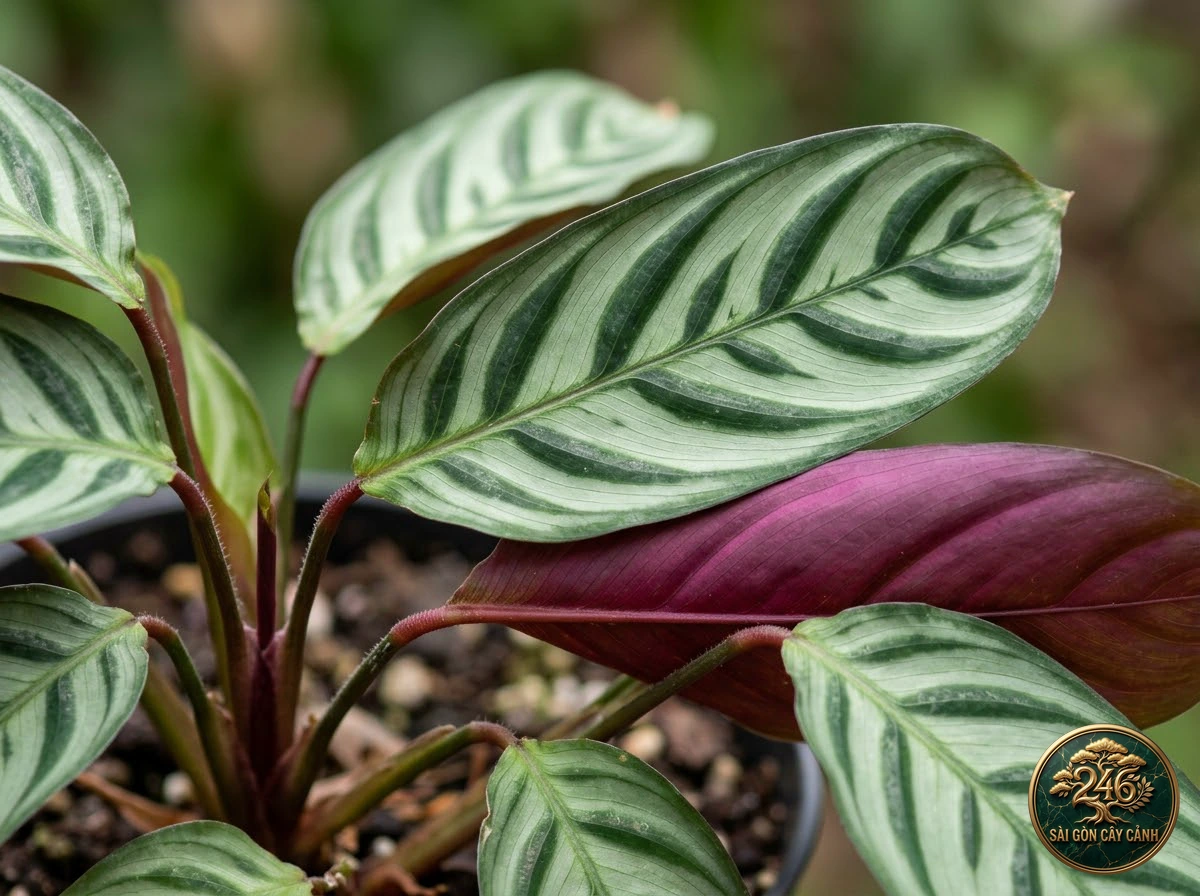
The prominent morphological feature of Ctenanthe oppenheimiana is its elongated leathery lanceolate blade, extending 25 to 40 cm in length and 8 to 12 cm across. Foliage possesses robust sub-coriaceous substance, featuring dark olive green lamina adorned with asymmetric silvery-white or creamy chevron brushstrokes radiating outward.
The abaxial surface is washed in vibrant carmine-purple or rich claret. As the tall canes ascend, the intermingling of silvery adaxial patterns and wine-red undersides provides multidimensional appeal. At the petiole apex sits the dynamic pulvinus motor node, regulating diurnal light capture and nocturnal elevation.
Foliar histology of Ctenanthe oppenheimiana exhibits complex mesophyll cell differentiation. Silvery-white variegated sectors lack functional chloroplasts, supported by epidermal cell walls 25% thicker than standard Calathea species. This enhanced cuticular density affords leathery, sub-coriaceous substance that resists mechanical desiccation far more effectively than delicate herbaceous foliage.
3. Photometric Calibration & Window Exposure Optimization
Owing to its firmer foliar substance, the Never-never plant accommodates broader light intensities spanning 1,200 to 2,000 lux. Optimal placement resides adjacent to sheer-veiled eastern or northern windows where bright diffused light fuels vigorous cane elongation without risking foliar sunburn.
Irrigation water must be dechlorinated prior to application. Although less sensitive to tip burn than fragile relatives, chronic tap water mineral deposition eventually induces crisp yellowing of apical points. Prioritize reverse-osmosis filtration or allow tap water to aerate in open containers for 24 hours.
Photonic calibration indicates optimal metabolic assimilation at PPFD levels spanning 60 to 110 µmol/m²/s. Because mature canes ascend past 1 meter, light must illuminate both upper canopies and lower cauline branches uniformly to prevent premature leaf shedding along basal internodes.
4. Cauline Branching Architecture & Pulvinar Diurnal Kinematics
Diverging from rosulate ground-hugging species, the cauline branching habit of Ctenanthe oppenheimiana provides multi-tiered architectural dynamics. Main canes ascend vertically, producing whorled petiole clusters at upper nodes that radiate like ornate fans, with each pulvinus operating semi-autonomously yet harmoniously.
Under darkness, potassium transport shifts across pulvinar motor tissue prompt the elongated blades to pivot vertically in unison. Because specimen heights approach 1 meter, this nyctinastic transformation radically alters room geometry from daytime spread to a slender nocturnal column.
Ideal room temperature ranges from 20°C to 29°C (68°F – 84°F). It relishes thermal consistency and dislikes abrupt chilling; keep containers away from concentrated air-conditioning exhaust streams.
Ambient relative humidity maintained between 60% and 80% preserves foliar luster and planar blade geometry. During arid seasons, position planters upon moist pebble trays or deploy room humidifiers to forestall margin puckering.
Within air-conditioned residential spaces, combining 22°C – 26°C warmth with 65% – 75% relative humidity establishes an optimal VPD of 0.7 – 0.9 kPa. This balance encourages continuous root water uptake without excessive foliar transpiration, ensuring lanceolate tips remain supple and uncurled.
The cauline branching architecture of Ctenanthe oppenheimiana is governed by moderate apical dominance. As primary canes reach threshold heights, declining auxin gradients allow axillary meristems at upper nodes to activate, developing into tiered fan-like foliar crowns that lend immense structural presence to interior spaces.
5. Porous Aggregate Substrate Engineering & Aeration Dynamics
To support tall branching foliage while eliminating root asphyxiation, Ctenanthe oppenheimiana demands weighted containers and highly aerated aggregate. The optimal mixture merges 40% coarse pumice, 20% composted mini pine bark fines, 20% thoroughly desalted coco coir, and 20% horticultural perlite.
The macroporosity of pumice and structural bark enables excess water to evacuate swiftly through drainage orifices, ensuring continuous oxygen diffusion to subterranean anchors and preventing lower cane defoliation.
Potting aggregate for the Never-never plant demands an air-filled porosity exceeding 20% at container capacity. Blending 5mm crushed horticultural charcoal with heat-conditioned pine bark creates a stable organic buffer that adsorbs heavy metal traces and fosters rhizosphere microbes antagonistic to Fusarium pathogens.
6. Organic Nutrition Schedules & Periodic Micronutrient Priming
Feed with balanced liquid organic nutrients at half-strength every 4 weeks throughout active warm seasons. Organic formulations rich in amino acids and natural potassium foster strong vertical canes and vivid variegation contrast.
Suspend fertilization during dormant winter lulls or when potting soil is excessively dry. Always pre-moisten the rhizosphere with pure water prior to feeding to avoid osmotic rootlet shock.
Monthly supplementation with purified humic acid and cold-water marine kelp extract enhances substrate cation exchange capacity (CEC). Soluble boron, zinc, and manganese fortify cauline cell walls, ensuring tall bamboo-like canes remain upright and rigid without drooping.
7. Clinical Diagnostic Matrix & Rapid Correction Protocols
| Clinical Symptom | Primary Etiology | Diagnostic Evaluation | Corrective Prescription |
|---|---|---|---|
| Crisp brown tips and leaf curl | Municipal water mineral excess or atmospheric humidity beneath 50% | Examine water source purity and monitor room hygrometer readings | Transition to pure RO or harvested rainwater and set container atop wet gravel trays |
| Leggy etiolated canes and bleached variegation | Chronic light starvation beneath the 800 lux threshold | Measure ambient light levels at cane height with digital photometer | Relocate specimen to bright indirect daylight (1,500 – 2,000 lux) near windows |
| Progressive yellowing of lower basal leaves | Substrate waterlogging causing root rot or night temperatures falling under 15°C | Inspect subterranean roots for browning and evaluate thermal stability | Repot into porous aggregate, excise damaged rootlets, and maintain room warmth above 18°C |
| Cottony webbing and minute white specks in petiole axils | Mealybug or spider mite colonization during dry, warm intervals | Examine clasping petiole sheaths closely using magnification loupe | Wipe axils with botanical alcohol swab and spray cold-pressed neem emulsion |
8. Cryptic Pest Prophylaxis & Foliar Surface Sanitation
Clasping petiole sheaths along tall canes provide potential shelter for mealybugs and soft brown scale. Systematically wipe internodal junctions and leaf undersides monthly with a soft cloth dipped in dilute biological soap solution to eradicate pests.
Routinely prune spent lower foliage at cane bases using sterilized bypass pruners. Removing senescent leaves improves basal air circulation, suppresses fungal pathogens, and stimulates vigorous new basal spear emergence.
Mitigate mealybugs and whiteflies along clasping petiole sheaths by applying cold-pressed sweet orange oil emulsion at 0.3% concentration. The natural d-limonene terpene dissolves the protective waxy coating of sap-sucking pests without scorching delicate foliar variegation.
9. Asexual Propagation Methodology & Root Strike Protocols
Propagation of Ctenanthe oppenheimiana is readily achieved through two pathways: basal rhizome division or stem node cuttings possessing adventitious root primordia. The optimal window occurs during early spring warmth.
For stem cuttings, harvest vigorous canes possessing 2 to 3 nodes and an intact crown fan. Root the cuttings in purified water or sterile sphagnum moss under warm, humid shade; robust root clusters develop reliably over a 25 to 35 day establishment period.
When propagating via stem node cuttings, select semi-lignified canes with firm basal internodes. Dusting nodal meristems with organic root-stimulating compounds prior to inserting into moist perlite and sphagnum induces dense adventitious root development over a 25 to 35 day establishment window.
10. Companion Animal Safety Profile & ASPCA Non-Toxic Verification
While non-hazardous from a veterinary toxicology standpoint, tall swaying canes may tempt curious cats. Cultivators should employ heavy ceramic or stone planters to ensure physical stability against accidental tipping.
11. Biophilic Curation & Contemporary Interior Design Styling
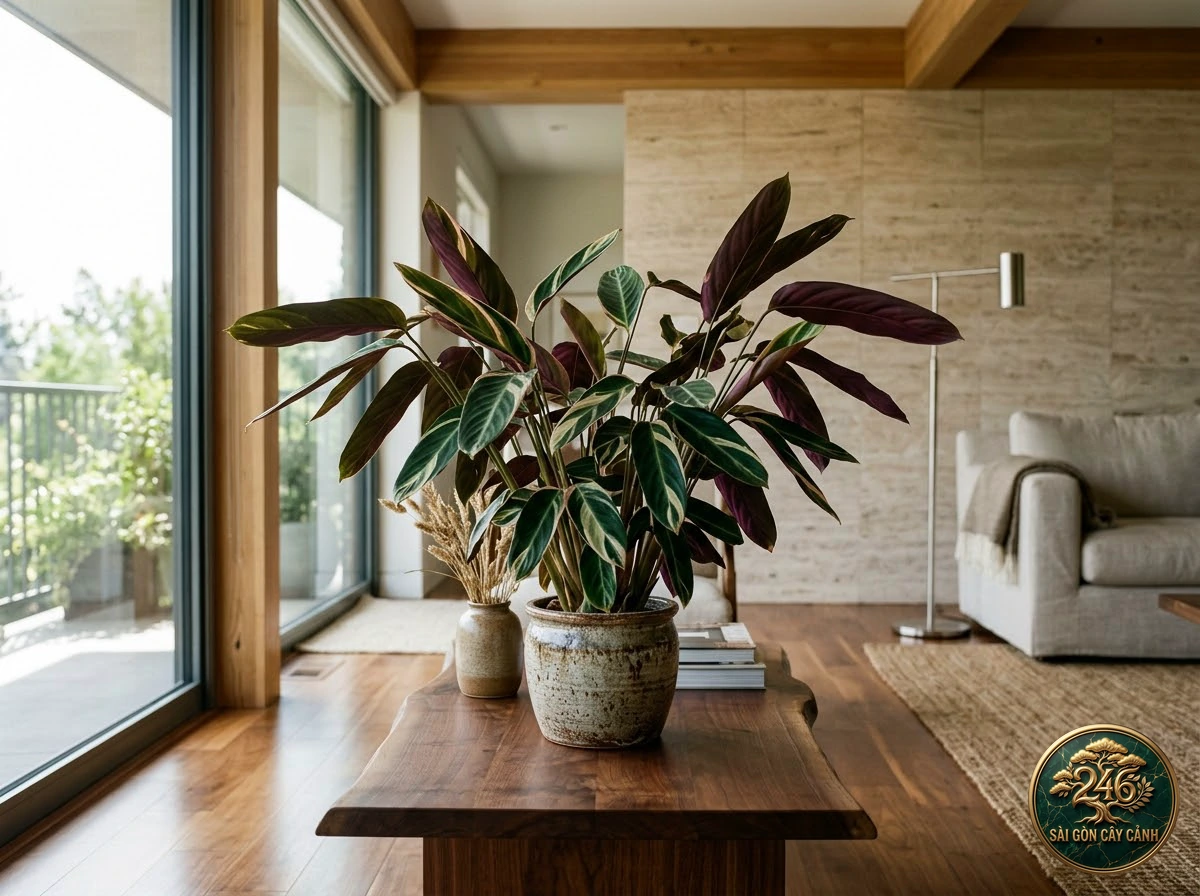
Boasting elevated height and graceful foliage fans, the Never-never plant is frequently specified by interior designers for living room corners, executive lounges, hotel reception foyers, and sunlit atrium promenades.
The interplay between ivory variegation, emerald fields, and deep purple backsides imparts architectural depth, infusing modern Biophilic developments with authentic tropical rainforest elegance.
In contemporary workplace architecture, the tall, statuesque silhouette of Ctenanthe oppenheimiana functions as an organic acoustic screen and living partition. It subtly delineates open-plan collaborative zones, softens acoustic reverberation, and elevates worker focus through biophilic engagement.
12. Master Principles for Sustainable Indoor Acclimatization
Three cardinal rules for cultivating flourishing Ctenanthe oppenheimiana specimens indoors:
- Hydration axiom: Container Stance Axiom: Deploy deep, heavy planters paired with porous pumice aggregates to anchor tall cane structures securely.
- Illumination axiom: Soft Water Protocol: Apply dechlorinated soft water once upper soil dries; never permit standing effluent in saucers.
- Maintenance axiom: Pruning Hygiene Practice: Periodically remove senescent basal leaves to direct vital energy toward emerging apical crowns.
13. Frequently Asked Questions Regarding Never-never plant (FAQs)
What is the maximum indoor height achievable by Ctenanthe oppenheimiana?
Under optimal indoor conditions with generous pots, specimens comfortably reach 90 to 120 cm tall with a spread exceeding 80 cm.
How can you encourage bushier cane branching from the base?
Pruning older leggy canes in early spring and feeding with organic nitrogen-rich fertilizer stimulates vigorous new basal shoots.
Is the Never-never plant safe around cats and dogs?
Yes. The ASPCA categorizes Ctenanthe oppenheimiana as 100% non-toxic to companion pets.
Why does the plant stop folding leaves upright at night?
Failure to elevate blades at dusk typically indicates dry soil, low humidity, or artificial night lighting disrupting circadian nyctinasty.
What is the ideal repotting interval?
Repot every 1 to 2 years in spring as expanding root systems fill the container profile.
Why is Ctenanthe oppenheimiana commonly called the Never-never plant?
The vernacular moniker ‘Never-never plant’ reflects its extraordinary resilience; the plant seems to ‘never, never die’ even during occasional neglect, drawing upon substantial water reserves stored inside its jointed bamboo-like canes.