Living plant profile
Pencil cactus
Euphorbia tirucalli
Euphorbia Euphorbiaceae Living Herbarium Master V2 Pencil Cactus (Euphorbia tirucalli): Cylindrical Photosynthetic Cladodes, Latex Safety and Arid Architecture Scientific Name: Euphorbia tirucalli L. Common Name: Pencil Cactus / Firesticks / Indian Tree Spurge Family: Euphorbiaceae Native Range: Sub-Saharan Africa, Madagascar, naturalized in tropical Asia Euphorbia tirucalli is an extraordinary xerophytic succulent featuring dense tangles of […]
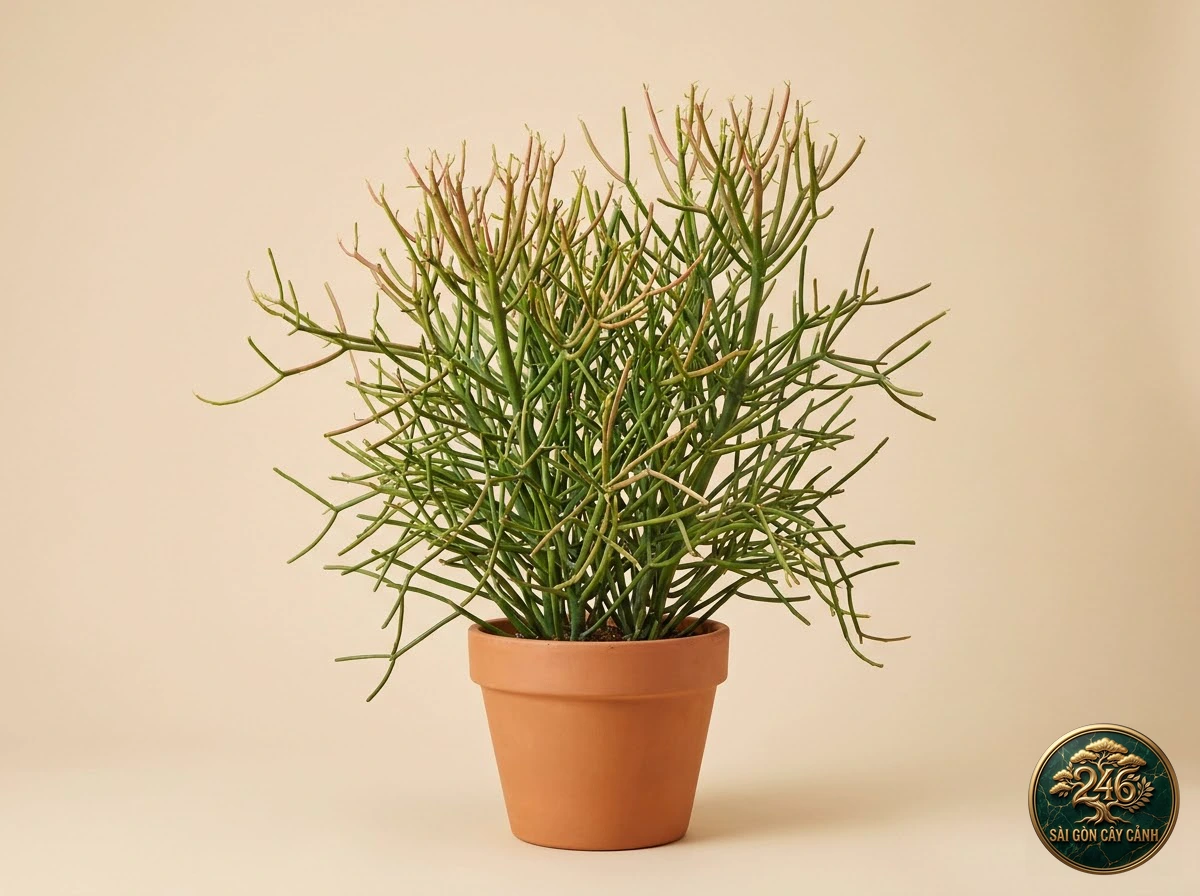
Pencil Cactus (Euphorbia tirucalli): Cylindrical Photosynthetic Cladodes, Latex Safety and Arid Architecture
Common Name: Pencil Cactus / Firesticks / Indian Tree Spurge
Family: Euphorbiaceae
Native Range: Sub-Saharan Africa, Madagascar, naturalized in tropical Asia
Euphorbia tirucalli is an extraordinary xerophytic succulent featuring dense tangles of smooth, pencil-thick cylindrical photosynthetic branchlets that transform into fiery coral hues under direct sunlight.
Sài Gòn Cây Cảnh Care Compass
1. Geographic Origin & Taxonomic Nomenclature History
Euphorbia tirucalli was cataloged by Carl Linnaeus in 1753. This distinctive pencil spurge is native across semi-arid zones of Sub-Saharan Africa and Madagascar, thriving in drought-stressed environments.
Leaves are reduced to minute ephemeral scales, leaving smooth cylindrical green cladodes to perform photosynthesis and minimize transpirational surface area under equatorial skies.
2. Morphological Architecture & Anatomical Specializations
Branchlets interlace in dense coral-like thickets, enveloped by a resilient cuticular sheath safeguarding internal photosynthetic cells from harsh solar irradiance.
An extensive laticifer network permeates branch parenchyma, pressurized with hydrocarbon-rich latex that provides potent defense against insect predation and desiccation.
3. Photosynthetic Radiance & Urban Microclimate Dynamics
The plant requires full direct sun from 5,000 to over 10,000 lux; intense ultraviolet radiation activates carotenoid pigments that ignite fiery orange-red tones in Firesticks cultivars.
Position containers on open sun decks, high-rise terraces, or airy atriums with vigorous airflow to keep nodal joints dry and well-ventilated.
4. Mineral Substrate Engineering & Fast Percolation Dynamics
Substrate for pencil spurge demands extraordinary drainage: blend 50% pumice, 25% coarse quartz sand, 15% perlite, and 10% washed coco coir.
Exceptional porosity eliminates root zone moisture stagnation, ensuring delicate feeder rootlets breathe comfortably during hot summer spells.
5. Biological Irrigation Protocols & Seasonal Rhythm
Drought endurance in Euphorbia tirucalli is exceptional; irrigate only when the entire substrate dries 100% bone-dry, spaced fourteen to twenty days apart.
During rainy or cloudy periods, suspend watering entirely for weeks; resilient cladodes will sustain turgor without foliar shrinkage.
6. Trace Mineral Nutrition & Slow-Release Fertility Protocols
Apply only light washes of diluted biochar ash water or mild organic microbial tea near the end of dry dormancy to encourage fresh branch bifurcation.
Avoid high-nitrogen fertilizers that turn branches dark green and succulent, eroding the celebrated coral-red chromatic signature.
7. Vegetative Propagation Protocols & Aseptic Methodology
Take 20-centimeter semi-hardwood branch cuttings using clean shears, submerging severed ends in cool water to stop sap dripping before dusting with activated charcoal.
Cure cuttings in dry breezy shade for twelve days until cut faces are completely callused, then insert into gritty sand to induce vigorous adventitious rooting.
8. Botanical Toxicity Profile & Contact Protocols
The milky latex of Euphorbia tirucalli contains hazardous phorbol and ingenol esters that blister skin and risk severe corneal ulceration and temporary blindness upon eye contact.
Full protective goggles and thick gloves are mandatory when grooming; keep specimens strictly segregated from curious pets and young children.
9. Physiological Diagnostics & Integrated Pest Management
The following diagnostic rubric provides nursery guidelines for identifying physical ailments on pencil cladodes:
| Clinical Symptom | Primary Root Cause | Standard Corrective Protocol |
|---|---|---|
| Pencil twigs shrivel with fine longitudinal ridges | Prolonged substrate starvation draining succulent cladode reservoirs | Deliver a thorough deep soak; branchlets will re-plump within 24-48 hours |
| Branch nodes turn black, soft and detach at joints | Water stagnation or wet cold soil cultivating anaerobic Phytophthora decay | Excise rotting limbs swiftly, treat cuts with sulfur dust and repot in gritty coarse sand |
| Vibrant fiery orange-red apex pigment fades to dull uniform green | Subdued indoor light levels lacking ultraviolet photon stimulation | Transition pot to sunny outdoor terrace receiving 4-6 hours direct daily sunlight |
| Milky sap splashes on skin causing stinging erythema | Direct epidermal contact with irritating phorbol diterpenes upon pruning | Flush immediately under cold flowing water for 15 minutes; seek urgent care if ocular contact occurs |
10. Comparative Taxonomic Evaluation Across Allied Taxa
The taxonomic matrix below differentiates Euphorbia tirucalli from morphological counterparts in the succulent trade:
| Species Taxon | Morphological Trait | Growth Architecture | Diagnostic Indicator |
|---|---|---|---|
| Cladode Morphology | Smooth cylindrical pencil-thick twigs branching coral-like | Ribbed 3-4 winged sinuous flanged stems | Massive arborescent candelabrum columns with heavy ribs |
| Chromatographic Shift | Shifts to blazing amber-orange-red under intense solar rays | Stable emerald with creamy variegation or subtle purple margin | Deep forest green stems lined with persistent grey thorns |
| Foliar Persistence | Minute vestigial leaflets shed almost immediately after emergence | Teardrop leaflets persist along winged ridges during growth | Leaves shed swiftly leaving thick photosynthetic bark |
| Vegetative Propagation | Stem cuttings root vigorously within 14 to 21 days in grit | Segment cuttings require prolonged callusing before rooting | Propagated via seed or substantial truncheons requiring anchor support |
11. Urban Landscape Architecture & Living Display Design
The abstract coral geometry of Euphorbia tirucalli delivers striking minimalist allure when housed in rustic terracotta or neutral concrete planters.
Its sun-induced chromatic radiance provides an arresting visual anchor for Mediterranean-style roof gardens and luxury urban outdoor terraces.
Nursery Care Journal & Living Greenery Moments
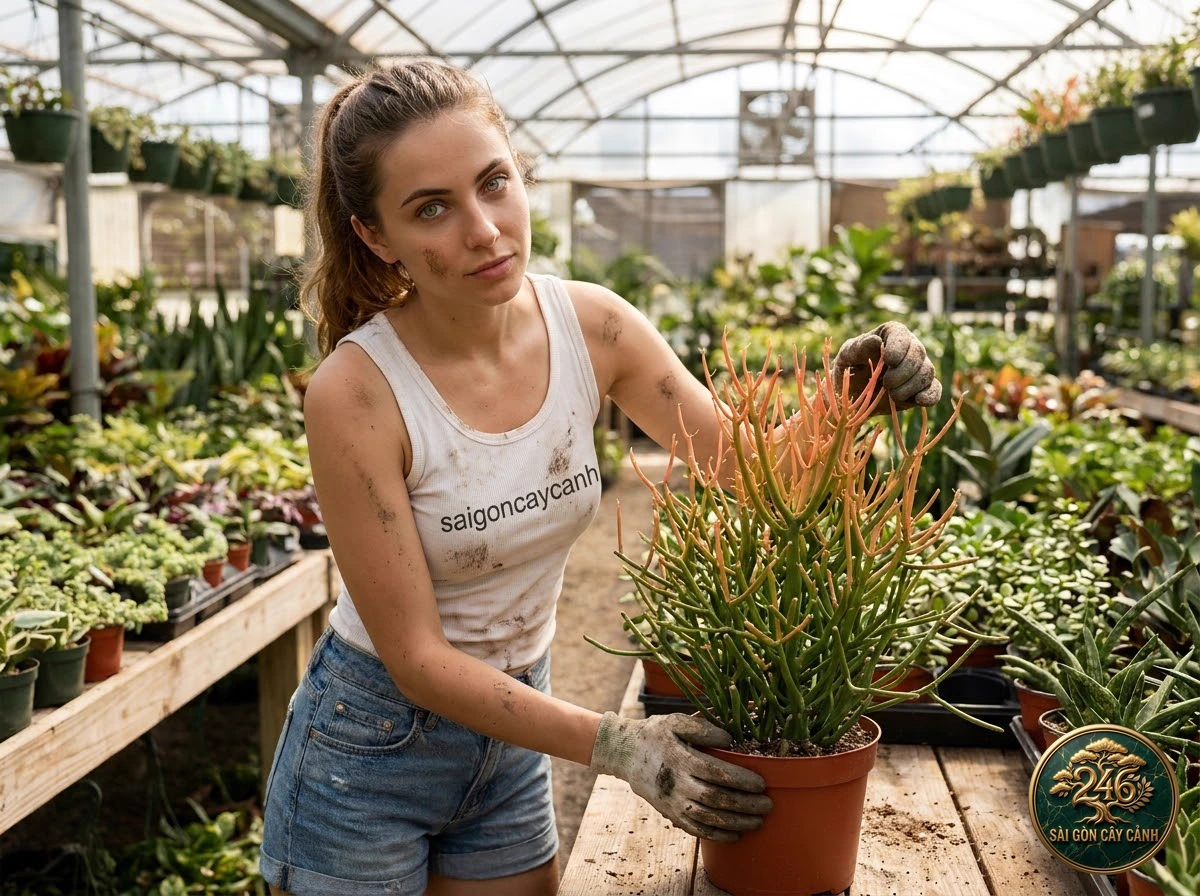
At Saigon Cay Canh greenhouse, each photograph captures genuine everyday care moments between plant lovers and living greenery, spreading a passion for nature and green-living inspiration.