Living plant profile
Polka dot begonia
Begonia maculata
Comprehensive botanical dossier for Polka dot begonia (Begonia maculata). Identification, lighting calibration, porous substrate formulation, and cultivation guide by Saigon Cay Canh.
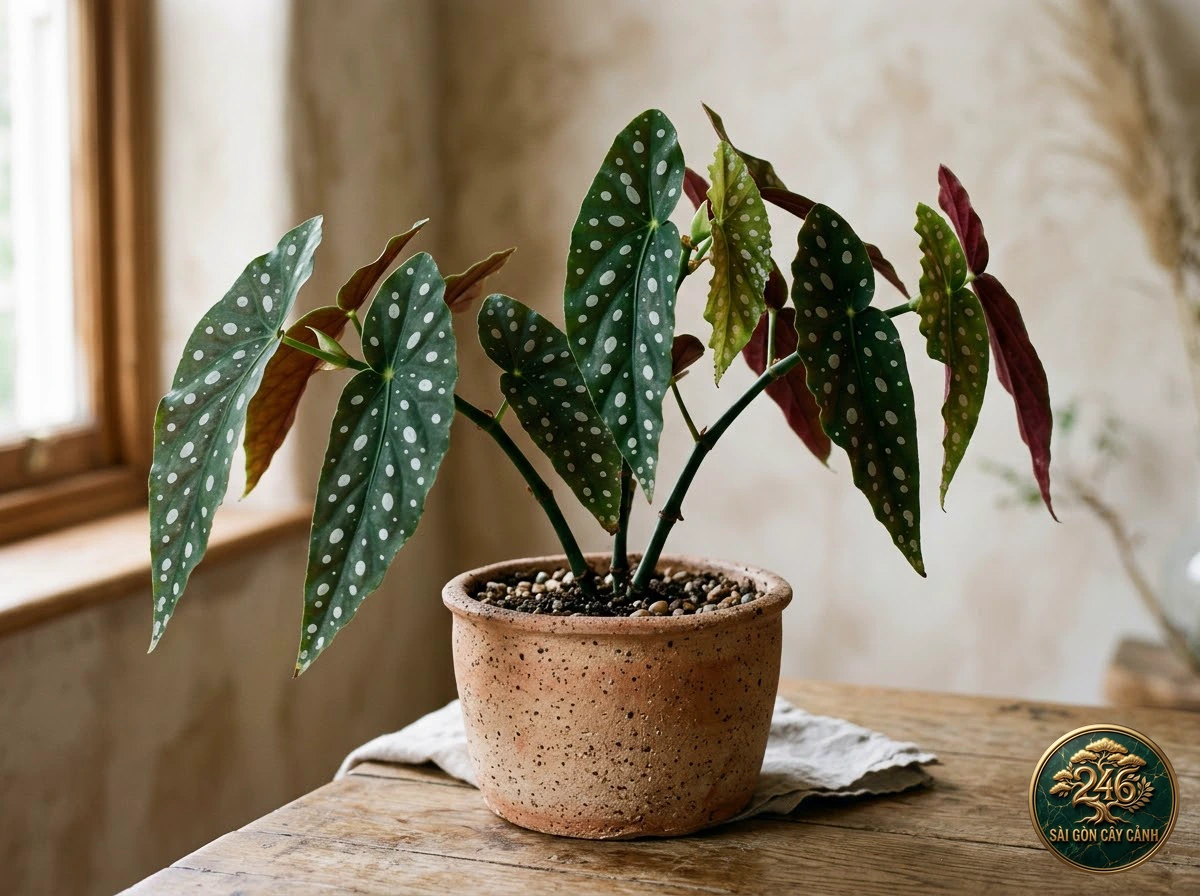
Polka dot begonia (Begonia maculata) is one of the most celebrated aesthetic icons within the Begoniaceae family indigenous to the Atlantic rainforests of southeastern Brazil. Renowned among botanical connoisseurs for its erect bamboo-like cane stems, the taxon features asymmetric angel-wing foliage in olive green stippled with raised silvery polka dots, contrasted against deep carmine-crimson abaxial surfaces.
Sài Gòn Cây Cảnh Care Compass
1. Core Botanical Taxonomy & Cultural Specifications
| Scientific Name | Begonia maculata |
|---|---|
| Botanical Family | Begoniaceae (Begonia Family) |
| Native Distribution | Southeastern Brazil (Atlantic Coastal Rainforests) |
| Growth Demeanor | Erect cane-stemmed (angel-wing) subshrub with jointed bamboo-like canes |
| Lighting Threshold | Generous bright diffused indirect light (1,400 – 2,200 lux) |
| Hydration Cadence | Hydrate with soft water once upper third of container substrate dries |
| Substrate Formulation | 40% pumice, 20% mini pine bark fines, 20% sphagnum moss, 20% perlite |
| Thermal Range | 19°C – 28°C (66°F – 82°F), growth arrests below 15°C (59°F) |
| Relative Humidity | Optimal relative humidity 60% – 75% |
| Cultivation Difficulty | Easy to Moderate (Requires structural staking and generous light) |
| Pet Safety Profile | Toxic to companion animals (ASPCA warning for oral mucosal irritation) |
Begonia maculata was originally collected and described in 1820 by Italian botanist Giuseppe Raddi during scientific expeditions across Rio de Janeiro state, Brazil. The species epithet ‘maculata’ derives from Latin meaning ‘spotted’ or ‘blotched’, referring to the silvery circular dots scattered across its asymmetrical leaves.
In native woodland habitats along the Brazilian Atlantic coast, specimens form erect cane-stemmed shrubs standing 80 cm to 1.5 meters tall. The stems possess swollen nodal joints resembling miniature bamboo culms, providing water storage capacity that affords greater drought tolerance than rhizomatous begonia relatives.
Modern taxonomic records at Kew POWO validate Begonia maculata (frequently cultivated under the morphological form Begonia maculata var. wightii) as an accepted distinct species. Beyond architectural foliage, mature specimens produce pendulous trusses of delicate white-to-blush florets throughout warm spring and summer intervals.
2. Morphological Identification & Foliar Architecture
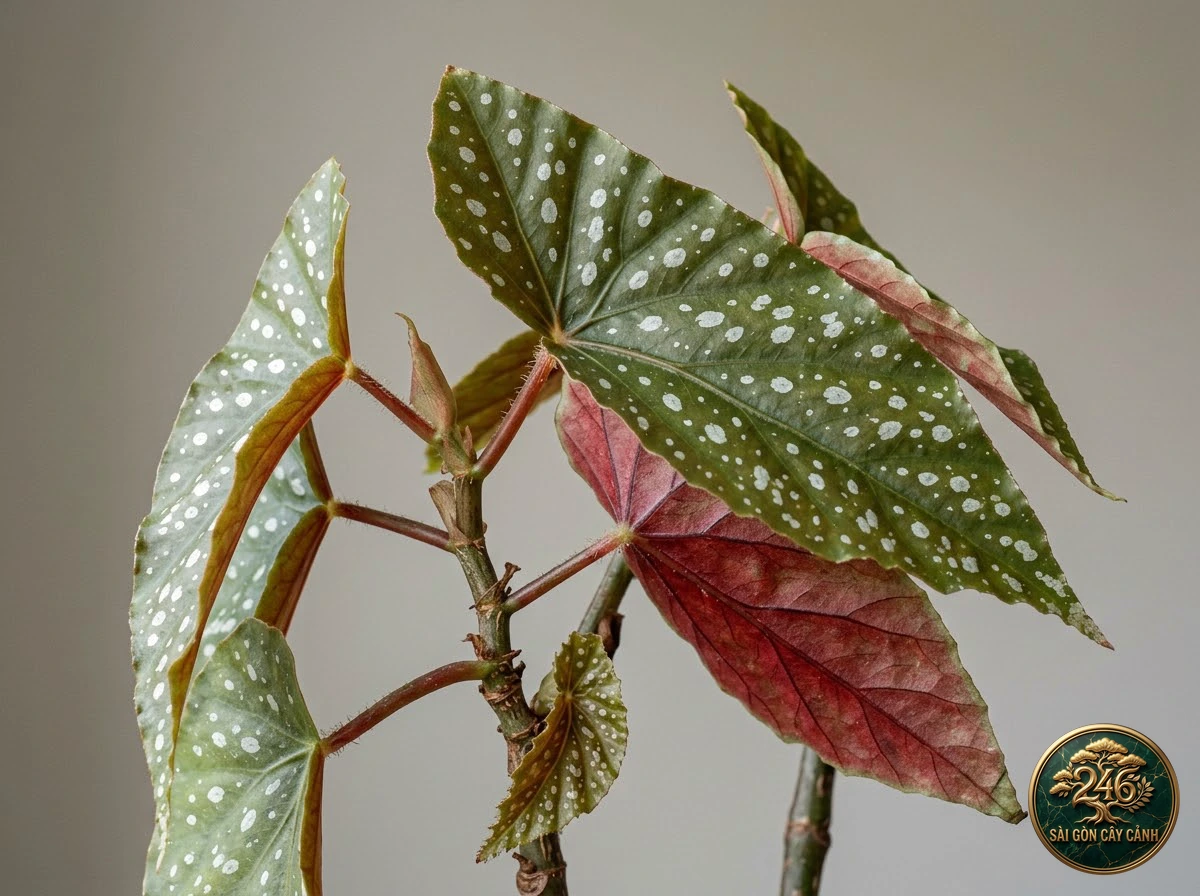
Distinctive morphological hallmarks feature elongated asymmetric angel-wing blades extending 15 to 25 cm in length and 5 to 8 cm in breadth. The adaxial surface displays glossy dark olive green, studded with dozens of raised, circular metallic silver polka dots resembling inlaid mother-of-pearl.
The abaxial surface is saturated in rich carmine-crimson, generating dramatic two-tone chromatic contrast against adaxial silver dots. Stems ascend vertically with elongated greenish-grey internodal canes, supported by slender petioles 4 to 8 cm long attaching eccentrically at leaf bases.
The striking silver polka dots of Begonia maculata represent a masterclass in photobiological micro-anatomy. Rather than white pigment granules, each dot is formed by a discrete sub-epidermal air space separating the transparent upper epidermis from the underlying palisade cells. This microscopic air gap causes total internal light reflection, producing brilliant metallic silver spots against emerald tissue and contrasting vividly with abaxial carmine reds.
3. Photometric Calibration & Window Exposure Optimization
Begonia maculata stands as one of the most light-loving begonias in cultivation. To maintain rich olive coloration and crisp silver polka dots, it demands strong diffused illumination spanning 1,400 to 2,200 lux. Gentle morning eastern sunlight for 1 to 2 hours stimulates vigorous cane branching and prolific flowering.
Irrigation must adhere to a strict ‘soak and dry’ rhythm. Allow the upper third of the potting aggregate to dry before applying thorough drenches of dechlorinated soft water. Avoid overhead spraying onto foliage, as standing water droplets foster bacterial leaf spot and fungal mycelia.
Photosynthetic performance peaks under bright, filtered light delivering PPFD levels from 60 to 105 µmol/m²/s. Generous filtered daylight promotes compact internodes, encourages robust branching, and triggers floral meristem induction, yielding magnificent pendulous sprays of delicate white-and-pink blossoms.
4. Bamboo Cane Habit & Structural Staking Engineering
The cane-stem architecture of Begonia maculata yields elegant vertical stature but necessitates proper structural staking. Because jointed canes ascend rapidly while carrying heavy foliar crowns at their summits, stems are prone to leaning or bending under their own weight.
Cultivators should insert slender bamboo stakes or fiberglass rods deep into the pot, securing canes loosely at internodes with soft horticultural ties. Pruning apical tips in early spring encourages multiple basal shoots, resulting in a dense, multi-stemmed specimen.
The optimum temperature regime spans 19°C to 28°C (66°F – 82°F). The plant acclimates effortlessly to tropical warmth, but foliar drop and petiole rot occur if ambient temperatures remain beneath 15°C (59°F) for extended intervals.
Optimal relative humidity spans 60% to 75%. Thanks to thicker foliar cuticles, it tolerates indoor dry air better than delicate Rex cultivars, though sustaining humidity above 55% prevents acute leaf tips from crisping.
The target vapor pressure deficit (VPD) ranges from 0.65 to 0.9 kPa. If ambient indoor relative humidity plunges below 50% during dry spells, vulnerable angel-wing leaf apexes suffer desiccation burn, and nascent floral buds may abort prematurely before unfurling.
The bamboo-like cane habit of Begonia maculata features swollen nodes storing water and structural fibers, enabling upright growth exceeding 1.2 meters. However, because large asymmetrical angel-wing blades exert considerable leverage, supporting mature canes with slender bamboo stakes or coir trellises is essential to prevent stem lodging during heavy flowering flushes.
5. Porous Aggregate Substrate Engineering & Aeration Dynamics
The root system of Begonia maculata thrives in highly permeable aggregate that drains excess moisture rapidly while retaining a soothing moisture film. The standard mix comprises 40% pumice, 20% boiled mini pine bark fines, 20% sterile sphagnum moss, and 20% horticultural perlite.
This aggregate porosity permits surplus irrigation water to evacuate freely through bottom holes without stagnation, delivering abundant oxygen to fine rootlets and completely preventing basal cane rot.
The potting mix for Polka dot begonia demands a calibrated balance between capillary moisture retention and brisk gravitational drainage. An optimal aggregate combines 35% pumice, 25% screened pine bark fines, 25% aged coco coir, and 15% worm castings, ensuring vigorous rhizosphere oxygenation and resilience against Pythium root rot.
6. Organic Nutrition Schedules & Periodic Micronutrient Priming
Due to vigorous vegetative growth and regular flower production, Begonia maculata demands slightly higher nutritional support. Apply balanced liquid organic fertilizer diluted to quarter-strength every 3 to 4 weeks throughout warm active periods.
Reduce feeding during low-light winter months. Flush the container thoroughly with pure water every 2 to 3 months to prevent mineral salt accumulation in the substrate.
Nutritional regimens for this cane begonia should incorporate balanced liquid organic formulations enriched with cold-water kelp every 2 weeks during active foliar and bud development. Keeping nutrient solution EC near 0.8 mS/cm supplies ample micro-elements to support stout canes and maintain crisp polka dot contrast.
7. Clinical Diagnostic Matrix & Rapid Correction Protocols
| Clinical Symptom | Primary Etiology | Diagnostic Evaluation | Corrective Prescription |
|---|---|---|---|
| Acute leaf tips turn crisp brown and split | Tap water chlorine/mineral excess or room relative humidity beneath 50% | Check room hygrometer reading and evaluate water purity | Transition to pure distilled or rainwater and elevate room humidity above 60% with misting |
| Progressive defoliation from lower stem nodes | Severe light deficit below 800 lux or prolonged root ball dehydration | Measure ambient lux levels with photometer and inspect substrate core moisture | Relocate planter to bright indirect daylight near windows and thoroughly hydrate |
| Basal cane softens, darkens, and collapses | Anaerobic substrate saturation triggering fungal basal cane and root rot | Unpot root ball to inspect root integrity and evaluate cane firmness | Excise decayed cane, harvest healthy apical cuttings for water rooting, and repot in airy pumice |
| Silvery polka dots fade and foliage turns dull pale green | Chronic light starvation suppressing pigmentation expression | Measure ambient lux levels at canopy height with photometer | Move specimen to bright filtered daylight zone measuring 1,500 to 2,000 lux |
8. Cryptic Pest Prophylaxis & Foliar Surface Sanitation
Primary pest targets comprise citrus mealybugs nesting within internodal petiole sheaths and spider mites colonizing red undersides. Regularly inspect and swab nascent colonies using cotton tips soaked in dilute biological soap.
Gently dusting blades with a damp microfiber cloth bi-weekly keeps the silvery polka dots shined and maximizes photosynthetic throughput across the olive green lamina.
To guard against physiological defoliation and bacterial leaf spot (Xanthomonas), maintain generous spacing between containers and always water the potting substrate directly in early morning. Eradicate early mealybug colonies within petiole joints using swabs dipped in diluted 70% horticultural alcohol.
9. Asexual Propagation Methodology & Root Strike Protocols
Propagation of Begonia maculata is exceptionally straightforward via stem node cuttings. The most favorable window occurs during active spring and summer flushes when tissue vitality is peak.
Using sterilized shears, sever a cane section possessing 2 to 3 nodes just beneath a leaf joint. Root the cutting in purified water or moist perlite and sphagnum under warm shade; robust root systems establish over a 25 to 35 day period.
Stem cane cuttings represent the most reliable and rapid propagation technique for Begonia maculata. Harvesting semi-firm cane segments with 2 to 3 nodes cut just beneath a nodal ring and placing them into de-chlorinated water or moist perlite produces robust adventitious root clusters over a 25 to 35 day developmental interval.
10. Companion Animal Toxicology Profile & ASPCA Safety Evaluation
Elevating specimen planters upon pedestals or plant stands simultaneously protects domestic animals and optimizes viewing angles for cascading angel-wing foliage and pendulous floral trusses.
11. Biophilic Curation & Contemporary Interior Design Styling
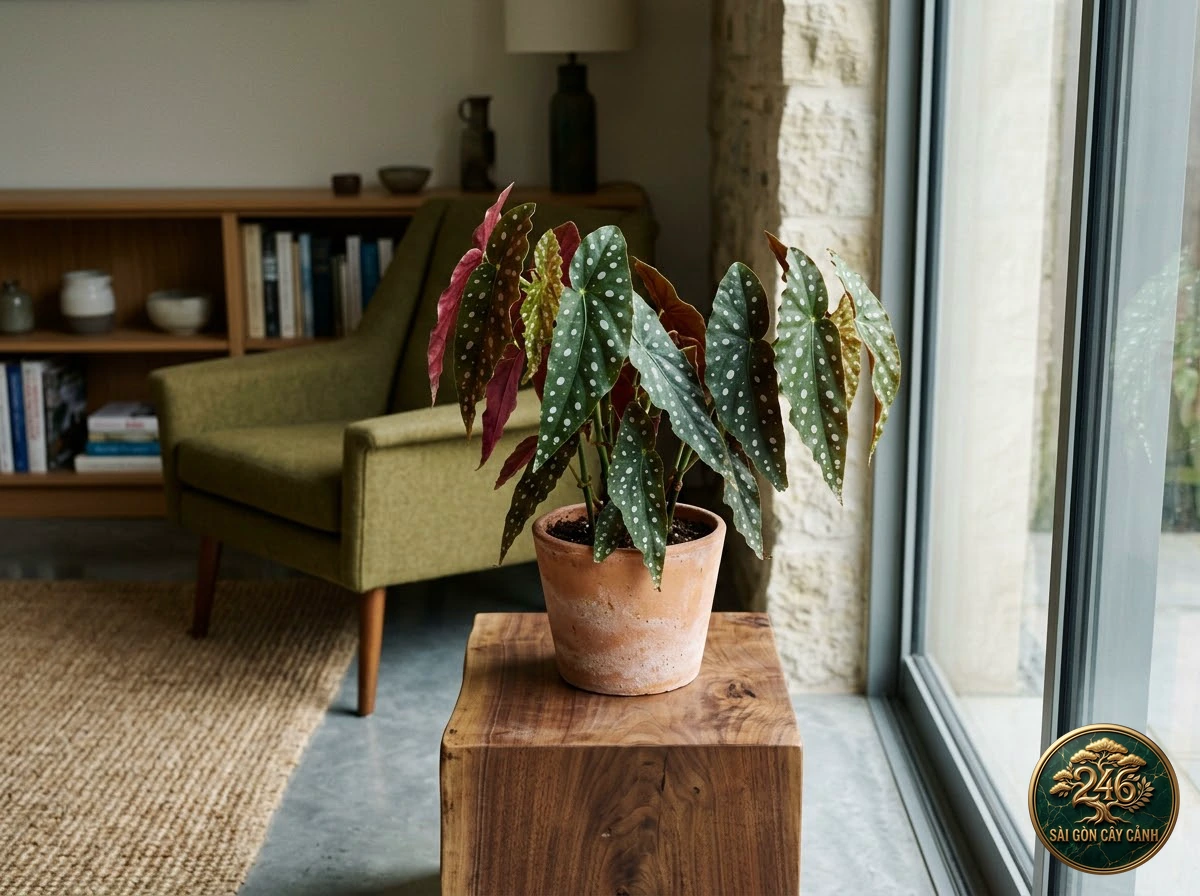
Boasting graceful cane architecture and contemporary polka dot graphics, Begonia maculata serves as a chic aesthetic focal point for Mid-Century Modern apartments, creative design studios, and trendy cafes.
The contrast of silvery polka dots over olive green with carmine-red undersides infuses residential environments with playful energy, artistic inspiration, and refined living taste.
With its graceful upright stance and whimsical polka-dot pattern, Begonia maculata stands as a quintessential icon of Tropical Modernist interior design. The plant exudes playful charisma and artistic flair, serving as a captivating focal centerpiece across contemporary urban lofts and creative design studios.
12. Master Principles for Sustainable Indoor Acclimatization
Three cardinal rules for cultivating flourishing Begonia maculata specimens indoors:
- Hydration axiom: Structural Staking Axiom: Provide supportive staking early to anchor ascending bamboo canes firmly against lodging.
- Illumination axiom: Generous Photonic Regime: Supply 1,800 lux bright indirect light with gentle morning sun to maintain bright polka dots and trigger blooming.
- Maintenance axiom: Wet-Dry Rhythm Protocol: Irrigate only when upper third of potting mix dries; strictly avoid splashing water onto foliar surfaces.
Nursery Care Journal & Living Greenery Moments
At Saigon Cay Canh greenhouse, each photograph captures genuine everyday care moments between plant lovers and living greenery, spreading a passion for nature and green-living inspiration.

13. Frequently Asked Questions Regarding Polka dot begonia (FAQs)
Why does Begonia maculata have silvery-white polka dots?
The silver spots are microscopic air pockets situated between the epidermis and palisade mesophyll that reflect light to optimize photosynthesis.
How often does Begonia maculata bloom indoors?
Specimens produce cascading trusses of delicate white or blush florets from spring through late summer when provided with ample bright indirect light.
Is Polka dot begonia safe around cats and dogs?
No. The ASPCA warns that Begonia maculata is toxic to pets, causing oral burning, hypersalivation, and vomiting. Keep elevated.
How can you encourage multiple cane branches from the base?
Pruning apical cane tips in early spring breaks apical dominance, stimulating dormant basal nodes to produce new vertical shoots.
What is the ideal repotting interval?
Repot every 1 to 2 years in spring as expanding root systems fill the pot and taller canes require larger weighted containers.
How can you encourage Begonia maculata to branch densely and bloom profusely?
Pinching apical tips when canes reach desired heights breaks apical dominance, triggering vigorous lateral branching. Providing generous filtered daylight and feeding organic phosphorus-rich fertilizer stimulates recurring pendulous blossom clusters throughout spring and summer.