
Living plant profile
Prayer plant
Maranta leuconeura
Comprehensive botanical dossier for Prayer plant (Maranta leuconeura). Identification, lighting calibration, porous substrate formulation, and cultivation guide by Saigon Cay Canh.
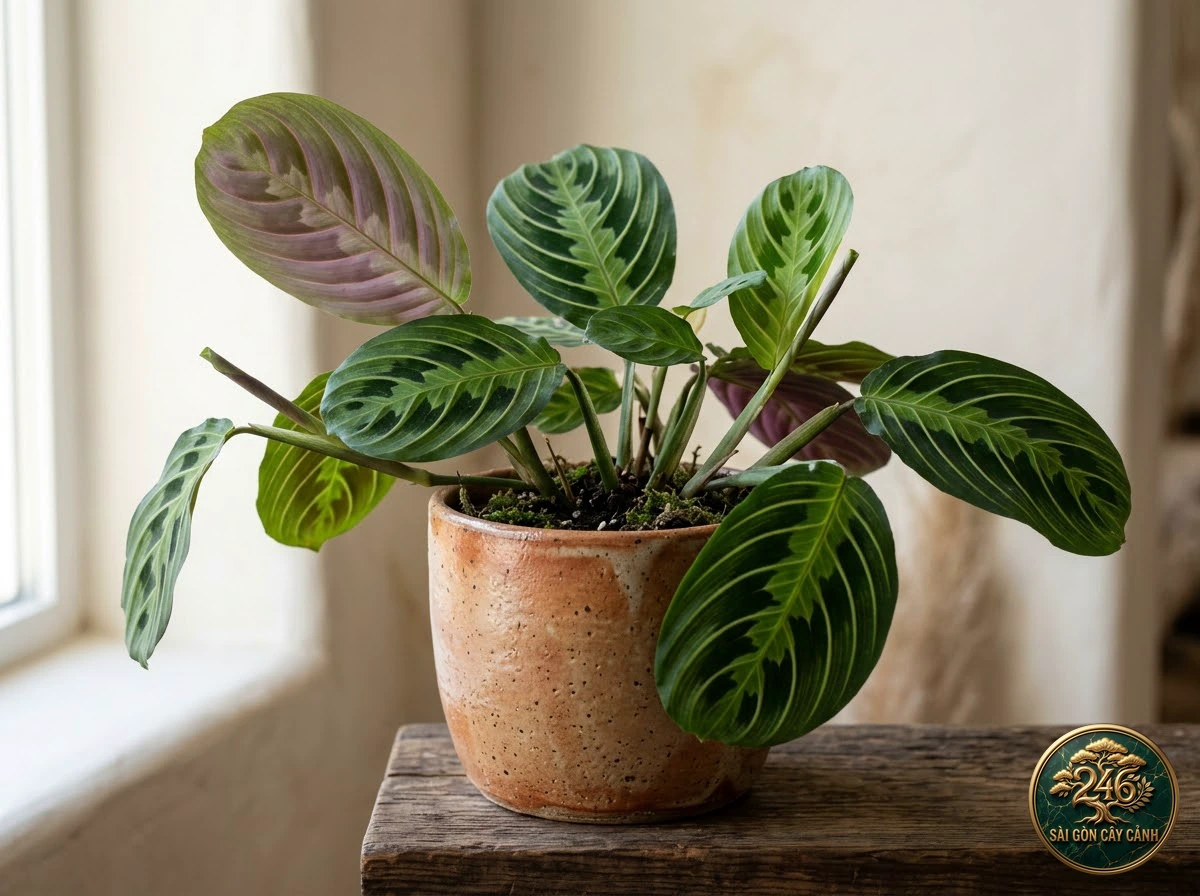
Prayer plant (Maranta leuconeura) is the iconic quintessential namesake of the prayer plant family, celebrated globally for broad oval leaves adorned with vivid carmine-red herringbone venation glowing against velvety olive-green patches. At twilight, foliage folds vertically together like hands folded in devout prayer, symbolizing gratitude, enduring peace, and positive domestic harmony.
1. Core Botanical Taxonomy & Cultural Specifications
| Scientific Name | Maranta leuconeura |
|---|---|
| Botanical Family | Marantaceae (Prayer Plant Family) |
| Native Distribution | Shaded forest floors of the Atlantic tropical rainforest in Brazil (Bahia, Minas Gerais, Rio de Janeiro) |
| Growth Demeanor | Low-growing, spreading rhizomatous perennial 20 to 35 cm tall with decumbent stems and vivid herringbone venation |
| Lighting Threshold | Gentle diffused daylight (1,200 – 2,500 lux); easily scorched by direct solar exposure |
| Hydration Cadence | Hydrate when top 20-25% substrate dries; favors consistent capillary coolness without waterlogging |
| Substrate Formulation | 35% fine pumice, 30% shredded sphagnum and fine aged bark, 20% desalted coco coir pith, and 15% perlite |
| Thermal Range | 20°C – 28°C (68°F – 82°F; thrives in warm ambient rooms, growth stalls below 15°C/59°F) |
| Relative Humidity | 65% – 85% (Elevated relative humidity prevents foliar crisping and preserves supple leaf turgor) |
| Cultivation Difficulty | Easy to Moderate (Vigorous growth, easily propagated via stem node cuttings, dependable indoors) |
| Pet Safety Profile | Non-toxic (Completely safe for companion pets; certified non-toxic to dogs and cats by the ASPCA) |
Circumscribed by botanist Edouard Morren in 1874, Maranta leuconeura is the flagship species of the genus Maranta (Marantaceae), documented in Kew’s Plants of the World Online (POWO). The genus commemorates sixteenth-century Italian physician Bartolomeo Maranta, while ‘leuconeura’ translates to ‘white-veined’, denoting prominent venation.
Unlike upright clumping Goeppertia, Maranta leuconeura features a decumbent, spreading habit supported by subterranean rhizomes bearing small starchy tubers. Stems develop swollen nodes capable of striking adventitious roots. An extraordinarily responsive basal pulvinus drives the most pronounced nyctinastic movements in the plant kingdom.
A shallow fibrous root network paired with miniature starchy root tubers stores reserve moisture and carbohydrates. This architecture grants remarkable drought resilience while requiring porous, well-draining media to avoid tuber decay.
2. Morphological Identification & Foliar Architecture
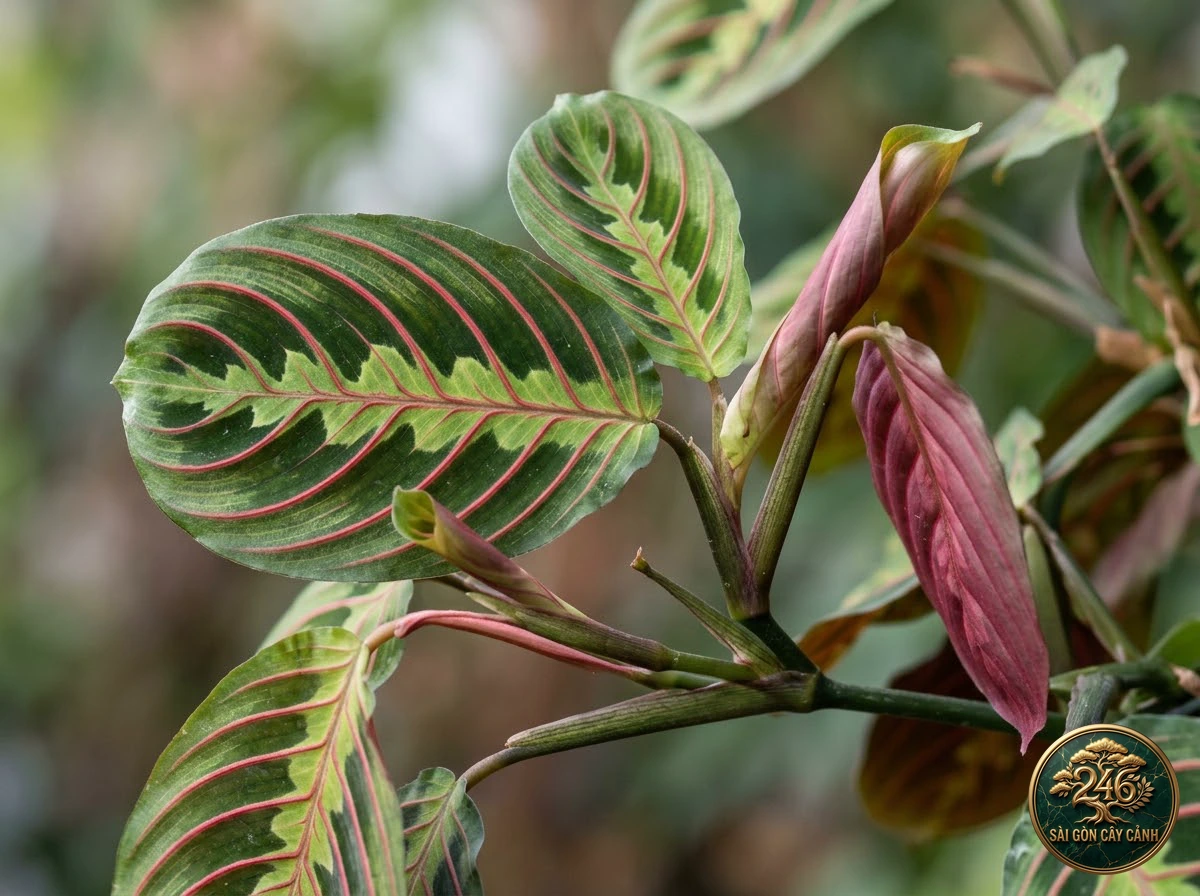
Foliar blades of the Prayer plant exhibit an oval to broadly elliptic outline measuring 12 to 18 cm in length and 8 to 12 cm in width with a soft satin-velvet finish. The defining visual hallmark is its carmine-red herringbone lateral venation arching symmetrically across velvety olive-green patches framed by a chartreuse central band.
The abaxial surface is flushed with a pale wine-purple wash. As blades fold vertically into nocturnal prayer, the specimen displays a warm purple-red silhouette, staging an enchanting visual transformation across domestic interiors.
Fluorescence microscopy of Maranta leuconeura blades demonstrates that the carmine-red herringbone venation is formed by anthocyanin-packed cells encasing vascular bundles, yielding glowing red lines under diffused illumination. Sandwiched between red veins are velvety olive-green patches dense with chloroplasts, producing an exquisite optical chromatic mosaic.
3. Photometric Calibration & Window Exposure Optimization
Inhabiting the deepest floor of tropical forests, Maranta leuconeura prospers under gentle diffused light between 1,200 and 2,500 lux. It performs magnificently on interior workdesks, shelves recessed from windows, or under standard office LED illumination.
Maranta exhibits extreme vulnerability to mineral salt deposition from standard tap water. Supply rested rainwater or reverse-osmosis water to preserve the vibrant luminescent clarity of red herringbone veins against tip dieback.
Photometric assays identify an ideal PPFD between 40 and 90 umol/m2/s for the Prayer plant. Exhibiting remarkable low-light adaptation, it flourishes upon interior workdesks and bookshelves receiving gentle indirect light (1,200 – 2,500 lux) without losing vivid carmine venation contrast.
4. Pulvinus Kinematics & Nyctinastic Diurnal Dynamics
Nyctinastic movement in the Prayer plant is a botanical marvel: as daylight wanes, potassium and water efflux from upper pulvinar motor cells causes blades to pivot upward, joining vertically like hands clasped in sacred prayer.
At daybreak, hydraulic flux reverses, lowering blades horizontally to intercept the first photons of dawn, reconnecting inhabitants with nature’s diurnal cadence.
Optimal temperatures span 20°C to 28°C (68°F – 82°F). The specimen flourishes in comfortable domestic warmth, ceasing growth below 15°C (59°F) and requiring shelter from AC drafts.
Relative humidity should be maintained at 65% to 85%. Placing containers on gravel moisture trays or using ultrasonic room misting preserves supple foliar turgor.
Ideal warmth from 20°C to 28°C (68°F – 82°F) paired with 65% to 85% relative humidity keeps velvety blades supple. Positioning pots on gravel humidity trays or inside terrarium biospheres ensures lush year-round development.
The prayer dance (nyctinasty) of Maranta leuconeura is a biomechanical wonder: at dusk, potassium and water fluxes trigger differential pulvinar motor cell turgor, pivoting blades upward until two leaf halves fold vertically together like hands joined in reverent prayer.
5. Porous Aggregate Substrate Engineering & Aeration Dynamics
Potting substrates demand 35% fine pumice (2-5mm), 30% shredded sphagnum moss with mini composted pine bark, 20% desalted coco coir, and 15% perlite, balanced to pH 5.8 to 6.5.
This aerated aggregate retains capillary moisture, safeguarding small starchy root tubers against desiccation without causing hypoxia.
An airy potting aggregate blending 35% fine pumice (2-5mm), 30% shredded sphagnum moss, and mini composted bark establishes ideal capillary moisture for small carbohydrate-storing root tubers, preventing both desiccation and anaerobic tuber decay.
6. Organic Nutrition Schedules & Periodic Micronutrient Priming
Apply diluted liquid organic bio-fertilizer (one-quarter standard strength) every 3 to 4 weeks during spring and summer to fuel vivid carmine-red venation.
Avoid concentrated chemical fertilizers that scorch delicate root hairs. Flush containers thoroughly with pure water bi-monthly to eliminate residual mineral salts.
Apply diluted liquid organic bio-fertilizer (one-quarter rate) every 3 to 4 weeks during spring and summer to accelerate apical bud division and fuel vibrant carmine-red venation.
7. Clinical Diagnostic Matrix & Rapid Correction Protocols
| Clinical Symptom | Primary Etiology | Diagnostic Evaluation | Corrective Prescription |
|---|---|---|---|
| Crisp brown leaf margins and inward blade curling | Ambient relative humidity dropped below 50% or chlorine toxicity | Monitor room hygrometer and evaluate irrigation water purity | Run ultrasonic humidifier above 65% and switch to pure dechlorinated water |
| Fading of brilliant carmine-red herringbone venation | Protracted light deficit below 700 lux or excessive nitrogen | Measure ambient lux at foliage level with light meter | Relocate to bright filtered daylight (1,500+ lux) and apply chelated feed |
| Sudden drooping of creeping stems and loss of nyctinasty | Severe root zone dehydration or anaerobic root rot decay | Probe substrate core moisture and evaluate root health | Bottom-water if desiccated; prune decayed roots and repot if soggy |
| Minute yellow punctate spots and fine webbing underneath | Tetranychid spider mites colonizing warm, arid environments | Inspect abaxial midrib surfaces with magnification loupe | Shower foliage gently with lukewarm water and treat with neem spray |
8. Cryptic Pest Prophylaxis & Foliar Surface Sanitation
The low-spreading decumbent habit of Maranta leuconeura keeps foliage near potting soil, rendering it attractive to sciarid fungus gnats. Top-dress the container with a 1 cm layer of coarse pumice grit to disrupt fly egg-laying cycles.
Dust blades with damp microfiber towels bi-weekly to ensure open stomatal pores and optimize photosynthetic efficiency.
Dust blades with damp microfiber towels bi-weekly to ensure open stomatal pores, optimize photosynthetic efficiency, and deter cryptic spider mites.
9. Asexual Propagation Methodology & Root Strike Protocols
Unlike Goeppertia, Maranta leuconeura propagates effortlessly via stem cuttings. Sever stem sections bearing 2 to 3 nodes just below a swollen joint.
Place cuttings into pure water or moist perlite; fresh white adventitious roots emerge vigorously from nodes within 10 to 14 days under warm filtered light.
Propagate effortlessly via stem node cuttings bearing 2 to 3 leaf joints in pure water or moist perlite. Fresh white adventitious roots emerge vigorously from nodes within 10 to 14 days under warm filtered light.
10. Companion Animal Safety Profile & ASPCA Non-Toxic Verification
Maranta leuconeura is verified 100% non-toxic to dogs and cats by ASPCA guidelines. Completely benign, making it an unreservedly safe selection for trailing hanging planters in pet homes.
11. Biophilic Curation & Contemporary Interior Design Styling
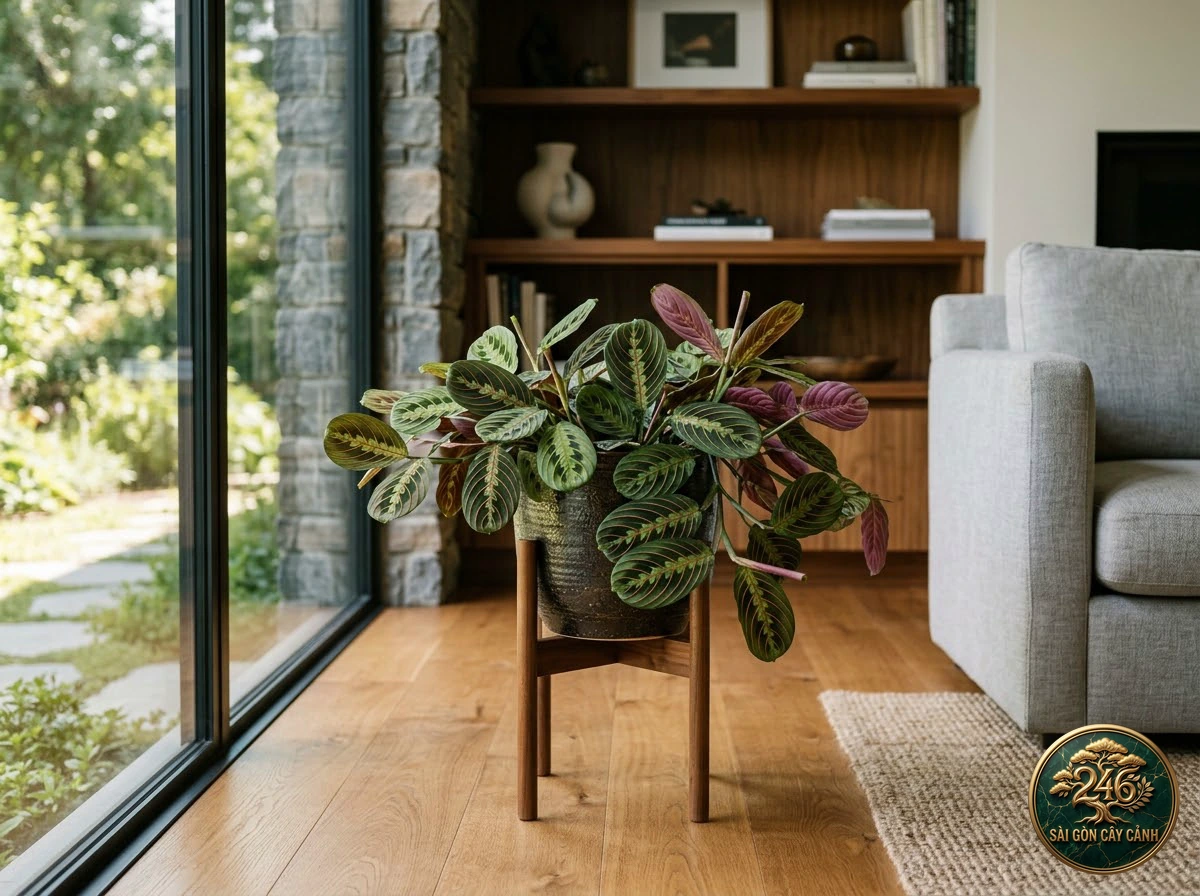
With creeping graceful habit, brilliant carmine venation, and sacred prayer choreography, the Prayer plant is an exquisite accent for desks, hanging baskets, and terrarium biospheres.
Its serene beauty and positive symbolism cultivate an atmosphere of mindful tranquility, gratitude, and replenishing energy within domestic living spaces.
With creeping graceful habit, brilliant carmine venation, and sacred prayer choreography, the Prayer plant is an exquisite accent for desks, hanging baskets, and terrarium biospheres.
12. Master Principles for Sustainable Indoor Acclimatization
To cultivate a thriving specimen of Maranta leuconeura and maintain vibrant red venation with dynamic daily prayer movements, growers should follow three golden rules:
- Hydration axiom: Irrigate with purified water when upper topsoil dries slightly; delicate shallow rhizomes require balanced moisture but perish quickly in waterlogged soil.
- Illumination axiom: Deliver gentle filtered illumination spanning 800 to 1,400 lux; exceptionally well-suited for hanging baskets or shelf displays away from direct sun.
- Maintenance axiom: Prune sprawling horizontal stems lightly in spring to stimulate bushier multi-branch basal shoots and maintain dense foliage mounds.
13. Frequently Asked Questions Regarding Prayer plant (FAQs)
How does water quality influence the nyctinastic prayer motion of Maranta?
Soft, chlorine-free room-temperature water enables motor cells in the pulvinus to maintain optimal ion-exchange kinematics. Harsh treated municipal tap water degrades pulvinar responsiveness and scorches luminous red herringbone veins.
Why is it famously called the Prayer Plant?
Due to the specialized pulvinus swelling at petiole bases, leaves spread horizontally by day and fold vertically at night like praying hands.
Is Maranta leuconeura toxic to companion pets?
Completely non-toxic. The ASPCA categorizes Maranta as 100% pet-friendly, presenting zero danger to cats and dogs.
Where is the premier display location indoors?
Suspended in hanging planters near curtained windows or positioned upon desks and bookshelves bathed in gentle ambient light.
What is the simplest propagation method for prayer plants?
Stem cuttings taken just below a nodal joint root readily in clean water or moist sphagnum within a few weeks.
Is the Prayer plant easy to propagate via cuttings?
Extremely easy. Simply snip a stem section bearing 2 to 3 leaf nodes and place it in pure water; vigorous roots emerge within 10 to 14 days.