
Living plant profile
Propeller plant (Crassula falcata)
Crassula falcata
Comprehensive botanical monograph on the Propeller plant (Crassula falcata): aerodynamic twisted falcate foliar symmetry, scarlet floral corymbs, and CAM physiology.
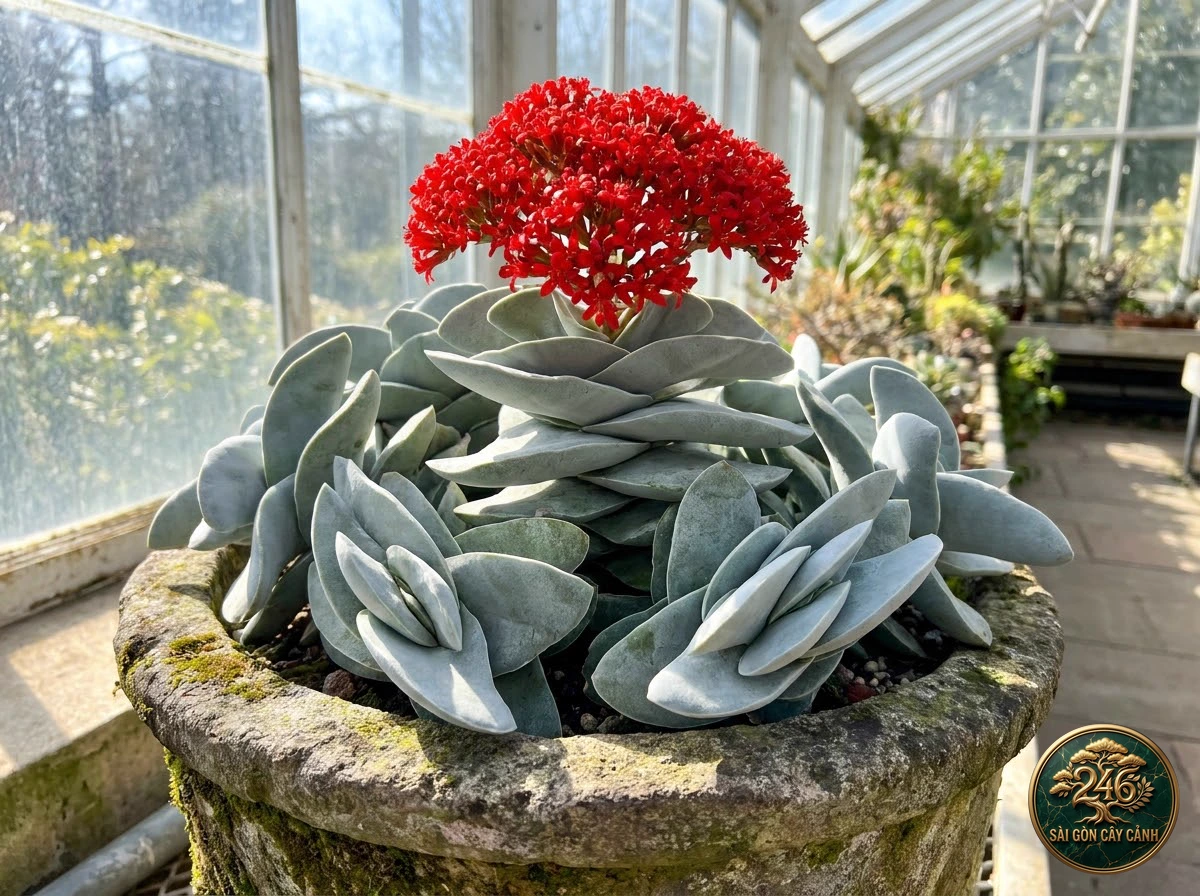
Propeller Plant (Crassula falcata)
The Propeller plant (botanical binomial: Crassula falcata H.Wendl., universally recognized under the taxonomic combination Crassula perfoliata var. minor (Haw.) Rowley) stands as one of the most structurally commanding and visually spectacular flowering succulents within the stonecrop family (Crassulaceae). Famously celebrated across global horticulture as the airplane plant or scarlet paintbrush crassula, this architectural perennial captivates observers with its uncanny aerodynamic symmetry. Its massive, sickle-shaped (falcate) leaves twist vertically in opposite pairs like the dual blades of an aircraft propeller, cloaked in a velvety glaucous-gray sheen of microscopic papillae.
Indigenous to the arid sandstone scrublands and rocky gorges of South Africa’s Eastern Cape, this xerophytic marvel was formally published in 1798 by Johann Christoph Wendland. In addition to its year-round sculptural foliage, the species achieves peak ornamental grandeur in midsummer by elevating colossal, flat-topped corymbose flower heads ablaze in brilliant scarlet-red florets that exhale a rich, honey-sweet perfume. In modern interior architecture and xeriscape landscaping, it serves as a triumphant focal point, symbolizing dynamic flight, bold vitality, and enduring botanical distinction.
Sài Gòn Cây Cảnh Care Compass
1. Comprehensive Botanical Taxonomy & Key Specifications
To establish an empirical baseline for botanical researchers and landscape architects, Saigon Cay Canh provides the definitive scientific metrics below:
| Taxonomic Descriptor / Biological Parameter | Empirical Botanical Metric & Cultural Value |
|---|---|
| Valid Botanical Binomial | Crassula falcata H.Wendl. (Botanische Beobachtungen 44, 1798) |
| Widely Accepted Homotypic Synonym | Crassula perfoliata var. minor (Haw.) Rowley |
| Standard International Common Names | Propeller plant, Airplane plant, Scarlet paintbrush crassula |
| Taxonomic Rank (Family / Genus) | Crassulaceae (Stonecrop family) / Genus Crassula |
| Native Geographical Provenance | Sandstone cliffs, scrublands, and dry valleys of Eastern Cape, South Africa |
| Growth Habit & Stature | Erect, stout-stemmed succulent subshrub, unbranched to sparsely clumping, 30-60 cm |
| Foliar Structure & Symmetry | Falcate (sickle-shaped), vertically twisted opposite pairs, velvety glaucous-gray |
| Floral Morphology & Inflorescence | Dense, flat-topped terminal corymb (10-20 cm broad), brilliant scarlet-red, fragrant |
| Photosynthetic Flux Density Need | Direct morning sun 5-6 hours daily or intense bright light (4,500 – 9,000 lux) |
| Companion Animal Safety Status | Certified non-toxic to domestic canines, felines, and avian companions (ASPCA certified) |
Standing up to 60 cm in height with substantial sickle leaves reaching 15-20 cm in length, this species represents one of the largest and most dramatic members of the genus. In our nursery conservatory, each specimen is cultivated under intense morning sun to stimulate massive terminal floral heads.
2. Morphological Diagnostic Keys & Foliar Anatomy
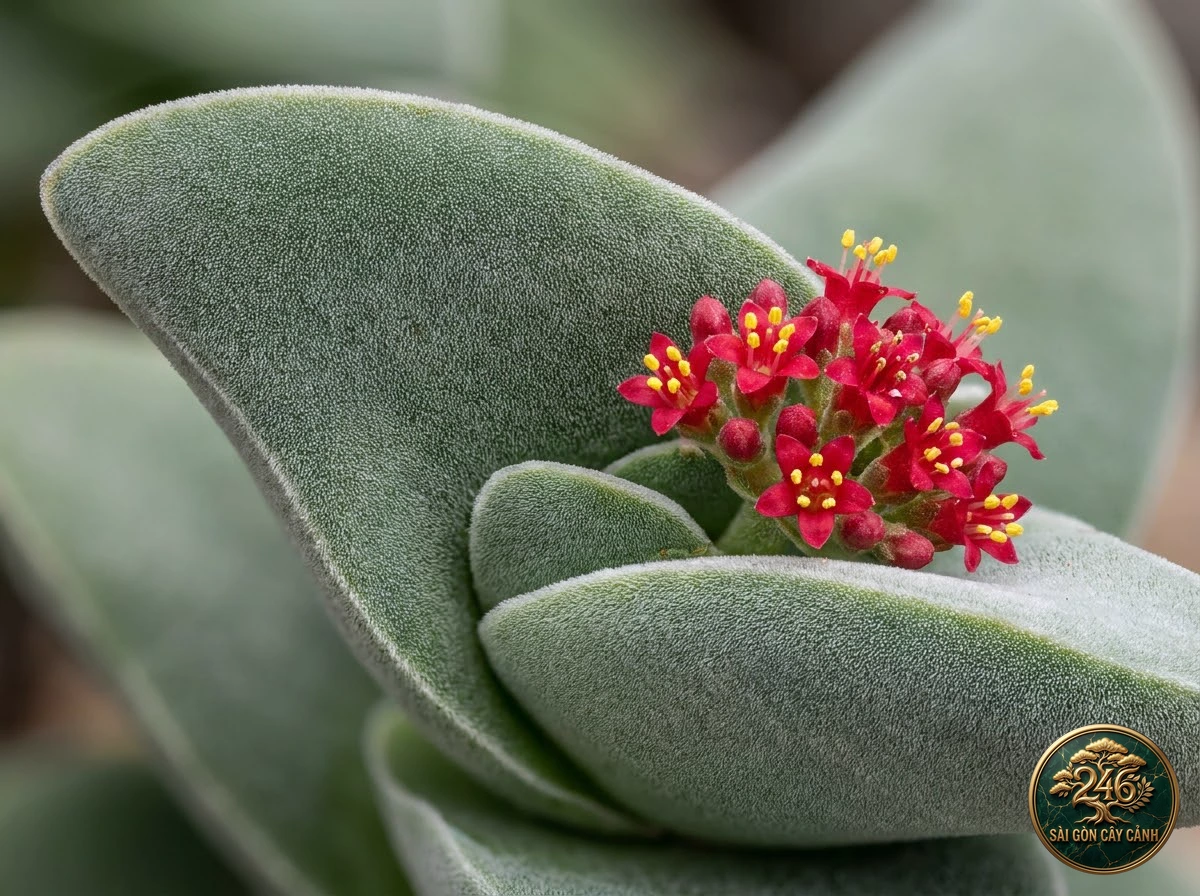
An anatomical dissection of this stonecrop highlights an array of specialized morphological adaptations engineered to survive intense solar desiccation:
Aerodynamic Falcate Foliage: The leaves are thick, succulent, falcate (sickle-shaped), measuring 10 cm to 20 cm in length and 3 cm to 5 cm in basal width. Clasping opposite pairs meet at the central stem, but each leaf blade twists 90 degrees along its longitudinal axis so that its sharp edges face upward and downward rather than horizontally. This vertical orientation minimizes direct exposure to searing overhead midday solar radiation, drastically lowering leaf surface temperatures during the hottest hours of the day.
Microscopic Papillae & Glaucous Sheen: The entire foliar epidermis is covered in dense microscopic epidermal papillae. This velvety coat imparts a chalky glaucous-gray coloration that scatters intense ultraviolet wavelengths while capturing ambient coastal mists and guiding condensed water droplets toward the root zone.
Stout Stems & Fibrous Xylem: The erect, unbranched stem reaches 1.5 cm to 3 cm in diameter, fortified with tough internal fibrous xylem tissues that support the substantial weight of water-filled leaves and massive summer flower heads.
Colossal Scarlet Corymbose Inflorescence: In midsummer, the apical meristem terminates in a stout peduncle bearing a massive, flat-topped corymb measuring 10 cm to 20 cm across. The dense cluster comprises hundreds of minute, tubular florets in dazzling scarlet red accented by bright yellow pollen-bearing anthers. Exuding an intoxicating cinnamon-honey fragrance, the inflorescence attracts sunbirds and butterflies across its native habitat.
3. Botanical Taxonomy & Nomenclatural History
The botanical cataloging of this plant represents an important contribution by Johann Christoph Wendland. Published in 1798 in Botanische Beobachtungen, the specific epithet falcata derives from Latin for “sickle-shaped”, directly describing the curved aerodynamic foliar blades.
In 1978, British succulent authority Gordon Rowley treated the taxon as a variety of Linnaeus’s earlier Crassula perfoliata, creating the combination Crassula perfoliata var. minor. Nonetheless, both names remain widely utilized across international taxonomic literature, with Crassula falcata prevailing in horticultural commerce due to its unambiguous identity.
Under the APG IV system, the species is placed in family Crassulaceae, order Saxifragales. Evolutionary biologists consider its upright stature and ornithophilous scarlet floral head an advanced adaptation for vertebrate pollination within semi-arid succulent scrublands.
4. Native Ecology & Crassulacean Acid Metabolism (CAM)
Wild populations inhabit the arid sandstone scrublands, dry river gorges, and quartzite ridges of South Africa’s Eastern Cape. In this habitat, annual precipitation ranges from 300 mm to 500 mm, falling unpredictably between intense dry spells on thin, rocky soils.
To endure sustained drought, the plant relies upon Crassulacean Acid Metabolism (CAM). Foliar stomata remain sealed during hot daylight hours, completely preventing moisture loss from internal hydrenchyma storage tissues.
At night, stomata open to harvest atmospheric CO2. The enzyme PEPC fixes carbon into malic acid, safely stored inside central cellular vacuoles overnight. Daylight triggers internal decarboxylation, feeding RuBisCO for carbohydrate synthesis via the Calvin cycle without requiring daytime gas exchange. Combined with vertical leaf orientation and light-scattering papillae, this nocturnal physiology optimizes water-use efficiency, ensuring resilience across barren terrain.
5. Photosynthetic Irradiance & Floral Induction Management
Light intensity is the critical cultural driver governing both foliar thickness and scarlet flower formation. To maintain rigid, glaucous-gray propeller blades and trigger summer flowering, the plant requires abundant luminous flux ranging from 4,500 to 9,000 lux.
Position specimens along eastern, southeastern, or southern exposures receiving 5 to 6 hours of direct morning sunlight daily. Morning sun supplies full-spectrum photons necessary for robust photosynthesis without generating destructive infrared heat loads.
When grown in low-light environments receiving under 2,500 lux, leaves become thin, limp, and dark green, while flower initiation fails completely. In sun-deprived urban interiors, install full-spectrum horticultural LED fixtures for 8 to 10 hours daily to sustain plant vigor.
6. Hydraulic Dynamics & The Soak-and-Dry Protocol
Given its thick, water-retentive leaves and specialized CAM physiology, the propeller plant is exceptionally drought-hardy. However, standing moisture around the root zone causes rapid root rot.
Adhere strictly to the soak-and-dry irrigation methodology. Apply water only after the potting substrate has remained completely dry for several days. Verify dryness by inserting an unpainted wooden skewer to the bottom of the container; water only when the skewer emerges bone-dry.
Bottom-watering is the superior technique: submerge the lower container in shallow water for 15 minutes, allowing capillary absorption to hydrate the roots while keeping the dense foliage completely dry. Avoid overhead sprinkling, as trapped water droplets within leaf crevices foster bacterial soft rot.
7. Granular Mineral Substrate Formulation & Aerobic Porosity
In wild habitats, root networks anchor within porous sandstone crevices where storm runoff percolates instantly through macroscopic voids. Replicating this high-drainage environment in container culture is essential to prevent root asphyxiation.
The custom mineral substrate engineered at Saigon Cay Canh for propeller plants utilizes a 65:35 inorganic-to-organic ratio: 35% porous volcanic pumice (grain size 3 to 6 mm), 15% calcined clay granules (akadama), and 15% crushed red volcanic scoria, blended harmoniously with 20% aged washed coco coir fibers and 15% microbially active earthworm humus. This ultra-gritty profile maintains abundant capillary macro-pores, ensuring rapid gravitational percolation while sustaining an optimum rootzone pH of 6.2 to 6.8.
High rhizosphere oxygen suppresses anaerobic water-mold pathogens like Pythium. The balanced cation-exchange capacity facilitates steady intake of phosphorus and potassium, fueling dense floral buds and intense scarlet pigmentation across terminal blooms.
8. Thermal Tolerances, Ambient Humidity & Airflow Dynamics
Thermal limits for the propeller plant span from 18°C up to 34°C for active vegetative vigor. While mature specimens withstand brief temperature dips to 5°C, sustaining vitality requires bone-dry roots during chilly periods. Cold moisture causes severe cellular collapse across the heavy water-storing falcate foliage, culminating in irreversible basal softening.
Target ambient relative humidity between 35% and 60% within well-ventilated quarters. Continuous gentle airflow serves a dual physiological function: it dissipates localized heat pockets around massive fleshy propeller blades under midday solar exposure and replenishes ambient carbon dioxide essential for nocturnally active Crassulacean acid metabolism.
9. Clinical Diagnostics & Plant Pathology Matrix
Use this verified clinical diagnostic matrix to identify and remediate cultural disorders in the propeller plant:
| Observable Clinical Symptom | Underlying Pathology & Etiology | Curative Horticultural Protocol |
|---|---|---|
| Stem base turns black and water-soaked; lower sickle leaves detach freely | Substrate hyper-saturation causing root hypoxia and secondary soft rot bacterial infection | Halt watering immediately; sever the firm upper green tip to root as a cutting; discard rotten base and replant in dry pumice grit |
| Stems elongate with wide internodal gaps; leaves lose glaucous-gray sheen and turn dark green | Insufficient natural sunlight disrupting normal CAM carbon fixation and causing etiolation | Relocate container to receive 5-6 hours of direct morning sunshine daily; acclimate gradually over one week |
| Sickle-shaped leaves appear wrinkled, limp, and deflated while maintaining gray color | Prolonged moisture deficit depleting internal water reserves within hydrenchyma storage cells | Submerge the nursery container in ambient rainwater for 15 to 20 minutes to saturate the dehydrated root ball thoroughly; turgor pressure across sickle blades will fully recover within forty-eight hours |
| Flower head turns black and moldy; unopened flower buds abort and drop prematurely | Water droplets trapped on flower head during overhead watering in poorly ventilated conditions | Prune away damaged flower stalk with clean shears; keep plant in breezy, well-ventilated location and water only at the soil line |
Observing the firm turgidity and glaucous sheen of apical leaf pairs offers a reliable measure of overall plant health.
10. Biological Pest Management & Sanitation
Protected by its thick waxy cuticle and velvety papillae, the propeller plant is resilient against larger chewing pests. However, citrus mealybugs (Planococcus citri) may occasionally lodge within the tight crevices where paired leaves clasp the central stem.
For targeted eradication, apply medicinal 70% ethyl or isopropyl alcohol directly to individual mealybug clusters using a fine cotton bud. The alcohol emulsifies their protective filamentous wax shield instantaneously upon contact, eradicating insects without scorching the glaucous epidermal bloom.
Nursery health maintenance involves keeping the soil surface free of fallen dried leaves and administering a gentle monthly evening mist of cold-pressed organic neem oil emulsion to repel sap-sucking pests.
11. Specialized Asexual Propagation Protocols

The propeller plant roots readily from vegetative stem tip cuttings and individual sickle leaves, producing adventitious roots from dormant nodal meristems.
Propagation Scheduling: Early spring through the onset of the warm dry cycle delivers optimum ambient warmth and daylight length to stimulate rapid callus synthesis and adventitious root emergence along severed propeller stems.
Stem Cutting Procedure:
- Using a sterilized razor blade, sever a healthy stem tip measuring 8 cm to 12 cm possessing 2 to 3 pairs of mature sickle leaves.
- Gently strip the lowest leaf pair to expose about 2 cm of clean stem.
- Allow cuttings to rest in dry, shaded air for 4 to 6 days until cut ends form a protective corky callus.
- Insert the callused base 2 cm deep into fine pumice or clean coarse sand. Avoid heavy watering for the initial week; instead, provide light surface misting around the pot rim. Adventitious roots establish firmly within a short time.
Leaf Propagation: Gently twist a mature sickle leaf from the main stem, ensuring the basal petiole bud remains intact. Rest leaves flat upon dry mineral substrate in diffuse light; tiny plantlets and roots will emerge from the leaf base within several weeks.
12. Companion Animal Safety & ASPCA Certification
Biochemical evaluations confirm that the sap and fleshy parenchyma cells of Crassula falcata lack cardiotoxic glycosides, saponins, or inflammatory diterpene esters. Direct dermal contact with internal fluids during cutting preparation poses zero threat of allergic dermatitis.
Even so, responsible pet owners should elevate potted propeller plants onto sturdy plant pedestals or high credenzas. Ingestion of bulky, fibrous succulent leaves by curious kittens or playful dogs can induce mild gastric irritation and temporary mechanical regurgitation simply due to indigestible plant fiber. Elevating the display simultaneously accentuates the architectural symmetry of the foliage and safeguards both flora and fauna.
13. Biophilic Design & Modern Interior Landscaping
With its striking aerodynamic silhouette and brilliant scarlet floral umbrella, the propeller plant functions as a living botanical sculpture in modern biophilic interior design.
Architectural Planter Pairing: The sculptural silhouette pairs exquisitely with minimalist matte charcoal ceramic planters, raw concrete pots, or unglazed stoneware in warm charcoal and sand tones. The glaucous-gray propeller leaves stand out sharply against neutral backdrops in executive offices, spacious living rooms, and reception galleries.
Xeriscape Landscaping: In modern drought-tolerant rock gardens, a cluster of propeller plants crowned with scarlet flower heads creates an unforgettable focal point against dark lava basalt gravel.
14. Brand Ambassador & Saigon Cay Canh Cultivation Philosophy
At Saigon Cay Canh, plant cultivation is an art form rooted in profound respect for botanical science. Our specialists nurture every propeller plant specimen with meticulous care, acclimating them to Southern Vietnam’s equatorial climate so that each living plant delivers long-lasting beauty and vitality to your living space.

The portrait of our nursery specialist gently grooming sickle leaves with hands dusted in mineral pumice reflects our authentic dedication to living botanical craftsmanship. We believe that cultivating living greenery within urban dwellings is the ultimate restorative practice for the human spirit.
15. Frequently Asked Questions (FAQs)
How old must a propeller plant be before it produces its massive scarlet flower head?
Specimens typically initiate their large terminal inflorescence upon reaching maturity at 2 to 3 years of age, provided they receive 5 to 6 hours of direct morning sun daily. The scarlet flower heads emerge in midsummer and persist in bloom for 4 to 6 weeks.
Why are the sickle leaves losing their velvety glaucous-gray sheen and turning dark green?
Fading of the glaucous bloom indicates insufficient sunlight. Relocate the plant to receive 5 to 6 hours of direct morning sunshine daily; the epidermal papillae will quickly re-establish their silvery sheen.
Should I remove the flower stalk after blossoms fade?
Yes, pruning away the spent floral stem close to the upper foliage conserves plant energy and encourages dormant axillary buds near the base to produce vigorous new offsets.
How do I prevent basal stem rot in propeller plants?
Use pots with generous drainage holes, plant in gritty pumice mineral substrate, and always water at the soil line or via bottom soaking rather than pouring water directly into leaf axils.