
Living plant profile
Rosary vine crassula (Crassula rupestris)
Crassula rupestris
Comprehensive botanical monograph on the Rosary vine crassula (Crassula rupestris): connate-perfoliate beaded morphology, CAM physiology, and coral margin enhancement.
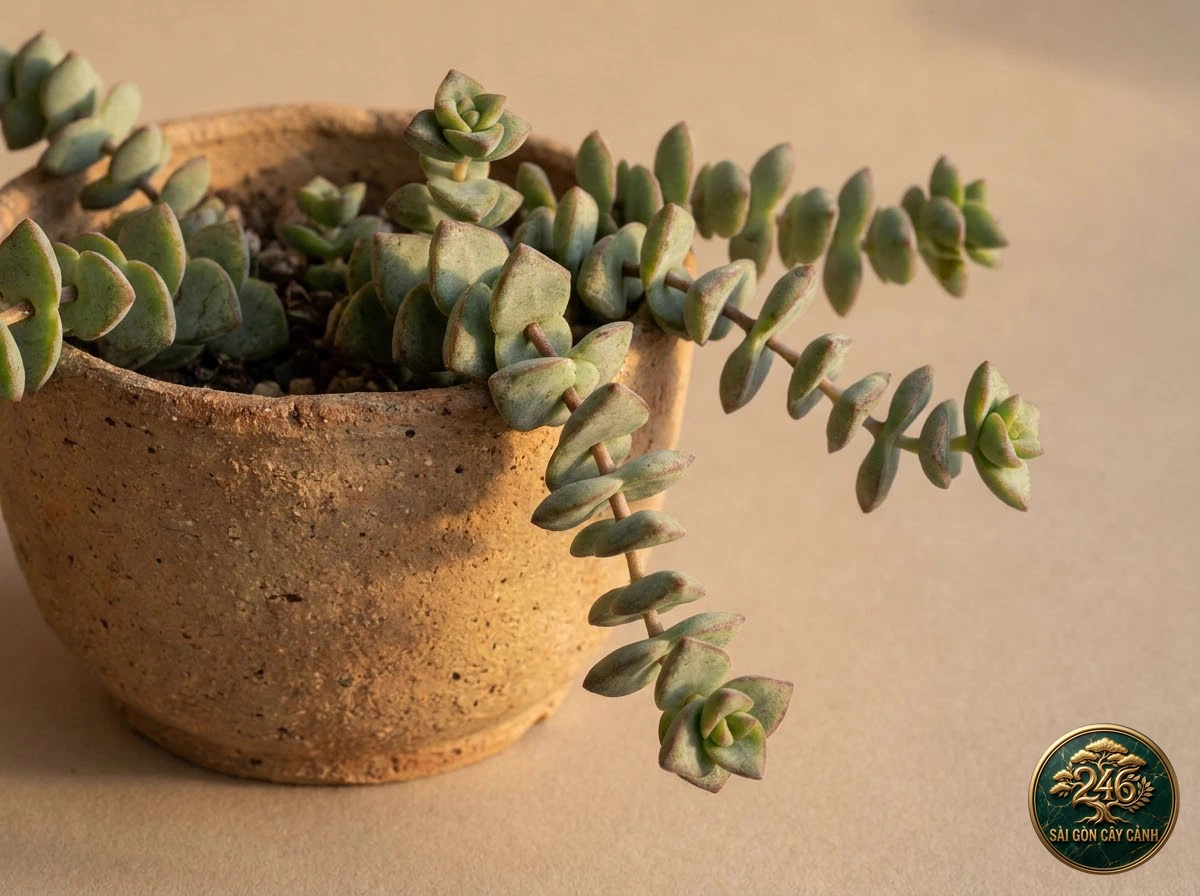
Rosary Vine Crassula (Crassula rupestris)
The Rosary vine crassula (botanical binomial: Crassula rupestris L.f.) stands as one of the most structurally intriguing and aesthetically geometric stonecrops within the family Crassulaceae. Famously celebrated across international botanical circles under the common names “Baby’s Necklace”, “Rosary Vine”, or “Kebab Bush”, this architectural perennial enchants plant enthusiasts with its bizarre foliar architecture. Thick, fleshy, glaucous-green paired leaves fuse seamlessly at their bases around central woody stems like carved stone beads strung along a cord, edged in exquisite coral-red margins that glow brilliantly under desert sunshine.
Indigenous to the rugged sandstone crevices and dry rocky gorges of South Africa’s Little Karoo and Western Cape, this lithophytic survivor was formally described in 1782 by Carl Linnaeus the Younger (L.f.). The specific epithet rupestris originates from Latin for “rock-dwelling”, reflecting its steadfast tenacity upon sheer, wind-scoured cliffs. In contemporary biophilic design and modern container landscaping, it serves as an exemplary living sculpture, imparting grounding presence, artistic harmony, and enduring botanical resilience.
Sài Gòn Cây Cảnh Care Compass
1. Comprehensive Botanical Taxonomy & Key Specifications
To establish a precise scientific baseline for botanists and landscape architects, Saigon Cay Canh provides the definitive taxonomic and cultural metrics below:
| Taxonomic Descriptor / Biological Parameter | Empirical Botanical Metric & Cultural Value |
|---|---|
| Valid Botanical Binomial | Crassula rupestris L.f. (Supplementum Plantarum 189, 1782) |
| Standard International Common Names | Rosary vine crassula, Baby’s necklace, Rock crassula, Kebab bush |
| Taxonomic Rank (Family / Genus) | Crassulaceae (Stonecrop family) / Genus Crassula |
| Native Geographic Provenance | Sandstone cliffs and rocky gorges of the Little Karoo, Western Cape, South Africa |
| Growth Habit & Stature | Woody-based succulent shrublet, erect to sprawling decumbent, 20-45 cm tall |
| Foliar Structure & Arrangement | Thick ovate connate-perfoliate leaves fused around stem, glaucous with coral margins |
| Photosynthetic Flux Density Need | Direct morning sun 4-6 hours daily or bright filtered light (4,000 – 8,000 lux) |
| Companion Animal Safety Status | Certified non-toxic to domestic canines, felines, and avian companions (ASPCA certified) |
| Engineered Substrate Composition | 70% coarse mineral aggregate (pumice, perlite, scoria) + 30% washed organic loam |
The species exhibits notable infraspecific diversity, with subspecies marnieriana displaying exceptionally dense, bead-like stacking along compact stems. In our conservatory, each specimen is cultivated under intense morning light to ensure sharp coral-red leaf margins and sturdy internodes.
2. Morphological Diagnostic Keys & Foliar Anatomy
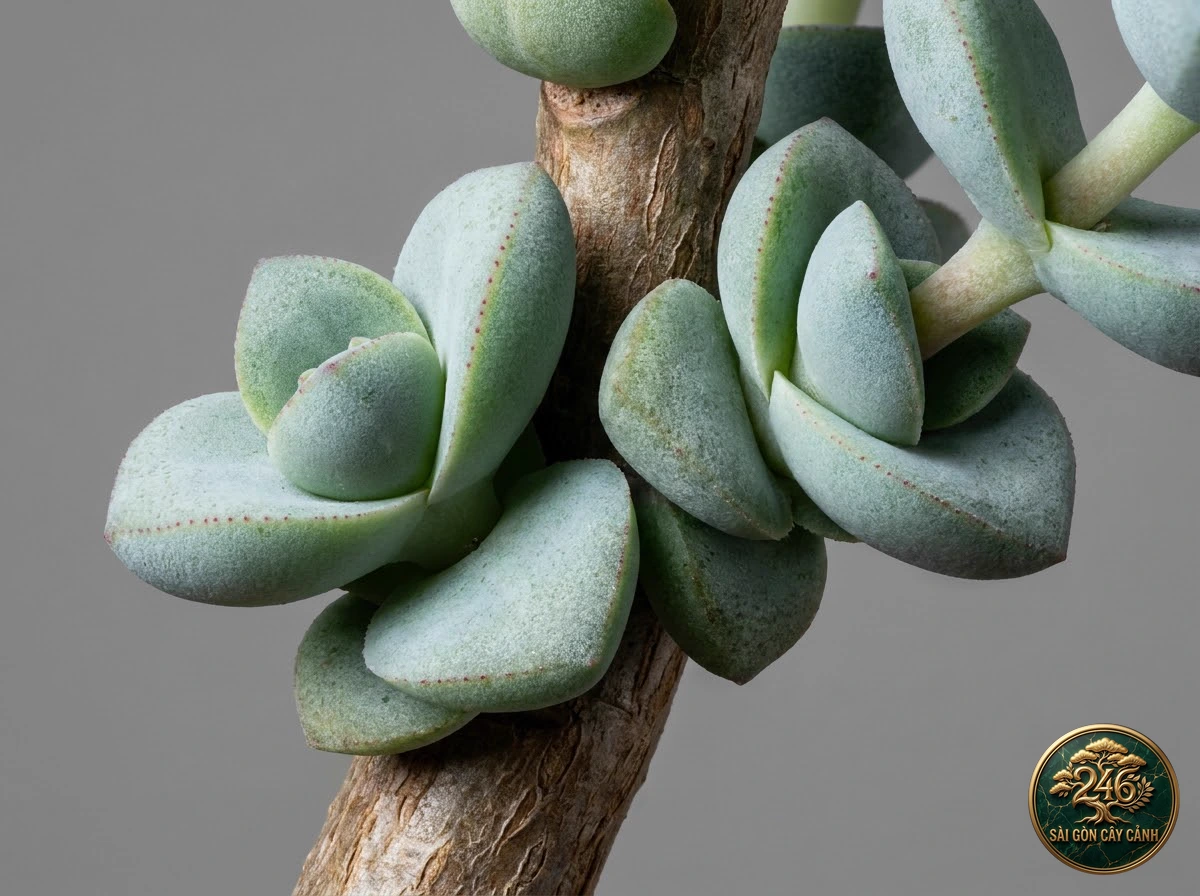
Examining the structural morphology of this stonecrop reveals an extraordinary architectural symmetry combined with specialized xerophytic survival traits:
Connate-Perfoliate Foliar Structure: The defining morphological hallmark of this species is its connate-perfoliate foliar attachment. Opposite pairs of leaves are fused together at their bases, completely encircling the central stem so that the axis appears to pierce through the center of solid fleshy beads. Each leaf blade is broadly ovate to suborbicular, measuring 1 cm to 2.5 cm in length and up to 4 mm to 7 mm in cross-sectional thickness. As successive decussate pairs stack tightly upon the stem, they form a tactile, beaded column evoking an artisanal jade rosary.
Glaucous Wax & Anthocyanin Margins: The epidermis is cloaked in a chalky glaucous wax bloom (epicuticular wax) that scatters intense solar radiation and minimizes non-stomatal cuticular water loss. Under direct solar irradiance, cells along the sharp leaf margins synthesize abundant anthocyanin flavonoids, framing each succulent bead in a vivid ribbon of coral-red or burnished bronze that contrasts beautifully against the cool gray-green dermal background.
Woody Stems & Sprawling Habit: While young branches ascend vertically, mature canes reaching 20 cm to 35 cm in length gracefully arch outward under the substantial weight of hundreds of water-filled leaves. The slender central axis contains tough fibrous xylem tissues that undergo secondary suberization at the base, developing a resilient woody core that anchors the expanding shrublet firmly onto rocky ledges.
Rounded Terminal Inflorescence: In winter or early spring, terminal branches produce short peduncles crowning the beaded stems with dense, hemispherical corymbose cymes. Each cluster bears dozens of minute, star-shaped blossoms with five pointed petals in shades of blush pink or pale ivory, accented by reddish-brown anthers. The flowers exhale a delicate, honey-sweet scent that attracts native desert pollinators.
3. Botanical Taxonomy & Nomenclatural History
The botanical cataloging of this plant represents an important contribution by Carl Linnaeus the Younger. Published in 1782 in Supplementum Plantarum, the specific epithet rupestris pays homage to the rocky clifftop habitats where the species thrives.
Within the APG IV classification framework, the taxon belongs to family Crassulaceae, order Saxifragales. A thorough monographic revision by South African botanist H.R. Toelken in 1977 established three recognized subspecies: subsp. rupestris (the nominate broad-leaved form), subsp. marnieriana (the tightly stacked jade bead form), and subsp. commutata (a more sprawling, loosely arranged variant).
In modern horticulture, the internationally famous hybrid ‘Baby’s Necklace’ (a controlled cross between Crassula rupestris subsp. marnieriana and Crassula perforata) has earned global acclaim for its compact square-beaded stems and rich crimson margins.
4. Native Ecology & Crassulacean Acid Metabolism (CAM)
Wild populations inhabit the semi-arid sandstone cliffs, ravine crevices, and rocky kloofs of the Little Karoo in South Africa’s Western Cape. In this rugged terrain, annual rainfall averages merely 150 mm to 300 mm, falling sporadically amidst blazing midday heat and cool, breezy nights.
To endure prolonged dry seasons, the plant relies upon Crassulacean Acid Metabolism (CAM). Foliar stomata remain sealed during hot daylight hours, completely preventing moisture loss from internal hydrenchyma storage tissues.
At night, lower ambient temperatures trigger stomatal opening, allowing carbon dioxide intake. The enzyme PEPC fixes atmospheric carbon into malic acid, which is safely stored inside central vacuoles until morning. Daylight drives light-dependent reactions, decarboxylating the stored malic acid to fuel the Calvin cycle internally via RuBisCO without requiring daytime gas exchange. Combined with glaucous solar screening, this nocturnal carbon fixation pathway optimizes water efficiency, ensuring survival across barren rock ledges.
5. Photosynthetic Irradiance & Coral Margin Enhancement
Luminous irradiance is the critical cultural driver governing both foliar compactness and coral margin pigmentation. To maintain tightly stacked bead pairs and vivid reddish edges, the plant requires abundant light flux ranging from 4,000 to 8,000 lux.
Position specimens along eastern or southeastern windows or balconies receiving 4 to 6 hours of direct morning sunlight daily. Morning sun supplies optimal UV wavelengths that trigger anthocyanin accumulation along leaf rims without inducing thermal tissue damage.
Avoid unacclimated exposure to scorching midday sun through closed window glass, which can burn the glaucous wax into brown scars. Conversely, deep shade below 2,500 lux causes internodal stretching, loose foliar spacing, and loss of red margins, reverting foliage to plain green. In dark interiors, provide 8 to 10 hours of daily illumination via full-spectrum horticultural LED fixtures.
6. Hydraulic Dynamics & The Soak-and-Dry Protocol
Given its thick, water-retentive bead leaves and specialized CAM physiology, the rosary vine crassula is exceptionally drought-hardy. However, standing water around the root zone causes rapid root rot and foliar drop.
Adhere strictly to the soak-and-dry irrigation methodology. Apply water only after the potting substrate has remained completely dry for two to three days. Verify dryness by inserting an unpainted wooden skewer to the bottom of the container; water only when the skewer emerges bone-dry.
Bottom-watering is the superior technique: submerge the lower container in shallow water for 10 to 15 minutes, allowing capillary absorption to hydrate the roots while keeping the dense beaded foliage completely dry. Avoid overhead sprinkling during warm midday hours, as trapped water droplets within leaf crevices foster bacterial soft rot.
7. Granular Mineral Substrate Formulation & Aerobic Porosity
In wild habitats, root networks anchor within porous sandstone crevices where storm runoff percolates instantly through macroscopic voids. Replicating this high-drainage environment in container culture is essential to prevent root asphyxiation.
The standardized potting formulation perfected by Saigon Cay Canh features 70% coarse inorganic minerals (40% horticultural pumice sized 3-6 mm, 15% expanded perlite, 15% crushed red scoria) blended with 30% sterile organic matter (20% triple-rinsed coco coir fiber and 10% sieved organic vermicompost).
This open aggregate structure allows irrigation water to drain through bottom holes in moments, while maintaining rich oxygen tension throughout the root zone. High rhizosphere oxygen suppresses anaerobic water-mold pathogens like Pythium. Maintain substrate pH between 6.2 and 6.8 to support efficient uptake of phosphorus and potassium, promoting firm foliar tissue and anthocyanin synthesis.
8. Thermal Tolerances, Ambient Humidity & Airflow Dynamics
The species prospers within a thermal range of 16°C to 30°C, showing vigorous growth during spring and autumn. Diurnal temperature swings (warm days near 26°C paired with cool nights near 17°C) stimulate anthocyanin synthesis, enriching the coral-red leaf margins.
Cold tolerance extends down to approximately 5°C, provided the potting medium is kept thoroughly dry. Sub-zero temperatures combined with wet substrate cause aqueous parenchyma cells to rupture, resulting in irreversible stem collapse.
Maintain relative humidity between 35% and 60%. Provide consistent, buoyant airflow: gentle air circulation dries moisture droplets, prevents foliar heat buildup during sunny afternoons, and supplies fresh ambient CO2 for nighttime CAM carbon capture.
9. Clinical Diagnostics & Plant Pathology Matrix
Use this verified clinical diagnostic matrix to identify and remediate cultural disorders in the rosary vine crassula:
| Observable Clinical Symptom | Underlying Pathology & Etiology | Curative Horticultural Protocol |
|---|---|---|
| Basal beaded leaves turn soft, yellow, and translucent; stem base darkens | Over-irrigation in heavy soil causing root rot and opportunistic bacterial infection | Halt watering immediately; snip healthy green top branches to propagate; discard rotten base and replant in dry pumice grit |
| Stems elongate with wide internodal gaps; leaves lose coral margins and turn pale | Insufficient natural sunlight causing etiolation and loss of anthocyanin pigments | Prune back elongated canes to stimulate compact basal branching; relocate to receive 4-5 hours of direct morning sun daily |
| Bead-like leaves appear wrinkled and deflated while maintaining gray-green color | Prolonged moisture deficit depleting internal water reserves within hydrenchyma | Administer a 15-minute bottom soak in room-temperature water; foliage will regain firm turgidity within one to two days |
| Fine spider webs appear across leaf axils accompanied by stippled leaf surfaces | Spider mite (Tetranychidae) infestation proliferating in hot, dry, stagnant air | Rinse stems gently with water spray; apply an emulsified cold-pressed organic neem oil spray during evening hours every two weeks |
Observing the firm turgidity and distinct red edge of apical leaf pairs offers a reliable measure of overall plant health.
10. Biological Pest Management & Sanitation
Protected by its thick waxy cuticle, the rosary vine crassula is naturally resilient against common chewing pests. However, under dry, sheltered indoor settings, citrus mealybugs (Planococcus citri) may occasionally lodge within the tight crevices where paired leaves encircle the stem.
When spotted, dab individual pests using a cotton swab dipped in 70% isopropyl alcohol. The alcohol dissolves their protective waxy coating instantly without damaging succulent tissue.
Maintain clean sanitation by regularly clearing dried leaves from the interior base of the container. A monthly prophylactic spray of cold-pressed organic neem oil emulsion during evening hours provides dependable biological defense against sap-sucking pests.
11. Specialized Asexual Propagation Protocols
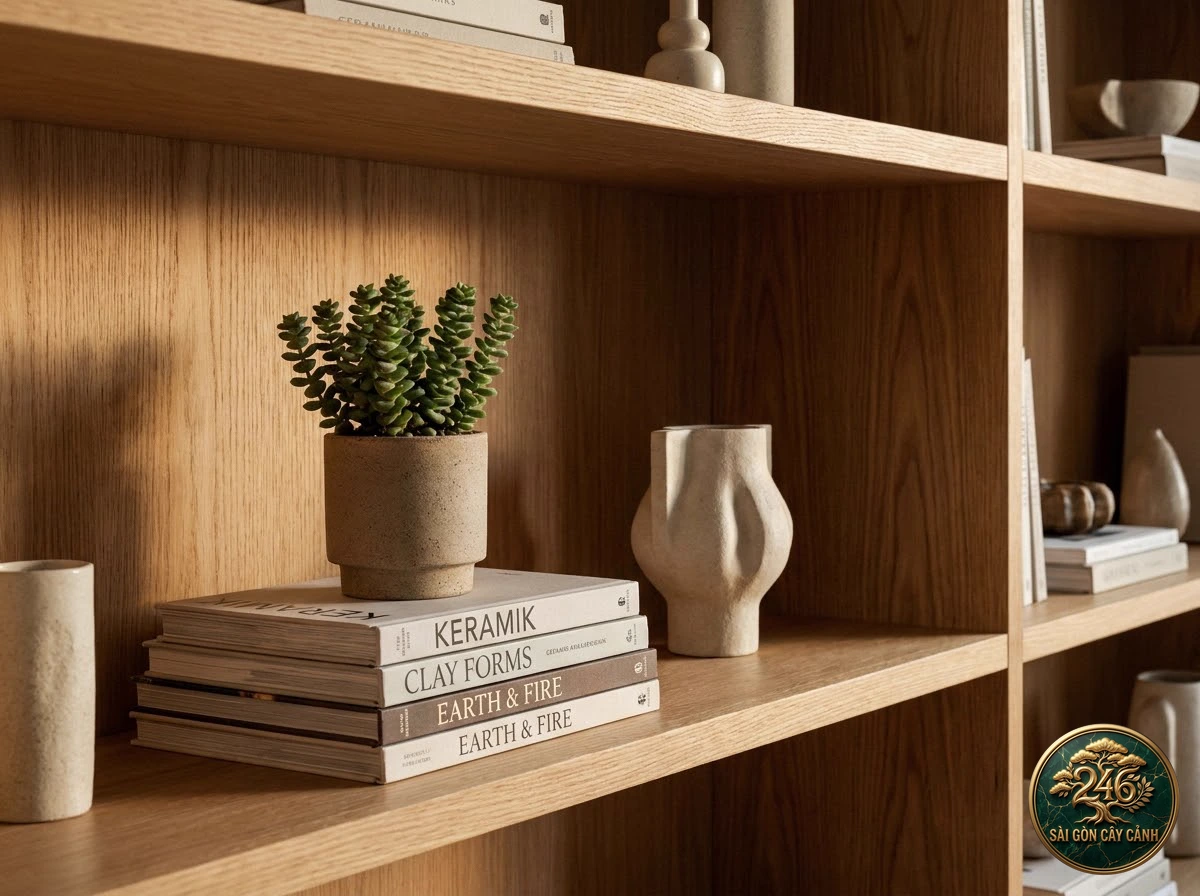
The rosary vine crassula roots readily from vegetative stem tip cuttings, producing adventitious roots from dormant nodal meristems.
Seasonal Timing: Early spring or the start of the dry tropical season provides optimal warmth and active meristematic division for swift rooting.
Stem Cutting Procedure:
- Using clean bypass shears sanitized with 70% isopropyl alcohol, snip a healthy stem tip measuring 6 cm to 10 cm possessing 4 to 6 tiers of bead leaves.
- Gently strip the lowest 1 to 2 leaf pairs to expose about 1.5 cm of clean stem.
- Allow cuttings to rest in dry, shaded air for 3 to 5 days until cut ends form a protective corky callus.
- Insert the callused base into a pot filled with fine pumice or clean coarse sand. Avoid heavy watering for the initial week; instead, provide light surface misting around the pot rim. Adventitious roots establish firmly within a short time.
12. Companion Animal Safety & ASPCA Certification
The botanical tissues contain no dangerous cardiac glycosides, neurotoxins, or caustic sap compounds. It is completely safe for household handling and causes no dermatological irritation during routine grooming.
Nonetheless, pet owners should practice sensible placement. Domestic carnivores cannot digest large quantities of dense, fibrous succulent foliage. Consuming foliage out of curiosity can cause mild mechanical stomach upset accompanied by self-limiting regurgitation. Elevating prized specimens upon stable plant stands or high shelves preserves specimen symmetry while maintaining a harmonious environment for four-legged companions.
13. Biophilic Design & Modern Interior Landscaping
With its architectural bead-like stems and refined coral margins, the rosary vine crassula functions as a living botanical sculpture in modern biophilic interior design.
Artisanal Ceramic Pairing: The rustic desert silhouette pairs exquisitely with minimalist matte white ceramic planters, raw concrete pots, or unglazed terracotta containers in warm charcoal and sand tones. The glaucous-green beaded canes stand out sharply against neutral backdrops on desks, open shelving, and architectural niches.
Mixed Succulent Bowls & Rockeries: Displaying both an erect and sprawling habit as branches lengthen, the species serves as a wonderful textural component in mixed succulent bowl arrangements. It provides upright height alongside rosette-forming Echeveria, while cascading gracefully over container edges.
14. Brand Ambassador & Saigon Cay Canh Cultivation Philosophy
At Saigon Cay Canh, plant cultivation is an art form rooted in profound respect for botanical science. Our specialists nurture every rosary vine specimen with meticulous care, acclimating them to Southern Vietnam’s equatorial climate so that each living plant delivers long-lasting beauty and vitality to your living space.

The portrait of our nursery specialist gently grooming beaded stems with hands dusted in mineral pumice reflects our authentic dedication to living botanical craftsmanship. We believe that cultivating living greenery within urban dwellings is the ultimate restorative practice for the human spirit.
15. Frequently Asked Questions (FAQs)
Why are the beaded leaves on my plant spreading far apart along the stem?
Internodal stretching is a clear symptom of insufficient natural light. In low-light settings, stems elongate rapidly to seek photons. Move the container to receive 4 to 5 hours of direct morning sunshine daily and maintain soak-and-dry watering to encourage compact, tightly stacked bead foliage.
Should I prune the stems when they grow too long and heavy?
Yes, periodic pruning is beneficial. Trimming overly long branches stimulates dormant axillary buds near the base, producing bushier lateral branching. The pruned stem tips can be easily rooted into fresh containers.
How do I maintain the coral-red leaf margins year-round?
To preserve vivid coral-red margins, provide 4 to 6 hours of direct morning sun daily combined with good air circulation and moderate watering. Morning sun stimulates anthocyanin pigment synthesis along the leaf edges.
When should I repot the rosary vine crassula?
Repot every 1.5 to 2 years during early spring when roots fill the pot or mineral media begins to break down. Upgrade to a pot one size larger and refresh with well-draining volcanic pumice mix.