
Living plant profile
Rubber fig
Ficus elastica
Comprehensive botanical dossier for Rubber fig (Ficus elastica). Identification, lighting calibration, porous substrate formulation, and cultivation guide by Saigon Cay Canh.
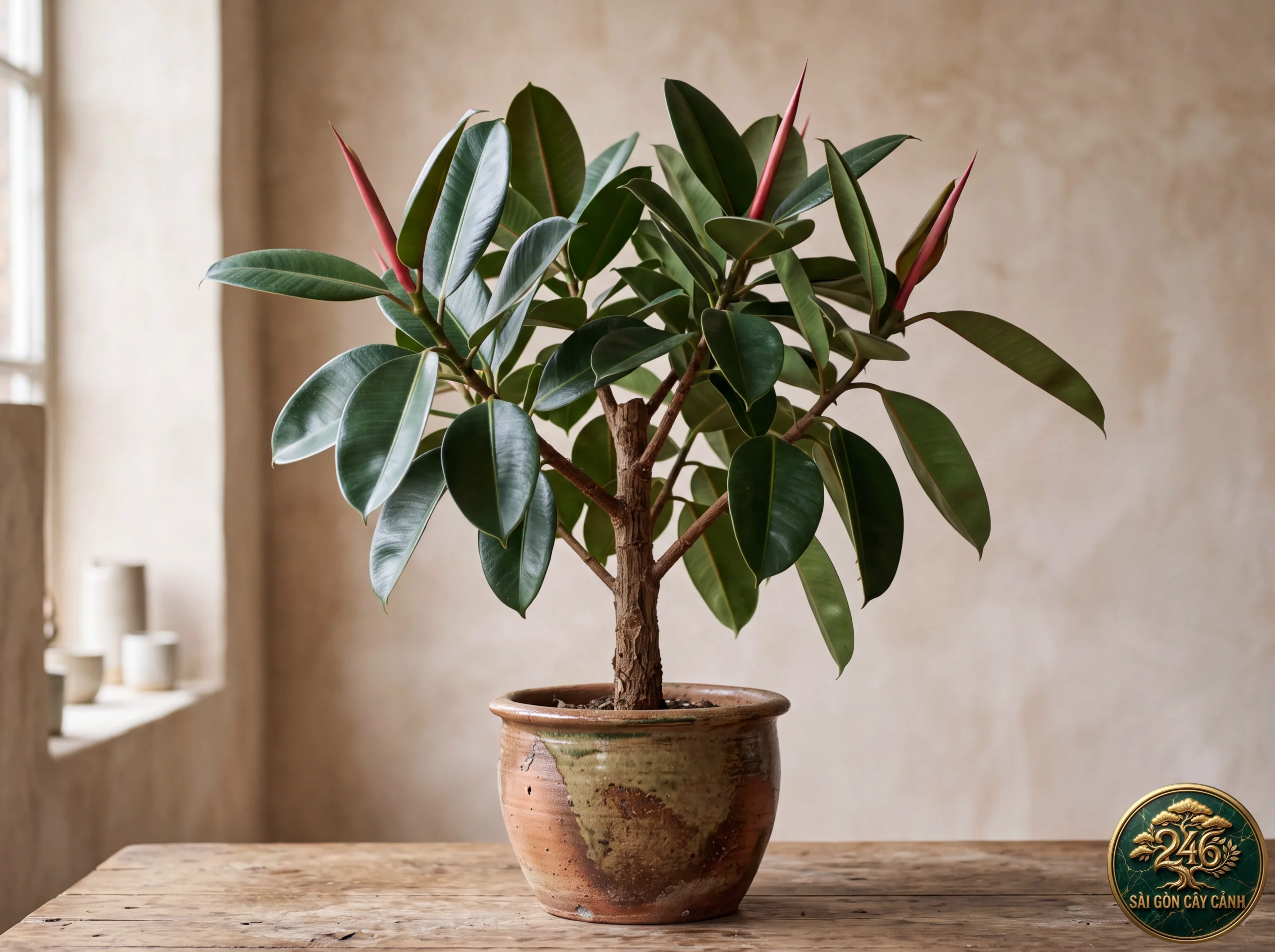
Rubber fig (Ficus elastica) is a monumental tropical woody tree within the fig family (Moraceae), celebrated for grand, glossy coriaceous foliage and brilliant crimson stipular sheaths sheltering emerging buds, imparting dignified architectural presence to modern interiors.
1. Core Botanical Taxonomy & Cultural Specifications
| Scientific Name | Ficus elastica |
|---|---|
| Botanical Family | Moraceae (Mulberry Family) |
| Native Distribution | Tropical rainforests of South and Southeast Asia (India, Nepal, Myanmar, Malaysia, Indonesia) |
| Growth Demeanor | Large evergreen woody tree; develops a stately upright habit in interior pots |
| Lighting Threshold | Bright indirect daylight to gentle direct morning sun (2,500 – 6,000 lux) |
| Hydration Cadence | Soak thoroughly when upper 50-60% substrate dries; ensure rapid bottom drainage |
| Substrate Formulation | Fertile alluvial loam, pine bark chips, coarse coco coir, perlite |
| Thermal Range | 18°C – 34°C (warm tropical envelope; vulnerable to chill below 12°C) |
| Relative Humidity | 50% – 75% (readily acclimates to modern residential and commercial air) |
| Cultivation Difficulty | Easy (vigorous, drought-tolerant, resilient woody constitution) |
| Pet Safety Profile | Pet caution (milky white latex contains ficin enzymes causing mild oral irritation) |
Taxonomically and ecologically, Ficus elastica is a monumental hemiepiphytic banyan tree indigenous to the tropical monsoon rainforests of the Indian subcontinent and Southeast Asia. In wild primary forests, it achieves towering heights of 30 to 40 meters, developing buttressing aerial prop roots that anchor into subterranean strata like living architectural pillars.
When cultivated as an indoor specimen tree, it maintains an imposing upright woody trunk typically pruned to 1 to 2 meters. The smooth gray-brown bark harbors specialized laticifer vasculature that, upon mechanical wounding, exudes copious opaque milky latex rich in natural rubber polymers and defensive botanical enzymes.
Foliar blades are broadly elliptic, measuring 15 to 35 cm long and 10 to 18 cm broad, with a rigid, coriaceous leather texture and a glossy mirror finish. The signature visual hallmark is the vivid crimson stipular sheath 5 to 10 cm long enveloping emerging terminal buds; upon leaf unfurling, this crimson sheath abscises to reveal a magnificent fresh emerald blade.
2. Morphological Identification & Foliar Architecture
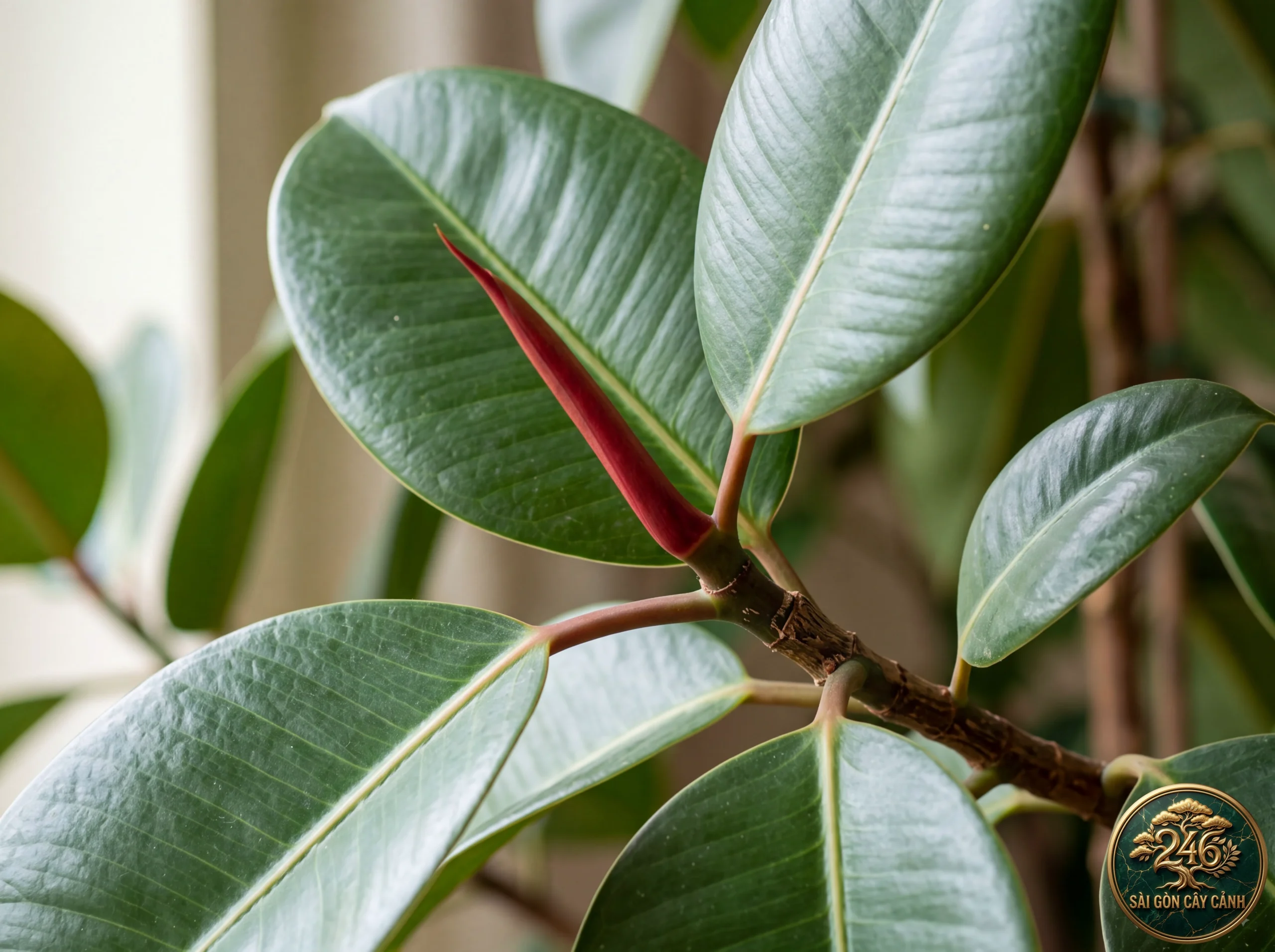
Diagnostic keys distinguishing Ficus elastica include its massive, heavy leathery blades with dense parallel penniveined lateral venation: from the prominent midrib, dozens of fine lateral veins run strictly parallel toward the entire margin. The apex terminates in a brief acute acumen, supported by a stout petiole 3 to 8 cm long.
Celebrated cultivars in contemporary horticulture encompass the ancestral emerald form, ‘Burgundy’ (or ‘Black Prince’) boasting near-black foliage with wine-purple undertones, and the prized variegated chimera ‘Tineke’ featuring creamy-yellow, pastel pink, and sage-green marbling.
Laminar micro-histology of Ficus elastica reveals a heavily fortified, multi-stratified adaxial epidermis sheathed in a mirror-gloss cuticular varnish. The defining anatomical marvel is an extensive branched network of non-articulated laticifers running parallel to vascular bundles; these specialized vessels produce viscous milky latex rich in proteolytic ficin enzymes and isoprenoid polymers, serving as a biochemical defense against herbivores and sealing mechanical injuries rapidly.
3. Photometric Calibration & Window Exposure Optimization
Biophotometrically, Ficus elastica is a canopy heliophyte thriving under robust daylight between 2,500 and 6,000 lux (50 to 120 µmol/m²/s PPFD). It revels in 2 to 4 hours of gentle morning sun; prolonged indoor shade beneath 1,200 lux prompts progressive lower leaf chlorosis and leaf drop, leaving bare lower trunks.
However, variegated selections like ‘Tineke’ containing achlorophyllous white tissue must be shielded from scorching midday summer rays exceeding 10,000 lux to avoid foliar burn. Positioning near large east-facing apertures or 1.5 meters back from sheer-curtained west windows ensures ideal photon delivery.
Biophotometric studies indicate that Rubber fig accommodates an extensive photon spectrum, reaching peak net assimilation across a PPFD flux of 60 to 180 µmol/m²/s. Concentrated anthocyanins and carotenoids within young crimson stipular sheaths shield apical meristems from ultraviolet damage; indoors, the species maintains metabolic equilibrium down to 30 µmol/m²/s without premature lower leaf drop.
4. Crimson Stipular Sheath Histology & Protective Latex Vasculature
The stout ligneous trunk of Ficus elastica develops substantial secondary xylem, anchoring the specimen securely within decorative containers without listing. When it reaches target heights of 1.5 to 2 meters, decapitating the apical meristem activates dormant cauline buds into balanced lateral branching.
The continuous laticifer network permeates bark, foliage, and petioles. Upon wounding, the milky latex coagulates rapidly upon air exposure, establishing a natural polymer bandage that seals the vascular wound against fungal spores and bacterial entry.
Thermal adaptability spans 18°C to 34°C, aligning naturally with warm tropical and subtropical climates. It tolerates heatwaves effortlessly; however, shield specimens from direct icy blasts from air conditioners and avoid chilling below 12°C which causes leaf drop.
Ambient relative humidity is ideally calibrated between 50% and 75%. Thanks to its thick foliar cuticle, it withstands dry air-conditioned atmospheres far better than delicate tropical foliage; periodic wiping with a damp microfiber cloth refreshes foliar luster.
The target vapor pressure deficit (VPD) spans 0.8 to 1.4 kPa paired with 50% to 70% relative humidity. Its impenetrable cuticular barrier curtails cutaneous transpirational vapor losses, conferring remarkable tolerance to dry, air-conditioned corporate environments without foliar wilting.
The crimson stipular sheath architecture of Ficus elastica represents a protective morphological masterpiece. Prior to leaf unfurling, this rigid lanceolate sheath encloses the apical bud under internal turgor, creating an impenetrable physical barrier against pests; once the mature leaf expands fully, the stipule desiccates and abscises cleanly, leaving a distinct annular nodal scar.
5. Porous Aggregate Substrate Engineering & Aeration Dynamics
Substrate engineering for indoor Rubber trees requires rich organic fertility, open crumb structure, and swift gravity percolation. An optimal formulation incorporates 40% alluvial topsoil loam, 25% pasteurized pine bark chips, 20% desalted coarse coco coir, and 15% perlite, holding a stable pH of 6.0 to 6.8.
Irrigation management adheres to the drench-and-dry protocol: apply water thoroughly when the top 50% to 60% container depth is dry. Soak evenly across the root zone until runoff emerges from bottom holes, promptly emptying saucer catch basins within 30 minutes to avert root rot.
Substrate engineering for Rubber fig requires coarse granular porosity ensuring robust oxygen diffusion throughout taproots and lateral root networks. Blending 30% pumice aggregate, 25% graded pine bark, and 25% chunky coir fiber achieves over 25% air-filled porosity, allowing swift gravitational water percolation without standing saturation, buffering pH between 6.0 and 6.8.
6. Organic Nutrition Schedules & Periodic Micronutrient Priming
Organic nutritional regimens deploy diluted vermicompost extract paired with fermented oilseed cake tea once monthly during active spring and summer flushes. Maintain electrical conductivity (EC) between 0.8 and 1.2 mS/cm to furnish nitrogen and trace elements for robust leaf expansion.
During cool autumn and winter intervals, reduce feeding frequency to once every 2 to 3 months or suspend entirely. Always pre-moisten potting soil with clean water prior to administering liquid nutrients to safeguard sensitive root hairs.
Biological nutritional management pairs controlled-release organic pellets with diluted vermicompost extract at an EC strictly below 0.8 mS/cm every 4 to 6 weeks during active vegetative flushes. Abundant bio-nitrogen and magnesium fuel the expansion of immense, lustrous, dark emerald foliage.
7. Clinical Diagnostic Matrix & Rapid Correction Protocols
| Clinical Symptom | Primary Etiology | Diagnostic Evaluation | Corrective Prescription |
|---|---|---|---|
| Lower mature leaves turning yellow and dropping, leaving bare lower trunk | Severe indoor light deprivation or chronic over-irrigation in heavy soil | Measure light levels below 1,200 lux or probe bottom soil to find wet mud | Relocate specimen into bright indirect daylight and calibrate irrigation |
| Crimson terminal stipular sheath turning black, shriveling, failing to open | Anaerobic root rot from waterlogging or desiccating air conditioning blasts | Check bottom drainage holes and assess chilling drafts aimed at the apex | Curttail irrigation, relocate away from cooling vents, and lightly mist crown |
| Foliar margins and tips developing crisp brown necrotic desiccated patches | Chronically arid indoor air or transient root ball dehydration under drought | Probe potting mix depth to discover bone-dry, compacted soil core | Give thorough drenching to rehydrate root core and wipe foliar blades |
| Small brown oval raised crusts firmly adhered along the central midrib | Brown soft scale insect infestation feeding upon vascular sap | Gently pry crust with fingernail to confirm immobile armored scale insect | Swab affected veins with cloth dipped in botanical alcohol or potassium soap |
8. Cryptic Pest Prophylaxis & Foliar Surface Sanitation
Pest management prioritizes surveillance against brown soft scales and two-spotted spider mites that congregate along the midrib beneath leaves. Monthly wiping with a soft cloth dipped in dilute botanical insecticidal soap keeps foliage clean while eliminating pests.
Phytophthora root rot and Cercospora foliar leaf spots can emerge if media remains waterlogged or foliage stays wet overnight. Prevent fungal outbreaks by watering early in the day and ensuring containers drain freely.
Plant health surveillance targets thrips, brown soft scale, and Anthracnose foliar spotting induced by stagnant moisture. Monthly wiping of broad laminar surfaces using damp microfiber cloths moistened with dilute botanical soap removes dust barriers to photosynthesis and disrupts insect colonization.
9. Asexual Propagation Methodology & Root Strike Protocols
Propagating Ficus elastica achieves highest success via air-layering or semi-lignified stem tip cuttings during warm spring months. For air-layering, select a vigorous branch, make a clean 2 cm ring cut through the bark, scrape the cambium clean, and wrap in moist sphagnum sealed in polyethylene.
Over a 25 to 35 day developmental interval in warm weather, abundant white adventitious roots penetrate the moss ball; once roots turn tan and firm, sever the air-layered branch below the ball and pot into fresh porous media with 100% strike rates.
During air-layering or semi-hardwood tip cutting propagation, copious latex exudation must be rinsed with tepid water and dusted with sterile activated charcoal powder to seal vascular conduits. Encased in moist sphagnum or inserted into airy perlite at 24°C – 28°C over a 25 to 35 day interval, vigorous adventitious root clusters emerge with 100% strike success.
10. Companion Animal Safety Profile & ASPCA Latex Caution
Per ASPCA veterinary toxicology archives, members of the genus Ficus harbor milky white latex loaded with proteolytic ficin enzymes and psoralens. This sap can elicit mild contact dermatitis or transient oral salivation and gastric upset if chewed by companion animals. Placing specimens on elevated plant pedestals beyond pet reach ensures harmonious coexistence.
11. Biophilic Curation & Contemporary Interior Design Styling

In contemporary Biophilic architecture and executive corporate interiors, Ficus elastica stands as a paramount statement tree embodying minimalist elegance. Its vertical trunk and monumental leathery foliage create a commanding architectural focal point in reception foyers and open-plan living rooms.
The Rubber fig carries rich symbolic resonance of steadfast resilience, longevity, and flourishing prosperity. The fiery red stipular sheath ascending toward the light symbolizes auspicious beginnings, vibrant energy, and upward career momentum.
In contemporary Biophilic architecture, the massive, mirror-lacquered elliptical foliage of Ficus elastica delivers an authoritative statement of structural permanence, luxury, and resilience. Anchoring corporate atriums, executive boardrooms, or residential entryways, it commands attention while actively capturing airborne particulate pollutants.
12. Master Principles for Sustainable Indoor Acclimatization
To maintain thriving Ficus elastica with grand glossy foliage and stately architecture indoors, adhere strictly to these three foundational rules:
- Hydration axiom: Hydration axiom: Water thoroughly only when top 50-60% substrate dries, ensuring complete drainage without saucer pooling.
- Illumination axiom: Illumination axiom: Provide luminous indirect daylight of 2,500-6,000 lux or gentle morning sun to maintain thick glossy foliage.
- Maintenance axiom: Hygiene axiom: Wipe foliar blades clean with a damp microfiber cloth monthly to maximize natural photosynthetic respiration.
13. Frequently Asked Questions Regarding Rubber fig (FAQs)
Does Rubber fig require high light levels when kept indoors?
Yes; it demands robust indirect daylight (at least 2,500 lux); deep shade causes lower foliar abscission and arrests terminal bud development.
How often should foliar dust be removed from the large leaves?
Wiping blades with a damp microfiber cloth once monthly preserves its mirror-like gloss and maximizes photosynthetic efficiency.
Why do red stipular sheaths drop onto the floor periodically?
The crimson sheath is a protective deciduous bract; once the nascent leaf inside unfurls fully, the sheath naturally abscises as a healthy developmental event.
Does pruning the apical leader encourage lateral branching?
Decapitating the central terminal tip awakens latent axillary buds along lower nodes, successfully transforming a single trunk into a ramified bush.
Is the white milky latex toxic to humans and pets?
The sap can cause mild dermal itching on sensitive skin or transient gastric upset if chewed by pets; simply wear gloves when pruning and wash hands with soap.
Why do lower basal leaves of Rubber fig turn yellow and drop?
Lower leaf chlorosis and abscission typically signal rootlet suffocation from chronic overwatering or inadequate luminous energy at lower canopy levels; reduce irrigation intervals, inspect bottom drainage, and relocate to brighter indirect illumination.