Living plant profile
Ruby glow peperomia
Peperomia graveolens
Comprehensive botanical dossier for Ruby glow peperomia (Peperomia graveolens). Identification, lighting calibration, porous substrate formulation, and cultivation guide by Saigon Cay Canh.
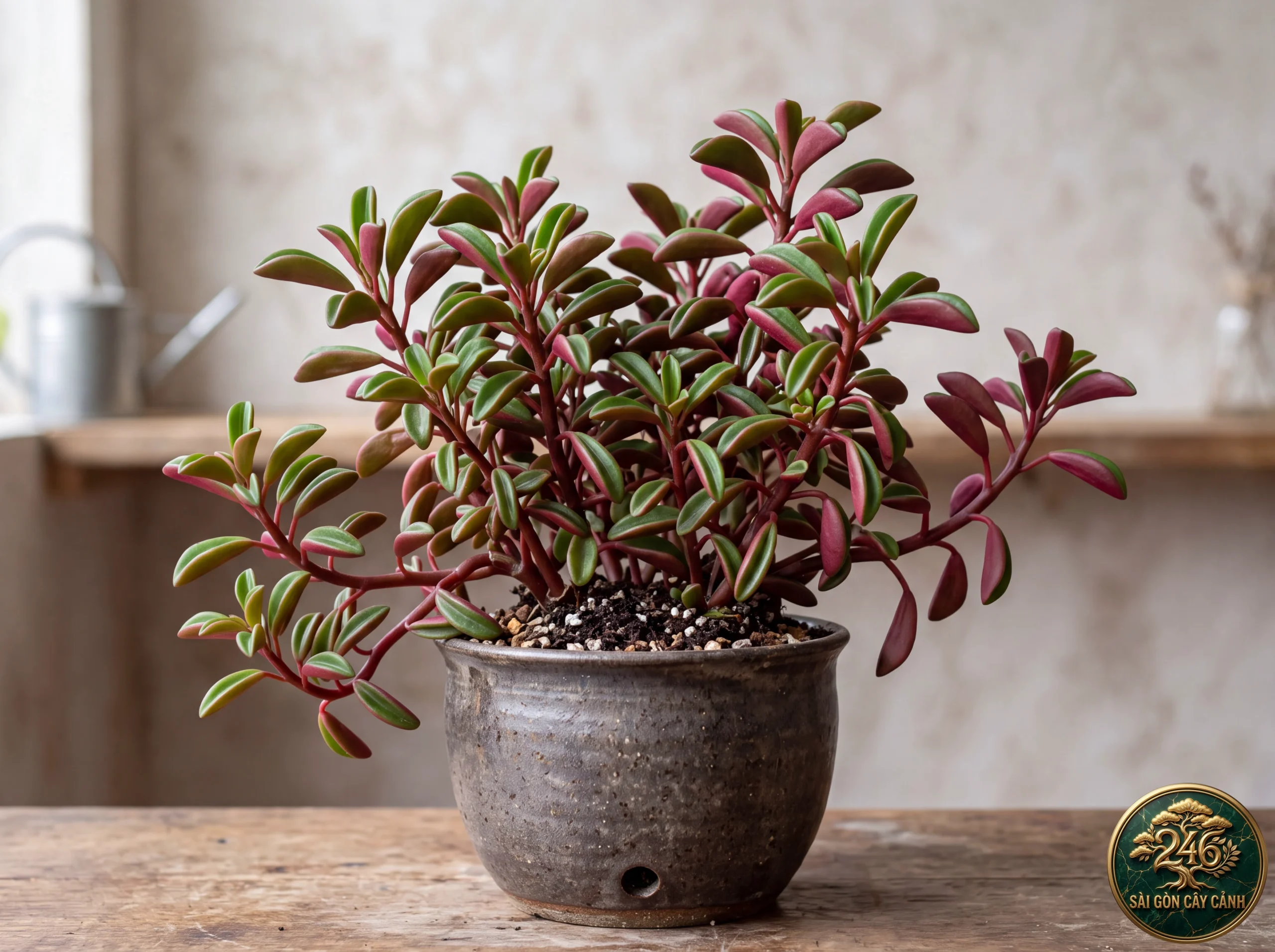
Ruby glow peperomia (Peperomia graveolens) is an extraordinary succulent foliage marvel within the pepper family (Piperaceae), renowned for canoe-shaped foliage boasting radiant ruby-red undersides and translucent optical windows along the upper groove that channel ambient light.
1. Core Botanical Taxonomy & Cultural Specifications
| Scientific Name | Peperomia graveolens |
|---|---|
| Botanical Family | Piperaceae (Pepper Family) |
| Native Distribution | Arid limestone canyon valleys of the southern Ecuadorian Andes |
| Growth Demeanor | Dwarf succulent subshrub with erect, wine-red branching stems |
| Lighting Threshold | Bright daylight with gentle direct morning sun (2,000 – 4,500 lux) |
| Hydration Cadence | Water only when substrate dries 70-80%; remarkably drought-tolerant |
| Substrate Formulation | Pumice aggregate, volcanic scoria, quartz grit, perlite mineral mix |
| Thermal Range | 18°C – 30°C (prefers warm arid envelope; protect below 10°C) |
| Relative Humidity | 40% – 60% (thrives in dry residential air; requires minimal humidity) |
| Cultivation Difficulty | Easy (desert succulent constitution, minimal watering needs) |
| Pet Safety Profile | 100% Non-Toxic (ASPCA certified safe for dogs and cats) |
Ecologically and phytogeographically, Peperomia graveolens is a specialized succulent endemic to arid limestone cliffs across Loja and Azuay provinces in southern Ecuador. Diverging sharply from rainforest congeners, this taxon evolved xerophytic adaptations to survive intense solar insolation and prolonged dry intervals upon sheer rock faces.
The most breathtaking anatomical feature of Peperomia graveolens is its V-shaped, canoe-like foliar morphology. The convex abaxial surface and lateral flanks are saturated in deep wine-red anthocyanin pigments acting as a solar shield, while the narrow adaxial groove forms a translucent emerald ‘epidermal window’ that funnels sunlight into internal photosynthetic mesophyll.
Cauline stems are stout, succulent, and wine-red, attaining heights of 15 to 25 cm and branching into a dense jewel-toned mound. Inflorescences emerge as elongate, chartreuse rat-tail spikes rising gracefully above the crown; flowers emit a distinct dry herbal aroma that inspired its specific epithet ‘graveolens’ meaning ‘strong-scented’.
2. Morphological Identification & Foliar Architecture
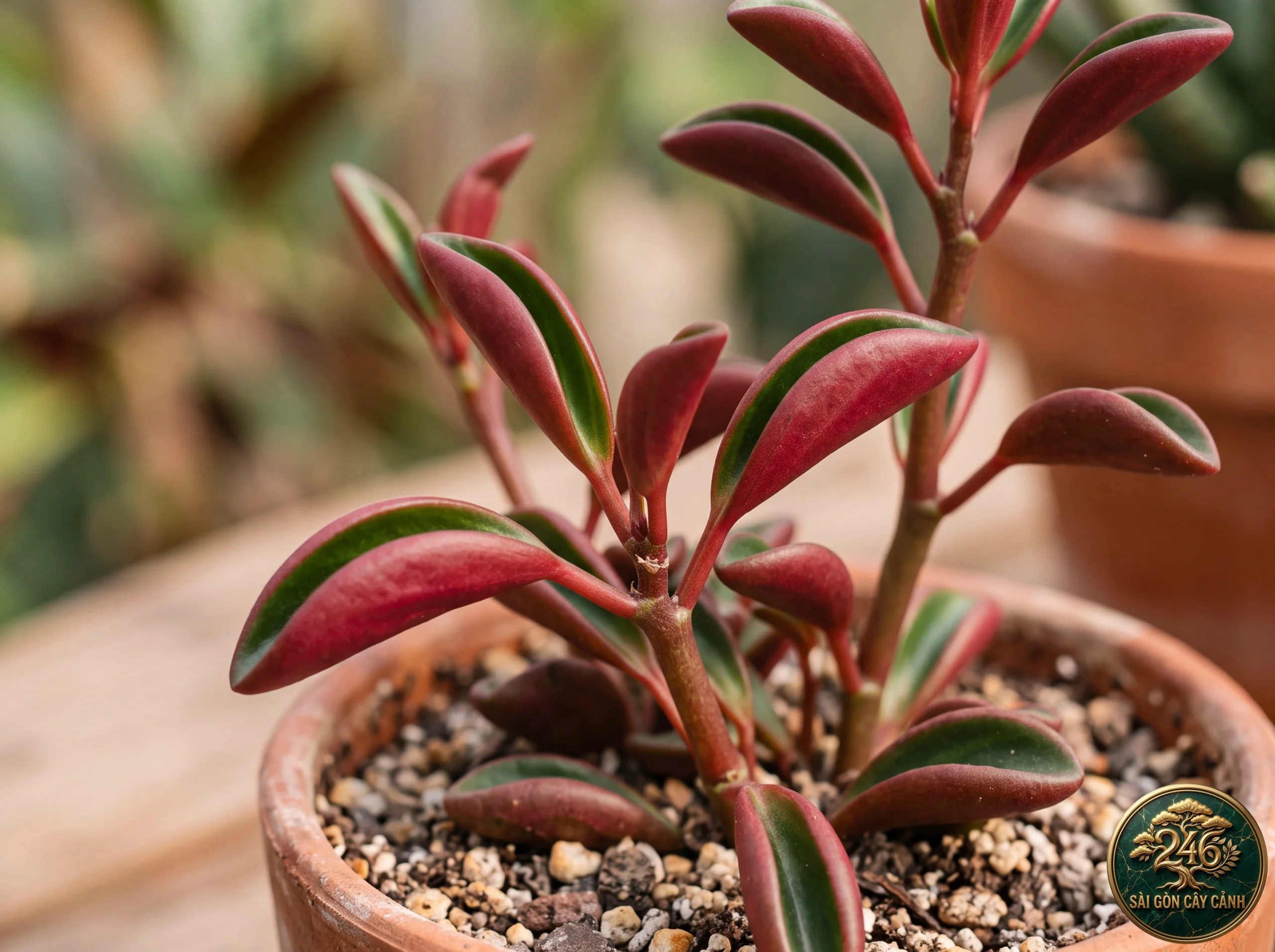
The definitive diagnostic key for Ruby glow peperomia is its high-contrast bicolored foliage: deep ruby-wine beneath and translucent emerald in the upper groove. The thick, turgid leaf substance gives it the sculptural aspect of a desert succulent, distinguishing it vividly from typical broad-leaved Piperaceae.
Cultivated under luminous daylight, the ruby coloration across stems and foliar undersides intensifies into incandescent crimson. Conversely, protracted indoor gloom bleaches the red tones into dull olive and induces cauline stretching that compromises its compact aesthetic.
Microscopic examination of Peperomia graveolens foliage reveals an extraordinary histological specialization adapted to arid Andean canyon microclimates. The convex abaxial surface is wrapped in an epidermal layer saturated with concentrated wine-red anthocyanin pigments; meanwhile, the narrow adaxial cleft comprises a transparent, achlorophyllous dome functioning as an optical window that channels diffuse sunlight deep into photosynthetic mesophyll sheltered within.
3. Photometric Calibration & Window Exposure Optimization
Photometric calibration requires robust daylight between 2,000 and 4,500 lux (40 to 90 µmol/m²/s PPFD). The species relishes 2 to 3 hours of direct, gentle morning sun along east-facing window sills to stimulate vibrant anthocyanin synthesis along the abaxial cuticle.
During midsummer heatwaves, shield the plant from harsh unshaded midday sun after 11 AM to prevent thermal dehydration of succulent tissues. Positioning behind sheer curtains or 1.5 meters back from west-facing windows delivers optimal protected irradiance.
Biophotometrically, Ruby glow peperomia thrives under intense daylight, with optimal net assimilation peaking between 40 and 90 µmol/m²/s PPFD. Operating via Crassulacean Acid Metabolism (CAM), it opens stomata nocturnally to capture CO2 while curbing diurnal transpirational moisture loss; gentle morning sun is the golden catalyst maintaining high contrast between emerald optical windows and ruby flanks.
4. V-Shaped Grooved Succulent Foliage & Ruby-Red Light-Harvesting Windows
The semi-succulent cauline architecture stores substantial water reserves within specialized parenchymal vacuoles. Consequently, the plant withstands weeks of drought with only slight wrinkling along the abaxial ruby cuticle.
The shallow fibrous root system is tailored for rocky ledges, exhibiting acute sensitivity to anaerobic waterlogging. Planting in porous unglazed terracotta pots with generous drainage apertures keeps the rhizosphere aerated and sound.
The thermal comfort zone spans 18°C to 30°C. It tolerates summer warmth exceptionally well due to CAM metabolic adaptations; however, frost and sustained chill below 10°C cause catastrophic tissue collapse and black stem rot.
Ambient relative humidity is ideally suited between 40% and 60%. The species prospers effortlessly in dry residential and air-conditioned atmospheres without requiring supplementary misting or humidifiers.
The optimal vapor pressure deficit (VPD) spans 1.0 to 1.6 kPa in breezy, arid conditions. The species flourishes within ambient residential and air-conditioned atmospheres calibrated between 40% and 60% relative humidity, requiring zero supplementary misting or artificial humidification.
The caespitose succulent branching architecture of Peperomia graveolens attains 15 to 25 cm in height, featuring stout, compressed purplish-red internodes. Dense collenchyma fiber sheaths encircling vascular bundles bestow remarkable tensile elasticity, supporting dozens of heavy succulent canoe blades securely along sheer cliff crevices without lodging.
5. Porous Aggregate Substrate Engineering & Aeration Dynamics
Substrate formulation demands an overwhelmingly inorganic mineral composition akin to desert cacti. An ideal recipe incorporates 50% pumice grit (3-5 mm), 25% crushed red volcanic scoria, 15% washed coir chunks, and 10% perlite, stabilizing a neutral pH of 6.5 to 7.2.
Regarding watering cadence, strictly adhere to the soak-and-dry regimen. Irrigate only when 70% to 80% of the potting medium volume is thoroughly dry; during cool winter intervals, watering once or twice monthly around the pot perimeter is ample.
Substrate architecture demands an overwhelmingly inorganic mineral fraction exceeding 80% to eliminate opportunistic fungal pathogen development. Blending 50% graded pumice (3-5 mm) with 25% crushed red volcanic scoria establishes an airy drainage matrix, ensuring instantaneous gravity percolation without ponding and holding a circumneutral to alkaline pH of 6.5 to 7.2.
6. Organic Nutrition Schedules & Periodic Micronutrient Priming
Nutritional requirements are extremely conservative. Administer ultra-dilute bio-organic liquids such as kelp extract or vermicompost tea mixed at an EC beneath 0.4 mS/cm every 6 to 8 weeks exclusively during active spring and summer flushes.
Never use high-nitrogen synthetic fertilizers which induce watery cell elongation, splitting the cuticular windows and fading the prized ruby pigment. Suspend feeding entirely throughout winter.
Nutritional requirements for this xerophytic succulent are exceptionally austere. Administer bio-organic potassium liquids with trace minerals at an EC beneath 0.4 mS/cm once every 6 to 8 weeks in active spring and summer; avoid high-nitrogen fertilizers which rupture swollen succulent cells and bleach ruby pigments.
7. Clinical Diagnostic Matrix & Rapid Correction Protocols
| Clinical Symptom | Primary Etiology | Diagnostic Evaluation | Corrective Prescription |
|---|---|---|---|
| Abaxial ruby coloration fading into dull olive-green | Prolonged light starvation in deeply shaded indoor locations | Measure ambient light levels beneath 1,200 lux at the container site | Relocate specimen to an east-facing window receiving 2-3 hours of morning sun |
| Leaves turning soft, watery, and stems blackening from base | Bacterial soft rot from waterlogged potting media and fungal attack | Palpate stem collar to find mushy, necrotic tissue with sour odor | Sever healthy uninfected shoot tips, air-dry wounds, and re-root in dry pumice |
| Canoe-shaped blades developing fine longitudinal wrinkles | Temporary physiological dehydration during extended dry intervals | Inspect substrate to find bone-dry, powdery media across container depth | Provide moderate irrigation around root crown to restore cellular turgor |
| White cottony wax deposits nestled inside foliar grooves | Mealybug infestation feeding upon succulent phloem sap | Examine crevices under 10x magnification to confirm mealybugs | Swab with cotton buds dipped in biological alcohol and apply organic soap |
8. Cryptic Pest Prophylaxis & Foliar Surface Sanitation
Pest management focuses on vigilance against root mealybugs and cottony scale sheltering within dry leaf junctions. Periodically inspect root collars and swab any isolated wax clusters with cotton buds dipped in botanical alcohol.
The paramount pathological hazard is black rot from over-irrigation in heavy potting soil. Prevention lies strictly in utilizing macroporous mineral mixes, terracotta pots, and watering only after full substrate desiccation.
Plant health surveillance focuses on deterring root mealybugs and preventing moisture-induced soft rot. Ensuring media remains dry and airy, employing porous terracotta containers, and periodically swabbing root collars with cotton buds dipped in biological alcohol preserves long-term vitality.
9. Asexual Propagation Methodology & Root Strike Protocols
Propagating Peperomia graveolens is straightforward via stem cuttings or single canoe leaf cuttings. Using a sterile blade, take 6 to 10 cm stem tip divisions, allowing them to dry in shaded warmth for 24 to 48 hours to establish a firm protective callus.
Insert callused cuttings into moist fine pumice grit kept in warm 22°C – 26°C indirect daylight. Over a 25 to 35 day interval, adventitious roots anchor securely and miniature ruby shoots emerge from basal nodes.
During succulent tip or canoe leaf cutting propagation, allowing cut ends to air-callus thoroughly in dry shade for 24 to 48 hours prior to insertion into dry pumice grit eliminates tissue maceration risks. Maintained at 22°C – 26°C under filtered light over a 25 to 35 day interval, vigorous white root clusters strike and miniature ruby shoots emerge.
10. Companion Animal Safety Profile & ASPCA Non-Toxic Verification
Per ASPCA veterinary toxicology records, Peperomia graveolens is confirmed 100% non-toxic to cats and dogs. Void of hazardous plant toxins or toxic sap, it represents an entirely safe succulent choice for pet owners.
11. Biophilic Curation & Contemporary Interior Design Styling
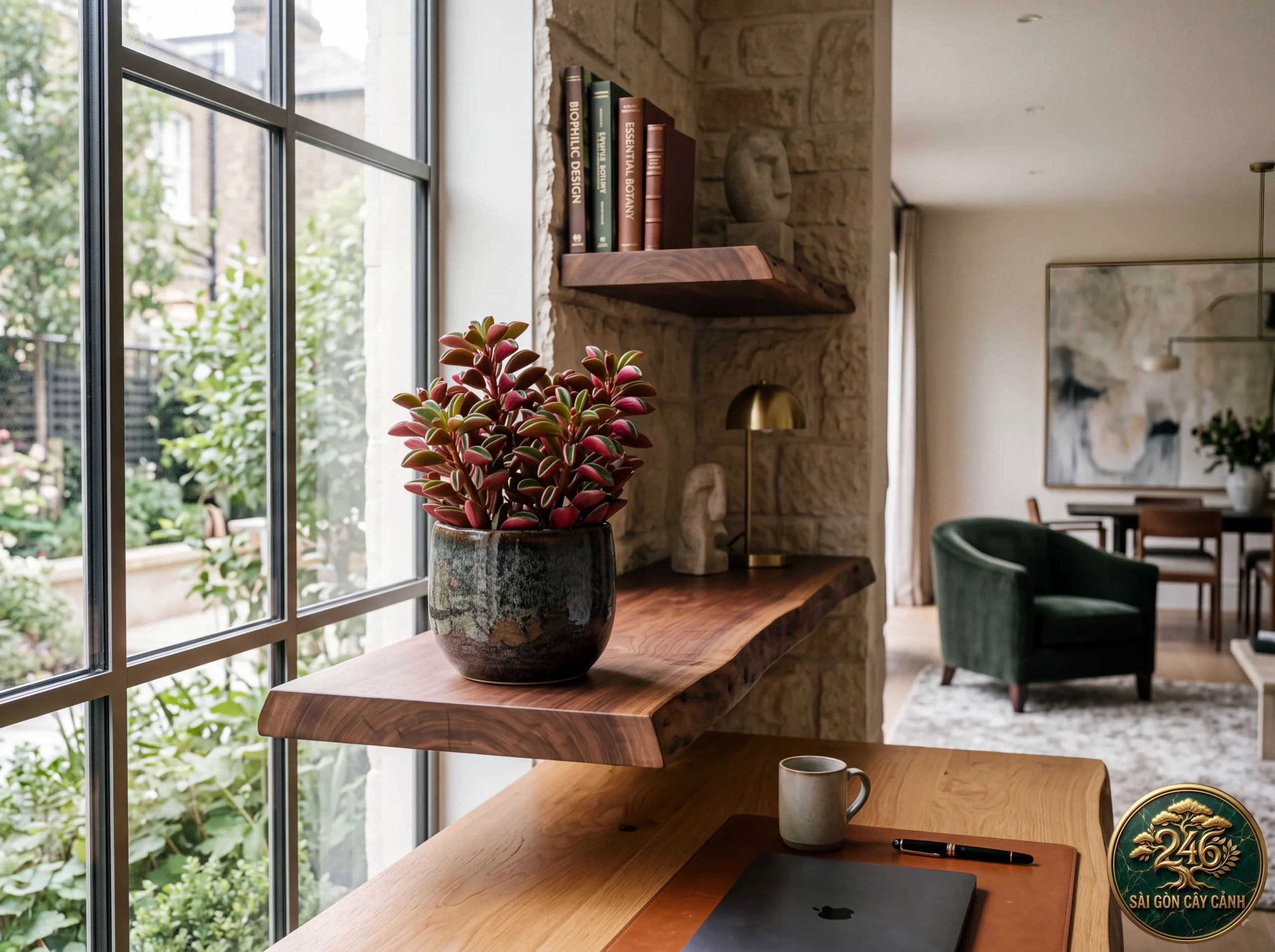
In contemporary Biophilic styling, Peperomia graveolens functions as a miniature living sculpture. The contrast of fiery ruby-red and luminous translucent emerald provides an architectural accent on executive desks, bookshelves, and curated succulent collections.
The warm ruby hue carries symbolic associations of prosperity, vitality, and renewal. Observing the luminous glow of its canoe-like leaves in morning sun awakens creative inspiration and relieves cognitive fatigue.
In contemporary Biophilic design, Peperomia graveolens stands as an emblem of biological resilience and exquisite minimalism. The juxtaposition of fiery ruby-wine tones with translucent emerald clefts renders it an architectural living sculpture on executive desks, inspiring creative contemplation.
12. Master Principles for Sustainable Indoor Acclimatization
To cultivate thriving Peperomia graveolens with incandescent ruby color and compact turgidity indoors, follow these three axioms:
- Hydration axiom: Hydration axiom: Water only when substrate dries 70-80%, ensuring swift gravity percolation without saucer puddling.
- Illumination axiom: Illumination axiom: Provide gentle morning sun or bright diffuse daylight of 2,000-4,500 lux to intensify ruby pigmentation.
- Maintenance axiom: Substrate axiom: Deploy mineral-dominant pumice and volcanic scoria mixes ensuring maximum aeration for succulent roots.
13. Frequently Asked Questions Regarding Ruby glow peperomia (FAQs)
Is Peperomia graveolens considered a succulent or foliage plant?
It is a true botanical member of the pepper family (Piperaceae) that has evolved extreme succulent morphology identical to desert succulents.
Why does the leaf possess a translucent groove along the center?
This is an ‘epidermal window’ that channels photons deep into internal photosynthetic tissues while ruby pigments shield against solar radiation.
Does Ruby glow peperomia produce flowers indoors?
Yes; it produces erect, slender chartreuse rat-tail spikes rising above the crown that emit a subtle, dry herbal scent.
How often should Peperomia graveolens be watered indoors?
Indoors, irrigation is typically required only every 10 to 14 days after verifying the potting medium has dried out thoroughly.
Can independent plantlets be struck from single leaf cuttings?
Yes; gently detach an intact canoe leaf, let the wound callus for 24 hours, and insert into moist pumice to strike roots and new shoots.
Why do the outer abaxial sides of Peperomia graveolens leaves develop wrinkles?
Foliar wrinkling is a natural physiological indicator of temporary substrate moisture depletion; applying a modest drink of water around the root zone allows parenchymal vacuoles to restore full turgidity within 24 hours.