
Living plant profile
Shingle vine rhaphidophora
Rhaphidophora cryptantha
Comprehensive botanical dossier for Shingle vine rhaphidophora (Rhaphidophora cryptantha). Identification, lighting calibration, porous substrate formulation, and cultivation guide by Saigon Cay Canh.
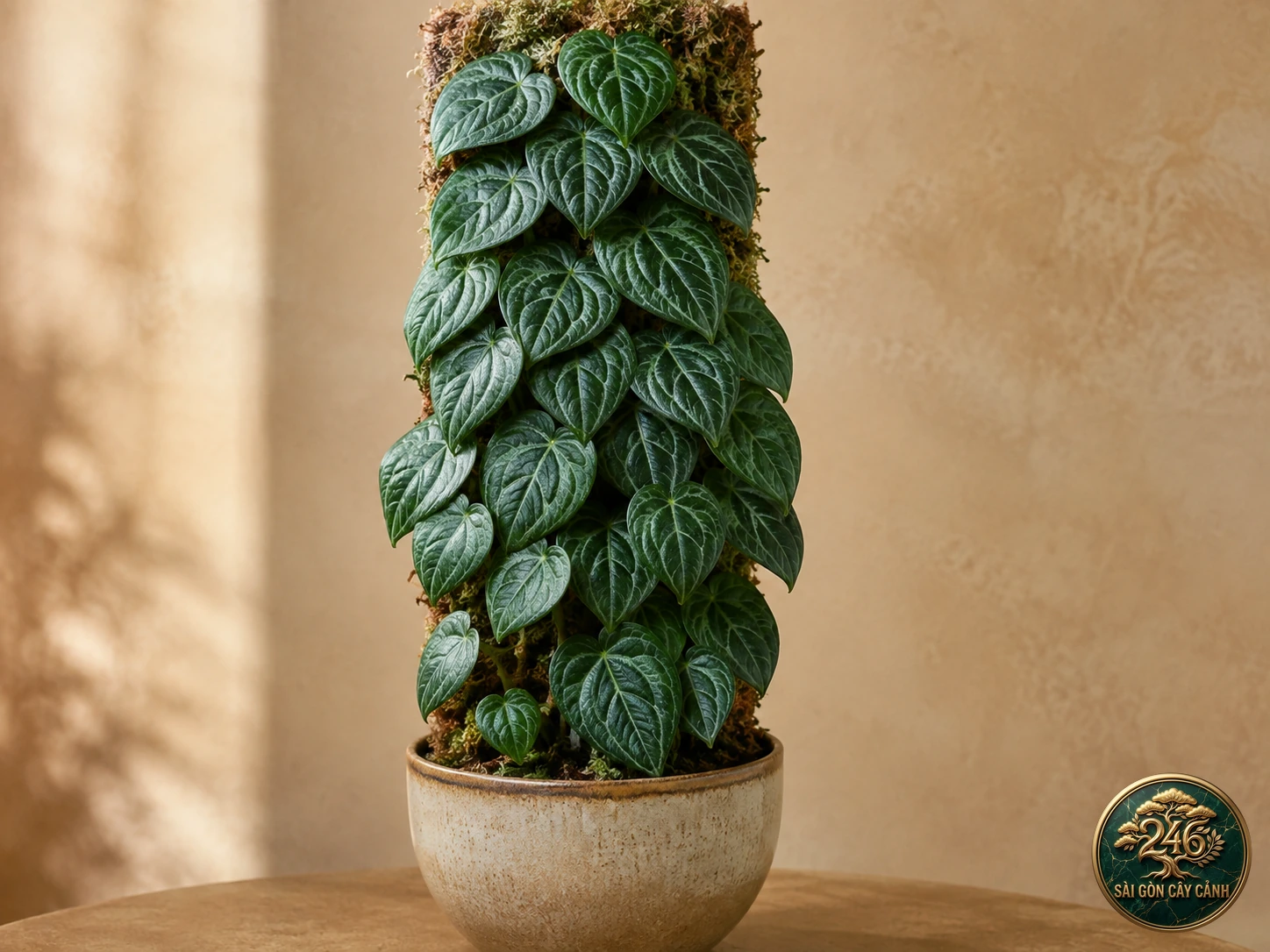
Shingle vine rhaphidophora (Rhaphidophora cryptantha) is one of the most mesmerizing geometric wonders of the Neotropical foliage world, celebrated for its true shingle-climbing habit where alternating leaves press flush against host surfaces like living emerald shingles. Adorned with crystalline silver venation etched across dark forest green velvet, this New Guinea native introduces spellbinding botanical artistry into indoor spaces.
1. Core Botanical Taxonomy & Cultural Specifications
| Scientific Name | Rhaphidophora cryptantha |
|---|---|
| Botanical Family | Araceae (Aroid Family) |
| Native Distribution | Tropical lowland rainforests of Papua New Guinea and adjacent Pacific archipelagos |
| Growth Demeanor | True shingle-climber, producing alternating heart-shaped leaves appressed flat to surfaces |
| Lighting Threshold | Gentle diffused daylight (1,200 – 2,500 lux); leaves scorch quickly under direct sun |
| Hydration Cadence | Consistently moist vertical mount; hydrate when surface dries, avoid root stagnation |
| Substrate Formulation | 40% fine pumice, 25% sphagnum moss, 20% fine pine bark, and 15% horticultural perlite |
| Thermal Range | 21°C – 30°C (70°F – 86°F; extremely sensitive to cold temperatures below 18°C/64°F) |
| Relative Humidity | 75% – 90% (High ambient humidity is essential for flat foliar adhesion against totems) |
| Cultivation Difficulty | Moderate to High (Demands flat cedar plank or moist moss mount and high humidity) |
| Pet Safety Profile | Toxic (Microscopic insoluble calcium oxalate crystals irritate pet oral tissues) |
Formally accepted within the Royal Botanic Gardens Kew (POWO) taxonomy, Rhaphidophora cryptantha represents an exceptional endemic hemi-epiphytic liana of Papua New Guinea. The specific name ‘cryptantha’ (meaning ‘hidden flower’) reflects its concealed inflorescences, while its supreme horticultural fame derives from its spellbinding geometric shingling habit.
In its native habitat, juvenile runners emerging from the rainforest floor immediately seek vertical tree trunks or moist rock faces. Rather than branching outward, the plant flattens its climbing axis and foliage flush against the host surface, forming an overlapping bilateral ladder of living shingles.
Short, dense adventitious rootlets emerge along the entire ventral surface of the climbing axis, secreting natural adhesives that cement the vine securely against bark substrates, anchoring it against forest winds.
2. Morphological Identification & Foliar Architecture
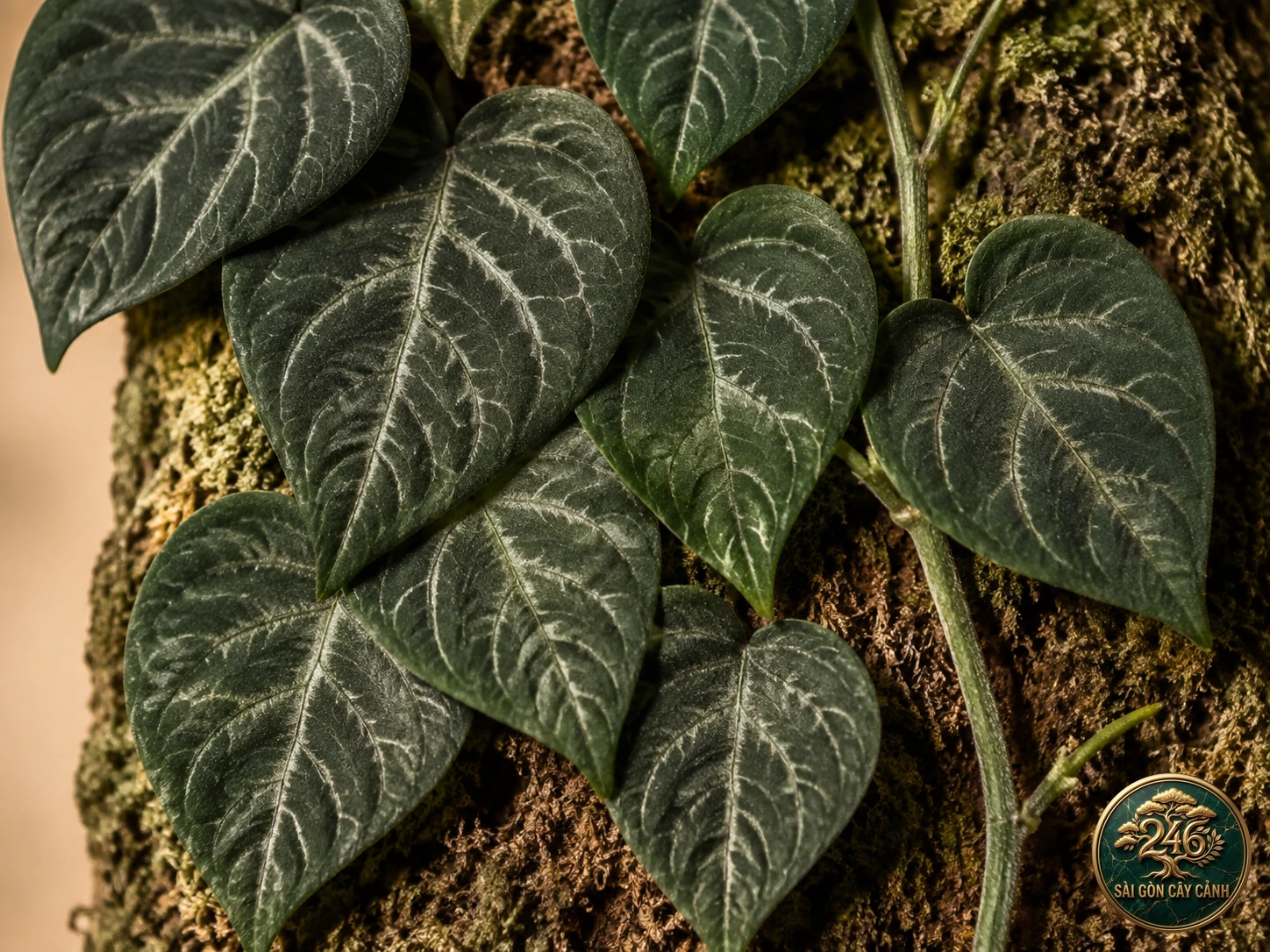
The shingling foliage of Rhaphidophora cryptantha displays a rounded cordate contour measuring 6 to 12 cm in length, arranged in strict alternating overlap. The velvety dark emerald surface is illuminated by an extraordinary network of crystalline silver-white veins radiating from the center like frosted snowflakes.
Leaves lack elongated petioles, attaching almost directly to the climbing stem to maintain an absolute two-dimensional flat plane. The pale abaxial surface continuously produces microscopic anchor roots that fuse against the support.
The bilateral shingling foliage habit of Rhaphidophora cryptantha represents an evolutionary masterpiece for low-light survival beneath dense New Guinea rainforest understories. Lacking elongated petioles, leaves clasp the climbing axis flush in alternating symmetry, presenting an absolute 100% planar surface optimized for diffuse photon capture while shielding anchor roots from evaporative moisture loss.
3. Photometric Calibration & Window Exposure Optimization
The shingle vine thrives under gentle diffused daylight between 1,200 and 2,500 lux. Soft filtered illumination preserves the sparkling silver venation and velvety emerald texture. Direct solar exposure must be strictly avoided as it rapidly scorches the thin foliar tissue.
The optimal domestic display is mounting the plank one meter from sheer-draped windows or inside an illuminated plant cabinet with front-facing LED lighting.
Mounting planks perpendicularly to ambient diffused daylight ensures uniform photon exposure between 50 and 90 umol/m2/s across all shingle tiers. Crystalline silver venation sparkles with natural brilliance against domestic display surfaces.
4. Structural Vining Architecture & Support Dynamics
Mounted upon wooden planks or flat moss boards, hydration demands daily diligence. Mist the moss mount thoroughly once or twice daily, ensuring the adventitious rootlets behind each shingle leaf absorb ample capillary moisture.
If grown with a bottom soil pot, water lightly when the topsoil dries, preventing waterlogging around basal roots.
Optimal thermal conditions range from 21°C to 30°C. Highly sensitive to cold, temperatures below 18°C (64°F) halt climbing progress and cause leaves to curl away from the mounting surface.
Ambient atmospheric humidity is critical, strictly requiring 75% to 90%. Consequently, Rhaphidophora cryptantha reaches absolute perfection within enclosed plant cabinets or large humid terrariums.
5. Engineered High-Porosity Substrate Formulation
The ideal growing mount for this species is a flat cedar wood plank or cork bark board lined with a thin layer of damp sphagnum moss. For potted specimens, use 40% fine pumice, 25% chopped sphagnum, 20% fine bark, and 15% perlite.
A buffered pH between 5.6 and 6.6 supports vigorous adhesive root growth.
Cedar planks or natural cork bark lined with damp sphagnum moss deliver ideal mechanical traction for hundreds of microscopic climbing rootlets. Natural aromatic compounds within cedar suppress opportunistic mold pathogens, ensuring a pristine long-term micro-environment for adhesive root respiration.
6. Organic Bio-Fertilization & Mineral Management
Apply heavily diluted liquid organic fertilizer at one-quarter strength via foliar misting onto the moss mount monthly during active months, supplying micronutrients to enhance silver vein clarity.
Suspend feeding during colder months to prevent fertilizer salt burn on delicate climbing rootlets.
Because anchor rootlets on timber mounts contact only thin moss layers, nutrition must be delivered exclusively as ultra-diluted organic foliar mist. Misting mounts monthly with one-fifth strength seaweed bio-fertilizer and potassium humate maintains iridescent silver veins and flush shingling.
7. Clinical Diagnostic Matrix & Horticultural Resolutions
| Clinical Symptom | Root Pathology | Diagnostic Method | Targeted Resolution |
|---|---|---|---|
| Leaves curl at margins and lift away from wood | Ambient humidity below 65% or desiccated mount | Increase misting frequency and sustain relative humidity >80% | Loss of shingling habit |
| Stem stretches into leafless runner, no adhesion | Lack of flat vertical mounting surface | Gently secure vine apex against a flat cedar board to re-engage shingling | Etiolation distortion |
| Silver venation fades, blades turn pale yellowish | Insufficient light or high-chlorine tap water | Move to 2,000 lux diffused light and irrigate with purified RO water | Pigment degradation |
| Gray mold develops behind shingle leaves | Saturated humidity combined with air stagnation | Activate mini circulation fans and treat with biological fungicide | Fungal stagnation blight |
8. Pest Mitigation Protocols & Foliar Sanitation
Inspect the narrow interface between leaves and wood mounts for mealybugs or spider mites, treating preventively with mild organic neem oil sprays.
Foliar mold arises in saturated air lacking air movement; operate miniature circulation fans inside cabinets to prevent fungal stagnation.
Moist timber mounts can occasionally attract tiny millipedes or fungal gnats in dim, stagnant settings. Mount planks where gentle air circulation prevails, misting strictly in early morning to guarantee that leaf surfaces dry thoroughly before nightfall.
9. Asexual Propagation Methodology
Propagate by harvesting stem segments bearing two to three firmly rooted shingle leaves. Use a thin sterile blade to gently tease the rooted stem section away from the wood mount.
Fasten the division onto a fresh wooden plank using soft cotton thread, maintaining saturated humidity in a propagation box; new shingling leaves resume within two weeks.
Maintenance for mounted planks requires daily morning misting using chlorine-free purified water to sustain adventitious rootlets. Gently dust the velvety silver-veined blades with a soft makeup brush, avoiding physical abrasion to fragile epidermal tissues.
10. Veterinary Toxicology & Domestic Safety Safeguards
Because planks are mounted on high walls or inside glass cabinets, they remain completely inaccessible to domestic pets.
11. Biophilic Interior Design & Architectural Styling
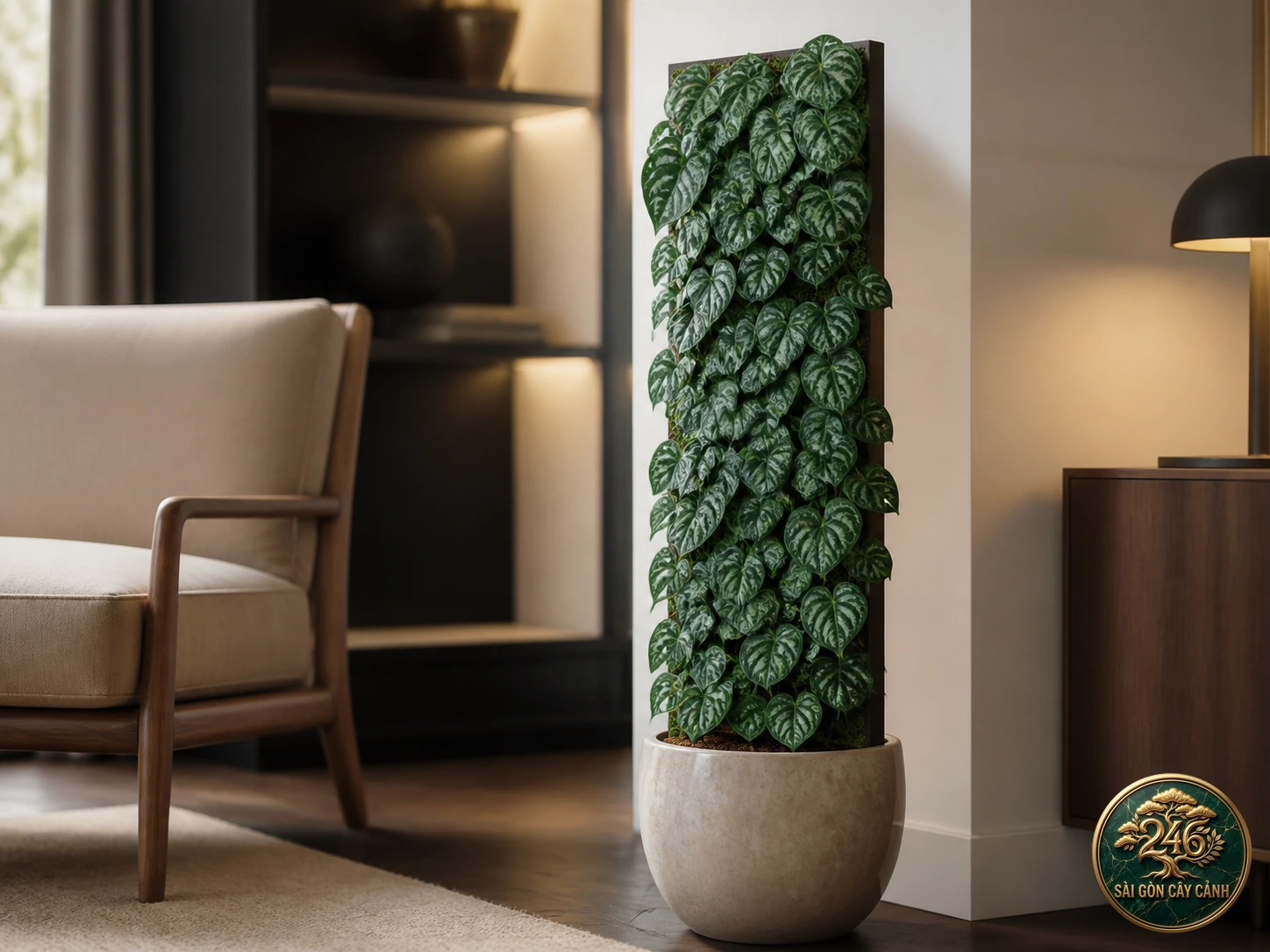
Within fine interior landscape design, Rhaphidophora cryptantha represents the pinnacle of botanical geometry. A wall-mounted wooden plank adorned with silver-veined shingle leaves serves as a living vertical art piece, infusing modern spaces with tranquil, otherworldly sophistication.
Staging mounted planks against raw concrete or dark timber walls yields breathtaking textural and organic contrast.
Within fine interior living design, a wall-mounted plank of Rhaphidophora cryptantha functions as an enchanting living relief sculpture. Crystalline silver veins shimmering across dark emerald velvet introduce serene depth, geometric elegance, and mystical allure into executive suites and modern living rooms.
12. Master Cultivation Axioms
Three master horticultural rules for cultivating exquisite shingle-climbing Rhaphidophora cryptantha specimens:
- Hydration axiom: Strictly provide a flat moss-lined timber plank for leaves to clasp flush, never allowing stems to dangle freely and regress.
- Illumination axiom: Deliver gentle diffused daylight between 1,200 and 2,500 lux, shielding delicate velvety blades from direct solar radiation.
- Sanitation axiom: Maintain elevated atmospheric humidity between 75% and 90%, misting the moss mount daily with purified water.
13. Frequently Asked Botanical Questions (FAQs)
Why is Rhaphidophora cryptantha called a ‘shingle plant’?
‘Shingle plant’ is a botanical term for climbing vines whose alternating leaves overlap tightly and press flush against tree bark like roof shingles.
Can it climb on a conventional round moss pole?
It struggles on round poles. It requires a broad flat plane, such as a cedar board, for its leaves to spread completely flat. Curved poles cause leaves to flare outward.
How do I ensure the vine adheres to a new plank?
Use soft cotton thread to gently secure the stem flat against a moss-lined plank; adventitious roots anchor securely within ten to fourteen days.
Does it ever produce large split adult leaves?
In nature, upon reaching high sunlit forest canopies, it can enter a free-branching adult phase. Indoors, collectors intentionally maintain its exquisite juvenile shingle form.
What is the easiest method to water a mounted plank?
The most effective method is taking down the plank, briefly submerging the moss mount in a basin of room-temperature water for thirty seconds, draining, and rehanging.
Can Rhaphidophora cryptantha be cultivated as a trailing hanging basket plant?
Strictly unrecommended. Deprived of a flat timber substrate, climbing axes regress, producing dwarfed foliage, losing silvery venation, and eventually collapsing as adventitious anchor roots fail to establish adhesion.