
Living plant profile
Shrubby sanchezia
Sanchezia speciosa
Comprehensive botanical dossier for Shrubby sanchezia (Sanchezia speciosa). Identification, lighting calibration, porous substrate formulation, and cultivation guide by Saigon Cay Canh.
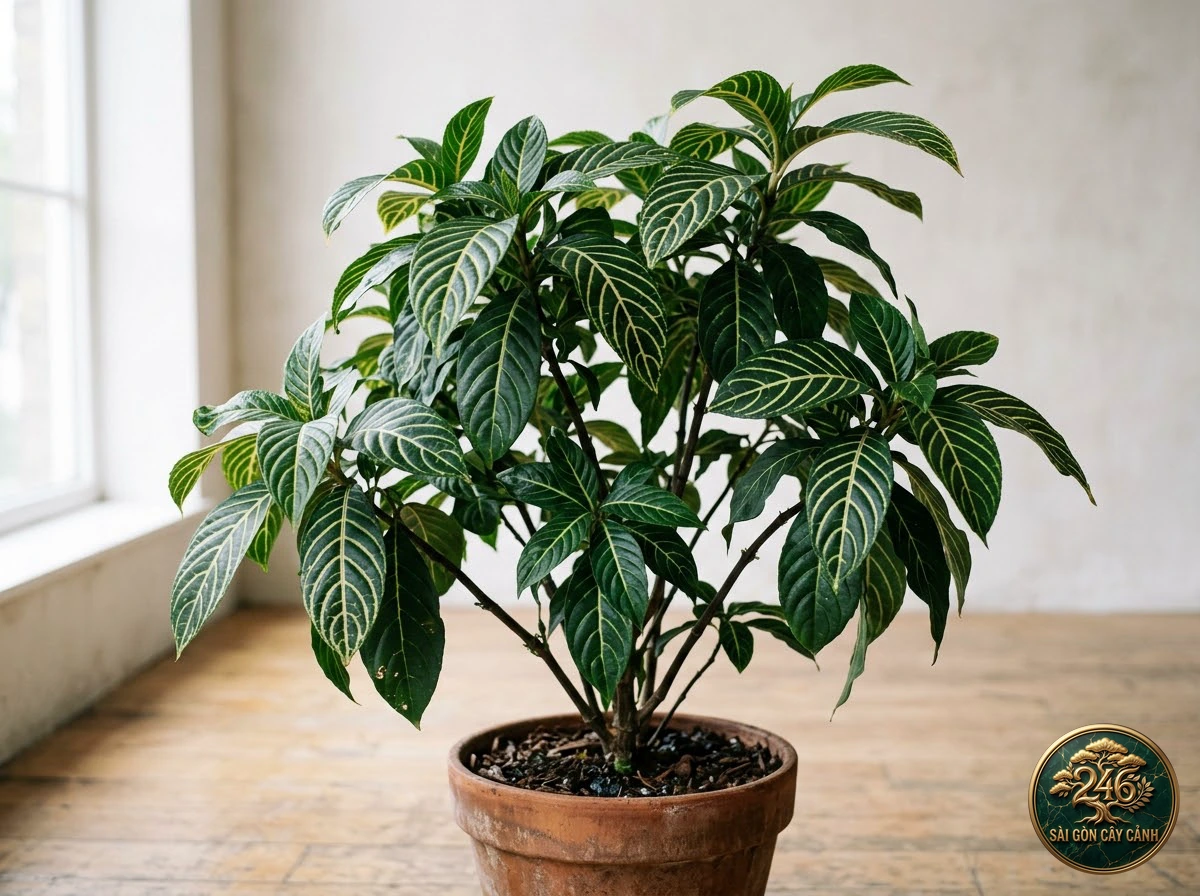
Shrubby sanchezia (Sanchezia speciosa) is an opulent, aristocratic tropical foliage shrub in the family Acanthaceae, indigenous to humid Andean rainforest understories of Ecuador and Peru. Renowned for sculptural quadrangular purplish stems, expansive glossy emerald foliage accentuated by vivid golden-cream radial venation, and tubular yellow flowers clasped in rich crimson bracts.
1. Core Botanical Taxonomy & Cultural Specifications
| Scientific Name | Sanchezia speciosa |
|---|---|
| Botanical Family | Acanthaceae (Acanthus Family) |
| Native Distribution | South American rainforests (Ecuador, Peru, Colombia) |
| Growth Demeanor | Erect evergreen soft-wooded shrub, lushly branched habit |
| Lighting Threshold | Bright diffuse light to gentle partial sun (1,500 – 3,500 lux) |
| Hydration Cadence | Generous steady hydration; moist but well-drained, intolerant of drought |
| Substrate Formulation | Humus-rich alluvial loam, pine bark chips, pumice, coco coir |
| Thermal Range | 20°C – 32°C (tropical warmth lover; sensitive beneath 15°C) |
| Relative Humidity | 70% – 85% (rainforest-tier ambient humidity) |
| Cultivation Difficulty | Easy to moderate (demands consistent moisture and bright diffuse light) |
| Pet Safety Profile | Certified 100% pet safe (non-toxic to companion animals) |
Morphologically, Sanchezia speciosa represents an erect, soft-wooded evergreen shrub growing 1.5 to 2.5 meters in wild understories, easily maintained between 60 and 100 cm in indoor containers. Stems display a sharply 4-angled (quadrangular) architecture, their smooth surfaces flushed with rich purplish-red or wine-colored hues along young internodes.
Leaves are arranged opposite-decussate, expansive blades measuring 15 to 30 cm long and 7 to 12 cm wide, obovate-oblong to broad-lanceolate with cuneate bases and acute apices. Adaxial surfaces are deep saturated emerald green, vividly illuminated by a golden-cream central costa and 10-14 pairs of lateral veins creating theatrical graphic contrast.
Inflorescences emerge as dense erect terminal spikes 10 to 20 cm long, enclosed by large, imbricated crimson-red ovate bracts. From these scarlet bracts, bright tubular golden-yellow flowers 4-5 cm long protrude gracefully, their stamens extending outward to attract tropical hummingbirds.
2. Morphological Identification & Foliar Architecture

Diagnostic keys distinguishing Sanchezia speciosa from Zebra plant (Aphelandra squarrosa) include Sanchezia’s prominent quadrangular purplish stems, much larger smooth non-bullate foliage, and distinct bicolored inflorescences featuring scarlet bracts contrasting with yellow florets, unlike Aphelandra’s monochromatic yellow bracts.
The abaxial foliar surface is pale sea-green with prominently raised carinate venation, providing rigid architectural scaffolding that keeps expansive leaves held flat and proud without drooping during diurnal humidity shifts.
Histological and morphological dissection of Sanchezia speciosa reveals polygonal foliar epidermal cells densely packed with deep green chloroplasts, dramatically offset by achlorophyllous parenchymal stripes flanking the midrib and primary laterals to generate stark ivory-gold banded venation. The distinctly quadrangular cauline stems feature an attractive purplish-red tint, typical of robust South American wet forest understory mega-herbs.
3. Photometric Calibration & Window Exposure Optimization
Photobiologically, Shrubby sanchezia attains optimal net assimilation under photon flux densities (PPFD) between 90 and 200 µmol/m²/s. It thrives in bright diffuse daylight; generous light exposure is essential to maintain vivid golden-cream venation and deep wine-red cauline tones.
Prolonged exposure to dim shade beneath 800 lux causes golden veins to narrow and fade toward dull pale green alongside leggy internodes; conversely, harsh midday solar exposure above 350 µmol/m²/s scorches broad blades and dulls foliar gloss.
Photobiological evaluation confirms that Shrubby sanchezia thrives under robust diffuse irradiance with an optimal PPFD span between 250 and 550 µmol/m²/s. Generous filtered daylight maximizes contrast between dark green lamina and striking golden venation; however, direct unshaded exposure exceeding 800 µmol/m²/s induces localized bleaching and foliar scorch along delicate golden vein pathways.
4. Quadrangular Purplish Cauline Histology & Golden-Crested Foliar Venation
Growth architecture in Sanchezia speciosa follows an upright, symmetrically branched shrub habit. To establish a balanced, compact profile for interior spaces, structural pinching in early spring or post-flowering triggers lateral nodes to branch freely, yielding a dense foliar dome.
Lower basal stems tend to lignify and shed older foliage over time; cutting back leggy canes encourages fresh basal shoots that produce the largest, most dramatically variegated golden-veined leaves.
Regarding irrigation, Sanchezia speciosa is an obligate moisture-loving tropical native. Its expansive foliar surface drives rapid transpiration during warm days; irrigate deeply whenever the topsoil surface dries slightly, sustaining gentle, continuous root hydration.
Despite heavy moisture consumption, roots succumb to stagnant puddle accumulation; always discard drained runoff from saucers after 15 minutes. Optimal vapor pressure deficit (VPD) ranges from 0.65 to 0.95 kPa; fine morning foliar misting preserves crisp turgor and leaf sheen.
The optimal microclimatic range requires warm temperatures between 22°C and 33°C, paired with a VPD index of 0.7 to 1.1 kPa and relative humidity above 65%. During dry spells, transient underwatering causes the substantial foliage to flag noticeably; generous irrigation promptly restores full cellular turgor within hours.
The robust semi-woody shrub habit of Sanchezia speciosa reaches 1.2 to 2 meters, bearing symmetrical ascending quadrangular branches. Terminal spicate inflorescences display brilliant scarlet bracts clasping tubular golden-yellow corollas 4 to 5 cm in length, with exerted stamens engineered by nature to invite hovering avian nectar feeders.
5. Porous Aggregate Substrate Engineering & Aeration Dynamics
Potting mix for Sanchezia speciosa demands high organic fertility married with superior porosity and drainage. A proven recipe consists of 35% humus-rich alluvial loam, 30% buffered coarse coco coir chips, 20% pumice or fine pine bark, and 15% aged organic worm castings.
Target substrate pH spans circumneutral 6.0 to 6.8. Because broad leaves demand abundant water and nutrients, choose generous containers with base drainage apertures lined with a 2 cm pumice drainage layer to ensure free outflow during humid monsoons.
Potting substrates for Sanchezia must reflect the rich fertility and open drainage of Andean montane forest soils. A standard potting recipe incorporates 40% loamy topsoil, 30% decomposed organic leaf compost, 20% carbonized rice hulls, and 10% coarse perlite, delivering consistent moisture retention and a buffered pH of 6.0 to 6.8.
6. Organic Nutrition Schedules & Periodic Micronutrient Priming
Nutritional management requires steady feeding with balanced bio-organic NPK (10-10-10 ratio) or diluted vermicompost tea calibrated to an EC of 0.8 to 1.2 mS/cm every 3 weeks through active vegetative flushes.
Periodic supplementation with soluble magnesium and zinc heightens the chromatic contrast of golden veins against deep emerald mesophyll; top-dressing slow-release organic granules at the onset of warm rains strengthens root health.
Nutritional management emphasizes liquid bio-organic feeds such as vermicompost extract enriched with natural fulvic acid applied monthly at an EC of 0.8 to 1.0 mS/cm. Chelate-rich microelements including iron and magnesium intensify the velvety emerald lamina and the luminous purity of golden leaf veins.
7. Clinical Diagnostic Matrix & Rapid Correction Protocols
| Clinical Symptom | Primary Etiology | Diagnostic Evaluation | Corrective Prescription |
|---|---|---|---|
| Broad leaves drooping severely and losing turgor | Acute moisture deficit from severe root ball desiccation in warm weather | Assess soil moisture depth and weigh container for lightness | Slowly drench root ball with water until thoroughly saturated; turgor restores within 2 hours |
| Golden veins fading into dull pale green | Chronic light starvation from placement in deep interior shade beneath 800 lux | Measure ambient lux levels at foliage height with light meter | Relocate planter to brighter window perimeter protected by sheer curtains |
| Foliar margins crisping brown, dry, and brittle | Excessively low humidity in air-conditioned interiors combined with dry drafts | Test ambient relative humidity and inspect air-conditioner airflow paths | Boost humidity using ultrasonic misting and relocate plant away from direct AC vents |
| Young leaves curling with sticky honeydew residues | Mealybugs or aphid colonies feeding within tender petiole axils | Examine leaf axils and abaxial surfaces under magnification | Wipe pests away with organic soap lather on a cloth and spray biological neem emulsion |
8. Cryptic Pest Prophylaxis & Foliar Surface Sanitation
Common pests include mealybugs clustering in leaf axils and spider mites rasping abaxial blade surfaces during dry indoor spells. Sponge or rinse leaves periodically with lukewarm water, applying biological 0.5% cold-pressed neem emulsion at dusk.
Cercospora fungal leaf spot may develop if water droplets linger overnight on broad blades in stagnant air. Always irrigate in early morning directly onto the potting medium, ensuring foliage dries completely before nightfall.
Plant health sanitation focuses on periodic wiping of wide foliar blades to deter cryptic mealybugs and spider mites. Gently wiping the distinctive vein valleys monthly with a soft damp cloth infused with a trace of pure cold-pressed neem oil maximizes foliar respiration while repelling pests naturally.
9. Asexual Propagation Methodology & Root Strike Protocols
Propagating Sanchezia speciosa succeeds reliably via semi-hardwood or apical stem cuttings taken during warm spring or rainy months. Select vigorous shoots 12-15 cm long bearing 2-3 nodes, make clean cuts beneath a node, and trim large leaves by half to curb transpiration.
Insert prepared cuttings into moist perlite or clean coarse sand inside a ventilated clear propagation box maintained at 23°C – 26°C. Over a 25 to 35 day developmental interval, profuse white roots emerge from nodes and fresh shoot flushes expand.
Vegetative multiplication using semi-lignified quadrangular stem cuttings achieves over 95% rooting success. Taking 12 to 15 cm shoot segments with 2 leaf pairs, reducing leaf area by half to minimize transpiration, and inserting into moist sand-perlite beds under warm shade over a 25 to 35 day interval produces vigorous root clumps.
10. Companion Animal Safety Profile & ASPCA Non-Toxic Verification
This non-toxic profile allows plant lovers to display Shrubby sanchezia boldly across living rooms, entrance halls, or balconies without concern over accidental companion pet contact.
11. Biophilic Curation & Contemporary Interior Design Styling

In tropical interior design and contemporary Biophilic concepts, Sanchezia speciosa radiates regal grandeur and authentic Amazonian vitality. Golden lightning-bolt venation radiating across saturated emerald blades produces magnificent graphic contrast and opulent sophistication.
A commanding specimen situated in reception atriums, sun-drenched living room corners, or interior lightwells becomes a dynamic living sculpture, testifying to refined taste and deep appreciation for tropical botanical treasures.
Within high-end Biophilic interiors and expansive tropical verandas, Sanchezia speciosa commands attention as a dramatic foliage centerpiece. Its boldly striped golden foliage paired with lustrous purplish stems and scarlet-bracted inflorescences introduces opulent tropical texture, illuminating dimly lit corners with architectural brilliance.
12. Master Principles for Sustainable Indoor Acclimatization
Preserving incandescent golden venation and robust cauline health in indoor Shrubby sanchezia demands three foundational axioms:
- Hydration axiom: Irrigate deeply when topsoil dries slightly; never permit the potting medium to desiccate into wilting.
- Illumination axiom: Position plants where bright diffuse daylight of 1,500 to 3,500 lux is received to preserve golden vein contrast.
- Maintenance axiom: Pinch terminal shoots in early spring to encourage dense lateral branching and compact bushy habit.
13. Frequently Asked Questions Regarding Shrubby sanchezia (FAQs)
Is Shrubby sanchezia easy to care for indoors?
Very straightforward provided bright diffuse light and steady moisture are maintained; it grows vigorously with few pest issues.
What is the ideal repotting interval?
Repot every 1 to 2 years in spring when roots fill the container, stepping up into a pot 5 cm wider.
How can cultivators coax vibrant tubular yellow flowers?
Supply generous bright diffuse daylight and feed phosphorus-rich organic fertilizer during summer to trigger terminal floral spikes.
Can the shrub be pruned to control height?
Yes; prune terminals back in early spring to encourage dense, compact lateral branching at lower elevations.
Is the specimen safe around domestic pets?
Completely non-toxic; certified 100% pet safe by ASPCA guidelines, presenting zero danger to companion animals.
Why does Sanchezia shed its lower basal leaves progressively?
Basal foliar drop typically indicates chronic low light starvation or prolonged dry-out between waterings; moving the container to bright diffuse light and maintaining consistent soil hydration quickly arrests lower leaf loss.