Living plant profile
Sky plant ionantha
Tillandsia ionantha
Comprehensive botanical dossier for Sky plant ionantha (Tillandsia ionantha). Identification, lighting calibration, porous substrate formulation, and cultivation guide by Saigon Cay Canh.
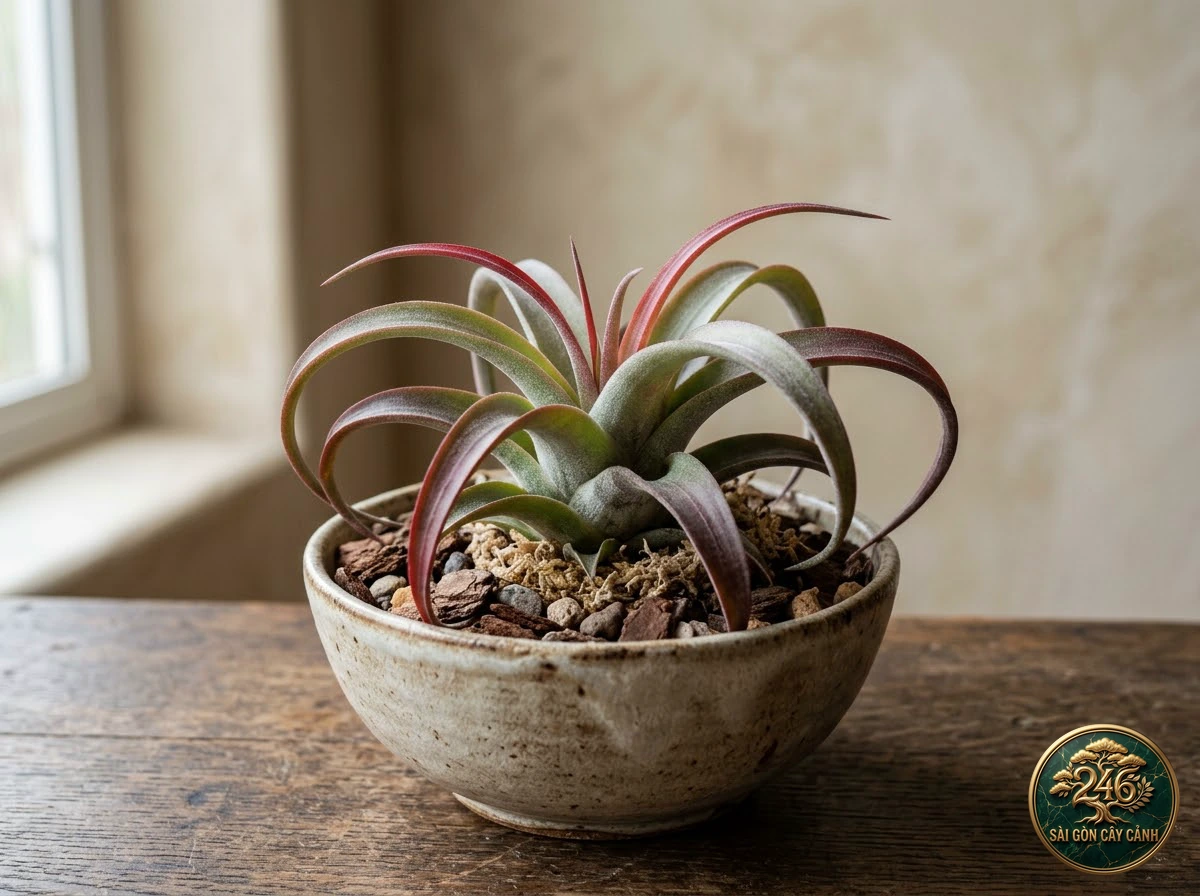
Sky plant ionantha (Tillandsia ionantha)
Comprehensive botanical monograph, morphological taxonomy, and cultivation guidelines by Saigon Cay Canh
Care Compass Quick Reference
| Light Spectrum | Bright indirect to filtered sunlight (3,000 – 6,000 lux); relishes gentle early morning sun and exceptional air ventilation near breezy windows. |
|---|---|
| Irrigation Routine | Never plant in soil; soak entire plant in fresh water for 15-30 minutes 1-2 times weekly, then shake gently and dry upside down in breezy airflow; mist lightly between soakings. |
| Substrate Formula | Zero potting soil! Mount onto driftwood, cork bark, wire cradles, or display freestanding in well-ventilated wire baskets. |
| Thermal Range | 15°C – 32°C (59°F – 90°F; broad temperature tolerance; thrives indoors or on breezy sheltered verandas). |
| Relative Humidity | 50% – 75% (buoyant air movement is paramount; stagnant humidity causes basal moisture rot). |
| Maintenance Level | Very Easy (soil-free, clean, endlessly versatile for creative living-space displays). |
| Pet Safety & ASPCA | 100% Pet Safe (ASPCA confirmed non-toxic to dogs and cats; completely benign to inquisitive pets). |
1. Taxonomy & Botanical Classification
In classical and phylogenetic taxonomic frameworks, Sky plant ionantha is formally designated by its binomial nomenclature Tillandsia ionantha, belonging to the botanical family Bromeliad family (Bromeliaceae). The species is documented and verified across authoritative plant registries including Plants of the World Online (POWO) maintained by the Royal Botanic Gardens, Kew.
Native to tropical rainforest ecosystems, this botanical specimen has evolved specialized physiological traits to thrive beneath filtered forest canopies. In modern botanical design and horticultural practice, it is classified among premier interior foliage and flowering subjects, celebrated for its structural poise, resilient constitution, and sophisticated architectural visual balance.
Within urban interiors, particularly across tropical and subtropical regions such as Ho Chi Minh City, Sky plant ionantha has garnered widespread acclaim as an exemplary living centerpiece that harmonizes natural beauty with high cultivation adaptability.
2. Morphological Characteristics & Identification
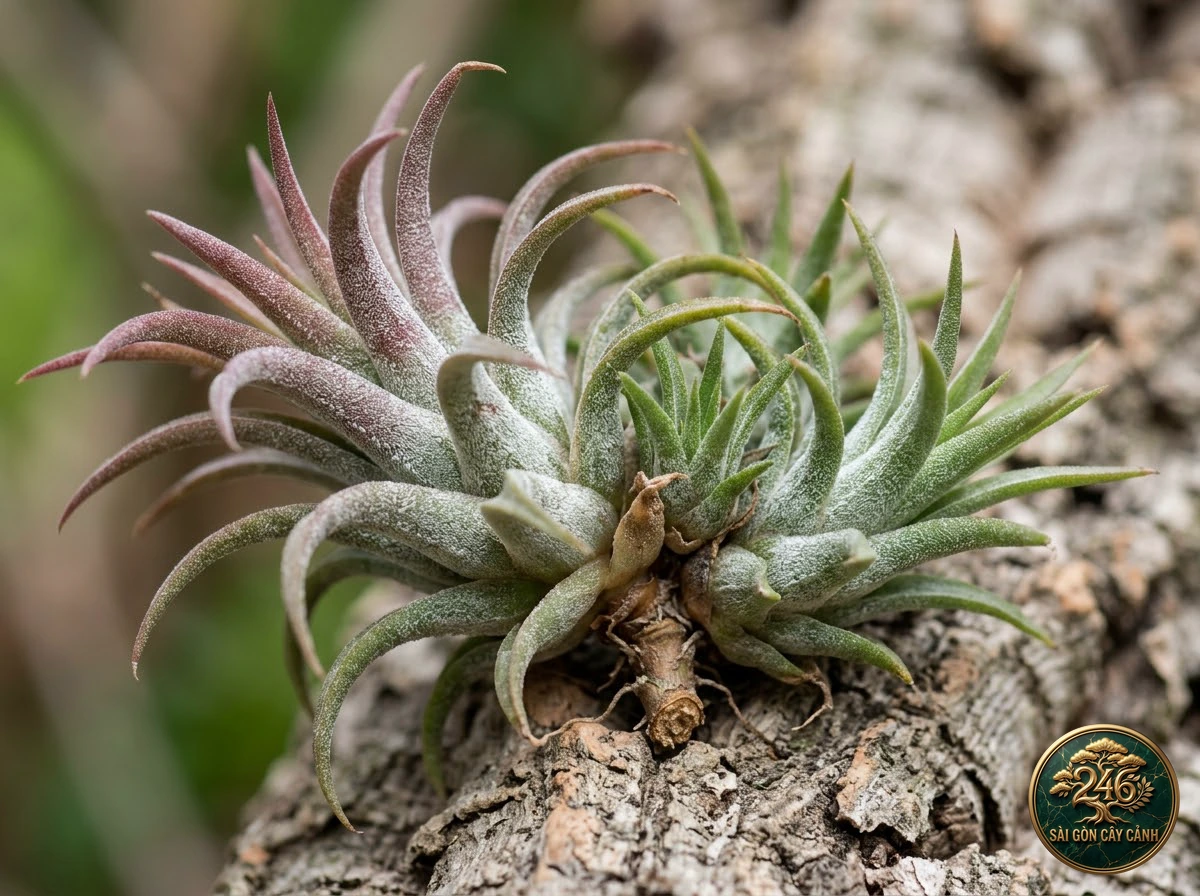
True atmospheric air plant (epiphyte) requiring zero soil; compact rosette of recurved succulent leaves densely clothed in peltate silvery-grey trichomes that absorb atmospheric moisture; foliage blushes fire-engine red prior to erupting with vivid violet-purple flowers with yellow anthers.
The foliar geometry of Tillandsia ionantha reveals exquisite adaptation for maximizing photosynthetic photon flux density within diffused light microclimates. The cellular arrangement of its epidermis minimizes transpiration while preserving dynamic leaf turgidity under steady indoor air currents. Leaf venation is distinct and finely textured, providing exceptional tactile and visual depth upon close inspection.
The subterranean root morphology is optimized for aeration and rapid moisture uptake. Adventitious feeder roots anchor firmly into granular substrate components while maintaining symbiotic relationships with beneficial microflora, conferring outstanding physiological stability against ambient shifts.
Key Nursery Identification Diagnostic Traits:
- Lamina Morphology: Symmetrical, well-developed coloration or patterning without chlorotic blotches under balanced lighting.
- Stems & Branching: Sturdy structural internodes exhibiting supple lignification and positive responses to canopy orientation.
- Root Integrity: Firm creamy-white or pale amber root tips grasping coarse media particles with complete absence of hypoxic odors.
3. Lighting Calibration & Spectrum
Bright indirect to filtered sunlight (3,000 – 6,000 lux); relishes gentle early morning sun and exceptional air ventilation near breezy windows.
Photosynthetically active radiation (PAR) dictates cell elongation rates and foliar pigmentation in Tillandsia ionantha. The recommended luminous intensity spans 2,000 to 4,500 lux of diffused illumination. Spectral requirements favor a balance between blue wavelengths (450 nm) for compact vegetative node development and red wavelengths (660 nm) for metabolic continuity and robust vigor.
Sustained placement in sub-1,000 lux environments triggers morphological etiolation, marked by elongated petioles, pale foliage, and weakened cellular turgor. Conversely, unshielded direct midday sun in excess of 10,000 lux results in rapid photo-inhibition and permanent foliar scorch lesions.
4. Watering Dynamics & Substrate Moisture
Never plant in soil; soak entire plant in fresh water for 15-30 minutes 1-2 times weekly, then shake gently and dry upside down in breezy airflow; mist lightly between soakings.
The foundational principle governing irrigation for Sky plant ionantha centers on establishing an alternating wet-aerated substrate moisture cycle. Root cells necessitate dissolved oxygen within interstitial capillary macropores for active metabolic respiration. Waterlogged conditions exceeding 48 hours induce anaerobic decay, facilitating opportunistic pathogens such as Pythium and Phytophthora.
Diagnostic Moisture Verification: Insert a wooden moisture probe 2-3 cm into the upper substrate layer; water only when the probe emerges dry and top granules lighten in shade. Deliver water evenly around the root zone until drainage runs freely from drainage ports, promptly discarding accumulated runoff from saucers.
5. Substrate Architecture & Soil Formulation
Zero potting soil! Mount onto driftwood, cork bark, wire cradles, or display freestanding in well-ventilated wire baskets.
Dense field soil and heavy peat blends without drainage aggregates invariably cause root asphyxiation in containerized specimens. To guarantee sustained botanical longevity, Saigon Cay Canh utilizes a custom-blended porous growing medium engineered with balanced physical parameters:
| Formulation Component | Volumetric Ratio | Hydraulic & Nutritional Function |
|---|---|---|
| Horticultural Pumice / Perlite | 35% – 40% | Maintains macro-porosity, resists compaction, ensures root oxygenation |
| Sphagnum Peat Moss / Coco Coir | 30% – 35% | Retains beneficial available moisture and buffers root-zone cation exchange |
| Carbonized Rice Hulls / Fir Bark | 15% – 20% | Promotes rapid hydraulic throughput and stabilizes substrate friability |
| Enriched Worm Castings | 10% | Supplies organic humic acids and beneficial protective rhizobacteria |
6. Temperature & Ambient Humidity
15°C – 32°C (59°F – 90°F; broad temperature tolerance; thrives indoors or on breezy sheltered verandas).
Relative humidity guidelines: 50% – 75% (buoyant air movement is paramount; stagnant humidity causes basal moisture rot).. In air-conditioned high-rise apartments where relative humidity drops beneath 45%, foliar margins can exhibit premature crisping. Mitigate dry microclimates by grouping plants to establish a communal transpiration envelope, or placing planters atop wet pebble trays.
Shield plants from direct thermal velocity shocks, avoiding proximity to HVAC supply louvers, space heaters, and heat-radiating electronics.
7. Nutrient Management & Fertilization
Feed Tillandsia ionantha following the proven “weakly, weekly” horticultural paradigm. During peak vegetative flushes throughout tropical warm and rainy months, administer a balanced water-soluble NPK formulation (such as 20-20-20 or 15-15-15 with chelated micronutrients) diluted to one-third to one-half of label strength.
Every 2-3 months, supplement with worm casting top-dressings or cold-water seaweed extract to reinforce resilient root development. During cooler or overcast intervals, reduce feeding frequency to every 6-8 weeks to prevent harmful mineral salt accumulation in the rhizosphere.
8. Pruning & Propagation Methods
Strategic structural pruning preserves an aesthetically refined crown, enhances airflow through dense foliar clusters, and stimulates active axillary bud growth. Always utilize clean bypass shears sterilized with 70% isopropyl alcohol between cuts.
Propagation is effectively executed via basal division, apical stem cuttings, or dividing subterranean rhizome structures in moist, well-aerated propagation media. Maintain cuttings under gentle shade and elevated humidity for 2-3 weeks until root establishment is confirmed.
9. Pest, Disease & Physiological Disorders
Common indoor pests include mealybugs (Pseudococcidae), spider mites (Tetranychidae), and thrips. Early-stage infestations are efficiently combated with manual alcohol swabbing or applying diluted horticultural cold-pressed neem oil suspensions.
Physiological Disorder Diagnostic Matrix:
- Generalized Basal Chlorosis: Typical consequence of saturated substrate, root oxygen depletion, or obstructed drainage holes.
- Desiccated Leaf Margins & Tips: Indicator of atmospheric drought, direct AC airflow exposure, or excess fertilizer salinity.
- Etiolated Stems & Reduced Leaf Size: Symptom of severe light deprivation, requiring relocation to an area with brighter indirect light.
10. Toxicity, Pet Safety & ASPCA Classification
Safety Assessment: 100% Pet Safe (ASPCA confirmed non-toxic to dogs and cats; completely benign to inquisitive pets).
According to veterinary toxicology databases including the ASPCA Animal Poison Control Center, botanical species within Bromeliad family (Bromeliaceae) are verified as physiologically benign to domestic pets. Plant tissues contain zero harmful alkaloids or dangerous physiological toxins.
Nonetheless, conscientious plant stewardship recommends elevating decorative specimens out of reach from playful pets to prevent physical breakage of the delicate foliage.
11. Interior Architecture, Styling & Feng Shui
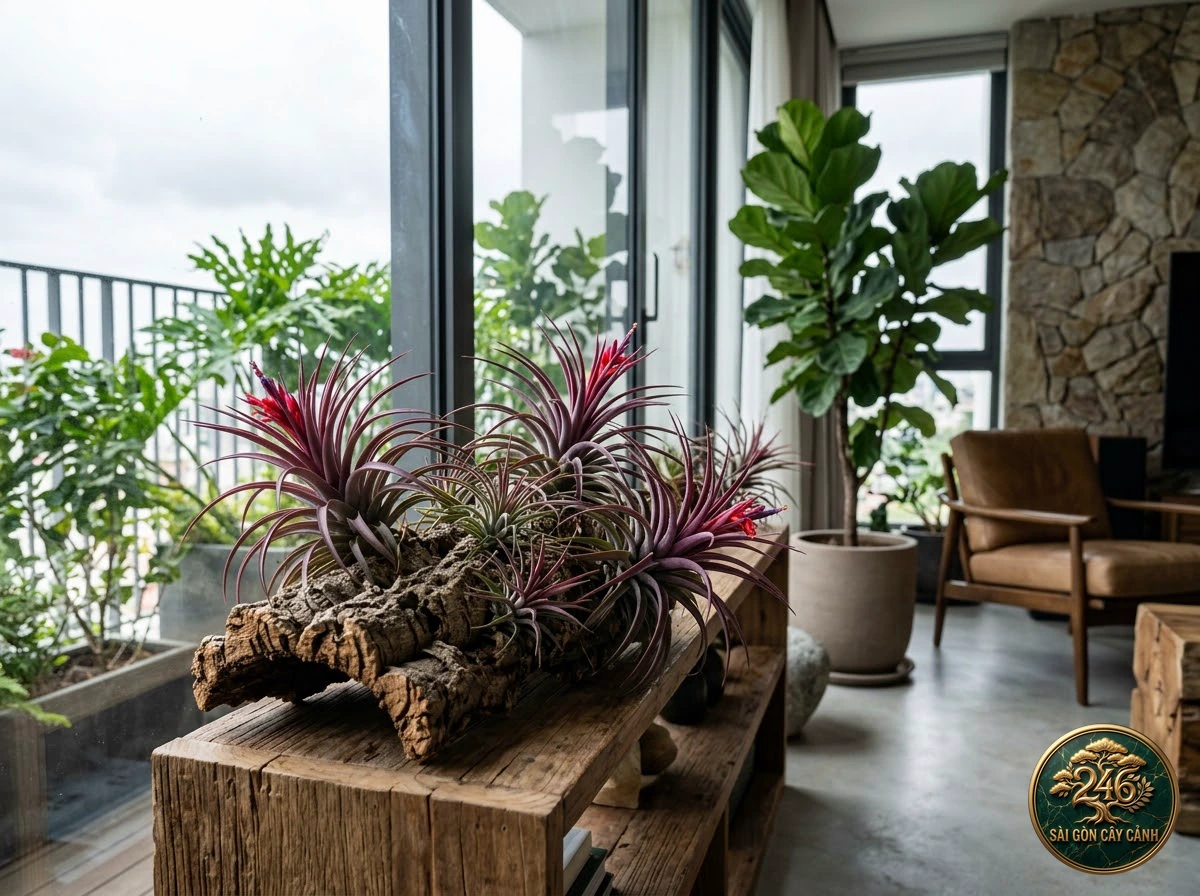
Within contemporary biophilic interior architecture, Sky plant ionantha serves as an exceptional living element, harmonizing modern urban minimalism with verdant organic vibrancy. It excels as an artistic desk companion, console table centerpiece, or featured specimen in residential atriums.
In classical botanical Feng Shui, the lush vitality of the plant stimulates uplifting chi circulation, symbolizing enduring harmony, growth, and prosperity. Integrating living plants into daily environments visibly reduces digital eye fatigue and fosters mental rejuvenation.
12. Common Pitfalls & Mistakes
- Rigid Calendar-Based Watering: Irrigating without testing substrate moisture invariably leads to root decay. Always verify moisture depth before watering.
- Placement in Deep Interior Shadows: Plants require minimum 1,500 lux diffused light to maintain positive net photosynthetic energy.
- Employing Undrained Decorative Vessels: Trapped standing water creates an anaerobic death trap for roots within 7-14 days.
- Excessive High-Concentration Fertilizing: Fertilizer overdose chemically burns tender feeder roots, triggering acute leaf drop.
13. Botanical FAQs
Can this plant thrive entirely under commercial fluorescent or LED office fixtures?
Yes, provided the artificial lighting delivers minimum 2,500 lux across full-spectrum white wavelengths for 8-10 hours daily.
What is the recommended repotting interval?
Repot every 12 to 18 months, or whenever roots fully encircle the inner root ball and substrate begins draining sluggishly.
Why are new leaves appearing smaller and paler?
This typically reflects either insufficient photosynthetic light or depleted substrate macronutrients. Reposition closer to bright indirect light and feed with dilute balanced fertilizer.