Living plant profile
Trailing jade
Peperomia rotundifolia
Comprehensive botanical dossier for Trailing jade (Peperomia rotundifolia). Identification, lighting calibration, porous substrate formulation, and cultivation guide by Saigon Cay Canh.
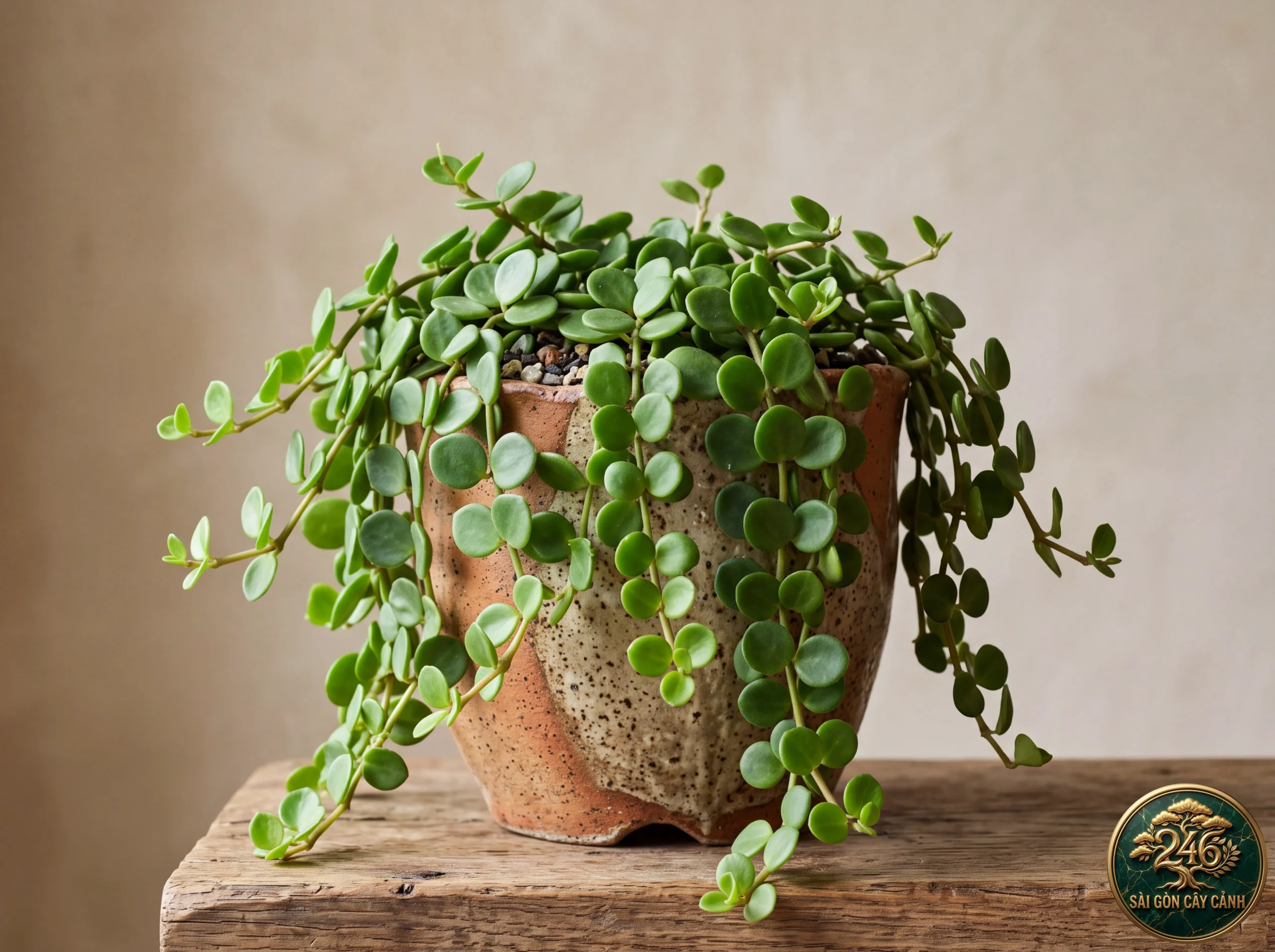
Trailing jade (Peperomia rotundifolia) is an exquisite miniature cascading foliage jewel in the pepper family (Piperaceae), renowned for thread-like creeping stolons adorned with innumerable plump orbicular jade coin leaves that spill softly over hanging pots.
1. Core Botanical Taxonomy & Cultural Specifications
| Scientific Name | Peperomia rotundifolia |
|---|---|
| Botanical Family | Piperaceae (Pepper Family) |
| Native Distribution | Tropical rainforests of Central and South America (Caribbean, Amazon basin) |
| Growth Demeanor | Epiphytic mat-forming or trailing creeping herb with dense foliar carpeting |
| Lighting Threshold | Gentle diffuse to moderate filtered daylight (1,000 – 2,500 lux) |
| Hydration Cadence | Irrigate when surface dries slightly; maintain gentle, uniform moisture |
| Substrate Formulation | Long-fiber sphagnum, fine pine bark, shredded coco coir, pumice |
| Thermal Range | 18°C – 28°C (comfortable temperate warmth; protect from chill below 12°C) |
| Relative Humidity | 65% – 85% (flourishes under elevated rainforest atmospheric humidity) |
| Cultivation Difficulty | Easy (vigorous trailing habit, ideal for hanging baskets) |
| Pet Safety Profile | 100% Non-Toxic (ASPCA certified completely safe for dogs and cats) |
Taxonomically and geographically, Peperomia rotundifolia is a widespread epiphyte throughout lowland tropical rainforests from Mexico across the Caribbean down into the Amazon basin. It carpets moss-padded tree trunks and damp riparian boulders, weaving lush living emerald tapestries that buffer moisture within rainforest canopies.
The specific epithet ‘rotundifolia’ derives from Latin meaning ’round-leaved’, capturing the geometry of its foliage: miniature circular to broadly elliptic button-like blades spanning merely 6 to 12 mm across. Thick and succulent with a lustrous emerald sheen and faint veins, leaves alternate densely along slender, creeping reddish-brown stolons.
Stolons trail 30 to 60 cm in graceful cascades, producing adventitious roots at nodes upon touching moist surfaces. Inflorescences are diminutive filiform spikes of pale green 1 to 2 cm long rising from branch tips, yielding tiny sticky berries adapted for animal and wind dispersal.
2. Morphological Identification & Foliar Architecture
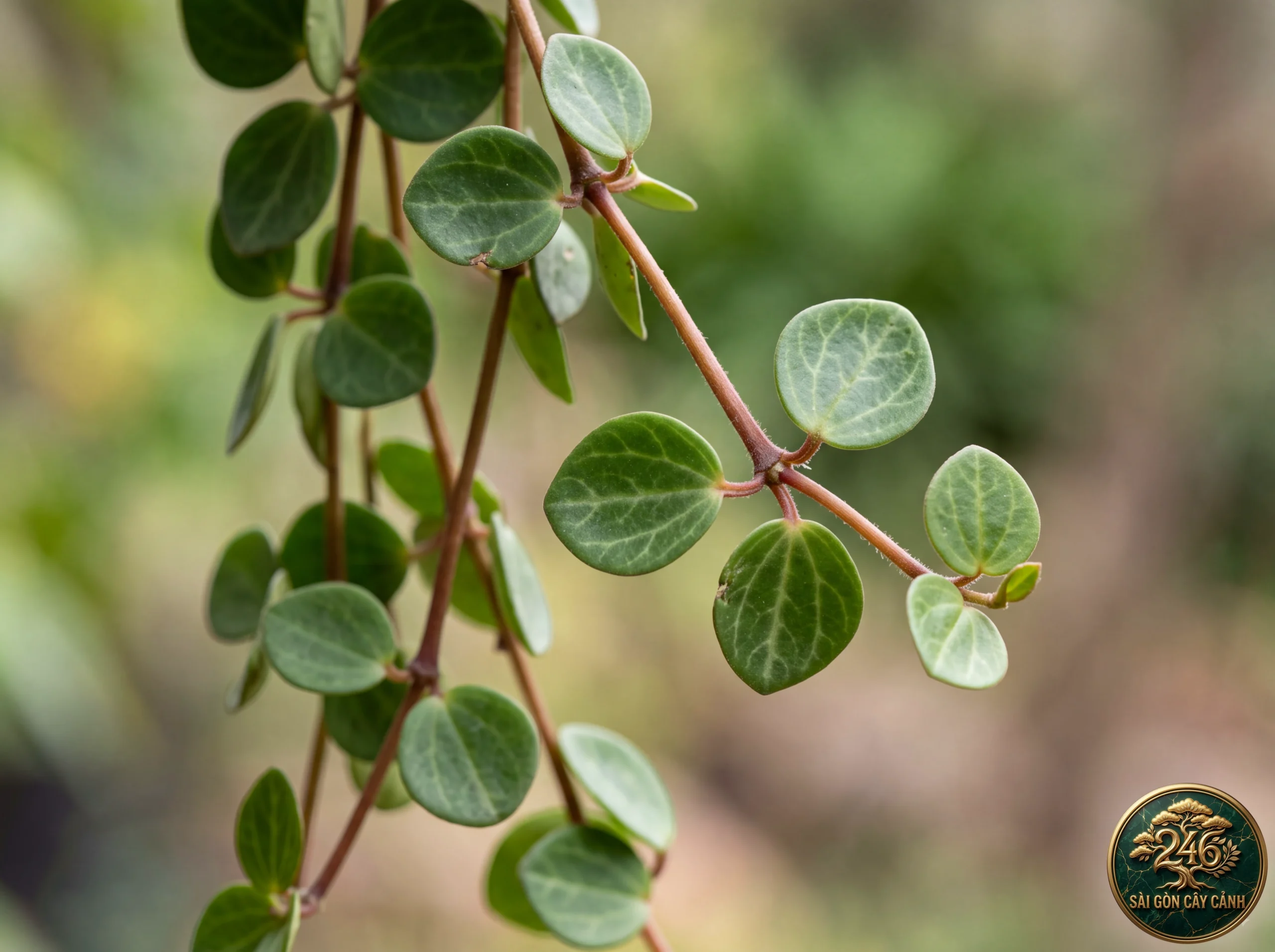
Diagnostic keys identifying Trailing jade center on its tiny, fleshy orbicular alternate leaves strung along thread-like stems, distinguishing it from Peperomia tetraphylla (whorled 4-leaf phyllotaxy) and Peperomia prostrata (turtle-shell patterned venation). Under micro-inspection, the glabrous cuticle reflects light with shimmering jade radiance.
Under indoor hanging basket cultivation, the plant forms a cascading emerald sphere tumbling like a living waterfall of green coins. The dense canopy completely cloaks the pot rim, introducing lush organic softness into bright interior settings.
Micro-histological analysis of Peperomia rotundifolia leaves reveals a smooth, flexible cuticular envelope over convex epidermal cells. Beneath lies a stratified 2 to 3 layered water-storing hypodermis occupying over half the miniature orbicular blade’s volume, buffering moisture reserves upon epiphytic bark ledges. Compact palisade mesophyll rich in dark emerald chloroplasts maximizes diffuse photon harvesting under dense canopies.
3. Photometric Calibration & Window Exposure Optimization
Photometric calibration targets gentle indirect daylight between 1,000 and 2,500 lux (20 to 50 µmol/m²/s PPFD). As an understory epiphyte, it flourishes when suspended near east-facing apertures or 1.5 to 2 meters back from sheer-curtained south-facing windows.
Shield the delicate cascading foliage from unshielded direct sunbeams, as intense thermal radiation quickly scorches the tiny button leaves and desiccates fragile stolons. Yellowing foliage accompanied by sparse internodal growth indicates insufficient ambient daylight.
Biophotometric assessments confirm that Trailing jade achieves net photosynthetic saturation across a modest PPFD threshold of 20 to 50 µmol/m²/s. As an understory epiphyte, it flourishes in gentle indirect daylight; exposure to unshielded direct sun exceeding 70 µmol/m²/s bleaches the tender coin leaves and causes rapid thermal desiccation.
4. Prostrate Mat-Forming Stoloniferous Habit & Diminutive Coin Lamina
The trailing growth habit of Peperomia rotundifolia features prolific branching and gravitational cascading. Pliant stolons weave into a multi-layered living mat that shelters root zones from rapid desiccation.
The root system is shallow and fine, adapted to anchor into mossy bark sheaths. Shallow, wide-mouthed containers are ideal, offering ample surface area for running stolons to strike adventitious nodal roots.
Thermal comfort spans 18°C to 28°C. The species flourishes within stable indoor temperatures; shield containers from direct cold air conditioning drafts and heating radiators.
Relative humidity is crucial for this epiphyte, ideally calibrated between 65% and 85%. Situating containers in bright bathrooms, near planted aquariums, or deploying ultrasonic humidifiers preserves foliar turgidity and glossy coin sheen.
The target vapor pressure deficit (VPD) spans 0.6 to 0.85 kPa matched with relative humidity of 65% to 85%. In sealed air-conditioned interiors, suspending containers over pebble-water trays or using ultrasonic humidification preserves natural stomatal conductance, eliminating premature coin leaf drop.
The cascading stoloniferous kinematics of Peperomia rotundifolia rely on pliant, thread-like stems that ramify into a dense lace-like web. At every alternate coin-bearing node, fine adventitious rootlets stand primed to anchor into moist moss pads, establishing a stabilizing living mat that insulates roots against tropical downpours.
5. Porous Aggregate Substrate Engineering & Aeration Dynamics
Potting substrates for Trailing jade require gentle moisture retention paired with supreme macroporosity. An optimal recipe blends 35% shredded Chilean sphagnum, 30% fine pumice (2-4 mm), 20% fine pine bark, and 15% perlite, stabilizing pH between 5.8 and 6.6.
Regarding hydration cadence, maintain uniform light moisture throughout the root zone; do not allow complete desiccation like desert succulents, but strictly avoid soggy media. Water via gentle overhead spray or brief bottom soaking in early morning.
Substrate engineering for hanging containers requires an air-filled porosity exceeding 35% paired with gentle capillary retention. Blending 35% shredded Chilean sphagnum with 30% fine pumice aggregate establishes a resilient organic matrix that supplies continuous cool root moisture while buffering pH between 5.8 and 6.6.
6. Organic Nutrition Schedules & Periodic Micronutrient Priming
Nutritional management deploys ultra-dilute organic liquids at one-quarter strength every 3 to 4 weeks during active growth flushes. Dilute vermicompost extract or hydrolyzed fish emulsion mixed at an EC beneath 0.4 mS/cm supplies gentle nutrients for trailing stolons.
Avoid administering concentrated fertilizers over dense foliage to prevent chemical salt scorch on tender coin leaves. Cease feeding during cool winter rest intervals.
Organic nutritional regimens deploy diluted vermicompost extract paired with hydrolyzed fish protein at an EC strictly below 0.4 mS/cm monthly during active growth flushes. Bio-available iron and magnesium nourish running stolons without chemical rootlet scorch.
7. Clinical Diagnostic Matrix & Rapid Correction Protocols
| Clinical Symptom | Primary Etiology | Diagnostic Evaluation | Corrective Prescription |
|---|---|---|---|
| Coin leaves turning translucent, yellow, and dropping profusely | Over-irrigation causing anaerobic rot among delicate epiphytic rootlets | Inspect potting mix to discover waterlogged, sour-smelling medium | Halt watering immediately, unpot to replace with airy sphagnum-pumice mix, ventilate |
| Trailing stolons shriveling dry and leaves falling crispy-dry | Severe dehydration or chronically hot, arid air-conditioned atmosphere | Feel leaves to observe deflated, thin, papery texture lacking turgor | Soak container bottom briefly in tepid water for 5 minutes and raise ambient humidity |
| Stolons stretching thinly with excessive internodal spacing between leaves | Light starvation from suspension in deeply shaded room corners | Measure ambient light levels below 800 lux at the basket position | Relocate hanging basket closer to luminous indirect daylight near windows |
| White cottony wax deposits clustered along creeping stolons | Mealybug infestation taking refuge inside the dense foliar mat | Examine under magnification to confirm small oval mealybug insects | Apply dilute 0.5% botanical insecticidal soap spray at dusk to eliminate pests |
8. Cryptic Pest Prophylaxis & Foliar Surface Sanitation
Plant health surveillance targets Botrytis gray mold and mealybugs by maintaining continuous convective airflow around the trailing canopy. Periodically trim elderly, desiccated strands beneath the mound to facilitate air movement.
If mealybugs appear, spray with dilute 0.5% botanical insecticidal soap at dusk to eradicate pests safely without damaging succulent foliar cuticles.
Integrated Pest Management (IPM) prioritizes continuous convective airflow to prevent Botrytis gray mold and mealybugs inside dense foliage. Trimming elderly desiccated strands and applying preventative 0.5% botanical insecticidal soap at dusk keeps the coin carpet vibrant.
9. Asexual Propagation Methodology & Root Strike Protocols
Multiplying Peperomia rotundifolia is exceptionally rapid via stem strand cuttings 8 to 12 cm long bearing multiple nodes and adventitious rootlets. Pin stolon segments horizontally across moist sphagnum or perlite beds.
Maintain humidity beneath a ventilated transparent cover at 22°C – 26°C; within a 25 to 35 day interval, nodal roots anchor firmly into substrate and vigorous new trailing shoots emerge with a 100% strike rate.
During trailing stolon propagation, pinning 8 to 12 cm running strands horizontally across moist sphagnum beneath a ventilated humidity cover at 22°C – 26°C over a 25 to 35 day interval induces robust nodal rooting and prolific branching with 100% success.
10. Companion Animal Safety Profile & ASPCA Non-Toxic Verification
Peperomia rotundifolia is verified by the ASPCA as 100% non-toxic to domestic pets. Devoid of noxious alkaloids or toxic sap, it is safe to display in hanging baskets in homes with curious pets.
11. Biophilic Curation & Contemporary Interior Design Styling

In modern Biophilic interior curation, Peperomia rotundifolia reigns as an ideal hanging basket specimen. Cascading strands of circular jade coins evoke a gentle green waterfall, softening sharp architectural lines in living rooms, reading nooks, and shaded balconies.
The plump coin geometry carries rich symbolic resonance of enduring abundance and good fortune. Its miniature emerald tapestry relieves visual fatigue and restores calm mindfulness to urban dwellers.
From a Biophilic environmental psychology viewpoint, the cascading emerald coin strands of Peperomia rotundifolia evoke the peaceful visual cadence of a living miniature waterfall. Watching the gentle motion of its trailing canopy relieves cognitive fatigue and restores calm mindfulness.
12. Master Principles for Sustainable Indoor Acclimatization
To maintain thriving, cascading Trailing jade foliage indoors, adhere faithfully to these three core principles:
- Hydration axiom: Hydration axiom: Maintain uniform light moisture, irrigating when surface dries slightly without bottom saturation.
- Illumination axiom: Illumination axiom: Suspend containers under gentle diffuse daylight of 1,000-2,500 lux, avoiding unshielded direct sun.
- Maintenance axiom: Humidity axiom: Maintain elevated ambient humidity of 65-85% with gentle convective air circulation around the canopy.
13. Frequently Asked Questions Regarding Trailing jade (FAQs)
Is Peperomia rotundifolia well-suited for hanging containers?
It is among the finest hanging basket foliage plants, naturally producing cascading strands of dense, fleshy round leaves.
How frequently should a hanging basket specimen be irrigated?
Depending on ambient room conditions, gentle watering every 2 to 3 days when the surface substrate dries slightly is ideal.
Does the plant shed foliage during cold winter weather?
Chilling beneath 15°C can trigger basal leaf drop; move containers into warmer, draught-free indoor spaces to protect foliage.
How can one make the hanging mound appear bushier?
Trim trailing stolons and pin the severed tips directly back onto the pot surface; they strike roots rapidly to thicken the crown.
Can this species be cultivated inside closed glass terrariums?
It thrives splendidly inside sealed terrariums owing to its high humidity affinity and miniature ornamental proportions.
How can one revive a dehydrated Peperomia rotundifolia following missed waterings?
If trailing stolons flag from dehydration, submerge the pot base in clean tepid water for 10-15 minutes until media is fully saturated, drain thoroughly, and place in cool shade; foliage recovers full turgidity within 24-48 hours.