
Living plant profile
Water jasmine
Wrightia religiosa
Comprehensive botanical dossier for Water jasmine (Wrightia religiosa). Identification, lighting calibration, porous substrate formulation, and cultivation guide by Saigon Cay Canh.
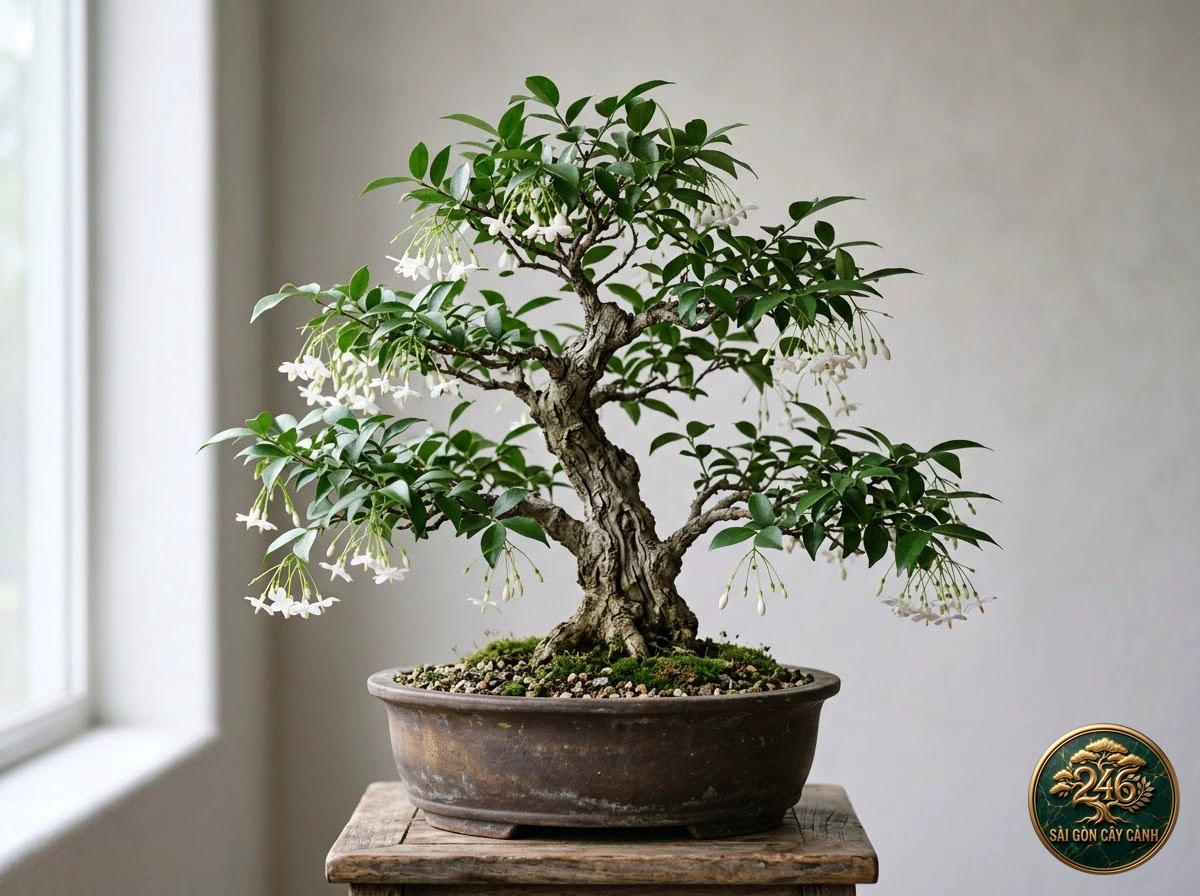
Water jasmine (Wrightia religiosa) is an illustrious woody shrub revered as a crown jewel in Southeast Asian bonsai traditions, belonging to the dogbane family Apocynaceae. Celebrated for gnarled, character-rich lignified trunks, delicate elliptic foliage, and pendulous clusters of pristine white star blossoms releasing intoxicating jasmine-like perfume at dusk.
Sài Gòn Cây Cảnh Care Compass
1. Core Botanical Taxonomy & Cultural Specifications
| Scientific Name | Wrightia religiosa |
|---|---|
| Botanical Family | Apocynaceae (Dogbane Family) |
| Native Distribution | Southeast Asia (Vietnam, Thailand, Cambodia, Malaysia) |
| Growth Demeanor | Woody shrub with supple branchlets ideal for classical bonsai |
| Lighting Threshold | High illumination, bright diffuse to full sun (2,000 – 5,000 lux) |
| Hydration Cadence | Regular hydration; requires steady moisture with rapid drainage |
| Substrate Formulation | Alluvial loam, composted coconut coir, rice husk biochar, pumice |
| Thermal Range | 22°C – 35°C (tropical warmth lover; intolerant of chill below 12°C) |
| Relative Humidity | 60% – 80% (ambient tropical humidity) |
| Cultivation Difficulty | Moderate (requires systematic pruning and timely watering) |
| Pet Safety Profile | Pet caution (milky latex typical of Apocynaceae causes mild oral irritation) |
Morphologically, Wrightia religiosa represents a semi-evergreen woody shrub reaching 1.5 to 3 meters in wild riverine margins, yet perfectly dwarfed beneath 50 cm in artistic bonsai containers. The rugged gray-brown bark develops swollen nodules and knobby burrs (‘goc nu’) with age, conveying a venerated, weather-worn silhouette.
Leaves are arranged opposite-decussate, with elliptic-lanceolate blades measuring 3-8 cm long and 1.5-3 cm wide. Foliar surfaces are lustrous, opening in vivid chartreuse tones before maturing into deep emerald leathery blades. Severed petioles exude opaque white milky latex rich in defensive alkaloids that naturally deter wood-boring insects.
The crowning attraction of Water jasmine resides in its pendulous cyme inflorescences terminating slender branchlets. Each pure white star flower bears five spreading petals spanning 1.5-2 cm across, suspended on delicate capillary pedicels that orient blossoms downward toward water mirrors (‘chieu thuy’). Blossoms emit an intoxicating, ethereal perfume carrying across evening breezes.
2. Morphological Identification & Foliar Architecture
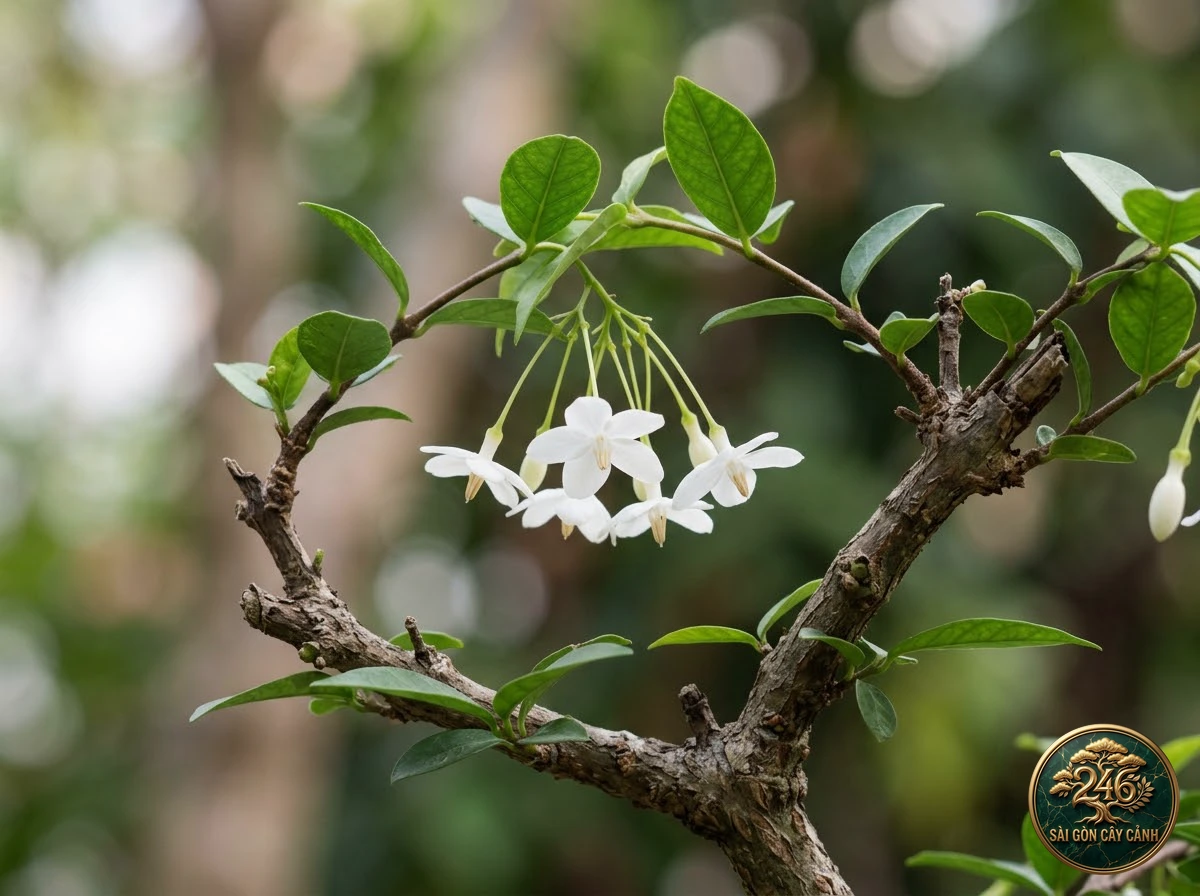
Diagnostic keys distinguishing Wrightia religiosa within its genus center on its distinctive corona: slender white filamentous scales encircling an erect conical stamen cluster at the floral heart. Post-pollination by nocturnal hawkmoths yields paired pendulous follicular pods 15-20 cm long joined at the tips, harboring seeds crowned with silky dispersal plumes.
Cultivated selections in Vietnam are classified primarily by foliar dimensions and bark topology: large-leaf forms, intermediate forms, and miniature micro-leaf varieties (‘kim thanh mai’) with diminutive, dense foliage celebrated globally for refined shohin and mame bonsai compositions.
Morphological dissection of Wrightia religiosa highlights highly pliable, lignified branches adorned with characteristic bark galls and fissured lenticels resulting from robust secondary xylem development. Elliptic-lanceolate leaves feature an emerald satin adaxial surface and a paler abaxial side with delicate pinnate venation; snapping a petiole elicits a droplet of milky white latex loaded with defensive botanical alkaloids.
3. Photometric Calibration & Window Exposure Optimization
Regarding photic energetics, Water jasmine demands generous illumination. Peak photosynthetic assimilation occurs across light intensities spanning 2,500 to 6,000 lux, or 4 to 6 hours of direct filtered sunlight daily. Robust light exposure is imperative to maintain compact internodes, dense foliage, and prolific flower bud initiation.
When displayed indoors on residential desks or consoles, place containers along southern or eastern window perimeters receiving morning sun. Sustained placement in dim room corners beneath 1,500 lux for over two weeks triggers defensive leaf drop, leggy cauline stretch, and complete cessation of fragrant bud flush.
Photoreceptive physiology reveals that Water jasmine is an obligate heliophyte native to tropical Southeast Asia, demanding intense photon flux to drive continuous floral meristem induction. Optimal photosynthetic assimilation occurs between 400 and 800 µmol/m²/s PPFD; prolonged indoor placement beneath 150 µmol/m²/s prompts spindly internodal stretching and arrests the production of pendulous blooms.
4. Bonsai Lignified Trunk Habit & Pendulous Fragrant Blossom Dynamics
Styling Water jasmine relies on precision wiring with annealed aluminum to establish cascading pads (‘tan’) across classical or contemporary naturalistic profiles. Given supple wood fibers and prodigious back-budding capacity from mature trunk wood, artists can shorten branches and manipulate silhouettes without risking dieback.
The iconic defoliation technique for synchronized flowering represents master craftsmanship: 35 to 45 days prior to an exhibition, cultivators manually strip 100% of leaves and withhold water for 2 days; upon re-saturating with high-phosphorus nutrition, the tree erupts into a simultaneous explosion of fragrant white blossoms.
Hydration protocols honor its moniker ‘Water jasmine’: the species transpires heavily throughout warm tropical cycles. Irrigate thoroughly 1-2 times daily during early morning and late afternoon, ensuring copious outflow drains completely through base holes to displace stagnant air.
Despite its moisture affinity, prolonged sub-irrigation puddle accumulation in compacted soils induces anaerobic root rot. Optimal vapor pressure deficit (VPD) spans 0.8 to 1.2 kPa; overhead foliar misting during arid middays cools leaf surfaces and preserves foliar gloss.
The optimal thermal envelope for Wrightia religiosa ranges between 22°C and 35°C, attuned to the tropical monsoon plains of Southern Vietnam. It thrives under a VPD regime of 0.8 to 1.3 kPa; during hot dry spells in urban lowlands, spraying the lignified bark with cool water at dawn awakens latent dormant buds into fresh floral flushes.
The basal root flare and lignified burl trunk of Wrightia religiosa represent apex aesthetics in classical tropical bonsai. Coarse anchor roots develop into sinuous surface buttresses clutching rocky mounds, while slender 1.5 to 3 cm pedicels arch downward, presenting fragrant five-lobed pendulous snowy corollas that diffuse intense jasmine-like perfume at dusk.
5. Porous Aggregate Substrate Engineering & Aeration Dynamics
Potting substrates for containerized Water jasmine require generous moisture capacity combined with instantaneous gravitational percolation to safeguard root respiration. A proven blend consists of 35% granular alluvial field loam, 30% horticultural pumice, 20% desalted coconut coir fiber, and 15% aged worm castings.
Pot drainage apertures must be fitted with mesh screens and a 1-2 cm basal drainage layer of coarse pumice to guarantee unobstructed drainage. The ideal substrate pH ranges between slightly acidic and neutral (6.2 to 6.8), facilitating effortless micronutrient uptake by feeder rootlets.
Bonsai container substrate for Water jasmine requires harmonious balance between capillary moisture capacity and macroporous aeration. The recommended matrix incorporates 40% fertile alluvial loam, 30% screened volcanic pumice, 20% washed coconut coir, and 10% biochar husk, facilitating rapid percolation while keeping delicate root hairs oxygenated and moist.
6. Organic Nutrition Schedules & Periodic Micronutrient Priming
Fertilization protocols balance slow-release organic cakes (fermented oilseed meal or pelletized organic manure) top-dressed on soil borders with dilute foliar NPK feeds (10-15-10 ratio) calibrated to an EC of 0.8 to 1.2 mS/cm every 3-4 weeks.
Following structural canopy shearing, boost nitrogenous organic extracts and humic acid to trigger vigorous vegetative shoots; as blooming flushes approach, transition toward elevated phosphorus, potassium, and chelated boron to fortify blossom texture and heighten fragrance emission.
Periodic nutritional protocols emphasize fermented organic cakes such as matured peanut meal tea or diluted vermicompost enriched with bio-phosphorus and potassium every three weeks during bud differentiation. Following canopy pruning, applying light hydrolyzed fish protein replenishes nitrogen reserves to drive dense, ramified twigs.
7. Clinical Diagnostic Matrix & Rapid Correction Protocols
| Clinical Symptom | Primary Etiology | Diagnostic Evaluation | Corrective Prescription |
|---|---|---|---|
| Sudden foliar defoliation upon moving indoors | Abrupt environmental shock and acute light starvation beneath 1,500 lux | Measure lux levels at plant placement and inspect moisture | Relocate specimen to morning-sun veranda or window ledge; moderate hydration |
| Shoots stretch leggy and internodes widen without buds | Excessive synthetic nitrogen nutrition paired with inadequate illumination | Audit nutritional schedules and count direct sun hours | Prune leggy stems back, reduce nitrogen inputs, and supply high-phosphorus feeds |
| Tender apical leaves curling, puckering, and deforming | Microscopic thrips or aphid populations rasping succulent young buds | Inspect under surfaces of young leaves with magnification loupe | Apply emulsified cold-pressed neem oil sprays at dusk, repeating after 5 days |
| Dieback progressing from branch tips inward | Root hypoxia from waterlogging or pink limb fungal blight on bark | Check root health for rot and inspect dead bark margins | Snip dead wood cleanly to healthy green tissue, seal with wound paste, repot in airy mix |
8. Cryptic Pest Prophylaxis & Foliar Surface Sanitation
The most troublesome pests affecting Water jasmine include leaf-rolling caterpillars and microscopic thrips feeding upon emerging apical shoots. Inspect tender growth tips regularly at dawn; hand-pick rolling larvae promptly or spray biological cold-pressed neem oil emulsion prophylactically.
During persistent monsoonal humidity, pink limb blight and fungal leaf spots may target crowded inner canopies. Thin out weak crossing interior twigs and coat woody burrs with biological colloidal silver (15 ppm) or dilute agricultural lime to preserve bark hygiene.
Plant health surveillance targets leaf-rolling caterpillars and cottony mealybugs that shelter beneath juvenile leaves and bark crevices. Mechanical washing via targeted water sprays coupled with basal trunk painting using dilute agricultural lime or 0.5% horticultural mineral oil effectively halts ant-borne scale vectors safely.
9. Asexual Propagation Methodology & Root Strike Protocols
Water jasmine propagates readily via air-layering or semi-hardwood stem cuttings taken during spring or early monsoons. Select vigorous branchlets 0.5-1 cm thick, prepare clean oblique cuts, and treat with biological rooting hormone before inserting into coarse sand or damp perlite.
House propagation trays within sheltered diffuse shade under high ambient humidity with perforated humidity covers. Over a 25 to 35 day developmental interval, submerged nodes generate dense white adventitious root clusters and emerge into active foliage, ready for potting.
Asexual propagation through semi-hardwood cuttings or air-layering achieves over 95% strike rates during warm monsoon intervals. Semi-lignified 12 to 15 cm cuttings with clean angled incisions planted into moist perlite-sand beds under 50% shade over a 25 to 35 day interval establish abundant fibrous white root systems ready for potting.
10. Companion Animal Toxicology Profile & ASPCA Safety Evaluation
For interior bonsai displays, elevate specimen pots onto display tables, hardwood stands, or sunny window recesses beyond reach of frisky pets; regularly sweep spent fallen blossoms and leaves to keep the living area pristine.
11. Biophilic Curation & Contemporary Interior Design Styling
In traditional Vietnamese feng shui and garden philosophy, Water jasmine embodies household serenity, continuous prosperity, and grounded longevity. The downward-facing blossom orientation symbolizes profound humility, gratitude to ancestral roots, and harmonious family unity.
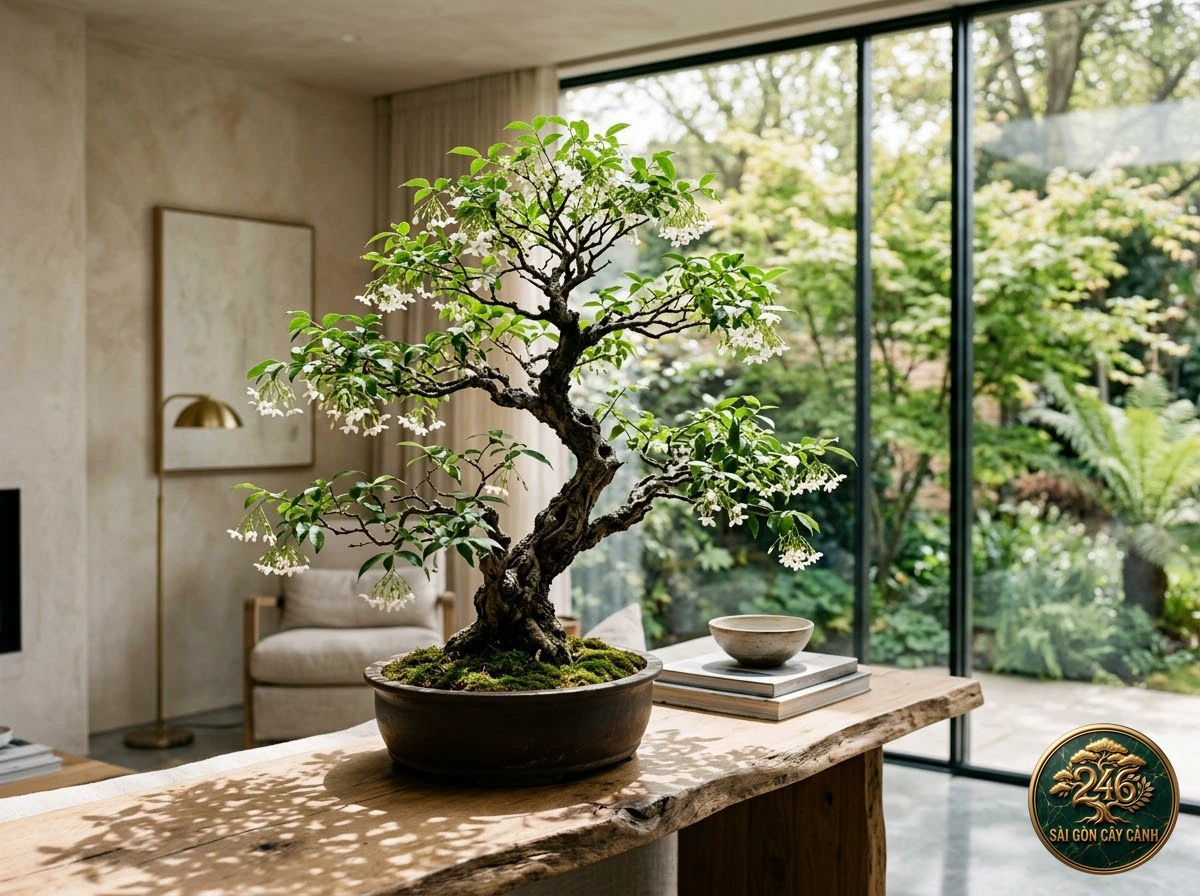
Positioning a flowering miniature Water jasmine bonsai on living room consoles or tea tables fills interiors with intoxicating nocturnal jasmine fragrances while articulating refined aesthetics, artistic distinction, and botanical devotion.
In traditional Vietnamese horticultural philosophy, Wrightia religiosa epitomizes serenity, enduring prosperity, and refined virtue. Displaying a mature weeping bonsai specimen on sunlit terraces, entry courtyards, or airy verandas envelops the dwelling in sweet natural fragrance, creating a deeply tranquil and contemplative living landscape.
12. Master Principles for Sustainable Indoor Acclimatization
Maintaining aesthetic balance and recurrent aromatic flowering flushes in potted Water jasmine requires three golden axioms:
- Hydration axiom: Irrigate deeply and systematically daily; never permit the porous bonsai aggregate to dry to utter depletion.
- Illumination axiom: Ensure at least 4 to 6 hours of strong diffuse daylight or direct morning sun to sustain foliage density and trigger flower buds.
- Maintenance axiom: Execute structural trimming after spent floral cycles to preserve silhouettes and induce vigorous secondary branching.
13. Frequently Asked Questions Regarding Water jasmine (FAQs)
How often should repotting and root pruning occur on Water jasmine bonsai?
Repot every 1 to 2 years in early spring or rainy season; trim away one-third of encircling root mass and refresh with coarse porous aggregate.
How can flowering be timed precisely for festive exhibitions?
Execute 100% manual leaf stripping 40 to 45 days prior to the target date, withhold water for 2 days, then re-saturate with high-phosphorus feeds.
Can Water jasmine survive permanently indoors year-round?
Continuous indoor confinement is inadvisable; rotate specimens to open sun balconies 2-3 days weekly to replenish photosynthetic reserves.
Why do abundant blossoms fade and drop prematurely?
Natural floral longevity spans 3-5 days; premature dropping stems from dry root balls or cold air-conditioner drafts desiccating petal margins.
Can the species withstand cold winter temperatures in northern regions?
The tree is sensitive beneath 12°C; shelter containers indoors during chilly winters under supplemental grow lights and reduce watering.
How can one induce synchronous flowering in Water jasmine for festive occasions?
Approximately 40 to 45 days prior to the desired blooming date, withhold irrigation for 3 to 5 days until foliage wilts slightly, prune back terminal leafy shoots, and resume thorough soaking enriched with potassium-rich organic tea to spark prolific flower buds.